

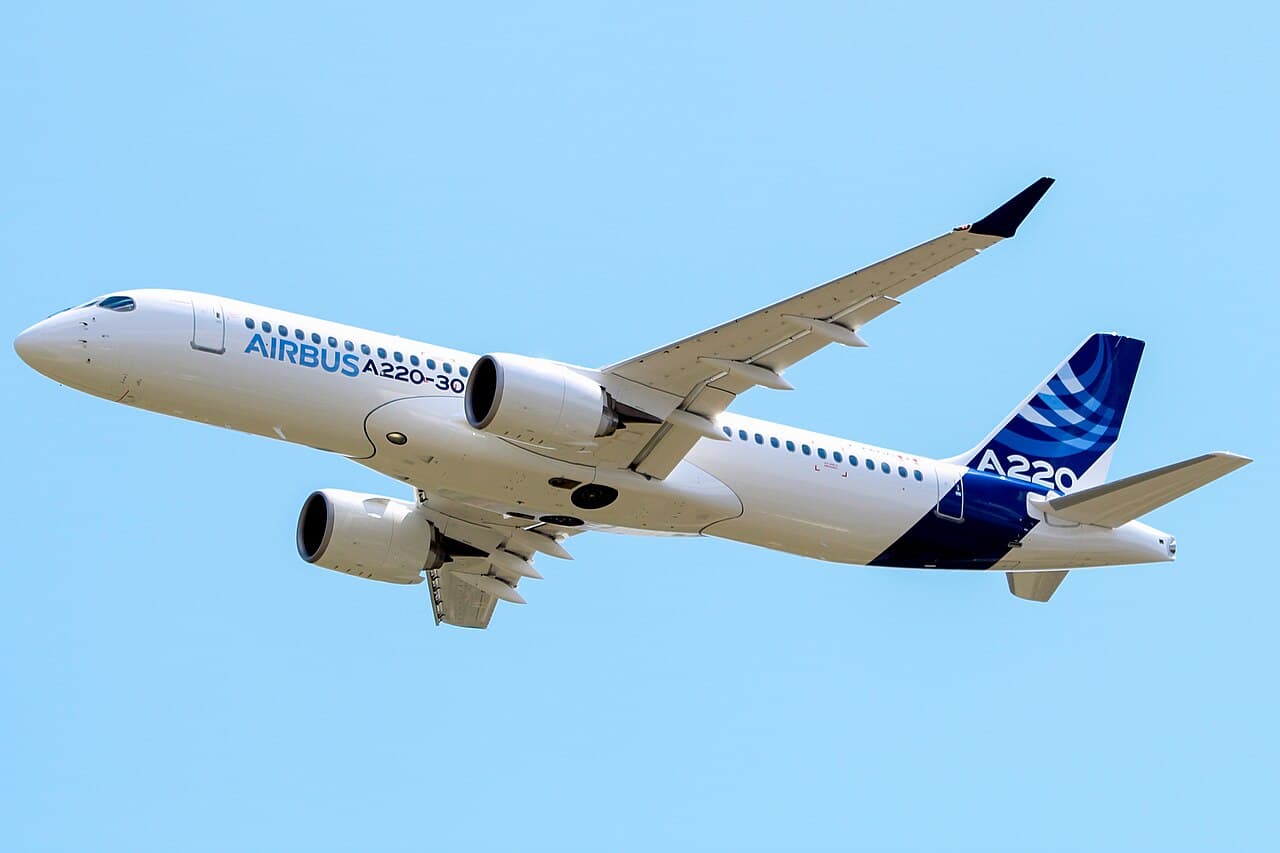
Airbus Drives A220 Growth With Production Ramp-Up and Global Footprint Expansion
Change has been the constant companion of the former CSeries, and as the twinjet marks a decade in service, the programme continues to evolve. To say that a lot has happened since the A220 entered service on 15 July 2016 would be, well, a colossal understatement. For one, back when launch customer Swiss received its first jet, it was still known as the CSeries – the carrier taking what was then a CS100 – and was made by Bombardier rather than Airbus. But the crippling cost of developing the small narrowbody had left Bombardier in a precarious place; laden with debts and facing import tariff pressure from the US government – acting on Boeing's behalf – the Canadian airframer was left with little choice but to sell a stake to its European rival. Airbus initially took a 50.01% stake in the entity that owned the programme, the C Series Aircraft Limited Partnership (CSALP), on 1 July 2018, increasing that two years later to 75% when Bombardier completely exited the venture (the balance is held by the Quebec government). A swift rebranding followed Airbus's taking control, with the CS100 becoming the A220-100 and the CS300 the -300. And while the orderbook looked underwhelming back then, save for the 75-unit commitment that Delta Air Lines placed in April 2016 – at that point, the largest order – the situation has since transformed. Thanks to the stability Airbus has brought to the programme, plus its sales strength, orders have accelerated and passed the 1,100 mark, standing at 1,109 at the end of May. Airbus continues to optimise the A220 production system for greater efficiency. Source: Airbus Deliveries too have risen accordingly – the 500th jet was shipped earlier this year – as Airbus has applied its industrial muscle and know-how. In fact, there are now two production facilities, the airframer in 2020 having opened a plant in Mobile, Alabama to complement the programme's home site in Mirabel, near Montreal. While it has by no means been plain sailing – issues with the jets' Pratt & Whitney PW1500G engines and wider supply chain malaise have not helped – Airbus sees a bright future for the programme. "It is a fantastic tool for airlines to open new markets and increase profitability," says Christian Kley, Airbus head of single-aisle marketing. "We are now at a point where the aircraft is at industry-benchmark levels." Airbus claims the A220 family holds a 56% share of the segment, outselling the Boeing 737 Max 7 (15%) and Embraer E-Jet E2 family (26%), and, it is worth noting, the A319neo (3%) as well. In fact, there is a strong argument that the A220’s success has hastened the latter’s relegation in the airframer’s line-up. But the A220 backlog is very much skewed towards the larger of the two variants: of the 1,109 total orders, just 108, or 9.7%, are for the 100-120-seat -100. Nonetheless, Kley believes the variant still has value, describing it as a "door opener", allowing Airbus to offer an aircraft that can replace turboprops or older regional jets, a space where it was not previously active. It is, he says, a "smaller brother" to the -300 "which is very good at carrying volume". As evidence, he points to the June 2025 order from Polish carrier LOT for 40 aircraft, divided evenly between the A220-100 and -300. "They have a number of routes where they know the -300 would be too big," he says. "We would never have had a chance to win the LOT campaign without the -100." Production ramp-up To deliver that backlog – and as a vital step towards reaching programme profitability – Airbus is ramping up production towards a target of 13-14 aircraft per month by 2028, split 2:1 between Mirabel and Mobile. While the manufacturer will not say its current rate, it is predicting a jump of 20-25% over 2025, a year in which it delivered 93 A220s, itself an increase on the 61 shipped in 2024. . Achieving output of at least 13 aircraft per month is crucial to reaching programme profitability, says Airbus Canada chief executive Guillaume Chevasson. "We want to continue to ramp up. We want to reach profitability, which is the cornerstone of the programme. It is my priority – there can only be a future for the programme if it is profitable." Airbus is "not far away" from that point, he says. "We can see it, we can touch it, now we have to make it." As a first step towards higher output, Airbus in 2022 introduced a Pre-FAL (final assembly line) facility at Mirabel, feeding the lines both there and Mobile. The Pre-FAL – housed in a building in which Bombardier previously built wings for the CRJ family – is effectively where the assembly process starts. Here, the rear fuselage is mated with the aft bulkhead, prior to the installation of other elements such as the water system, waste water tanks and insulation blankets, up to the full close-out of the section. Those completed fuselage barrels are then either trucked down to Mobile – a journey of some 1,500 miles (2,400km) – or routed back into the Mirablel production flow. Laurent Labre, head of development, new fuselage, says the change was required to open up more space on the final assembly lines to cope with the planned rate increase. Other tweaks are also planned at Mirabel to help raise output, says head of quality Pierre-Luc Clermont. For example, Airbus in the coming months will begin installing lavatories and galleys prior to the fuselage join – at present they must be partially dismantled and loaded through an exit door, adding time and complexity to the process. "It is not optimised," he admits. Given the site's history as the home of the CRJ family, some production quirks are harder to eradicate, however. Notably, the paint shop is sized for the former Bombardier-owned regional jet and the 26.2m (85.9ft) wingspan of the largest variant, the CRJ1000. Almost inevitably, the A220, at 35.1m, is too wide to be accommodated. The solution? The aircraft are painted without their winglets installed, reducing the wingspan to a manageable size. Test department Airbus's acquisition of the programme created other oddities too. While the CSeries made its maiden sortie from Mirabel, most of the certification flight-test programme was carried out from Bombardier's facility in Wichita, Kansas. But the test fleet remained there post-sale, with Airbus left in the strange position of sub-contracting flight-test activities to the programme's former owner. In fact, it took until the tail-end of 2023 before two flight-test vehicles – one A220-100 and one -300 – were "repatriated" to Montreal, with the pair now a key part of the A220 Flight & Integration Tests Center that was established at the start of 2024. Leading that operation is Nicholas Ranque, a former French air force pilot. Although it "took some time to build up this capacity", he is delighted with the outcome: "It is natural for an airframer to have its own testing premises." In addition to carrying out pre-delivery flights, Ranque's team also conducts flight testing in support of programme development. "For this product we like to stay on top of our game; we want to develop the aircraft even if there's not a new programme, adding new functions to improve reliability and safety and so on." Airbus repatriated A220-300 test aircraft from Wichita to create flight-test department. Source: Dominic Perry/FlightGlobal Rounding out Airbus's development of the Mirabel site was the opening of a new A220 delivery centre in February 2025, replacing dedicated bays located adjacent to the production line. Mark Arpin, head of the facility, says it provides the level of experience customers have come to expect from Airbus: "It has a 'wow' factor now. If you look at where we were before, we were surrounded by tools – we had to convince customers their aircraft were ready." But with many of the programme's fundamentals now on a stable footing – last year's acquisition of parts of Spirit AeroSystems has also helped – the big question is now whether Airbus will