

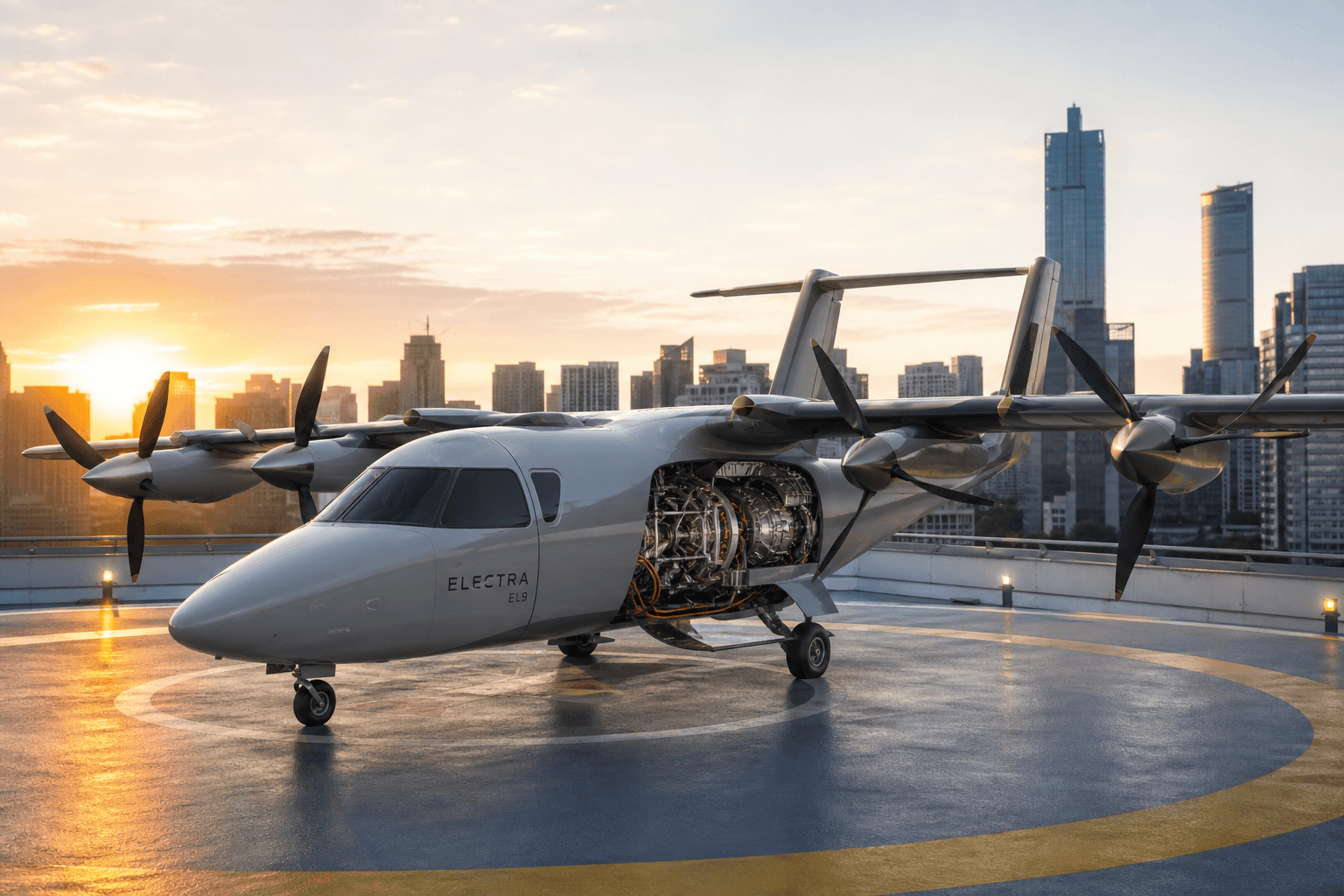
Safran's TG600 Turbogenerator Powering Electra EL9 Hybrid-Electric Aircraft
Hybrid-electric aircraft developer Electra on Wednesday announced a "life-of-program" agreement covering the production of turbogenerators for its flagship EL9 Ultra Short. The EL9, designed for operations with only a 150-foot ground roll, will be powered by Safran Helicopter Engines' TG600, which is built around the latter's Arrano gas turboshaft engine. Electra said it placed an initial order for 250 turbogenerators. The companies previously signed a deal for Safran, which is also an investor, to develop the 600-kilowatt electric turbogenerator propulsion system for EL9 prototype aircraft. Now, the TG600 is set to power the real deal. "We've closely evaluated the advanced air mobility market, and we believe the Electra eSTOL [electric short takeoff and landing] aircraft offers groundbreaking capability in a practical design that meets market needs of both today and tomorrow," said Florent Chauvancy, the former executive vice president of OEM sales for Safran Helicopter Engines, in a 2023 news release . On Wednesday, Electra CEO Marc Allen in a statement called the new deal a "defining step forward for Electra and for the future of advanced air mobility." The nine-passenger EL9 is expected to make its debut flight in 2027 or '28, with certification and entry into service by '30. Electra claims to have about 2,200 provisional orders from more than 60 operators. This is not Safran's first foray into electrification. The manufacturer in February 2025 achieved the first type certification for an electric motor for civil aircraft, after the European Union Aviation Safety Agency (EASA) declared its ENGINeUS 100 system airworthy. The engine is designed to provide 100 percent electric power for two-to-four-seat aircraft—such as Diamond Aircraft's eDA40, an early candidate—or hybrid propulsion for 19-seat regional models. Other ENGINeUS 100 customers include Swiss propulsion specialist H55, French manufacturer Aura Aero, and Aura's recently acquired VoltAero subsidiary. BRM Aero and Bye Aerospace intend to install the engine on their respective electric trainers, the Bristell B23 Energic and eFlyer family. At the 2025 Paris Air Show, Safran joined forces with Collins Aerospace and French firms Daher and Ascendance to research hybrid-electric propulsion for six-to-ten-seat aircraft. The consortium is targeting a platform "in the category" of Daher's Kodiak family of single-engine turboprops. The Integration Electra said the TG600 will be the "heart" of the EL9's hybrid-electric propulsion system, which also comprises eight electric engines from supplier Evolito. The Arrano engine around which it is built burns 18 percent less fuel versus "other in-service engines," the company said. The turboshaft will be complemented by two GENeUS electric generators provided by Safran Electrical & Power. In March, AviationWeek reported that Safran Helicopter Engines began assembling the first TG600 unit for Electra's prototype aircraft. Cédric Goubet, the company's president, said in a late 2025 LinkedIn post that it is "ready to launch development and gear up for flight testing." Goubet in a statement Wednesday said the new contract "signifies the official launch of our turbogenerator activities, a promising new chapter that complements our leadership in turboshaft technology." "We believe we have the most advanced and efficient hybrid-electric product in its class, a perfect fit for the EL9 to achieve revolutionary capabilities in new air mobility," he said. According to Electra, the EL9 is designed to move air travel away from airports. Instead, the aircraft will use ultra-short "access points" located on rooftops, parking lots, fields, barges, malls, casinos, or even ski resorts, cutting out unnecessary connections and ground transfers. The manufacturer believes it could save travelers hours on more than 2,600 routes spanning 50 to 265 miles that are suboptimal for driving, but lack routine commercial air service. It estimates 12,000 to 16,000 aircraft will be required to meet demand within the first decade of operation. EL9 access points will require just 150 feet of space for takeoff and landing, an unlock from the aircraft's blown-lift propulsion system. By redirecting airflows toward the ground, the EL9 is designed to take off at a leisurely 35 knots. Electra has already proven the capability on the EL2 Goldfinch, a demonstrator. But Safran's TG600 will be key to validating it with EL9 prototypes and, eventually, the real deal. Like many young aerospace startups, Electra is largely tight-lipped on suppliers, but it has said that Honeywell will provide the EL9's flight control computers and electromechanical actuation systems. Lockheed Martin's Skunk Works is helping design and commercialize the model. Many of the EL9's components and systems, however, are built in house. Electra has obtained several patents for novel portions of the blown-lift propulsion system.