

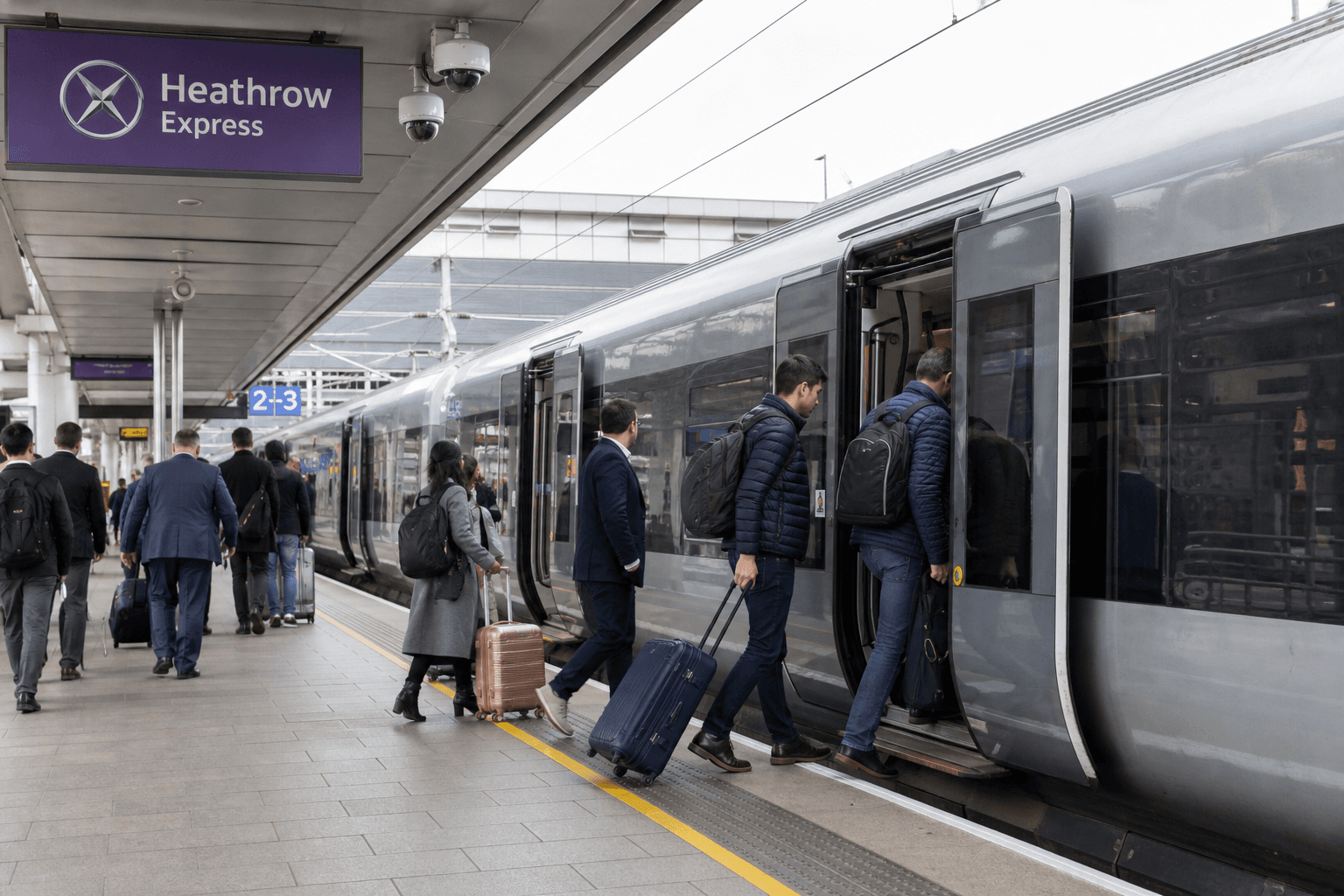
How London integrates transport to safeguard 180 million airport passengers annually
Six London airports collectively serve around 180 million passengers per year, and for most of them the journey to the aircraft begins not at the check-in counter but on a metro or commuter rail platform. ezstandalone.cmd.push(function () { ezstandalone.showAds(119); }); The safety of an air passenger essentially starts in the city. In this article, we explain how the transport networks of the British capital build this invisible line of protection from the center of London to the terminal doors. Integrated Transit Systems Connecting Major Global Gateways to the City Center Every major London airport is connected to the city center by a dedicated rail route, and this is not just a matter of convenience. ezstandalone.cmd.push(function () { ezstandalone.showAds(127); }); Predictability of travel is the foundation of safety. A passenger carrying luggage and documents is especially vulnerable in an unfamiliar environment. Here, the general rush and dense crowds make them an easy target for pickpockets. Dedicated express trains and lines with permanent staff minimize the number of transfers and, with them, the number of risky situations. The scale of this infrastructure is clearly visible on the main routes: ezstandalone.cmd.push(function () { ezstandalone.showAds(128); }); All of the paths in the table have their own control service but share a common logic. All stations are fully staffed, and emergency contact points are provided. There is constant surveillance by video from the rail terminal to the airport terminal. The passenger need not know who takes on what since the protection is felt to be seamless. For a passenger who has a boarding pass in his pocket, it translates to a single notion. It can be done in a pre-planned way with no last-minute decisions. Advanced Surveillance and Crowding Management Technologies Across Key Routes London’s transport network is one of the most camera-dense in the world. According to Transport for London, it uses more than 77,000 CCTV cameras, around 15,000 of which are in the Underground. Stations on the Elizabeth line, the key route to Heathrow, were designed from the start with full coverage. There are 749 cameras installed on the London section alone. ezstandalone.cmd.push(function () { ezstandalone.showAds(129); }); However, footage by itself solves little. Recordings flow into control centers where operators monitor not only incidents but also passenger density. When platforms become overcrowded, station control is introduced. Entry is temporarily restricted, and flows are redirected to less busy exits and escalators. The peak waves at airport hubs coincide with flight schedules. Thus, such measures are planned in advance rather than at the moment of collapse. The cameras’ own health is monitored automatically, and repair teams fix issues before passengers notice them. Photo Credit: Airports Council International The Crucial Role of Frontline Transit Personnel and Dedicated Patrol Teams Technology plays a key role, but the final decision in an unusual situation is still made by a human. This means thousands of specialists, from station staff to patrol teams, and demand for them continues to grow. ezstandalone.cmd.push(function () { ezstandalone.showAds(130); }); The website Jooble shows the current London transport security roles from nearly the entire market. Around 2,800 vacancies are open in this category alone, with an average salary of £49,200 per year. The service aggregates listings from most sources on one page, verifies posts, blocks spam and phishing, and subscription alerts eliminate the need to manually monitor job boards. The scale of the platform speaks for itself: 66 countries of presence and around 300,000 new vacancies daily. Such a high demand for personnel on recruitment platforms directly reflects the city’s commitment to maintaining a visible security presence, ensuring that vacancies are rapidly filled to keep the transit network fully staffed. ezstandalone.cmd.push(function () { ezstandalone.showAds(131); }); The core of the system is formed by two agencies. British Transport Police is responsible for railways, the Underground, and DLR. The Roads and Transport Policing Command of the London Police, a division where more than 1,500 positions are funded directly by Transport for London, patrols the bus network and roads. This is why a passenger rushing to a flight will typically see uniformed personnel on nearly every segment of the route. Photo Credit: London Gatwick Airport Interagency Collaboration with Aviation Authorities and Met Police Forces Jurisdiction boundaries here are deliberately blurred. Heathrow is patrolled by the aviation unit of the Metropolitan Police; Gatwick, by Sussex Police; and although these are formally different structures, joint operations have long been the norm. ezstandalone.cmd.push(function () { ezstandalone.showAds(132); }); A telling example is Project Servator, unpredictable patrol deployments in time and place, where uniformed and plainclothes officers work side by side with dog units at transport hubs. Since 2015, such operations have led to more than 650 arrests. The aviation industry itself sets a high pace of change: The adoption of technologies like AeroSHARK highlight the speed at which the industry adopts innovations in flight operations. Ground networks, being the first link in the passenger journey, must maintain a comparable level, and interagency exercises with aviation authorities are held regularly for exactly this purpose. ezstandalone.cmd.push(function () { ezstandalone.showAds(133); }); Passenger Awareness Initiatives and Real-Time Emergency Response Protocols Passengers continue to be the most common sensor deployed in the network, despite all the cameras and patrols. The campaign of ‘See it. Say it. Sorted.’ has become a habit, and a suspicious item can be reported free of charge by SMS to 61016, and each message is dealt with by the British Transport Police control center. There is a list of basic measures that passengers can take: Reporting of unusual conduct to station staff or 61016 — suspicious items. Do not leave luggage unattended even for a couple of minutes; Use emergency contact points installed on platforms; Do NOT follow staff evacuation routes; follow staff instructions. ezstandalone.cmd.push(function () { ezstandalone.showAds(134); }); Emergency procedures practiced in advance: joint drills with airports, well-designed evacuation schemes, and real-time alerts via displays and mobile services. Additionally, inter-coordination between transport control centers and airport services enables the immediate redirection of all passengers in the event of an incident. So the safety of an air passenger in London is not an individual service but a characteristic of the redirection: from the first turnstile to the boarding gate. ezstandalone.cmd.push(function () { ezstandalone.showAds(135); });