
Boom Supersonic Launches $800K Prize for Amateur Supersonic RC Aircraft
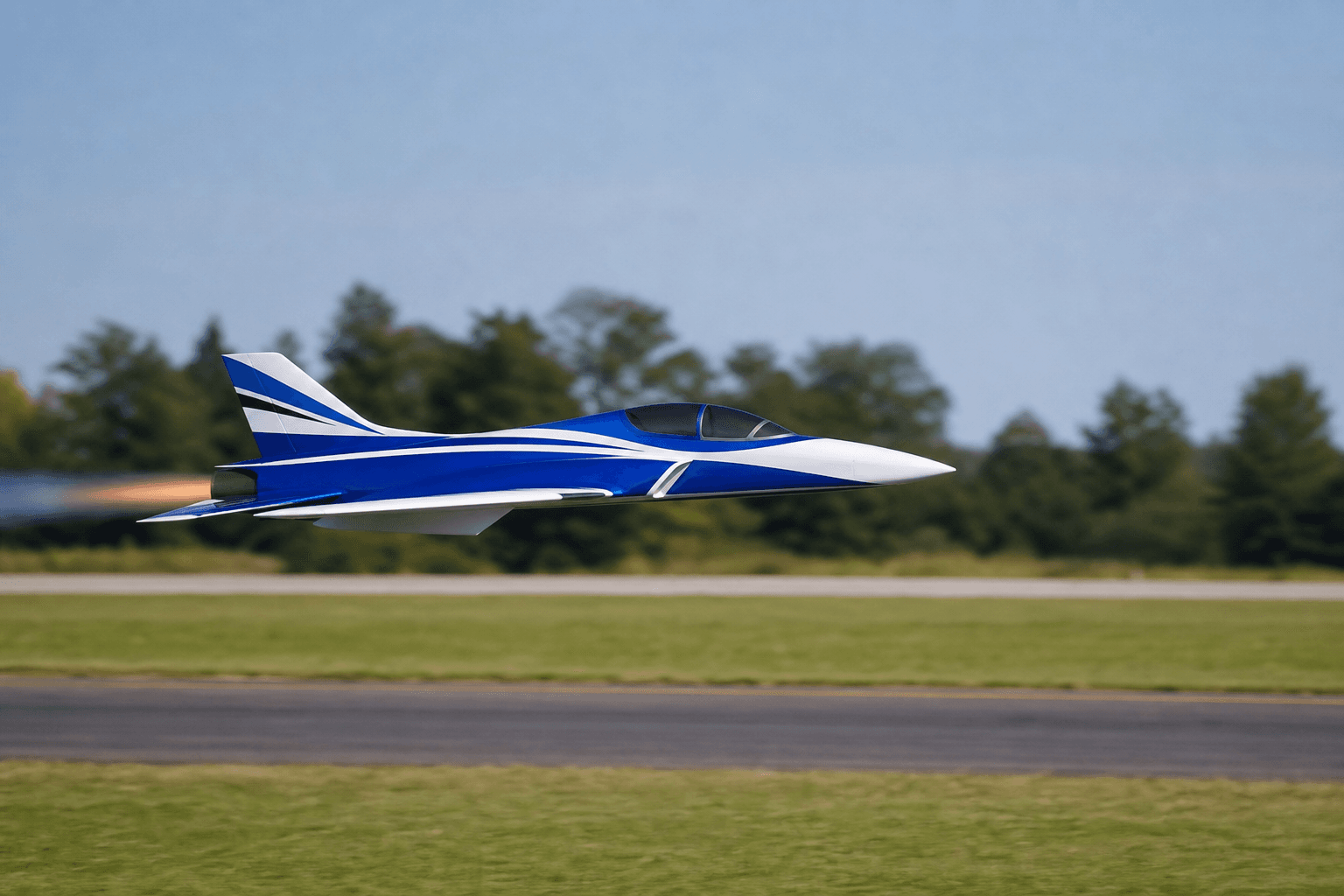
Famed U.S. Air Force aviator Chuck Yeager was the first to exceed the speed of sound in 1947, flying a rocket-powered Bell X-1. Nearly 80 years later, $800,000 in prize money is up for grabs for the first to break the sound barrier with an amateur-built, air-breathing aircraft. Boom Supersonic CEO Blake Scholl last week announced the "Boom Prize," challenging armchair engineers to build a radio-controlled airplane that exceeds Mach 1. The winner will receive $750,000 in prize money and $50,000 in the company's stock. Judges include NASA Administrator Jared Isaacman and popular science YouTuber Scott Manley. The Orteig Prize put Lindbergh across the Atlantic and ignited the airline age. The Kremer Prize produced human-powered flight. The Ansari XPRIZE opened private spaceflight. Today, we're announcing The Boom Prize: $750k in cash and $50k in Boom stock for the first American… — Blake Scholl (@bscholl) July 10, 2026 "The Orteig Prize put [Charles] Lindbergh across the Atlantic and ignited the airline age," Scholl wrote on X . "The Kremer Prize produced human-powered flight. The Ansari XPRIZE opened private spaceflight. Today, we're announcing The Boom Prize." To win the competition, which is free to enter, participants must fly and land a remotely piloted, air-breathing aircraft that breaks the sound barrier in level flight. To prove that the feat is repeatable and not a stunt, they must do so twice in a single day between sunrise and sunset. According to Boom , that has never been achieved and may even be impossible. But the company—which is developing what it bills as the first commercial supersonic jet since Concorde—hopes the contest will have the ripple effect of previous aviation prizes. Lindbergh and the Spirit of St. Louis won the $25,000 Orteig Prize in 1927 by making the first nonstop flight from New York to Paris. A number of aviators died while competing for the prize and in subsequent Atlantic crossing attempts. But Lindbergh's effort preceded an explosion of investment and technological advancement in the commercial aviation world. Similarly, Scaled Composites' Tier One program in 2004 won the $10 million Ansari XPRIZE after flying the first privately built, reusable, crewed spacecraft to space—twice in two weeks. More than two decades later, SpaceX is the world's largest provider of orbital launch services, public or private. Supersonic flight may be on a similar precipice. The FAA in June took the first steps toward repealing its 53-year-ban on supersonic commercial flight over the continental U.S., which is intended to address the noise of sonic booms. The agency proposed a set of interim, noise-based certification standards that would permit those operations without a special flight authorization (SFA)—such as the one Boom used to conduct 13 flights of its XB-1 demonstrator in early 2025. However, the proposal would only permit supersonic flight over land if the aircraft can reduce sonic booms to a quieter "thump"—something the XB-1 demonstrated on two of those flights. The Boom Prize tells participants to build, test, and fly their aircraft in a location that is "entirely up to you" but does not require quiet operation. "Not sure how the FAA will take to this idea," Phil Hardy, president and CEO of a Washington, D.C.-based consulting and government relations firm, replied to Scholl's post on X. "Amateur supersonic missile toys. Sure, why not?" An FAA spokesperson told FLYING that entrants will be responsible for complying with all agency safety and operational requirements, including those covering supersonic SFAs, implying that they would need to obtain such permissions. However, the regulator has awarded only four supersonic SFAs, all to private companies rather than individuals. Boom notes that "entrants are fully and solely responsible for the safety of their operations and for compliance with all applicable laws and regulations." How It Works To compete for the Boom Prize, entrants must be U.S. persons and funded by private, personal, or crowdfunded donations. The contest is intended for amateurs such as students and hobbyists. Corporate entrants or teams backed by venture capital, corporate sponsorships, or institutional or government funding are not allowed. Aerospace professionals can still compete but only using their own resources. "Build it in your garage like everyone else," the contest's website states. Registration is free but must be completed before the first supersonic attempt. The competition will remain open through the end of 2030, though Boom could extend it. One key requirement for the Boom Prize is the use of turbojet, turbofan, or ramjet propulsion. Rocket thrusters and onboard oxidizers are not permitted. In addition the aircraft must have a maximum takeoff weight no higher than 55 pounds (including fuel), be fixed-wing and generate lift primarily from aerodynamic surfaces, and allow a human to maintain continuous command and instant abort authority. Teams can build their aircraft using commercial components. But participants will need to prove they did most of the work themselves, "in the spirit of the FAA's amateur-built rule," Boom said. The aircraft will need to sustain a true airspeed faster than the local speed of sound—dependent on air temperature—for five or more seconds, without losing altitude during the transition from Mach 0.80 to Mach 1. Diving and using gravity for acceleration is forbidden. The aircraft must then make a controlled landing in a designated area, such that it does not require replacement of major components to fly again. Between attempts, participants will be able to refuel and make minor repairs. But they must use the same wings, fuselage, engine, and flight control computer for both flights, completing the second on a reciprocal heading to the first. Speed will be measured by onboard instruments and verified using GPS telemetry, ground atmospheric measurements, and other data. In addition to Isaacman and Manley, judges include Phil Condit, the former chairman and CEO of Boeing who oversaw development of the 777. Rounding out the panel is Tom Mueller, the co-founder of SpaceX and CEO of in-space transportation provider Impulse Space. The prize is cosponsored by Josh Buckley, who heads Boom investor Buckley Ventures, Balaji Srinivasan, an angel investor and former CoinBase executive, and Alex Gerko, who founded the British electronic trading firm XTX Markets, as well as a trio of venture capital firms. Boom said the purse could grow as more sponsors sign on. The $750,000 prize money would be paid out within 60 days of verification of the winning team's attempts. Boom stock worth $50,000 at the time of issuance would be awarded to the team's designee "at a valuation determined by Boom," the company said. The firm implied it may collaborate with the winning team, noting that "whoever builds the first supersonic RC airplane knows things we want to know." However, each team will retain intellectual property rights for their aircraft.