

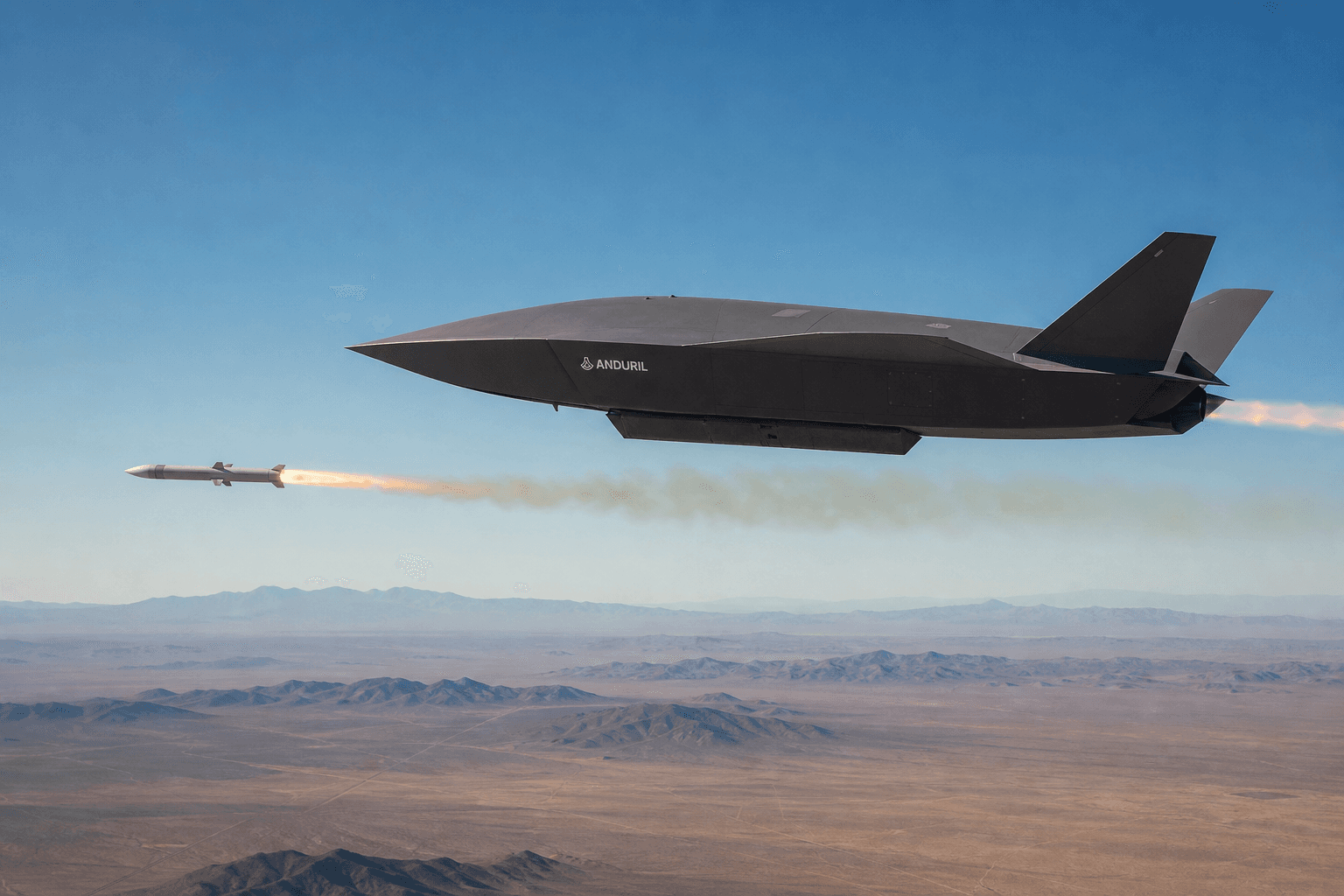
Anduril YFQ-44 unmanned fighter fires AIM-120 missile in Mojave Desert test
The test event over the Mojave Desert involved an externally carried Raytheon AIM-120 AMRAAM radar-guided missile. Anduril Industries has successfully fired an air-launched missile from the developmental YFQ-44 prototype. The test shot took place on 10 July over California’s Mojave Desert and was confirmed by both the US Air Force (USAF) and Anduril on 15 July. A single Raytheon AIM-120 AMRAAM (Advanced Medium Range Air-to-Air Missile) was fired from an underwing pylon on the YFQ-44’s port side. Anduril describes the scenario as an “end-to-end, beyond-line-of-sight strike against a simulated target”. The missile shot was carried out in conjunction with the US Air Force’s 412th Test Wing at Edwards AFB The YFQ-44 is one of two prototype uncrewed fighter jets selected by the USAF to become a frontline Collaborative Combat Aircraft. Both the Anduril jet and the General Atomics Aeronautical Systems YFQ-42 were awarded production contracts to transition from prototype development and testing into the delivery of operationally configured CCAs. “The test… represents an important step in turning CCA into an operational capability,” the 412th Test Wing says. The YFQ-44 missile shot was conducted from Edwards AFB in California’s Mojave Desert. Source: US Air Force The YFQ-44, which will be designated the FQ-44 for combat service, is now the first American CCA design to have successfully launched a guided missile and the latest uncrewed fighter design to do so overall. Boeing and the Royal Australian Air Force destroyed a drone with an AMRAAM fired from the Australian-built MQ-28 Ghost Bat in December 2025. The MQ-28 shot closely followed a successful air-to-air missile shot by the Turkish-made Baykar Kizilelma unmanned combat aircraft. The Block 1 test model of the MQ-28, like the YFQ-44, used an externally carried munition for its test shot. The future MQ-28 Block 3 combat variant will feature internal weapons bays for carrying stores. The FQ-44 is not expected to include internal bays, while the General Atomics FQ-42 will. The YFQ-42 has not yet attempted any live-fire weapons tests. General Atomics had paused flight testing on its CCA for roughly six weeks after a crash in early April led to the total loss of one aircraft. FQ-42 flights resumed in late May. No one was injured in the incident, which was attributed to an autopilot miscalculation for the aircraft’s weight and centre of gravity. The issue was resolved via a software fix, according to General Atomics. Governments around the world are racing to field operational CCAs, which are viewed as an affordable option for increasing the number of available combat aircraft and enhancing the capabilities of conventionally piloted fighters.
