

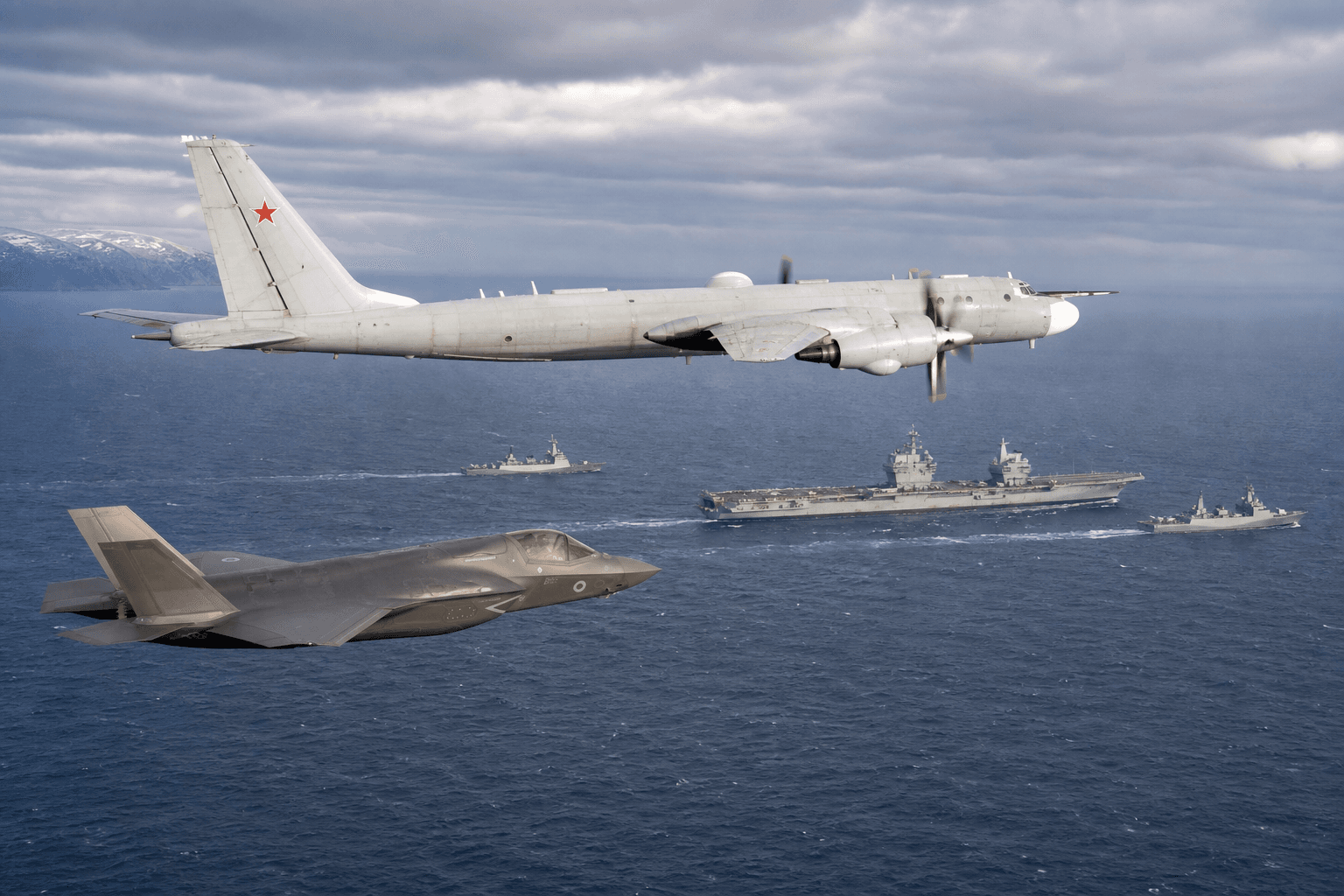
UK F-35s intercept Russian Tu-142 near Royal Navy carrier HMS Prince of Wales
London says the long-range maritime patrol aircraft failed to respond on international safety frequencies. A Russian long-range patrol aircraft flew “unnecessarily close” to the UK Royal Navy’s flagship, acting in a dangerous manner, according to London. The UK Ministry of Defence (MoD) says a Tupolev Tu-142 Bear-F maritime reconnaissance aircraft buzzed the Royal Navy’s HMS Prince of Wales aircraft carrier in the Norweigan Sea on 6 July. Two Lockheed Martin F-35B stealth fighters from the embarked 809 Naval Air Squadron were launched to intercept the Russian aircraft, which did not respond to hails, according to London. “The aircraft flew unnecessarily close to HMS Prince of Wales , dropped multiple sonobuoys nearby, and failed to respond on international safety frequencies,” the MoD says. “This activity was unsafe and unprofessional.” The British carrier and its supporting vessels are deployed to the region as part of NATO’s Arctic Sentry mission — a multi-domain military effort launched in February 2026 to strengthen the alliance’s presence and ability to operate in the High North. Following the Tu-142 incident, London says the UK Carrier Strike Group will continue to operate in the region. The Royal Navy vessels began the mission in June under the designation Operation Firecrest. Two F-35Bs from 809 Naval Air Squadron escorted the Tu-142 out of the area, according to London. Source: UK Ministry of Defence Photos released by the MoD show one of the F-35Bs flying off the wing of the Tu-142, which carries tail number RF-34059. The aircraft can also be seen making a low pass near one of the Prince of Wales ‘ escort vessels, which appears to be the Type 45 destroyer HMS Duncan . Fleets data from aviation analytics company Cirium indicates the Tu-142 was built in 1983 for the Soviet navy. Tu-142s assigned to support Russia’s Northern Fleet operate from an airbase in Vologda Oblast, some 435 miles (700km) east of St Petersburg. The four-engined turboprops provide naval reconnaissance and conduct anti-submarine warfare. Cirium shows Moscow has 32 Tu-142s in service, although some appear to have been lost in Russia’s ongoing war in Ukraine. The available Tu-142 fleet is split between Russia’s Northern and Pacific fleets, with the Pacific aircraft operating from an airbase in Russia’s Far East region of Khabarovsk Krai. Russia’s Pacific Fleet Tu-142s have been used to probe airspace near Alaska and northern Canada, according to the North American Aerospace Defense Command.