

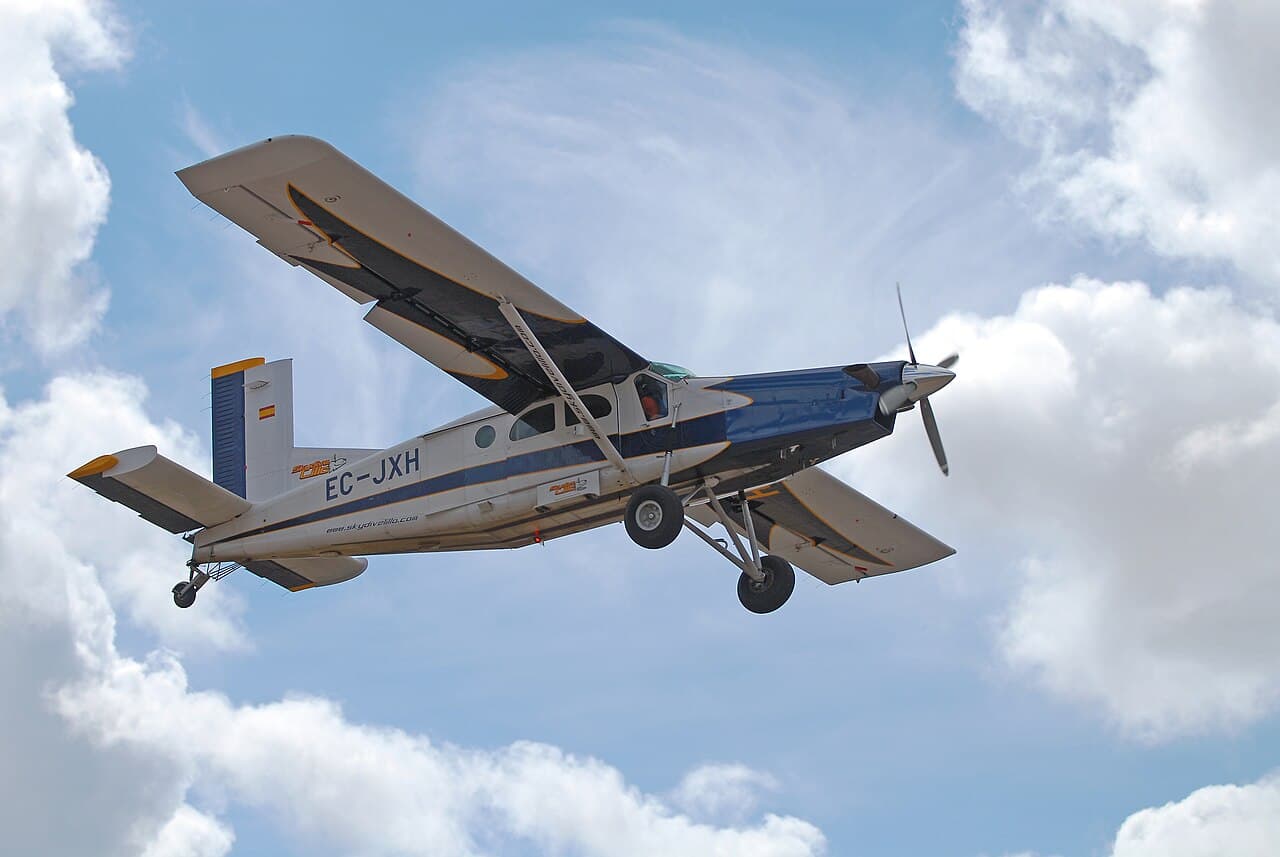
Pilatus PC-6 crashes after take-off near Nancy with smoke onboard, killing 11
None of the 11 occupants survived the loss-of-control accident near Nancy. French investigators have indicated that smoke was observed by skydivers in the cabin of a Pilatus PC-6 during take-off before the aircraft stalled, rolled to the left, and crashed. Neither the pilot nor the 10 skydivers on board survived the accident at Tomblaine , near Nancy, on 28 June. Examination of the instrument panel suggests it was "highly probable" that warning lights for engine oil contamination by metallic particles, fuel filter clogging, and minimum propeller pitch were illuminated at the time of impact. "Analysis is continuing to determine whether these warning lights activated before or after the loss of control," says French investigation authority BEA. Reconstruction of the flightpath has largely relied on witness and surveillance video from the ground, as well as the Garmin GI-275 electronic flight display and cameras carried by the skydivers. BEA says that, during the take-off roll, an instructor in the rear remarked, "It's smoking." The pilot did not appear to hear this comment, while another instructor in the centre of the cabin also exclaimed, "There's smoke," while pointing to an area near the floor. BEA says the instructors agreed to ventilate the cabin by partly opening the side door. Spectral analysis of audio indicates the gas generator speed of the single Pratt & Whitney PT6A-27 turboprop was initially stable at 96% of maximum. But unlike the five previous flights that day, the speed then fell by 10% and remained at this reduced level. "At this stage of the investigation, it has not been determined whether this decrease was intentional or involuntary," says BEA. Rotation occurred at about 60kt and the aircraft reached 73kt some 2s after the fall in engine speed. The aircraft's airspeed began declining, while its pitch "sharply" increased, and it rolled initially to the right and then the left. Pitch attitude rose to 19° nose-up and the left roll exceeded 20°, while the airspeed fell to 55kt. BEA says the stall speed at take-off configuration would have been 53kt, rising to 57kt at 30° bank. "Control of the aircraft was lost shortly afterwards," says the inquiry, stating that the PC-6 stalled asymmetrically and lost height at about 200ft. It crashed 200m off the end of runway 21, and 150m to the left of its centreline. Pratt & Whitney is examining the engine. Fuel samples from the airport revealed no anomalies. None of the skydivers was carrying smoke grenades or phones, and the only phone recovered – probably the pilot's – showed no sign of thermal runaway. Neither was there evidence of overheating or abnormality in the aircraft's electrical system, nor signs of an automatic pyrotechnic charge detonation. BEA adds that the aircraft's mass and centre-of-gravity were within limits and no movement of the occupants was observed prior to the loss of control. It has yet to reach conclusions on the cause of the accident.