

Pilots Urged to Secure Cockpit Gear to Prevent Hazards and Distractions
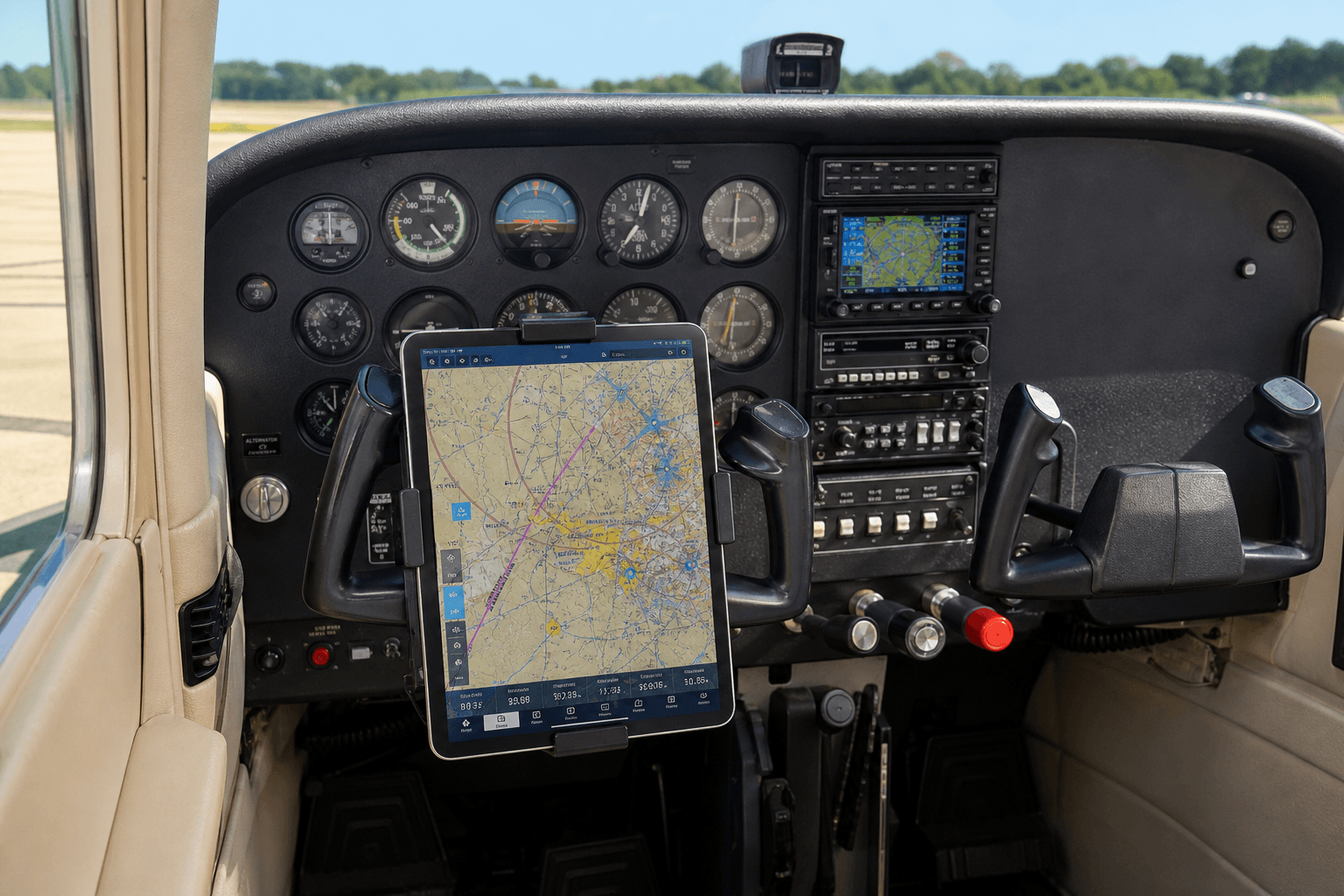
The learner showed up early for his IFR lesson with his tablet EFB ( electronic flight bag ) and spent the next 15 minutes trying to secure it in the aircraft. The tablet measured 8 by 11, and he wanted to use a yoke mount he had before in a Mooney. I don't know if it was the yoke on the Cessna 172 or the tablet, or the mount, or a combination—but it just didn't work. The tablet was too large and heavy, got in the way of the controls, and blocked the view of the instrument panel. Undaunted, we attempted a few flights with the tablet on the learner's lap. It was awkward and unstable, and scared both of us when it made a loud noise when it fell off his leg during a steep turn and landed hard on the floor of the aircraft. This was one of those times when the EFB intended to be used for navigation and situational awareness became a distraction rather than a help. In the worst case, it can become a hazard. READ MORE: When GPS Fails: Lessons From a Fatal Air Ambulance Crash READ MORE: Beat the Heat: Mastering Density Altitude One of my former students learned this the hard way. During an aerobatics lesson she was struck in the head by an EFB still attached to the kneeboard. It was her instructor's kneeboard that became a projectile when the leg strap failed. It's not just pilot gear that can go rogue. A mentor of mine shared a cautionary tale about a flight he did with his wife in their SkyCatcher that turned dramatic when they hit some turbulence and her purse—in his words—"barfed." He was assaulted by a hostile lipstick, giving him a large bruise under his eye. The lesson here is to make sure everything is secure in the cockpit. If you're not using it, keep it tucked away and secured. That means a pen, pencil, flashlight, E6-B, tablet, phone, or even plastic-laminated checklist can potentially do damage if they hit you just right. This concept can be convoluted. One particular learner tossed the checklist in the back seat after the engine run-up was complete. I was the fill-in instructor that day and asked why he did that. He said he wanted to make sure it was "out of the way," and "we were just in the pattern." I retrieved the checklist with the admonishment "we're not done with that yet" and instructed him to put the checklist in the bulkhead pouch next to his leg, clip it to his kneeboard, or place it under his right thigh so it wouldn't become a projectile or go missing. He was surprised, as he only used the flow of GUMPS check for landing. He experimented with all three locations for checklist storage and decided the kneeboard with the checklist open to the page pertinent to the flight worked the best for him, and he learned the art of "flow, and verify with the checklist." Having the right kneeboard is critical for cockpit organization. Finding the right one for you is very much trial and error. It may change, depending on the aircraft you're flying. As I write this I am working with an IFR candidate who is very happy with the kneeboard he received for Christmas that's specifically designed to hold an EFB. It's solid enough to keep the unit from sliding yet has a small enough profile that it doesn't get in the way of the yoke. I envied the latter, as the very first kneeboard I owned is missing an inch after I took a hacksaw to it when the yoke of the Cessna 172RG I did my commercial training in kept jamming it when I pulled the yoke full aft. Since the invention of EFB there has been an explosion in the creation of external mounts to secure it. Again this is trial and error. You can attach them to an arm extending from the floor, panel, etc. I'm not a fan of putting it up on the glareshield, although I know those who have and sent the magnetic compass into a tizzy and actually scratched the interior of the plexiglass windscreen. Neither is a good thing. Some mounts come with clips or suction cups, allowing them to attach to the aircraft. Be careful of anything that attaches to the windscreen side window because it blocks part of the view. Don't forget to have a reliable power source, including a cord that connects to the aircraft if appropriate. I've learned to carry two power cords for the unit just in case one fails or the learner forgets theirs, although savvy instructors use the EFB running out of battery as a realistic distraction. Please don't be the learner who thinks having a tablet and two backup phones will keep you from having to navigate with Mark 1 Eyeball during a check ride. Several DPEs I know tell me about failing all electronic means of navigation in the cockpit as a means to ascertain the applicant is capable of pilotage and dead recockoning. Apparently there are pilots who rely heavily on the magenta line to tell them where they are even in VFR conditions and, when it is taken away, they struggle. I thought this was hyperbole until I flew a stage check with an applicant who appeared to be genetically attached to his tablet. His regular CFI was trying to break him of the habit of being head down in the cockpit. Luckily, in the Seattle area we have some beautiful scenery and humongous landmarks you can't miss on a clear day—such as the cities of Seattle, Tacoma, Olympia, a couple of military bases, Mount Rainier, and Puget Sound. To wean him off the tablet we did a VFR flight sans EFB specifically to overfly the military bases (making proper radio calls to obtain permission to transition their Class D airspace) and then over the sound to look for whales. I am part of a whale observation group, and the position of the whales are shared online. You can't be head down in the cockpit when looking for whales. They don't show up on the ADS-B. You need your head on a swivel with eyes outside and mind your altitude so you're at least 2,000 feet above the creatures. By the end of the flight the learner was an "outside man." Learning had taken place.