

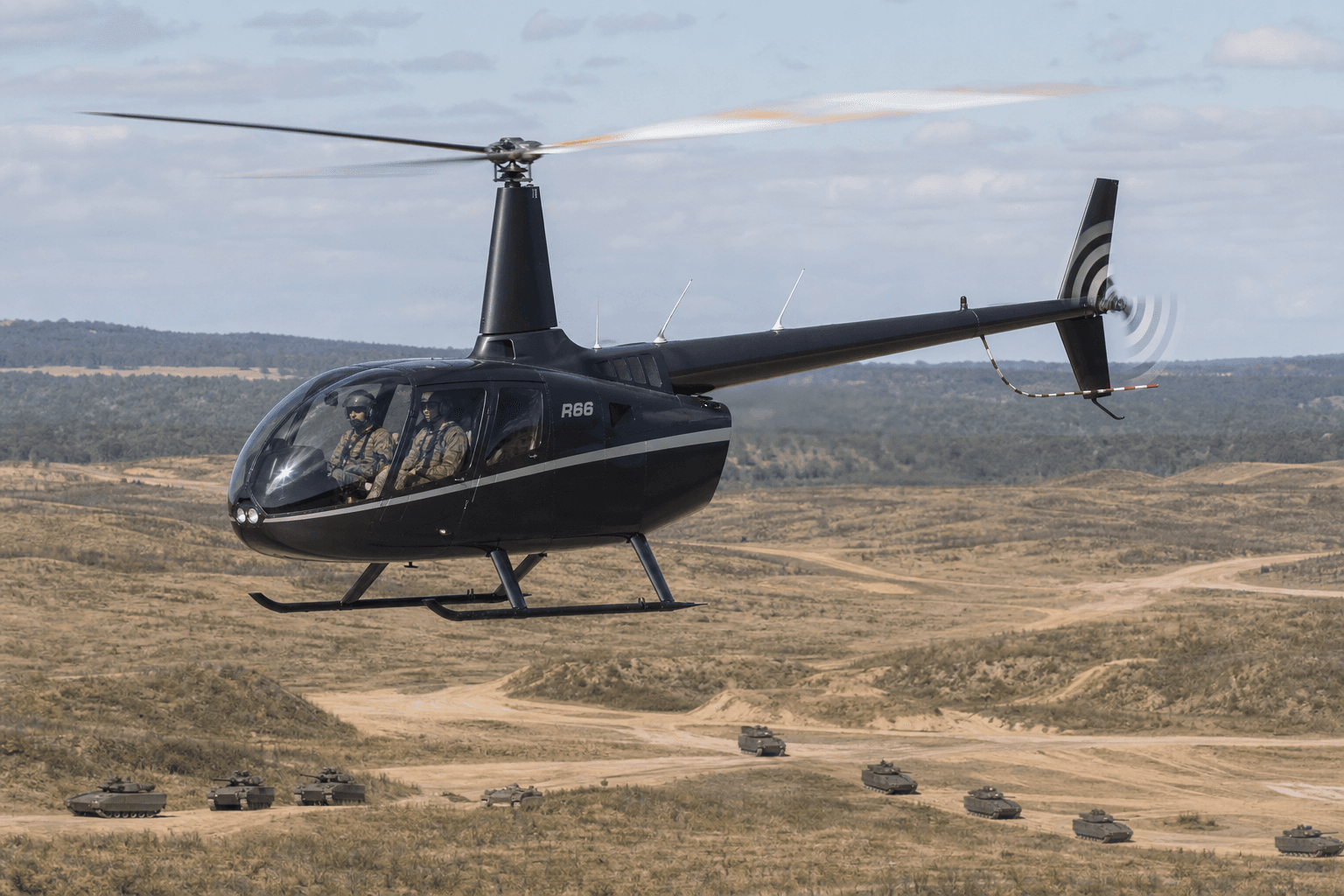
US Army selects Robinson R66 for $10bn Flight School Next rotary-wing training overhaul
Military training services provider M1 won the hotly contested Flight School Next contract with a bid centred on the R66 light-single. The US Army has selected a winner in the hotly contested competition for a multi-billion-dollar overhaul of the service’s rotary-wing flight instruction programme. Military training provider M1 Support Services was announced as the army’s vendor of choice on 13 August. The associated contract is valued at $10 billion over a potential 26-year period. Known as Flight School Next, the deal will entirely replace the service’s current helicopter instructional programme, which is split among multiple different vendors using a fleet of government-owned Airbus Helicopters UH-72 Lakotas as the primary training aircraft. Unlike the current model, Flight School Next will use a contractor-owned/contractor-operated approach to the physical rotorcraft as well as instructional and sustainment services. The service says consolidating the various functions into a single fixed-price contract will ultimately reduce costs. “Flight School Next delivers a critical improvement in our Initial Entry Rotary Wing Training model,” says Major General Clair Gill, commander of the US Army Aviation Center of Excellence. “Simply put, it delivers new military helicopter pilots with far better foundational skills," he adds. "The fact that it delivers this increased capability at a significant long-term savings to our army is a great added benefit." The new training structure will provide basic flight instruction for 800-1,500 new pilots annually, compared to 1,250 annually under the current system. M1 was chosen from a crowded field that had at various points included vertical lift heavyweights Lockheed Martin, Bell and Boeing. "M1 will deliver a fully integrated, innovation‑rich training solution designed to develop more proficient army aviators on time and on budget,” says M1 chief executive George Krivo. The company calls its comprehensive rotary-wing training package “Flight School First”. US Army leaders have long been critical of the UH-72A as a trainer helicopter, saying they would prefer a simpler single-engined alternative. Credit: US Army Three of the four finalists for the Flight School Next contract, including both M1 and Lockheed, had submitted bids based around the Robinson R66. Bell, meanwhile, had crafted a proposal using its 505 light single, while Boeing had partnered with Leonardo Helicopters to offer the TH-73. The army says the first phase of the Flight School Next plan will cover a three-to-four-year transition that will see the UH-72 phased out. The service has long been critical of the Lakota, describing the light twin as too sophisticated an aircraft on which to teach rudimentary flying skills. In particular, army leaders allege automation features included in the UH-72 led to new pilots graduating without sufficient “stick and rudder” flying skills. The army has linked an increase in serious rotary-wing accidents to adoption of the UH-72A as the service’s primary trainer in 2020. Airbus has countered that the automated flight assistance can easily be dialled down or turned off entirely using existing aircraft controls but that the US Army has not endeavoured to modify its flight procedures. In the run-up to the Flight School Next decision, army leaders made it clear they wanted a lightweight, single-engined rotorcraft with minimal computer assistance as the next trainer. The Army National Guard will continue to operate the UH-72, which is based on the Airbus H145 civil rotorcraft, in a light utility role for natural disaster response and other domestic operations. Robinson assembles the R66 at a factory in Torrance, California, that uses a highly vertically integrated supply chain, extending as far as sheet metal fabrication.