

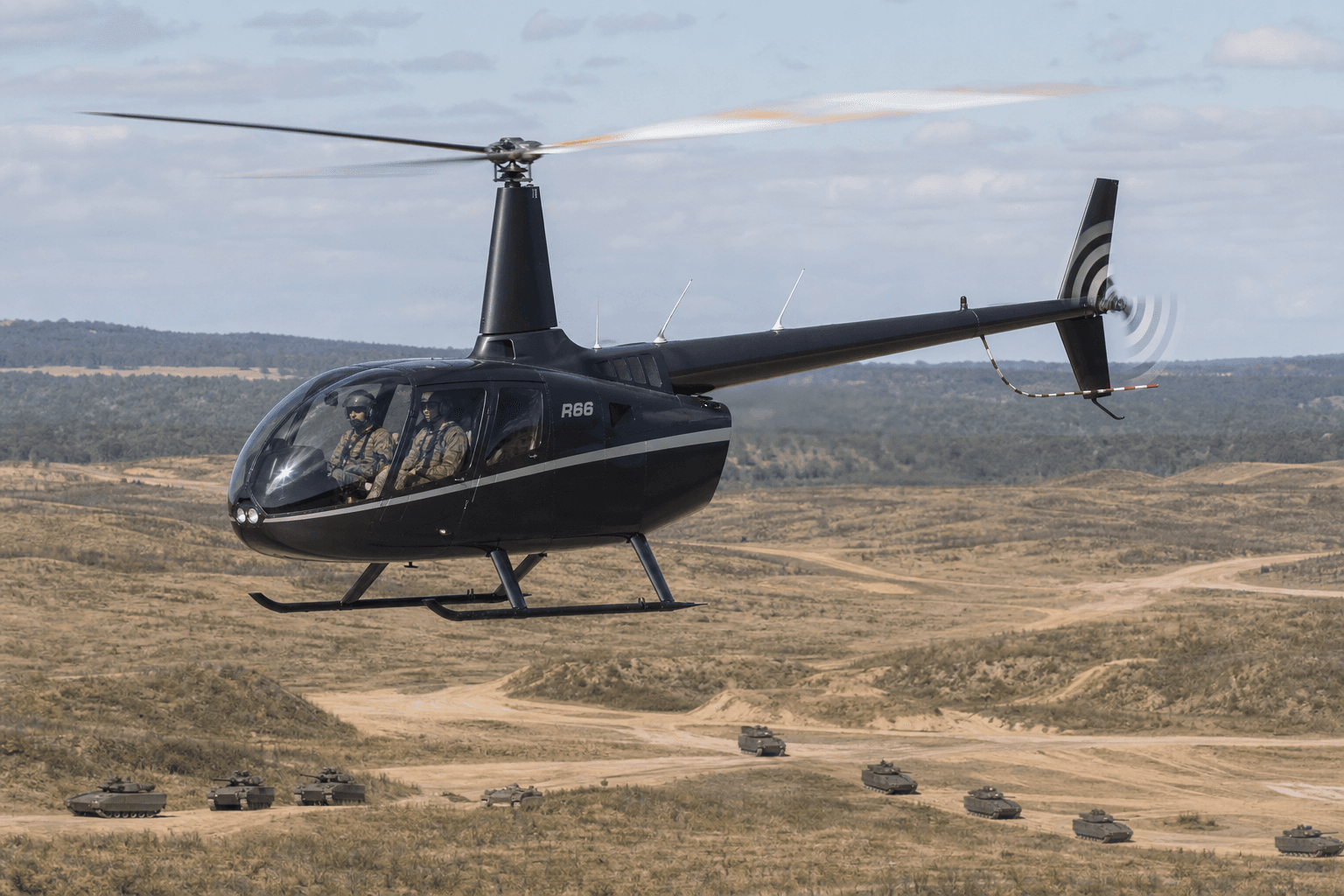
Illustration: The Touch & Go
US Army selects Robinson R66 for $10bn Flight School Next rotary-wing training overhaul
M1 Support Services won the US Army's $10 billion Flight School Next contract, replacing UH-72 Lakotas with Robinson R66 helicopters in a contractor-operated training model.
The gist
The US Army chose M1 and Robinson R66 helicopters for a $10bn contract revamping its rotary-wing flight training program.
The US Army has awarded a landmark $10 billion contract to M1 Support Services to revamp its rotary-wing flight training program over the next 26 years. This major initiative, known as Flight School Next, replaces the current training system where government-owned UH-72 Lakotas are employed across multiple vendors. Unlike the existing setup, Flight School Next adopts a contractor-owned and operated model for both helicopters and instructional services, aiming to enhance efficiency and reduce costs.
M1's winning bid centered around the Robinson R66, a light single-engine helicopter, which aligns with the Army's expressed preference for a simpler training platform. The R66's suitability as a basic trainer meets the Army's objective of improving initial pilot skills by minimizing automated flight assistance features prevalent on the current UH-72A Lakotas. This selection comes after four finalists competed, with other bids featuring the Bell 505 and Boeing partnered with Leonardo’s TH-73.
Under Flight School Next, the training syllabus will produce between 800 and 1,500 trained military rotary-wing pilots annually. This marks a slight decrease compared to the 1,250 graduates of the current system but is expected to deliver pilots with stronger foundational skills. The consolidation of multiple contracts into a fixed-price single contract aims to streamline training delivery and management.
The adoption of the contractor-operated model represents a significant shift for the Army, which previously relied on multiple vendors to manage various components of flight instruction using government aircraft. The change intends to reduce complexity and cut long-term costs, while improving pilot proficiency through integrated and innovation-rich training methodologies branded by M1 as Flight School First.
The Army's dissatisfaction with the UH-72A Lakota as a training platform has been longstanding. The twin-engine helicopter, derived from the Airbus H145, incorporates significant automation that reportedly undermined pilots' development of essential stick and rudder skills. Some army officials have linked the uptick in serious rotary-wing accidents since 2020 to this inappropriate trainer selection.
Airbus defends the UH-72's design, noting the automation systems can be disabled or adjusted via existing controls. However, the Army has indicated reluctance to change flight procedures to mitigate these automation effects. The Flight School Next program’s shift to a lighter, single-engine Robinson R66 signifies the Army’s commitment to grounding pilots more firmly in manual flying fundamentals from the outset.
During the transition phase, expected to last three to four years, existing UH-72 Lakotas will be gradually phased out from the Army’s basic flight training curriculum. Meanwhile, the Army National Guard will continue to utilize UH-72s in their traditional light utility roles, including natural disaster response and domestic operations.
The Robinson R66 helicopters earmarked for the new training program are produced in Torrance, California, where Robinson maintains a highly integrated supply chain. This vertical integration spans everything from sheet metal fabrication to final assembly, underpinning the reliability and availability of the aircraft types contracted by M1 for Flight School Next.
M1 Support Services CEO George Krivo emphasized the company's commitment to delivering an integrated training program that enhances pilot skills on schedule and within budget. The Flight School Next contract not only meets military aviation training objectives but also secures employment and industrial activity in the US rotorcraft manufacturing and service sectors.
Frequently asked questions
- What helicopter will the US Army use for rotary-wing flight training under Flight School Next?
- The US Army will use the Robinson R66 light single-engine helicopter as the primary aircraft for the Flight School Next training program.
- How much is the Flight School Next contract worth and what is its duration?
- The contract is valued at $10 billion over a potential 26-year period, covering training services and aircraft operations.
- Why is the Army replacing the UH-72 Lakota in its pilot training program?
- The Army found the UH-72 too sophisticated with automation that hindered the development of fundamental piloting skills, linking it to increased accidents.
Read more
All Military/Defense →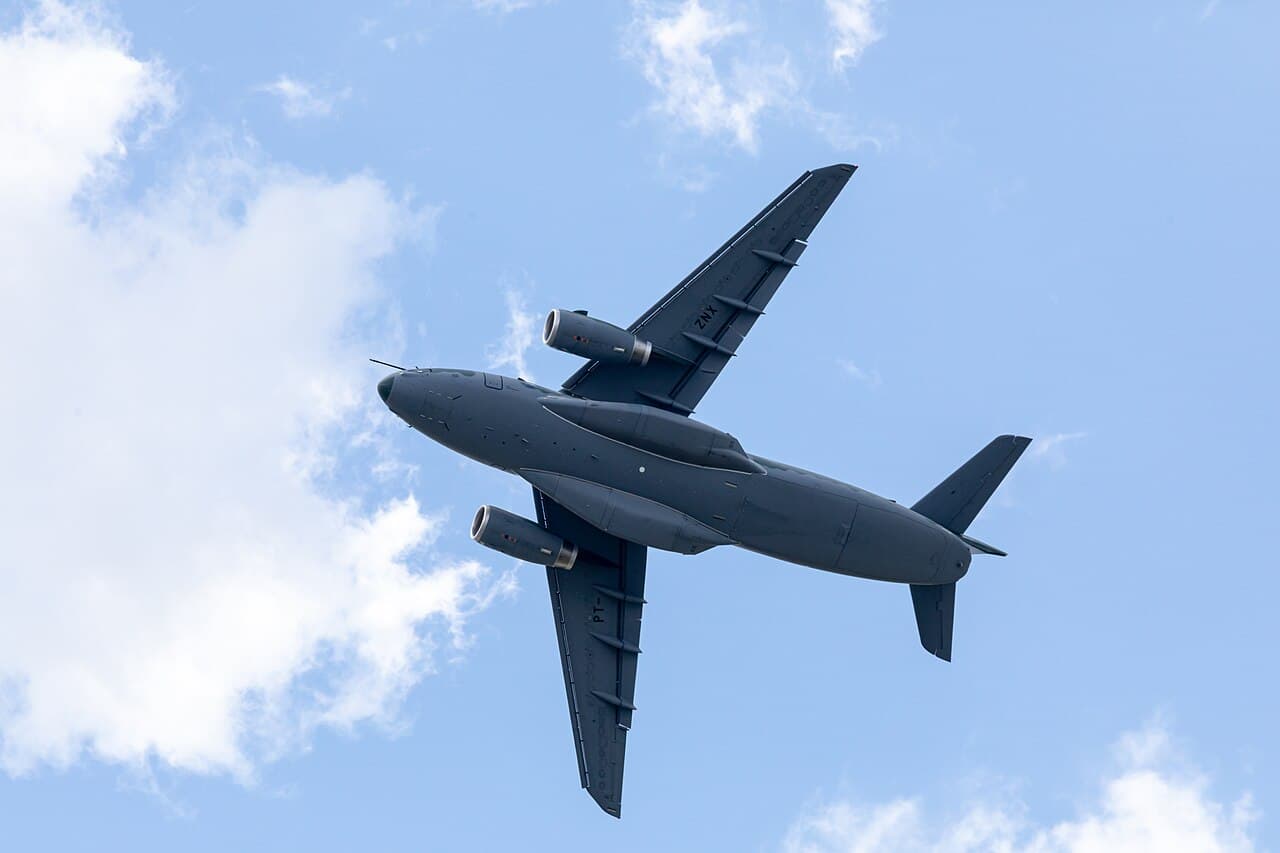
Embraer's KC-390 Secures 5 NATO Orders as a C-130 Alternative but USAF Remains Uninterested
Embraer's KC-390 Millennium has debuted to a resoundingly successful reception from many air forces around the world. A number of operators in Europe have jumped at the compact airlifter with its aerial refueling capability bundled in the twinjet, akin to a half-scale McDonnell Douglas C-17 Globemaster III. The US Air Force is currently struggling severely with its new Boeing KC-46A Pegasus, but it has not shown any interest in the Millennium.

Heart Aerospace's X1 Achieves Historic First Flight as Largest Battery-Electric Plane
The largest battery-electric, fixed-wing aircraft in history made its debut flight this week, marking the start of a test campaign to validate a planned, 30-seat, hybrid-electric airliner. Los Angeles-based Heart Aerospace said Thursday that its X1 demonstrator, a precursor to its flagship ES-30, flew out of Plattsburgh International Airport (KPBG)—the company's flight testing base in upstate New York—on all-electric battery propulsion. Heart said the X1 is the largest aircraft of its kind, by both wingspan and takeoff weight, to achieve first flight. The X1 weighs more than 25,000 pounds at takeoff and has a 106-foot wingspan, with a nose-to-tail length of 76 feet. FLYING could not verify any battery-electric aircraft that have flown with a heavier takeoff weight or longer wingspan. Heart believes the X1 may also be the largest battery-electric model to fly by volume, but it could not say so definitively. The Swedish Solar Impulse project's all-electric Solar Impulse II had a wingspan longer than 200 feet, but it derived power from a combination of batteries and solar energy. Eviation's Alice demonstrator, which completed a nine-minute test flight in 2022, appears to be the next-largest in the all-electric category. Alice had a 63-foot wingspan and maximum takeoff weight (MTOW) of about 16,500 pounds, powered by MagniX's Magni650 electric engines. After minimal flight activity over the following years, Alice in 2024 underwent a redesign, and Eviation in early 2025 laid off most of its staff , placing the project on an indefinite hold. MagniX itself has flown an all-electric Cessna 208B Caravan powered by its Magni500 engine, which it is no longer developing. The company's Magni650 has a dry weight of 317 pounds, which combined with the Caravan's MTOW would give the retrofit a total MTOW of 8,317 pounds. Heart originally planned to fly the X1 by mid-2025, but delays have pushed the company's certification target for the ES-30 from 2028 to 2031 . Most developers of all-electric aircraft are targeting between four and nine seats or are designing models for cargo rather than passenger operations. A cockpit mock-up was installed aboard Heart Aerospace's X1 demonstrator aircraft for its rollout. [Credit: Heart Aerospace] Due to lengthy development and certification timelines, several firms originally focused on fielding all-electric passenger airliners have switched to hybrid propulsion systems, pivoted to defense applications, scaled back their workforces, or even gone bankrupt. SkyWest took a hit in June with the bankruptcy of Maeve Aerospace . The carrier was the exclusive launch customer for the manufacturer's hybrid-electric, 76-100-passenger Maeve Jet, and it invested in Maeve as part of its fleet replacement strategy. However, some airlines continue to bet on all-electric aviation. United Airlines is Heart's largest customer, having placed an order for 100 of the manufacturer's earlier ES-19 model that it later converted to the ES-30. Michael Leskinen, United's chief financial officer, reiterated the company's commitment this week. "Electric commercial aircraft have real potential to deliver a better travel experience for passengers while strengthening our business, and we look forward to Heart's continued development of the ES-30 and its potential future role in United's network," Leskinen said in a statement accompanying Heart's announcement . Other ES-30 customers include Mesa Air Group, Air Canada, JSX, Loganair, and Scandinavian Airlines, though many have only signed letters of intent to place orders. New York, one of the 26 states chosen for the FAA's eVTOL (electric vertical takeoff and landing) Integration Pilot Program (eIPP), is soon expected to host more flights of electric, autonomous, and other novel aircraft. All-Electric Debut Leaders in the nascent electric and hybrid-electric aircraft industries echoed Leskinen's bullishness on the ES-30 following the X1's debut. "A fantastic milestone for electric regional aviation," Evio, which is developing a hybrid-electric airliner for up to 100 passengers, wrote in response to Heart's post on LinkedIn . "Congratulations to the Heart Aerospace team on your first flight! Looking forward to seeing the continued progress across our industry." Rob Wolleswinkel, co-CEO of Elysian Aircraft—a Dutch company developing a larger, all-electric regional airliner—wrote, "Congratulations! Really impressive! A big step for Heart and the whole industry." The flight received similar praise from leaders of competitors Noemi and Vaeridion. Plattsburgh International Airport's 11,750-foot runway—one of the largest in the U.S. Northeast—made it an ideal locale for the debut of a novel aircraft. Heart Aerospace's X1 demonstrator aircraft lines up on Plattsburgh International's Runway 35. [Credit: Heart Aerospace] The X1 took off from the runway and soared over nearby Lake Champlain, reaching a top altitude of 1,100 feet agl. The sortie lasted about 27 minutes and was conducted under an FAA Special Airworthiness Certificate in the Experimental Category (SAC-EC) awarded in July. Heart said the test profile was intended to demonstrate "scale relevant to commercial airline operations." "Electric commercial aircraft have the potential to fundamentally reshape airline economics and, ultimately, lower the cost of air travel for passengers," said Anders Forslund, founder and CEO of Heart. The ES-30 is designed to reduce operating costs by more than 40 percent. Heart said Thursday that the X1's debut flight used only $5 worth of energy during a period where the average price for a gallon of jet fuel is north of $3.80, per the Argus U.S. Jet Fuel Index . That figure was closer to $2 in August 2025. For comparison, Beta Technologies—which also conducts testing in Plattsburgh—said its 45-minute flight into John F. Kennedy International Airport (KJFK) last year cost about $7. The X1 is designed for a single pilot to fly up to 140 knots and 2,000 feet agl. It integrates electric propulsion, batteries, power electronics, flight controls, and avionics systems, as well as a 30-seat cabin mockup. Propulsion comes from four wing-mounted motors. The demonstrator uses a provisional version of the "independent hybrid" propulsion system intended to power the ES-30, comprising a pair of commercial turboprops installed on the wing and two inboard electric motors. It intends to demonstrate the full system using the X2, a planned preproduction prototype. The X1 is designed to be representative of Heart's fixed-wing, 30-seat, Part 25 hybrid-electric airliner. The ES-30 will use simpler, lower-cost electric propulsion and flight systems, as well as an integrated electronics and software architecture designed to improve uptime. "Heart foresees this cost advantage widening over time through advances in battery technology, technology-enabled gains in crew efficiency, and the ES-30's low exposure to a growing range of emissions-related aviation taxes and fees worldwide," the company wrote in its announcement. The ES-30 has a projected range of 125 miles in all-electric mode or 500 miles in hybrid configuration, with charge time estimated at 30 minutes.
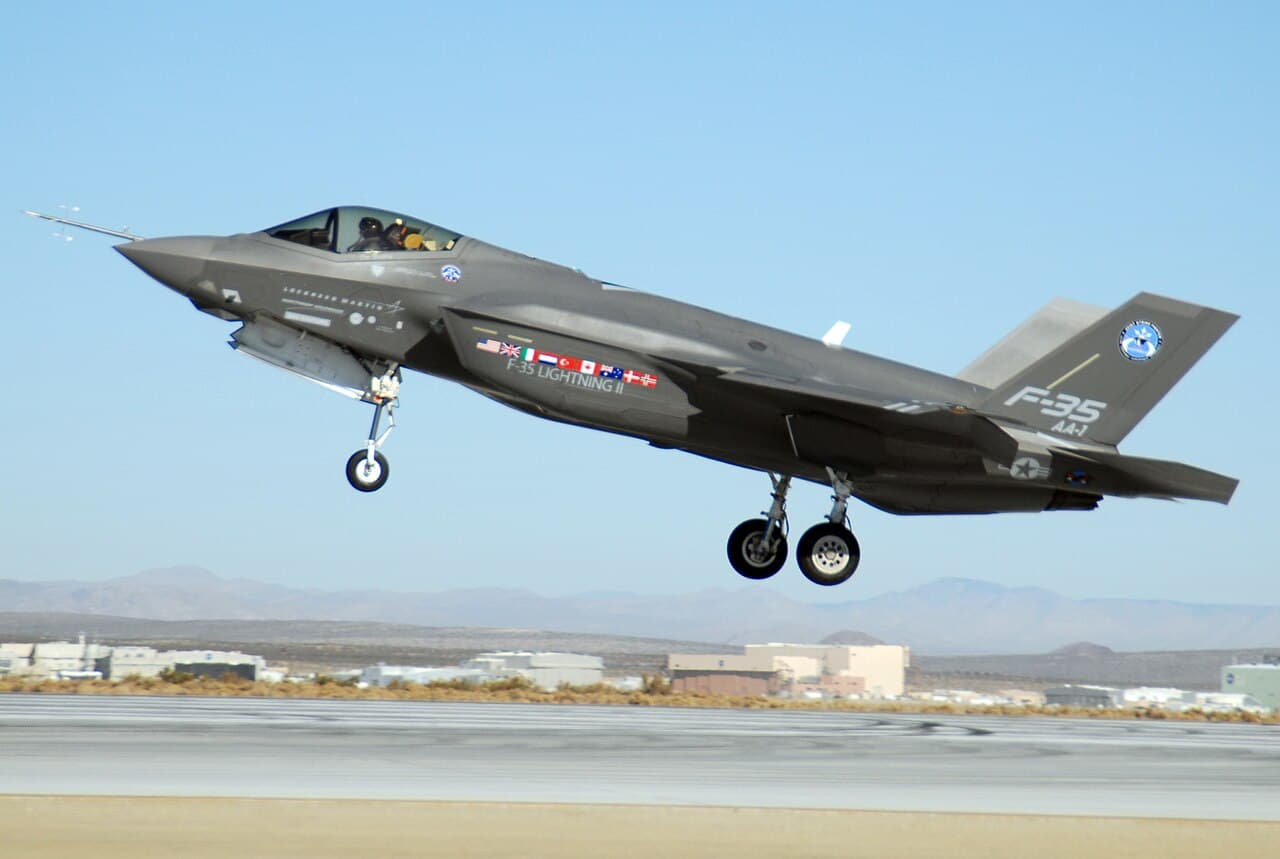
World's Stealth Fighter Landscape in 2026 Divided Between F-35 Allies and Sino-Russian Blocks
According to TheWorldData's 2026 F-35 statistics roundup , the global Lockheed Martin F-35 fleet has already passed 1,300 aircraft delivered across 17 or more nations, dwarfing every other stealth fighter program combined. Everyone else on Earth flying stealth fighter jets in 2026, such as China, Russia, and their allies, is flying something else entirely, built by a different country, sold under different rules, and answering to a different set of allies.
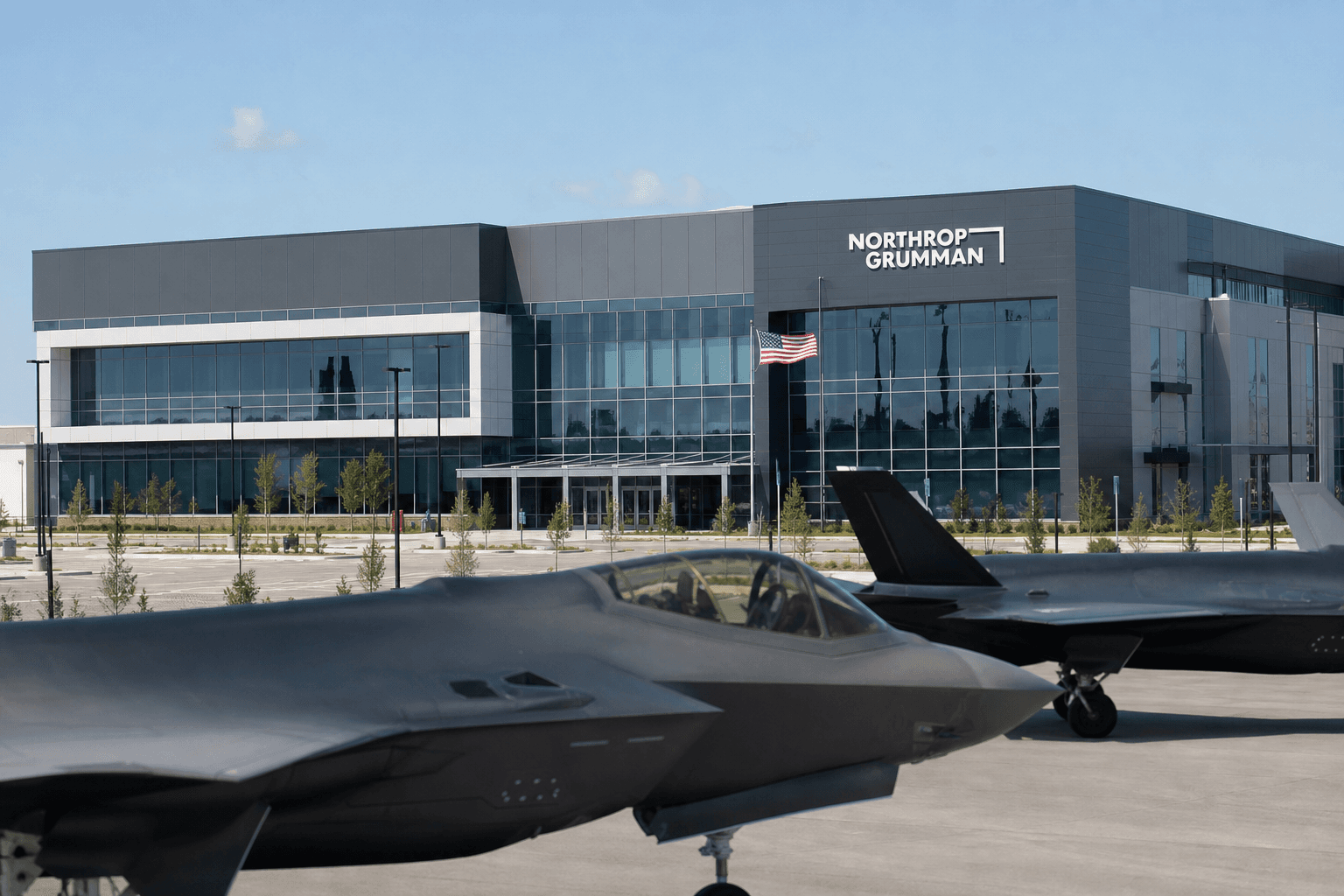
Northrop Grumman opens Florida engineering hub for Navy's next-gen carrier fighter
The defence contractor is vying to build the US Navy’s sixth-generation F/A-XX carrier-based fighter. Northrop Grumman has opened a new factory in Florida aimed at supporting the design and production of a sixth-generation aircraft. The defence manufacturer’s 27,870sq m (300,000sq ft) engineering facility is situated within Northrop’s broader hub in Melbourne, Florida. It will house space for 1,200 engineers and 17 secure laboratories dedicated to advanced aircraft design, Northrop says. Northrop unveiled the new site in early August. “This facility reinforces Melbourne as the epicentre of sixth-generation aircraft,” says Tom Jones, president of Northrop Grumman’s aeronautics division. “Between these walls in just a few months, we will have cutting-edge labs and hundreds of skilled engineers coming together in a world-class facility,” he adds. “This is what momentum looks like.” Northrop is one of two aircraft manufacturers still competing to build the US Navy’s future carrier-based sixth-generation fighter jet. Officially called the Next Generation Fighter, the programme is colloquially known as F/A-XX and is intended to deliver a successor to the more than 470 Boeing F/A-18E/F Super Hornets in the US Navy inventory. In April, Northrop shared a rendering of what an F/A-XX fighter might look like, including a tailless design and low-profile recessed air intakes located dorsally on either side of the fuselage centreline – similar in position to the air intakes featured on Northrop's B-2 and B-21 stealth bombers. Northrop Grumman released a rendering of a potential carrier-based sixth-generation fighter earlier this year. Credit: Northrop Grumman Boeing is the other finalist competing against Northrop for the secretive contract after a proposal from Lockheed Martin was rejected by the Navy in 2025. Both companies have a strong position. Boeing is hard at work on the US Air Force’s F-47 sixth-generation fighter, with flight testing scheduled to begin in 2028. Meanwhile, Northrop is actively assembling B-21 stealth bombers for the air force, with at least two early models already flying and delivery of operational aircraft expected in 2027. Industrial capacity is a major consideration in the respective programmes and was likely a driver behind Northrop’s build-out of the new sixth-generation engineering facility. Boeing successfully gambled that investing in a new factory built to assemble highly classified advanced combat aircraft would help it secure the F-47 contract. The company spent nearly $2 billion to develop such a facility at its St. Louis, Missouri fighter production campus, even before it had secured the F-47 win in March 2025. Construction on that 102,000sq m facility began in 2024 and remains ongoing. During a 2024 FlightGlobal visit to the headquarters of Boeing Defense, Space & Security in St Louis, company executives described the plant as a "bet" on the company's future. Northrop appears to be taking a similar approach with its own investment in sixth-generation industrial capacity, describing the move as a commitment to the “workforce, technology and infrastructure required to deliver next-generation airpower”. However, the future of the F/A-XX remains uncertain. The Navy has been inching toward a decision on a vendor for the new fighter, with a decision promised sometime in the second half of 2026. However, political support for the programme has repeatedly oscillated. The Trump administration previously sought to cut the budget for the Next Generation Fighter programme, with the White House and Pentagon instead prioritising development and fielding of the F-47. "The administration strongly supports re-evaluating the F/A-XX programme due to industrial base concerns of two sixth-generation programmes occurring simultaneously,” the White House said in a 2025 memo. "Awarding the F/A-XX contract as written is likely to delay the higher-priority F-47 programme, with low likelihood of improving the timeline to field a Navy sixth-generation fighter." Northrop Grumman is already flying two test examples of the new B-21 stealth bomber, with operational aircraft expected to reach frontline units in 2027. Credit: US Air Force Pentagon chief Pete Hegseth came out in support of the F/A-XX earlier this year, although he left some room for doubt as to the timeline for production and fielding of the new jet. "It's not a matter of if; it's a matter of when," Hegseth said during congressional testimony in April. "It's a critical capability that we need to fund for the future of naval aviation." An F/A-XX vendor decision has previously been teased as happening in August, with an initial engineering and manufacturing design contract going to either Northrop or Boeing. If Northrop prevails, it would mark the first fighter aircraft the company has delivered since the venerable F-14 Tomcat. Northrop also built the YF-23 demonstrator that ultimately lost out to Lockheed Martin’s YF-22 to become the US Air Force’s F-22 Raptor air dominance fighter.
The Daily Touch & Go
The day's best aviation news in your inbox. Free, no spam.