

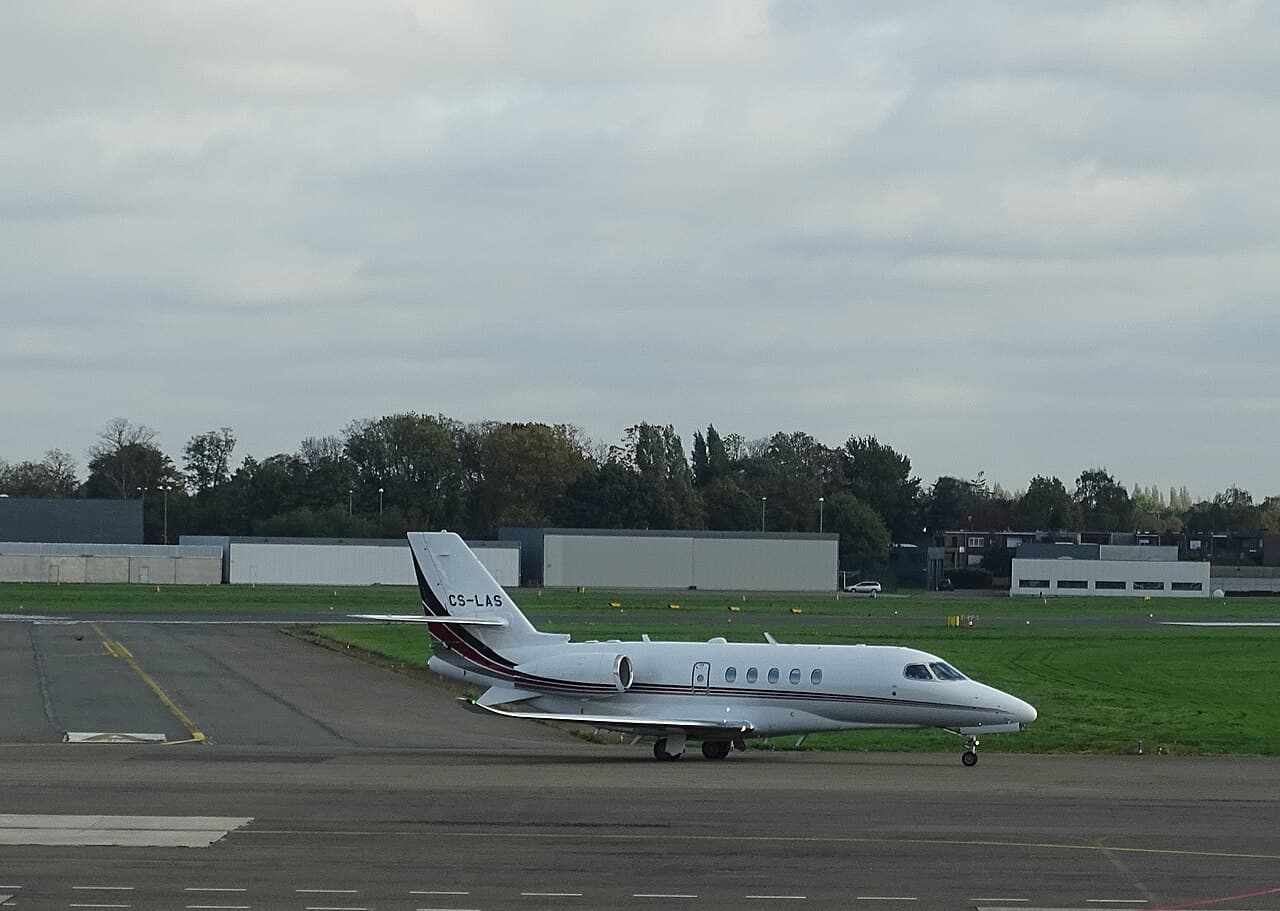
NTSB probes right engine starter generator failure in fatal Laredo NetJets Citation crash
Pilots aboard the Cessna Citation Latitude that crashed in Laredo, Texas, in June reported detecting an unusual vibration in the aircraft shortly after takeoff from Los Cabos, Mexico (MMSD), according to the preliminary report from the National Transportation Safety Board (NTSB). The aircraft, owned by fractional ownership company NetJets , was heading for Austin, Texas, when the flight crew notified the NetJets flight operations duty manager (FODM) about what they described as a "low frequency vibration and a humming noise. It sounds like a fan is on." The pilots stated they could feel it in the dashboard, saying it was steady during the climb but went away when the aircraft entered cruise flight. According to the NTSB report, NetJets maintenance control joined the call. READ MORE: NetJets Crash in Texas Kills 1, Injures 5 READ MORE: NetJets Takes Delivery of First Bombardier Global 8000 The captain stated that the vibration was "intermittent for a while, and now it is gone." "During the discussion, the flight crew received a Crew Alerting System (CAS) message related to the Air Data Computer (ADC), 'BOTH ON ADC 1.' The maintenance controller suggested that the vibration might be caused by an avionics cooling fan in the forward instrument panel. This idea was reinforced by the CAS message." The captain noted the vibration appeared to be cycling on and off, and asked if the vibration could be the ADC related to the fan. The crew continued to troubleshoot the issue, accomplishing the quick reference handbook procedure for the CAS message, and subsequently cleared the message. "After further discussion with the maintenance controller and FODM, it was determined that the flight could safely proceed to its planned destination and write up the vibration once the flight was completed," the report said. Around 10 p.m. CDT, as the airplane approached the U.S.-Mexico border, the flight crew received a "FUEL BST PUMP ON R" CAS message, which indicated the right fuel system had low fuel pressure. A few seconds later they received a "FUEL PRESS LOW R" CAS message, which indicated that the right fuel system pressure was low. Approximately three minutes later, two more CAS messages were displayed: "ELEC TRU FAIL R" and "WSHLD HEAT INOP R". Eleven minutes later, a "FUEL LEVEL LOW R" message was displayed. The flight crew declared an emergency with the Monterrey (Mexico) Area Control Center and was subsequently handed off to Houston Air Route Traffic Control Center (ARTCC) as they entered U.S. airspace. On the initial check-in with the Houston ARTCC, the flight crew reported a generator failure and "multiple other failures," and issues including "fuel level low." The crew requested to divert to Laredo International Airport in Texas, and were cleared to KLRD via radar vectors. When asked if they were ready for the approach or if they needed time to execute checklists, the flight crew stated that they were ready and requested a visual approach to a 5-mile final for Runway 36L. Houston ARTCC gave the crew a right 270-degree turn to allow them to lose altitude and get established on a 14-mile final to Runway 36L. The flight crew made contact with the tower at KLRD. While the airplane was on final approach, the right engine flamed out, followed a few seconds later by the left engine. The first officer, who was the pilot monitoring, asked ATC, "Is there a field off to our right?" ATC replied, "Negative, there are no other fields next to you." The first officer then asked if there were any open pastures or fields to their right and ATC replied, "It's just going to be the main highway, and that's just about it." The NTSB reports that video collected from several security and doorbell cameras show the airplane was on fire as it was on final approach. The flight touched down on the northbound lanes of Texas State Highway Loop 20, approximately 1 mile southeast of the airport. There was vehicular traffic on the road at the time. The jet sheared off several light poles and struck a vehicle before coming to a stop, straddling the edge of an overpass. The airplane came to rest laying on its right side with the rear cabin emergency exit on the ground and the main cabin door exit oriented upward. Good samaritans and law enforcement rushed to the burning wreckage, trying to break the windows to rescue the people inside. Eventually they were able to force open the main cabin door to rescue the five occupants. Local media reported there was a minor injury to a motorist and to police officers who assisted in the rescue. There were five minor injuries and one serious one to the occupants of the aircraft. The one fatality was identified as Joshua Baer, co-founder and CEO of Capital Factory, an Austin-based company created to help local entrepreneurs launch and grow businesses in Texas. Baer spent 20 years making Capital Factory one of the Lone Star State's most influential startup incubators and venture networks, connecting founders with investors, mentors, and corporate partners. Investigators Focus on Right Engine The wreckage was moved to a hangar for study. During the teardown of the engines, the NTSB investigation found the right engine starter generator was missing multiple screws from the outer housing. The starter generator interval overhaul was 1,200 hours, with the last one performed April 25, 2025. NTSB investigators noted the unit had 57.2 hours of time remaining until its next overhaul. Agency investigators removed the starter generator and found its shaft was bent and the cooling fan fractured. Multiple cooling fan blades and ball bearings were found when the generator was removed. There were circumferential scoring marks in the cooling fan shroud. The fuel tube assembly, starter generator, and multiple components were sent to the NTSB Materials Laboratory in Washington, D.C., for further analysis. The NTSB stressed that this information on the accident is preliminary. The final report is still several months away. The complete NTSB preliminary report can be found here .