

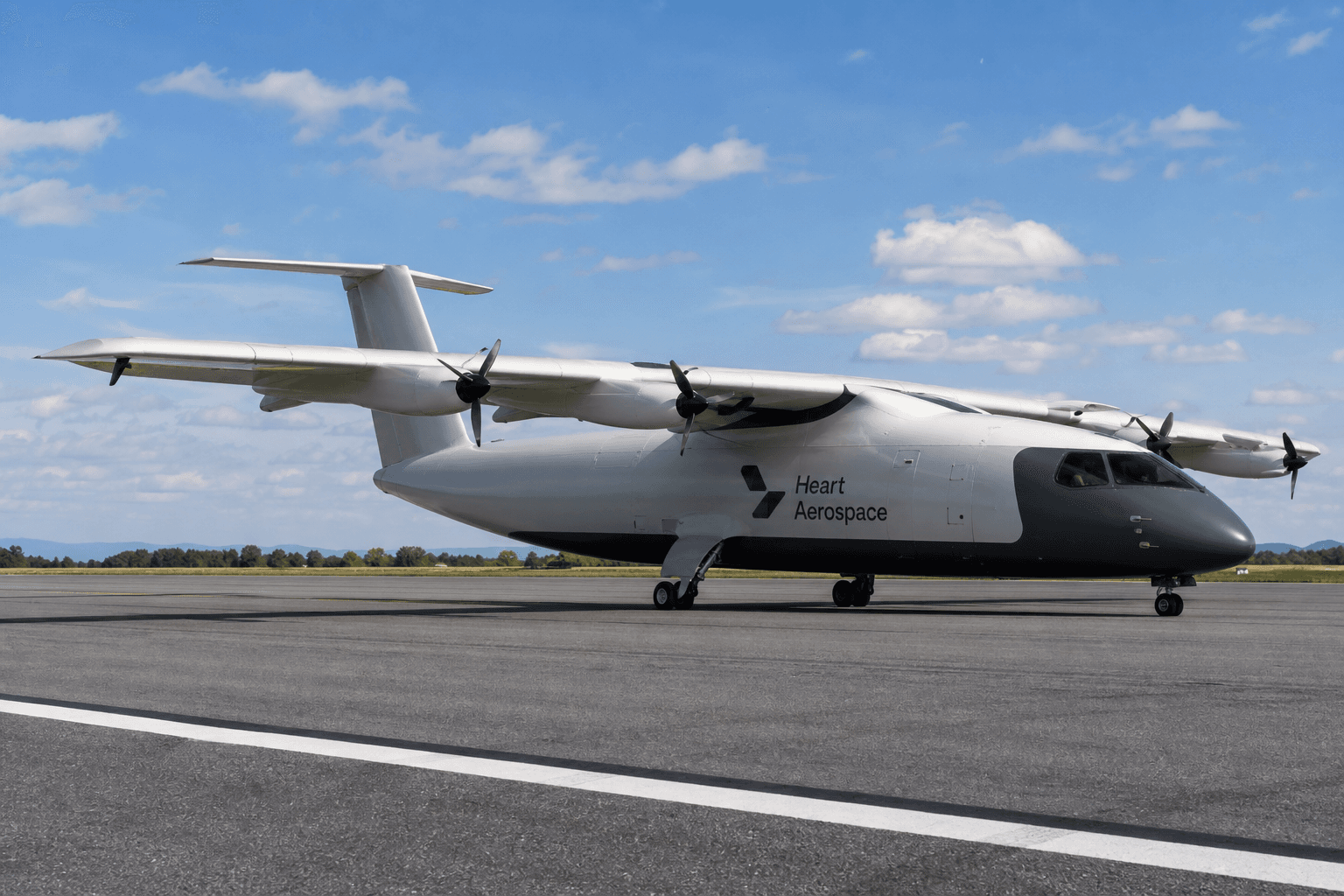
Heart Aerospace's X1 Achieves Historic First Flight as Largest Battery-Electric Plane
The largest battery-electric, fixed-wing aircraft in history made its debut flight this week, marking the start of a test campaign to validate a planned, 30-seat, hybrid-electric airliner. Los Angeles-based Heart Aerospace said Thursday that its X1 demonstrator, a precursor to its flagship ES-30, flew out of Plattsburgh International Airport (KPBG)—the company's flight testing base in upstate New York—on all-electric battery propulsion. Heart said the X1 is the largest aircraft of its kind, by both wingspan and takeoff weight, to achieve first flight. The X1 weighs more than 25,000 pounds at takeoff and has a 106-foot wingspan, with a nose-to-tail length of 76 feet. FLYING could not verify any battery-electric aircraft that have flown with a heavier takeoff weight or longer wingspan. Heart believes the X1 may also be the largest battery-electric model to fly by volume, but it could not say so definitively. The Swedish Solar Impulse project's all-electric Solar Impulse II had a wingspan longer than 200 feet, but it derived power from a combination of batteries and solar energy. Eviation's Alice demonstrator, which completed a nine-minute test flight in 2022, appears to be the next-largest in the all-electric category. Alice had a 63-foot wingspan and maximum takeoff weight (MTOW) of about 16,500 pounds, powered by MagniX's Magni650 electric engines. After minimal flight activity over the following years, Alice in 2024 underwent a redesign, and Eviation in early 2025 laid off most of its staff , placing the project on an indefinite hold. MagniX itself has flown an all-electric Cessna 208B Caravan powered by its Magni500 engine, which it is no longer developing. The company's Magni650 has a dry weight of 317 pounds, which combined with the Caravan's MTOW would give the retrofit a total MTOW of 8,317 pounds. Heart originally planned to fly the X1 by mid-2025, but delays have pushed the company's certification target for the ES-30 from 2028 to 2031 . Most developers of all-electric aircraft are targeting between four and nine seats or are designing models for cargo rather than passenger operations. A cockpit mock-up was installed aboard Heart Aerospace's X1 demonstrator aircraft for its rollout. [Credit: Heart Aerospace] Due to lengthy development and certification timelines, several firms originally focused on fielding all-electric passenger airliners have switched to hybrid propulsion systems, pivoted to defense applications, scaled back their workforces, or even gone bankrupt. SkyWest took a hit in June with the bankruptcy of Maeve Aerospace . The carrier was the exclusive launch customer for the manufacturer's hybrid-electric, 76-100-passenger Maeve Jet, and it invested in Maeve as part of its fleet replacement strategy. However, some airlines continue to bet on all-electric aviation. United Airlines is Heart's largest customer, having placed an order for 100 of the manufacturer's earlier ES-19 model that it later converted to the ES-30. Michael Leskinen, United's chief financial officer, reiterated the company's commitment this week. "Electric commercial aircraft have real potential to deliver a better travel experience for passengers while strengthening our business, and we look forward to Heart's continued development of the ES-30 and its potential future role in United's network," Leskinen said in a statement accompanying Heart's announcement . Other ES-30 customers include Mesa Air Group, Air Canada, JSX, Loganair, and Scandinavian Airlines, though many have only signed letters of intent to place orders. New York, one of the 26 states chosen for the FAA's eVTOL (electric vertical takeoff and landing) Integration Pilot Program (eIPP), is soon expected to host more flights of electric, autonomous, and other novel aircraft. All-Electric Debut Leaders in the nascent electric and hybrid-electric aircraft industries echoed Leskinen's bullishness on the ES-30 following the X1's debut. "A fantastic milestone for electric regional aviation," Evio, which is developing a hybrid-electric airliner for up to 100 passengers, wrote in response to Heart's post on LinkedIn . "Congratulations to the Heart Aerospace team on your first flight! Looking forward to seeing the continued progress across our industry." Rob Wolleswinkel, co-CEO of Elysian Aircraft—a Dutch company developing a larger, all-electric regional airliner—wrote, "Congratulations! Really impressive! A big step for Heart and the whole industry." The flight received similar praise from leaders of competitors Noemi and Vaeridion. Plattsburgh International Airport's 11,750-foot runway—one of the largest in the U.S. Northeast—made it an ideal locale for the debut of a novel aircraft. Heart Aerospace's X1 demonstrator aircraft lines up on Plattsburgh International's Runway 35. [Credit: Heart Aerospace] The X1 took off from the runway and soared over nearby Lake Champlain, reaching a top altitude of 1,100 feet agl. The sortie lasted about 27 minutes and was conducted under an FAA Special Airworthiness Certificate in the Experimental Category (SAC-EC) awarded in July. Heart said the test profile was intended to demonstrate "scale relevant to commercial airline operations." "Electric commercial aircraft have the potential to fundamentally reshape airline economics and, ultimately, lower the cost of air travel for passengers," said Anders Forslund, founder and CEO of Heart. The ES-30 is designed to reduce operating costs by more than 40 percent. Heart said Thursday that the X1's debut flight used only $5 worth of energy during a period where the average price for a gallon of jet fuel is north of $3.80, per the Argus U.S. Jet Fuel Index . That figure was closer to $2 in August 2025. For comparison, Beta Technologies—which also conducts testing in Plattsburgh—said its 45-minute flight into John F. Kennedy International Airport (KJFK) last year cost about $7. The X1 is designed for a single pilot to fly up to 140 knots and 2,000 feet agl. It integrates electric propulsion, batteries, power electronics, flight controls, and avionics systems, as well as a 30-seat cabin mockup. Propulsion comes from four wing-mounted motors. The demonstrator uses a provisional version of the "independent hybrid" propulsion system intended to power the ES-30, comprising a pair of commercial turboprops installed on the wing and two inboard electric motors. It intends to demonstrate the full system using the X2, a planned preproduction prototype. The X1 is designed to be representative of Heart's fixed-wing, 30-seat, Part 25 hybrid-electric airliner. The ES-30 will use simpler, lower-cost electric propulsion and flight systems, as well as an integrated electronics and software architecture designed to improve uptime. "Heart foresees this cost advantage widening over time through advances in battery technology, technology-enabled gains in crew efficiency, and the ES-30's low exposure to a growing range of emissions-related aviation taxes and fees worldwide," the company wrote in its announcement. The ES-30 has a projected range of 125 miles in all-electric mode or 500 miles in hybrid configuration, with charge time estimated at 30 minutes.