

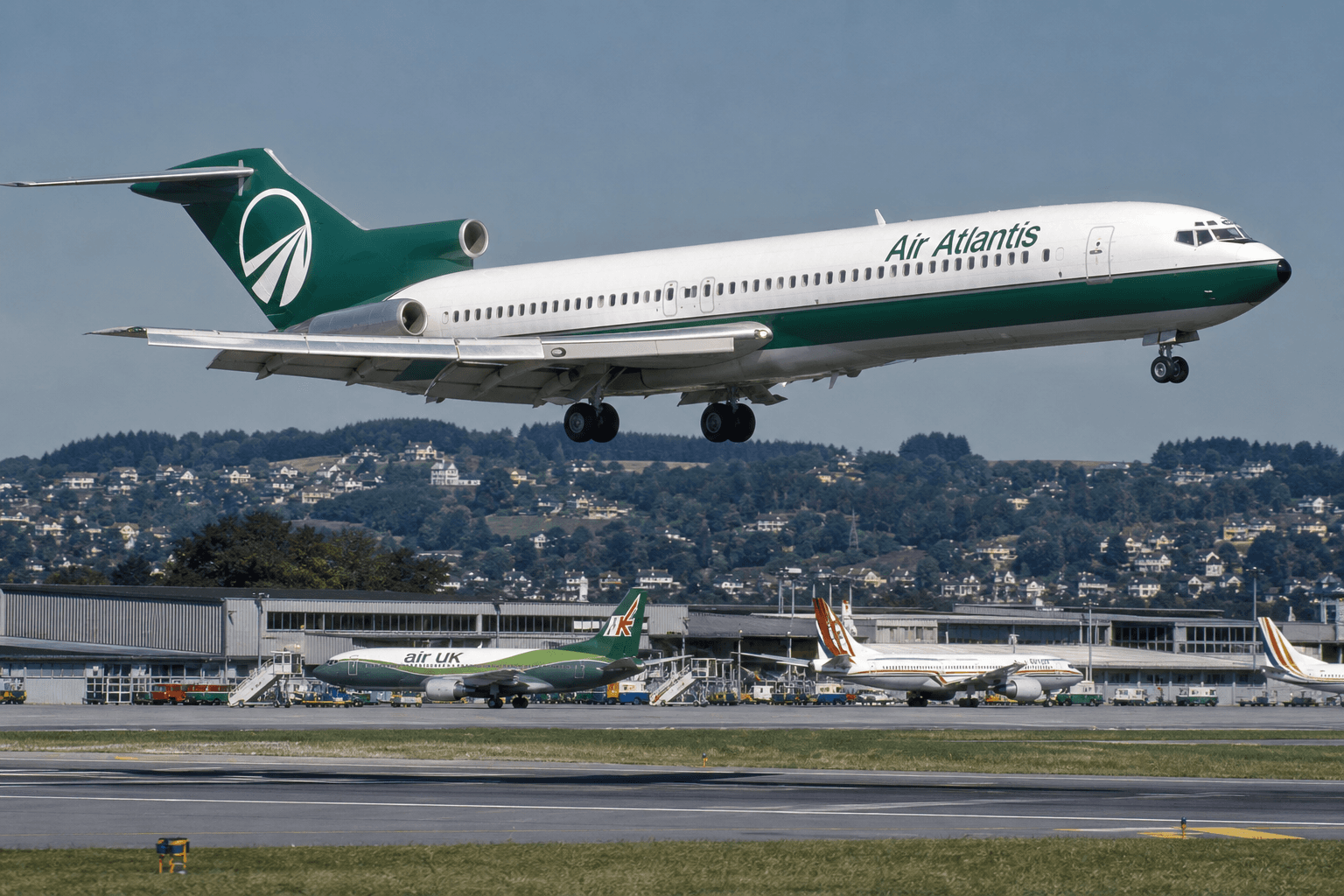
Air Atlantis, Portuguese Charter Airline, Shaped 1980s European Holiday Travel
For many plane spotters who frequented regional airports during the late 1980s and early 1990s, the sight of an Air Atlantis aircraft arriving from Portugal remains a fond memory. Wearing an attractive green-and-white livery and operating a fleet of Boeing 727s and 737s, the airline became a familiar visitor at airports across the UK and Europe during the package holiday boom. Although Air Atlantis existed for less than a decade, it played an important role in Portuguese aviation and helped support the rapid growth of tourism to the Algarve and Madeira before eventually being absorbed back into its parent company. The Birth of Air Atlantis Air Atlantis Boeing 707 at Birmingham. Photo: simon butler Air Atlantis was established in 1985 as a wholly owned subsidiary of Portugal’s flag carrier, TAP Air Portugal. During the 1980s, demand for leisure travel from northern Europe to Portugal was growing rapidly, particularly from the United Kingdom, Germany and Scandinavia. Rather than use its mainline fleet on charter operations, TAP created a dedicated airline that could focus entirely on the booming holiday market while allowing the parent airline to concentrate on scheduled international services. Based at Lisbon Airport, Air Atlantis began operations in 1986 and quickly became a major player in Portugal’s charter sector. Charter Flights Across Europe Air Atlantis 727-200. Photo: Rob Hodgkins The airline’s business centred on flying holidaymakers from across Europe to Portugal’s popular resort destinations. Flights linked cities throughout Britain, Ireland, Germany, France, Belgium, the Netherlands and Scandinavia with Lisbon, Faro, Funchal and Porto, carrying thousands of package holiday passengers every summer. British enthusiasts regularly saw Air Atlantis aircraft at airports including Manchester, Birmingham, Glasgow, Newcastle, East Midlands, Bristol, Bournemouth and many other regional airports. Their flights were often operated on behalf of major tour operators, meaning the airline became a familiar sight despite never operating scheduled services of its own. As well as leisure flights, Air Atlantis occasionally undertook ad hoc charter work and aircraft leasing for other airlines when demand required. The Air Atlantis Fleet Pedro Aragão, CC BY-SA 3.0 GFDL, via Wikimedia Commons Air Atlantis operated a fleet mostly in line with its parent, TAP Air Portugal, through whom it mostly procured its aircraft. In fact, the airline’s livery closely resembled that of the parent carrier through its use of white, green and red, reflecting the Portuguese flag. Air Atlantis began operations with Boeing 707-300, 727-100 and 737-200 aircraft in 1985. It later added Boeing 727-200 and 737-300 types as the fleet grew. In total, 19 aircraft were operated by Air Atlantis between 1985 and 1989. Perhaps the airline’s greatest attraction for enthusiasts was its fleet. The aircraft were configured in high-density seating layouts to maximise passenger capacity. Part of the Golden Age of Charter Flying Air Atlantis arrived at a time when charter airlines were flourishing across Europe. During the late 1980s, airports around the UK welcomed a fascinating variety of leisure carriers every summer. Britannia Airways, Dan-Air, Air Europe, Monarch, TEA, Spantax and many others regularly appeared alongside overseas operators such as Air Atlantis. For plane spotters, this meant regional airports often offered far greater variety than they do today, with unusual airlines and aircraft arriving from across Europe on weekly holiday flights. Why Did Air Atlantis Disappear? After Air Atlantis was closed down some of its fleet merged back into TAP Air Portugal. Photo: Aero Icarus By the early 1990s, the European airline market was changing rapidly. Charter and scheduled operations were becoming increasingly integrated, while deregulation created new opportunities for airlines to operate more flexibly. In 1993, TAP decided to wind up Air Atlantis and bring its charter activities back under the main airline. The fleet was gradually dispersed, with several aircraft finding new homes elsewhere around the world. Although the airline disappeared after only seven years, it left behind fond memories for enthusiasts who photographed its aircraft during the golden age of European package holidays. Do you remember seeing Air Atlantis at your local airport? Did you ever fly on the airline? Leave a comment below! For more articles on historic airlines and aircraft, remember to sign up for our free newsletter below! Title image: Maarten Visser