

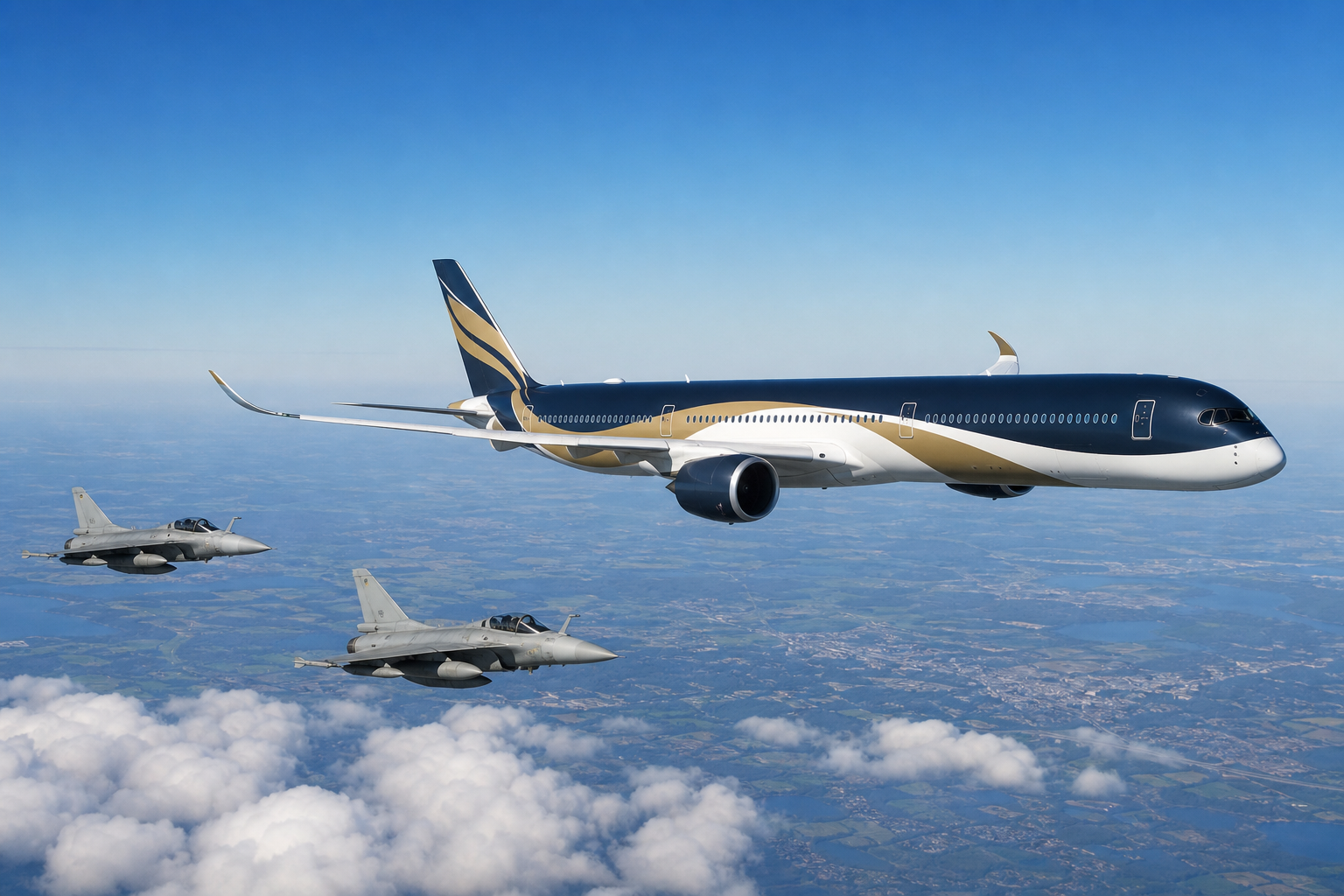
Cathay Pacific A350 Intercepted by NATO Jets After Radio Silence Over Europe
A packed Cathay Pacific plane with as many as 334 passengers on board, which was flying to London Heathrow Airport from Hong Kong, was intercepted by fighter jets as it flew over Hungary after communications between the pilots and Air Traffic Control (ATC) went ‘dark.’ The alarming incident involved Cathay Pacific flight CX-257, which was operated by an eight-year-old Airbus A350-1000. The flight path that Cathay Pacific flight CX-257 took on July 4. The aircraft departed Hong Kong at around 8:40 am on July 4 for the long-haul 13-hour and 40-minute flight to London, which involves the pilots having to weave a path around Russia in order to finally reach Europe and then the United Kingdom. As the plane flew through Romanian airspace at an altitude of 38,000 feet, Air Traffic Controllers were unable to make contact with the pilots over the established radio frequency. ATC continued to try to get through the plane, but without any luck. The aircraft continued flying towards London, crossing the border into Hungary, without checking with the Air Traffic Controller covering airspace over the country. At this point, a potential security alert was declared, and NATO fighter jets were scrambled to intercept the aircraft. The fighter jets reportedly flew close to the Cathay Pacific aircraft, making a “visual warning” towards the plane. At this point, the pilots made contact with ATC and confirmed that nothing was amiss. Having reestablished communications, the fighter jets were stood down, and the plane was allowed to continue its journey to London Heathrow. You might think that would be the end of the matter, but the question remains: Why did communications go dark in the first place? Hong Kong’s Civil Aviation Department, for one, sure wants to know what went so wrong, saying in a press release that it had instructed Cathay Pacific to “follow up seriously and submit an investigation report within one week. Cathay Pacific has said that it is carrying out a “comprehensive review as instructed, including meeting with relevant crew members.” One line of inquiry is that there was a possible malfunction with the radio system, although the fact that communications were reestablished within moments of the fighter jets making their presence known makes this theory less likely. Aviation regulators are also looking into the possibility that the pilots set the radio to the wrong frequency by mistake, while some commentators have pondered whether the two pilots in the cockpit at the time of the incident may have fallen asleep. It’s certainly a possibility on an ultra-long-haul flight such as this, although mitigating measures are taken to avoid this type of incident. Cathay Pacific crews its Hong Kong to Europe flights with at least four pilots, two of whom are resting at any one time. In addition, if the two on-duty pilots start to feel the effects of fatigue, they can make use of what is known as ‘controlled rest,’ in which one pilot takes a short nap in their cockpit seat, while the other remains alert and monitors the flight. Controlled rest rules vary slightly around the world, but in Europe, the period of controlled rest is limited to 45 minutes, plus a 20-minute recovery period. The whole point of limiting the rest period is two-fold: Prevent the pilot from falling into a deep sleep that would prevent them from recovering quickly in the event of something going wrong. Limit the amount of time that the monitoring pilot might accidentally nod off, leaving both pilots asleep at the controls. The European Aviation Safety Agency (EASA) has found that controlled rest can "significantly increase the levels of alertness [of pilots] during the later phases of flight, particularly after the top of descent." In other words, pilots are far less likely to suffer severe tiredness during landing when it's crucial that they are on top form. Bizarrely, however, in the United States, the Federal Aviation Administration (FAA) has never approved the use of controlled rest as a fatigue management strategy, instead preferring to rely on other methods like scheduling rules and augmented crew on longer flights that allow for the use of proper in-flight rest. Cathay Pacific has not commented on these rumors and has maintained that the aircraft “adhered to its authorised routing throughout the journey.” In 2022, both pilots of an Ethiopian Airlines flight from Khartoum in Sudan to Addis Ababa reportedly fell asleep at the controls and only woke up when the Boeing 737 they were flying overshot their destination , triggering an alarm in the cockpit that woke them up. As the 12-year-old aircraft passed high above the runway at Addis Ababa International Airport that it was meant to land on, the autopilot disconnected, and a wailing alarm activated in the flight deck.