

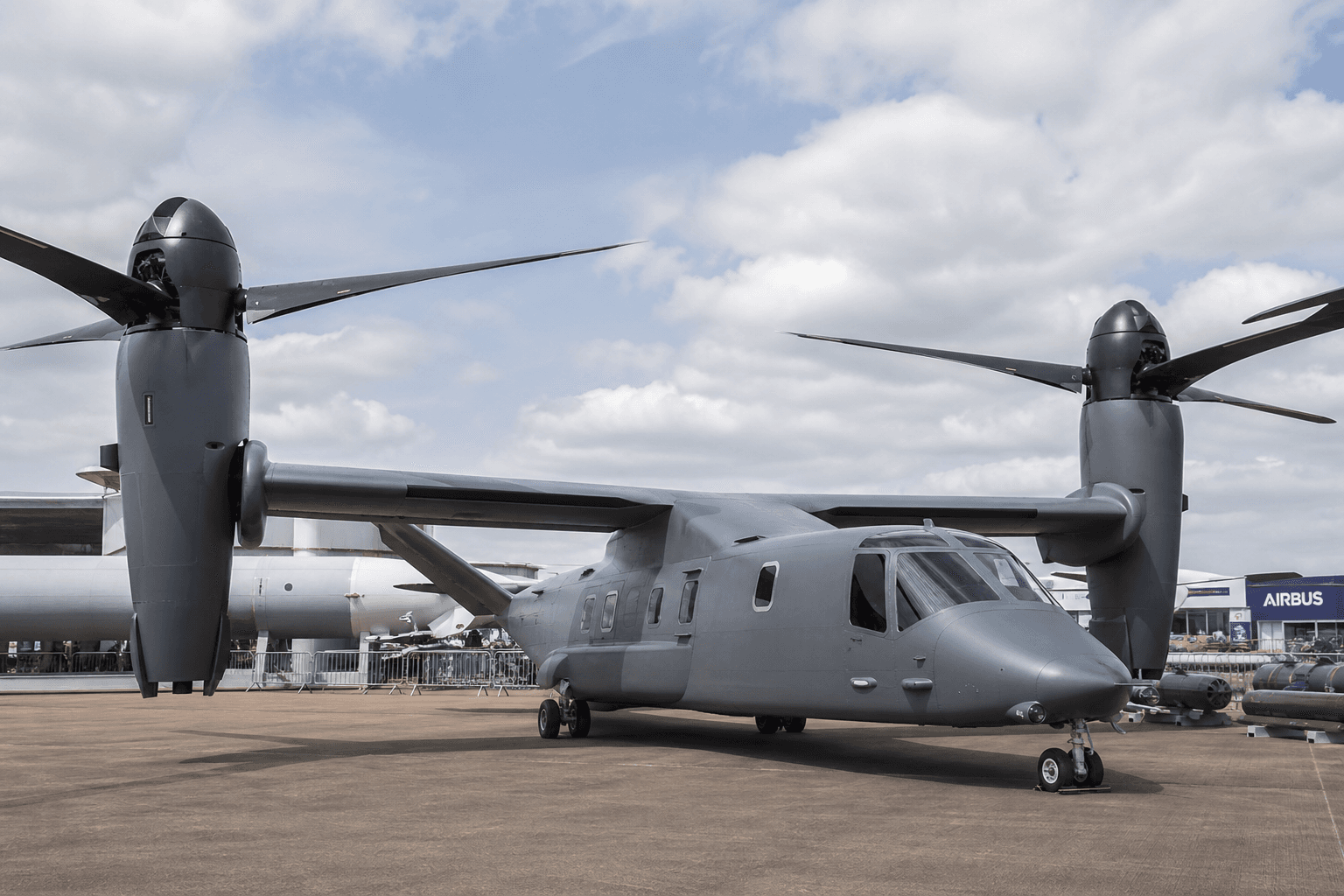
Archer unveils Halo, an autonomous hybrid tiltrotor for commercial and parapublic markets
The new uncrewed tiltrotor will target commercial cargo and parapublic customers as a complement to the Midnight passenger aircraft. Electric aircraft developer Archer Aviation has unveiled a new concept for an uncrewed tiltrotor aimed at commercial cargo and parapublic operators. Revealed at the 2026 Farnborough air show, the Halo is a complement to the Thunder armed tiltrotor announced earlier at the Farnborough show by Archer and US defence start-up Anduril Industries. Both rotorcraft will use a common design, structure and drivetrain, all of which will be assembled by Archer. Airframes destined to become Thunder variants will be turned over to Anduril for militarisation, while Archer will handle Halo production entirely in-house. California-based Archer is best known for its developmental Midnight design – a multi-rotor, fully electric vertical take-off and landing (eVTOL) passenger craft that is still in the certification process. Corporate leaders in the eVTOL sector, including Archer, are on the hunt for alternative lines of business to the urban air mobility passenger market, which has been slow to develop. Defence was an early target, but it turned out that militaries had limited use for all-electric aircraft. Enter the pivot to hybrid-electric. “The feedback was there really isn’t a mission for a battery-electric e VTOL that solves a defence problem today,” says Archer’s chief technology officer, Tom Muniz. “I f we could solve some of the sort of range limitations that come with battery electric, there are some really interesting things that we could do.” Other eVTOL competitors, including Beta Technologies and Joby Aviation, have similarly unveiled hybrid-electric derivatives of their original battery-powered designs, partnering with established defence players to court military business. In Archer’s case, Muniz says the company was approached by Anduril to partner on a hybrid VTOL “t o address a very specific defence requirement set”. That co-development agreement generated both the Thunder and Halo. Although the Halo design will be commercially focused like Midnight, Muniz says that’s where the similarities end. “While Midnight [moves] people in and around cities or congested areas, with a pilot on board, t his new aircraft is autonomous, has a hybrid powertrain for very long range and substantially more payload and speed,” Muniz says. Concept renderings show a large fuselage with a roughly similar outer mould shape to the Bell-Boeing V-22 or Bell MV-75 tiltrotors. The Halo will use two wing-mounted nacelle assemblies that pivot up and down for transition between vertical and horizontal flight. However, the design will be far simpler than a conventional tiltrotor, owing to the use of electric motors rather than conventional turboshaft-powered rotors. “If you think about a vehicle like the V-22, there’s multiple gearboxes and power transmission shafts,” Muniz says. “For the Halo platform, it’s replaced by wires because it’s electric.” An onboard turboshaft engine will burn jet fuel, but that engine will be used to charge the electric drivetrain’s batteries, rather than directly powering the rotors. While commercial operations for Halo remain far off, initial flight testing will begin in the near future. Muniz says the design unveiled at Farnborough was finalised about a year ago, with prototyping now underway. “We’re now in the process of building the first flight articles for Halo,” he says. “ We’ll be in flight test next year.” The company sees support to offshore oil and gas operators, organ transplant flights, air cargo, medevac rescue flights, and search and rescue all as possible use cases for the hybrid tiltrotor.