

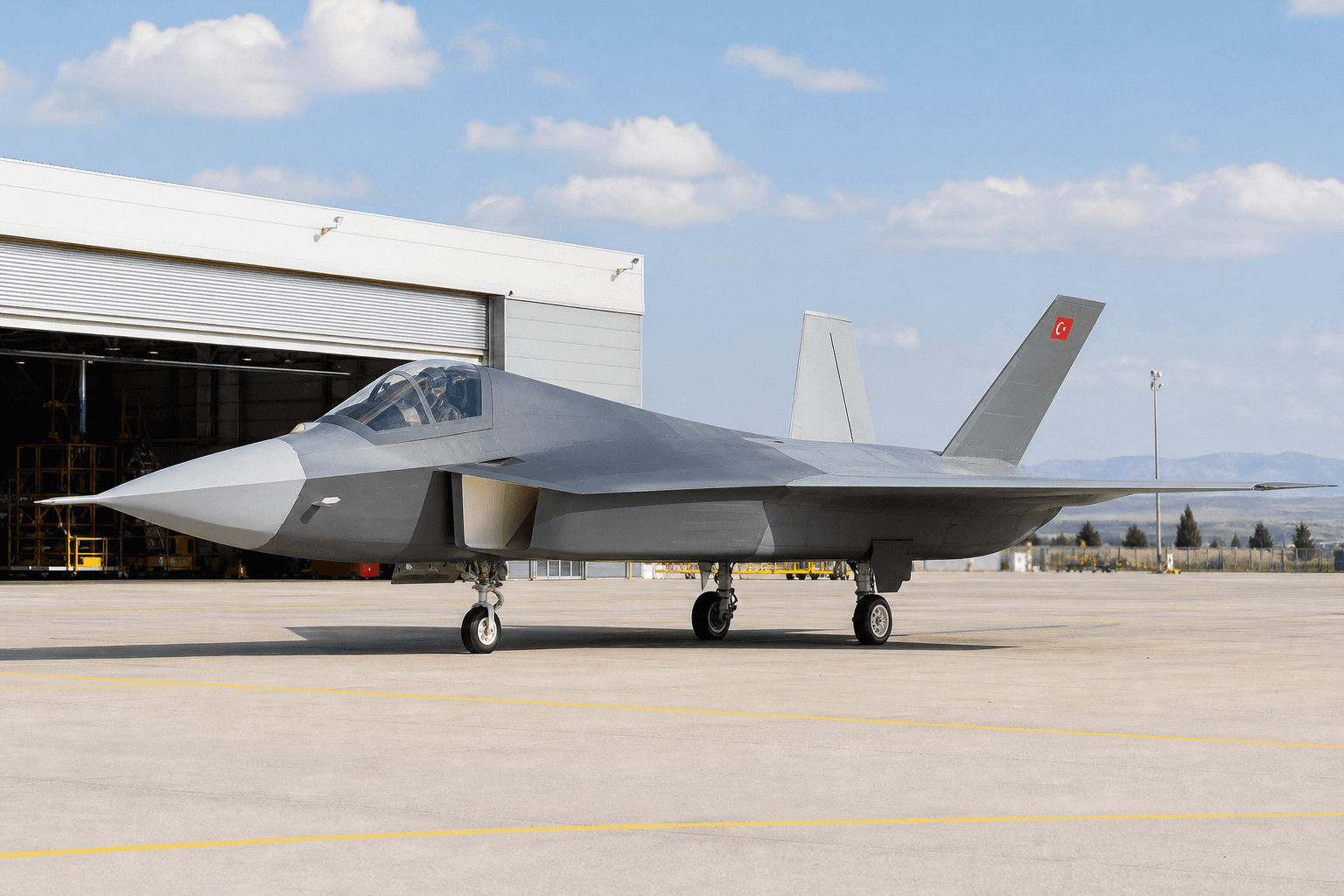
Turkish Aerospace confident Kaan fighter prototypes will fly by end 2026 with US-engine deliveries approved
Turkey’s ambitious Kaan fighter is set to enter a new phase of testing, with export approval for US-made F110 engines apparently in hand. The Turkish Aerospace (TAI) Kaan fighter programme is on track to meet its delivery schedule, with test flights of two prototypes before the end of 2026. Both the P1 and P2 prototype aircraft will be airborne before the end of year, says Mehmet Demiroglu, chief executive of Turkish Aerospace. He indicates that ground tests have already started with the aircraft. "We are waiting for a number of tests to be completed," says Demiroglu. "We are hoping that it's going to be in a couple of months that we will see [the first Kaan prototype] flying. On the second one, our goal is to also fly by the end of the year. Two Kaans will be flying by the end of year…that's our goal, and let's hope that's the case." Demiroglu spoke to FlightGlobal at the 2026 Farnborough air show. The P1 and P2 prototypes will kick testing into full gear. A demonstrator aircraft already flew in February 2024. The Kaan is powered by a pair of GE Aerospace F110 engines, but deliveries of 80 additional engines were held up owing to US sanctions related to Ankara’s earlier procurement of a Russian S-400 air defence system. TAI already had possession of 10 engines for use on Kaan prototypes prior to the restrictions. Demiroglu confirms that the US Congress has approved the export licence for the engines, and the company is now working with GE to secure the powerplants. The Trump administration recently approved Turkey's acquisition of "dozens" of F110 engines for use on the Kaan, although some congressional lawmakers have questioned the arrangement. Deliveries had been held up owing to US CAATSA (Countering America's Adversaries Through Sanctions) legislation. The CAATSA action was triggered in 2019 by the S-400 purchase, a decision that also saw Ankara booted from the Lockheed Martin F-35 programme. "Since these engines are for serial production, which is at least two, two and half years away, we will have no issue receiving those engines in time to support our serial production for the Turkish air force," says Demiroglu. He adds that the first Kaan delivery should be on track for 2028, although he concedes that the Kaan is a "challenging programme”. A specific delivery timeline for the F110 engines remains murky. A senior member of the Foreign Relations Committee in the US House of Representatives says the turbofans will "not be delivered for years". Initial Block 10 and Block 20 Kaan jets will use the F110 engine, but subsequent Block 30/40 examples will use the locally made Tusas TF35000 engine from 2032. Demiroglu also confirmed that industrial collaboration is also underway with Indonesia, which has orders for 48 Kaan fighters . While this may not lead to a Kaan assembly line in the Southeast Asian country, Indonesia's aerospace sector will be part of the aircraft's supply chain and will also support other TAI programmes. TAI is in discussion with Jakarta about offsets related to the Kaan order. It has 60 people working in Indonesia, with this number set to grow. "Kaan is the future of the Turkish air force," he adds. "It is a programme that will continue for the next 20 to 30 years."