

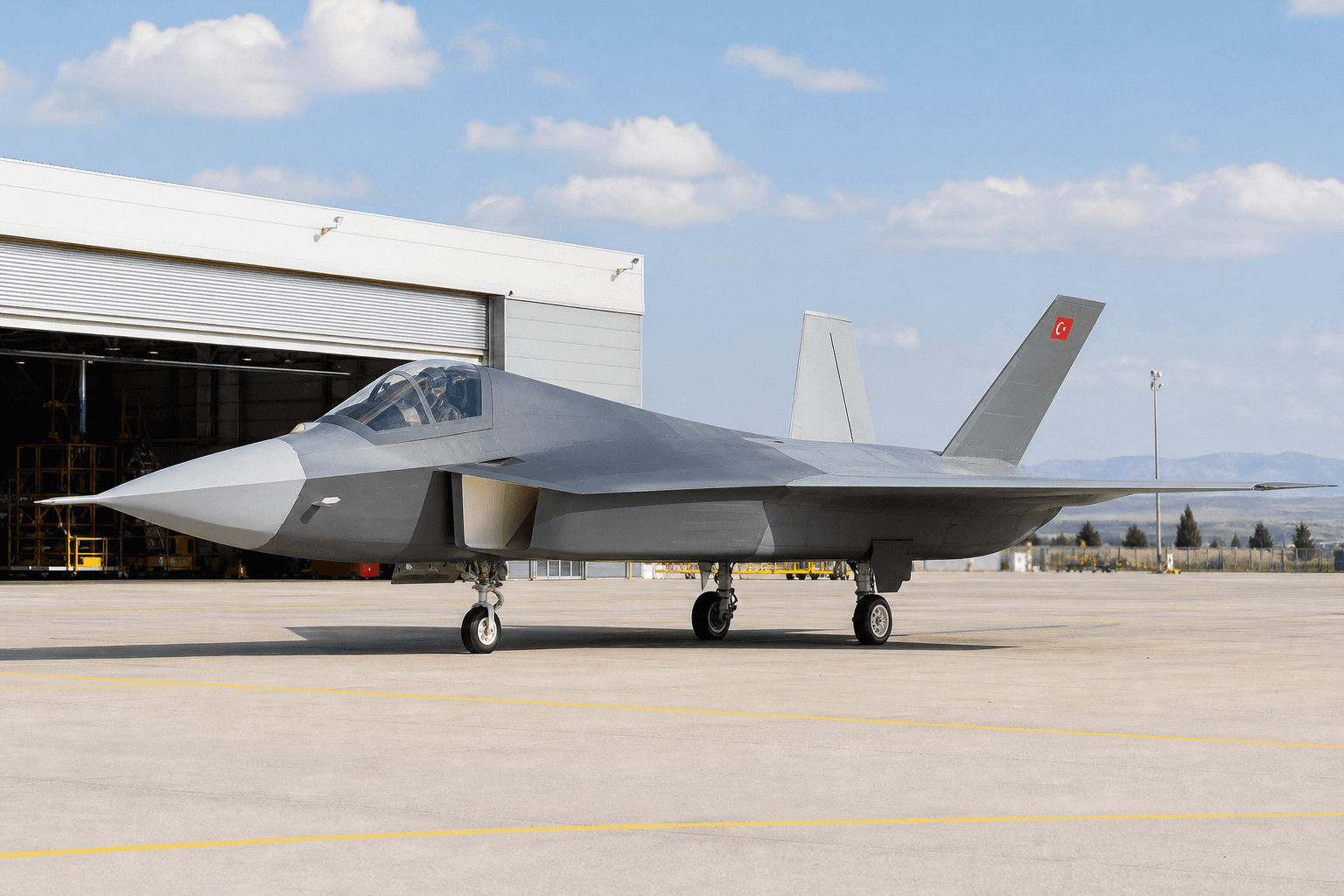
Illustration: The Touch & Go
Turkish Aerospace confident Kaan fighter prototypes will fly by end 2026 with US-engine deliveries approved
Turkish Aerospace's Kaan fighter program targets prototype flights before year-end after export approval of GE F110 engines amid ongoing US sanctions challenges.
The gist
Turkish Aerospace aims to fly two Kaan fighter prototypes by end-2026 as US clears export of critical F110 engines.
Continuing coverage
All Defense Cooperation →Turkish Aerospace Industries (TAI) is advancing its Kaan fighter jet development with a firm target to fly its two prototypes, P1 and P2, by the end of 2026. Company CEO Mehmet Demiroglu stated these test flights are imminent, with initial ground tests already underway. He expressed optimism that the first prototype will take to the skies within a couple of months, followed by the second before year’s end, marking a significant milestone in the ambitious indigenous fighter program.
The Kaan fighter project is notable for employing two General Electric F110 turbofan engines per aircraft. However, deliveries of 80 additional F110 engines faced delays due to U.S. sanctions connected to Turkey’s earlier procurement of the Russian S-400 air defense system. TAI retained 10 engines for prototype testing, but the broader serial production engines were held back. Recent developments bring relief as the U.S. Congress authorized export licenses for the engines, allowing TAI to collaborate with GE Aerospace to secure the necessary powerplants for the next production stages.
These sanctions stemmed from the 2019 acquisition of the S-400 system, which also led to Turkey’s removal from the F-35 fighter program, creating lasting complications for its domestic fighter ambitions. Despite some congressional opposition and statements cautioning that engine deliveries remain years away, Demiroglu reassured that timelines for engine receipt align with the two- to two-and-a-half-year horizon before full serial production initiation. This timing is critical to ensuring initial Kaan units meet planned delivery schedules to the Turkish Air Force.
The Kaan program envisages initial operational versions, Block 10 and Block 20, powered by the licensed GE F110 engines. Future iterations, namely Block 30/40 jets anticipated from 2032 onwards, will transition to a domestically developed engine, the TUSAŞ TF35000, marking a strategic move towards more extensive local production and technological sovereignty. This staged approach integrates foreign technology while gradually increasing indigenous capability in fighter engine manufacturing.
International collaboration forms another important facet of the Kaan program. TAI has expanded industrial cooperation with Indonesia, where a contract for 48 Kaan fighters has been secured. While Indonesia will not host an assembly line, its aerospace sector will integrate into the supply chain and provide support to other TAI initiatives. Approximately 60 personnel are currently deployed in Indonesia, with plans to increase this workforce as offset agreements and local industrial participation deepen.
TAI’s CEO underscores the Kaan as the backbone of Turkey’s future air combat power, projecting a program lifespan extending two to three decades. This long-term perspective aligns with Turkey’s strategic imperative to reduce reliance on foreign vendors for key military technologies and to nurture its domestic aerospace industry through sustained investment and export partnerships.
The first demonstrator Kaan flew in February 2024, marking the start of flight testing efforts. The progression to flying two near-production prototypes by the end of 2026 signifies an accelerated timetable intended to keep the ambitious project on schedule despite earlier sanctions and supply chain setbacks. Managing this complex development within Turkey’s defense-industrial framework underscores both strategic ambition and pragmatic adjustments to international political realities.
The path ahead will require careful coordination of engine deliveries, assembling industrial partnerships, and continuing development of the TF35000 engine for future production blocks. While recent export license approvals have cleared a significant hurdle, some uncertainty remains about the exact timeline for comprehensive engine deliveries. Nonetheless, TAI’s leadership remains confident the program will proceed on track with first deliveries targeted for 2028, meeting operational needs of the Turkish Air Force as planned.
Frequently asked questions
- When are the Kaan fighter prototypes expected to fly?
- Turkish Aerospace aims to have the two Kaan prototypes, P1 and P2, complete test flights and airborne by the end of 2026.
- What engine powers the Kaan fighter and are there delivery issues?
- The Kaan uses two GE Aerospace F110 engines; US export licenses were delayed by sanctions but have now been approved, allowing engine deliveries to proceed on time for serial production.
- What is the plan for future Kaan fighter engine variants?
- Initial Block 10 and Block 20 Kaans will use GE F110 engines, while later versions from 2032 will switch to a domestically made Turkish TF35000 engine.
Read more
All Military/Defense →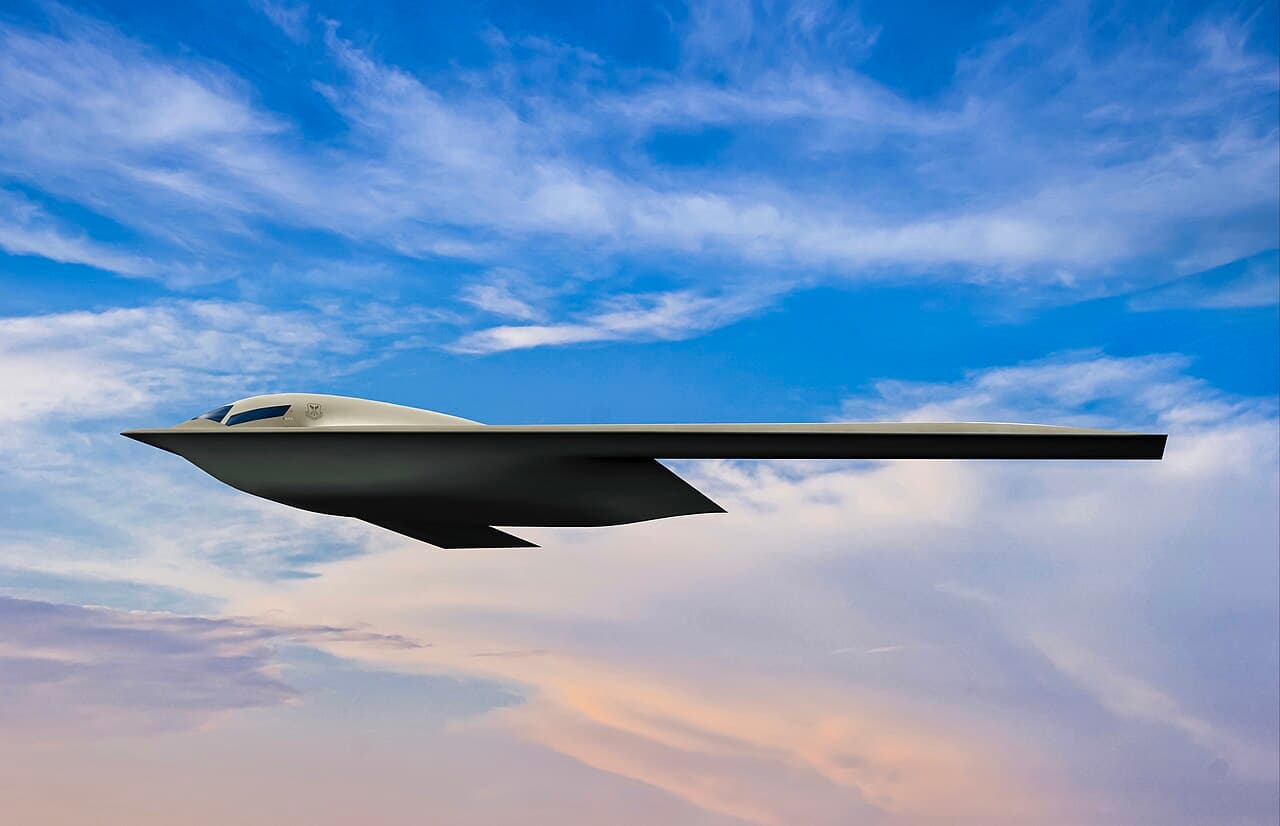
USAF to Convert B-21 Raider Test Jets Directly into Combat Bombers from 2027
The United States Air Force has a couple of test Northrop Grumman B-21 Raiders that are blurring the line between testing and fielding. The B-21 Raider is expected to enter service in 2027, making it the world's first all-new strategic bomber to enter service since the B-2 Spirit entered service in 1997. China is also working to develop its Xi'an H-20 stealthy strategic bomber, but it is unclear when it will enter service.

US Army Warrant Officer Pilots Differ in Pay and Roles from Commissioned Officers
In the armed forces of the United States of America, there are many different jobs and ranks assigned to aviation missions. In fact, all four service branches have their own pilot corps, including the Army and the Coast Guard. While the US Air Force, Navy, and Marines are better known for their fixed-wing tactical aviation, including many fighter jets, the Army has an enormous number of helicopters.
France and Germany pivot defense strategy after joint fighter jet project collapse
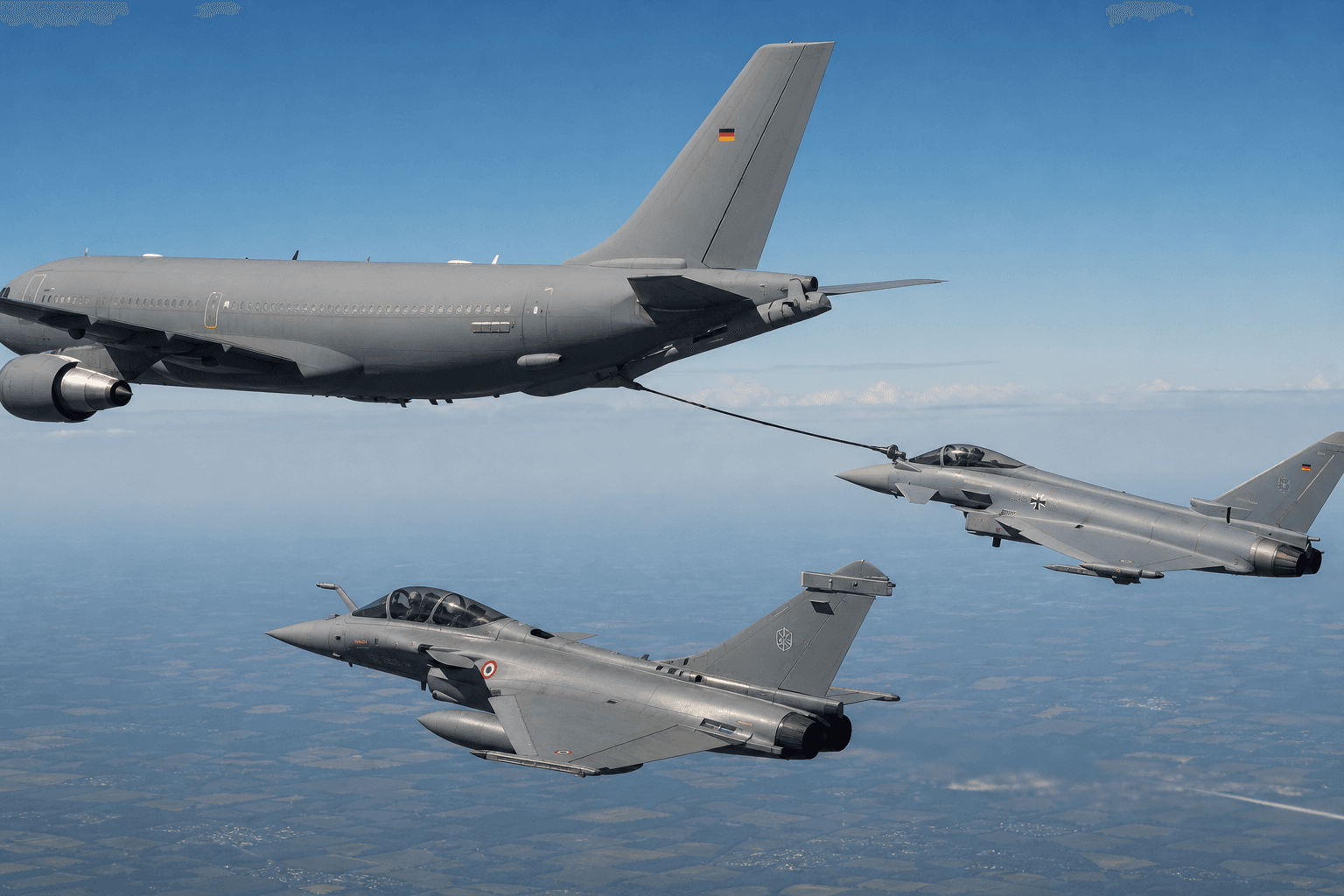
France and Germany have formally shifted their defense relationship away from the wreckage of a failed joint fighter jet program. President Emmanuel Macron and Chancellor Friedrich Merz met near Cologne on July 17, 2026, to move toward new areas of cooperation, including nuclear deterrence. Macron and Merz then chaired the annual Franco-German government consultations at Augustusburg Castle in Bruehl, a site specifically chosen for its history: French President Charles de Gaulle and German Chancellor Konrad Adenauer laid the groundwork for a Franco-German friendship treaty there in 1962. En Allemagne, le Conseil des ministres franco-allemand que nous co-présidons aujourd'hui avec le Chancelier Friedrich Merz doit nous permettre de renforcer notre compétitivité, notre sécurité et notre défense et la résilience de nos démocraties. Le réflexe franco-allemand… https://t.co/9utgniu3Ni — Emmanuel Macron (@EmmanuelMacron) July 17, 2026 A show of force at Noervenich Alongside the government consultations, the two countries will hold a Franco-German Defense and Security Council meeting at the Noervenich Luftwaffe air base, underscoring the push for European rearmament amid concerns over Russia and a less reliable American security commitment. On July 16, 2026, two French Rafale jets, capable of carrying nuclear weapons, were deployed to Noervenich, while a German Eurofighter was refueled mid-air by a French aircraft, a Luftwaffe spokesman told AFP. The French presidency says the goal for the July 17, 2026 talks is to move past symbolism and advance "concrete" projects, an explicit attempt to recover from the collapse of the Future Combat Air System (FCAS), the countries' joint sixth-generation fighter jet program, which ran aground in June 2026. How the fighter jet program began FCAS was launched in 2017 by Macron and then-German Chancellor Angela Merkel. Positioned as Europe's flagship sixth-generation combat air program, it came with an estimated price tag of roughly €100 billion. The project centered on a manned New Generation Fighter, paired with a 'combat cloud' architecture meant to link aircraft, drones and satellites into a single digital system. In October 2019, the two governments met in Toulouse to resolve early friction over how the work would be divided and succeeded in producing an arms export agreement covering jointly developed weapons. Under the deal, one country would automatically approve arms sales if its share of the selling price fell below a threshold rumored at around 20%. Both governments called it proof of mutual trust, a condition for the success of FCAS and the parallel Main Ground Combat System tank program. Where it fell apart The industrial workshare dispute between Airbus, representing Germany and Spain, and France's Dassault, proved to be the program's fatal obstacle. Tensions became public in February 2026, when Merz questioned openly whether a single aircraft platform could meet both countries' requirements, since France needed a nuclear-capable, carrier-compatible jet, whereas Germany did not. A mediation effort launched after a Macron-Merz dinner in Brussels on March 18, 2026, collapsed a month later, after the mediator concluded that a jointly-built crewed fighter was no longer realistic. At an informal EU summit in Cyprus on April 23, 2026, Macron and Merz sent the decision back to their defense ministries, with Macron insisting two days later that the program was "not at all" dead. The core issue never changed. Dassault's Eric Trappier repeatedly demanded the lead role, rejecting equal footing with Airbus, and a reported personal appeal from Merz failed to change his position. Germany's new national aviation strategy, adopted by cabinet on June 10, 2026 and unveiled at the ILA Berlin air show, states that Airbus must co-lead any future German combat aircraft program. Spain, the program's third partner, had already hedged by funding an Airbus-Indra study into its own combat air system. Belgium, an observer since 2024, went further. After Merz's February remarks, Defense Minister Theo Francken declared the program dead, and Brussels announced plans to buy 11 additional F-35A jets instead. Two countries, two fighter jets With the joint fighter program dead, France and Germany are now pursuing separate sixth-generation aircraft. Dassault will develop France's jet independently, backed in part by more than €4 billion allocated to the Rafale F5 standard. Airbus is to lead Germany's program, with Spain expected to remain involved. The company has also opened talks with Sweden's Saab, seen in Berlin as a more cooperative partner. Both programs are expected to produce aircraft during the early 2040s. Despite the split, the two countries plan to keep developing the combat cloud architecture that formed FCAS's other core pillar, with responsibilities for that piece expected to come up for discussion at the July 17, 2026 council. RELATED Germany, France abandon joint FCAS fighter after industry deadlock
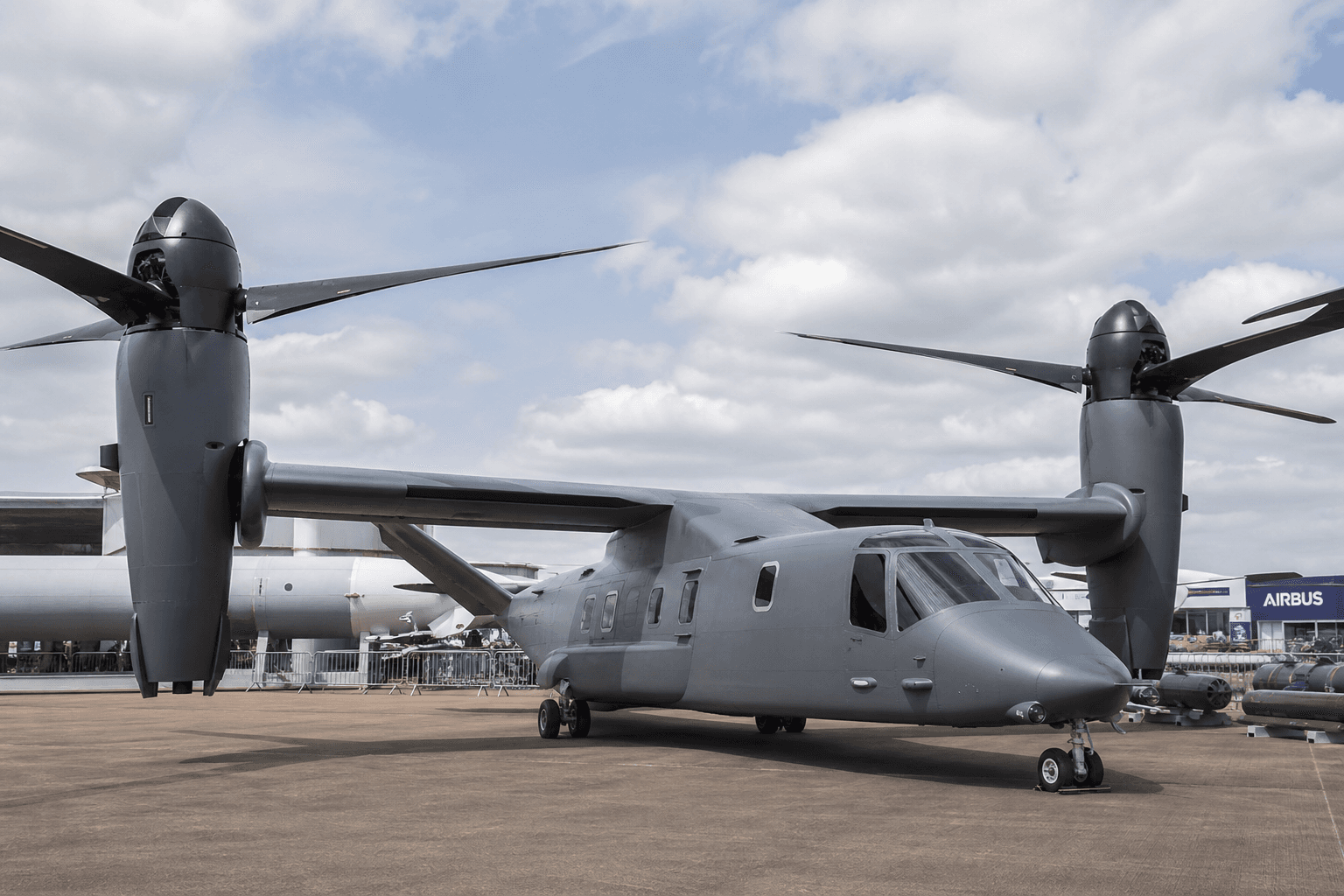
Archer unveils Halo, an autonomous hybrid tiltrotor for commercial and parapublic markets
The new uncrewed tiltrotor will target commercial cargo and parapublic customers as a complement to the Midnight passenger aircraft. Electric aircraft developer Archer Aviation has unveiled a new concept for an uncrewed tiltrotor aimed at commercial cargo and parapublic operators. Revealed at the 2026 Farnborough air show, the Halo is a complement to the Thunder armed tiltrotor announced earlier at the Farnborough show by Archer and US defence start-up Anduril Industries. Both rotorcraft will use a common design, structure and drivetrain, all of which will be assembled by Archer. Airframes destined to become Thunder variants will be turned over to Anduril for militarisation, while Archer will handle Halo production entirely in-house. California-based Archer is best known for its developmental Midnight design – a multi-rotor, fully electric vertical take-off and landing (eVTOL) passenger craft that is still in the certification process. Corporate leaders in the eVTOL sector, including Archer, are on the hunt for alternative lines of business to the urban air mobility passenger market, which has been slow to develop. Defence was an early target, but it turned out that militaries had limited use for all-electric aircraft. Enter the pivot to hybrid-electric. “The feedback was there really isn’t a mission for a battery-electric e VTOL that solves a defence problem today,” says Archer’s chief technology officer, Tom Muniz. “I f we could solve some of the sort of range limitations that come with battery electric, there are some really interesting things that we could do.” Other eVTOL competitors, including Beta Technologies and Joby Aviation, have similarly unveiled hybrid-electric derivatives of their original battery-powered designs, partnering with established defence players to court military business. In Archer’s case, Muniz says the company was approached by Anduril to partner on a hybrid VTOL “t o address a very specific defence requirement set”. That co-development agreement generated both the Thunder and Halo. Although the Halo design will be commercially focused like Midnight, Muniz says that’s where the similarities end. “While Midnight [moves] people in and around cities or congested areas, with a pilot on board, t his new aircraft is autonomous, has a hybrid powertrain for very long range and substantially more payload and speed,” Muniz says. Concept renderings show a large fuselage with a roughly similar outer mould shape to the Bell-Boeing V-22 or Bell MV-75 tiltrotors. The Halo will use two wing-mounted nacelle assemblies that pivot up and down for transition between vertical and horizontal flight. However, the design will be far simpler than a conventional tiltrotor, owing to the use of electric motors rather than conventional turboshaft-powered rotors. “If you think about a vehicle like the V-22, there’s multiple gearboxes and power transmission shafts,” Muniz says. “For the Halo platform, it’s replaced by wires because it’s electric.” An onboard turboshaft engine will burn jet fuel, but that engine will be used to charge the electric drivetrain’s batteries, rather than directly powering the rotors. While commercial operations for Halo remain far off, initial flight testing will begin in the near future. Muniz says the design unveiled at Farnborough was finalised about a year ago, with prototyping now underway. “We’re now in the process of building the first flight articles for Halo,” he says. “ We’ll be in flight test next year.” The company sees support to offshore oil and gas operators, organ transplant flights, air cargo, medevac rescue flights, and search and rescue all as possible use cases for the hybrid tiltrotor.
The Daily Touch & Go
The day's best aviation news in your inbox. Free, no spam.