

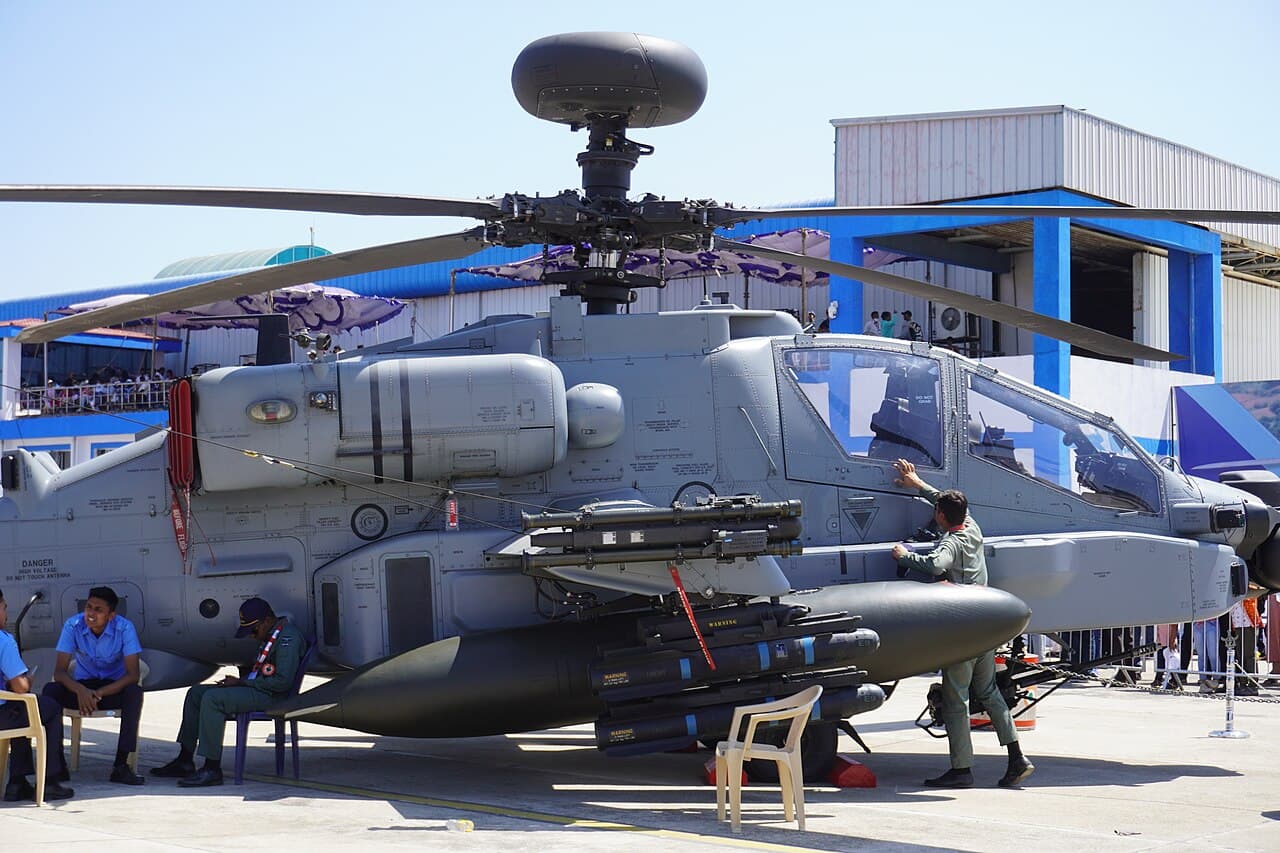
Boeing Eyes AESA Radar to Boost Apache Attack Helicopter Against Drone Threats
More capable sensor would boost detection of airborne threats. Boeing is advancing further enhancements for its AH-64E Apache to boost the platform's ability to engage non-traditional threats such as one-way attack drones. The US Army has used the attack helicopter to "great effect" in the counter-drone application recently in the Middle East, including in the Strait of Hormuz , says TJ Jamison, Boeing's director of business development for attack helicopter programmes. That has included using a new air-to-air mode with its Longbow fire-control radar to "help locate enemy drones coming in and engage and destroy them". "Adapting to change is nothing new for the Apache – it has been doing it since its inception," he notes. "The next chapter is we take lessons learned from Ukraine [and] the ongoing conflict with Iran… as we continue to modernise and adapt this aircraft to meet the changing face of warfare." He refers to a US Army trial conducted last year named Operation Flyswatter, during which the service "flew 14 small-, medium- and large-scale drones at two Apaches". The rotorcraft shot down 13 of the targets, with the remaining one having accidentally flown off the exercise area, ruling it out from being engaged. Among enhancements now being made to the type include the use of a new proximity fuze on the 30mm shells fired from its chin-mounted cannon, so that a direct hit is no longer required to bring down a drone. Meanwhile, the Apache's V6.5 software standard, which Jamison says is "in the process of finalising its certification and testing, and will be fielded soon… [with] increased range, lethality and survivability", uses an open system architecture, enabling rapid updates. "The goal is to get it as simple as a download on your iPhone," he says, while adding: "We're not quite there yet." Another option being explored by the US Army would involve the integration of a fuselage-mounted active electronically scanned array (AESA) radar. "Now you can see the next generation of drones – the very small, swarm type – all organic to the aircraft," Jamison says of the possible addition. "There are a number of OEMs that have an AESA capability currently that we are looking at for potential integration into Apache as we continue down that army modernisation path," he says. However, the service has made no decision yet about funding any such update. Noting that the Apache's original Longbow radar detection capability gave "an 8km [4.3nm] range", necessitating the sensor to be installed on top of the rotor mast, he says: "As you get out to the 50, 60, 70km range, hiding it behind a hill or a tree or a building is not quite as critical as it was when we had that shorter range." Boeing also sees an opportunity to potentially use directed energy, microwave or electronic warfare capabilities to counter the drone threat in the future.
