

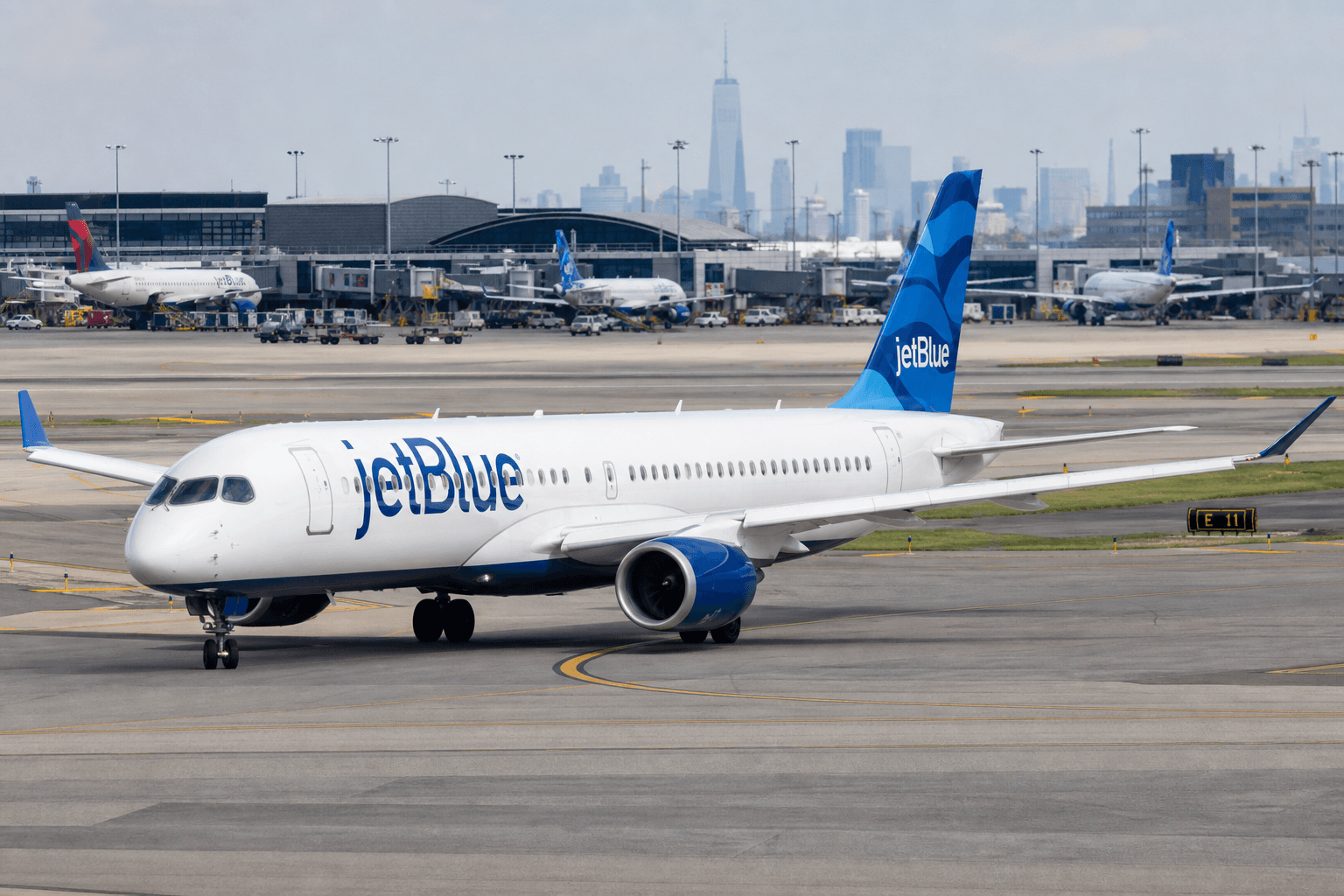
Illustration: The Touch & Go
JetBlue Flies Longest Airbus A220 Routes Up to 6.5 Hours, Deploying Smaller Jets Strategically
JetBlue operates Airbus A220-300 aircraft on nonstop flights approaching seven hours, leveraging the type's range to serve long routes with lower capacity demand.
The gist
JetBlue uses Airbus A220-300 jets for some of its longest nonstop flights, including NYC to Reno, maximizing operational flexibility with smaller jets.
JetBlue Airways operates some of the longest nonstop flights using its Airbus A220-300 fleet, with block times nearing seven hours. The carrier’s longest A220 deployment in 2026 is from New York JFK to Reno International Airport, clocked at over 6.5 hours on schedule. This illustrates how modern narrowbody aircraft can now fulfill longer routes historically served by larger jets, thanks to advances in aircraft design and technology.
JetBlue exclusively utilizes narrowbody aircraft on its routes, mainly Airbus A220-300s alongside the Airbus A320 family. The A220-300 is the larger variant of the type and provides the airline with the range and flexibility to serve transcontinental and transatlantic routes that stretch well beyond typical narrowbody flight durations. Cirium data reveal multiple JetBlue A220 flights exceed six-hour block times in 2026, highlighting the operator’s strategic use of this aircraft type on longer haul services.
While competing airlines often deploy larger narrowbodies like the Airbus A321 or Boeing 737 MAX on similar routes, JetBlue opts to use the smaller A220 on several services. For example, on the Boston-Portland corridor, JetBlue operates both A321 and A220 aircraft, with the A220 complementing the larger jet by providing capacity right-sizing for demand variability. This approach allows JetBlue to optimize yield and operational efficiency by matching capacity to passenger demand more precisely.
The Airbus A220 originally evolved from Bombardier’s C-Series program before Airbus acquired it. Positioned effectively between regional jets and mainline narrowbodies, the A220 blends range capability with lower seating availability. Manufacturer figures show the A220-300 has a maximum seating capacity of 160 and a range of 3,400 nautical miles, comparable with or exceeding some larger narrowbodies such as the Boeing 737 MAX 9 and Airbus A321 variants in certain metrics.
Compared side-by-side, the A220-300 can operate virtually any route the A320neo can, though with fewer seats. It surpasses the range of newer Boeing MAX 9 and MAX 10 models, which have reduced range compared to earlier variants. Notably, the smaller A220-100 model offers an even longer range (3,600 nm) and a seating capacity around 135 passengers, which gives operators further flexibility in matching aircraft to route profiles and passenger numbers.
JetBlue configures its A220-300 fleet below the certified maximum capacity to enhance operational performance. AeroLOPA data indicate JetBlue seats just 140 passengers on its A220-300, 20 fewer than its certified limit. This reduction offsets weight allowances to accommodate additional passenger amenities such as larger overhead bins, USB and AC power outlets, inflight entertainment, and WiFi, all of which improve the passenger experience on long flights.
The ability of the A220 to maintain long range while carrying fewer passengers allows JetBlue to deploy it strategically as a more efficient option on routes with moderate demand. This capacity flexibility permits JetBlue to substitute larger narrowbodies with the smaller A220 without sacrificing route coverage. On routes like Boston to Portland, the addition of A220 services complements their larger jets, efficiently balancing capacity across their network.
In sum, JetBlue’s use of the Airbus A220-300 on flights exceeding six hours demonstrates the aircraft’s role as a bridge between regional and mainline narrowbodies. By leveraging its range and capacity advantages, JetBlue optimizes its route network with tailored aircraft deployment, maximizing operational efficiency and passenger amenities on longer routes traditionally requiring larger aircraft.
Read more
All Airlines →
SAS CEO Anko van der Werff to lead Air Canada starting early 2027
Anko van der Werff, Chief Executive Officer (CEO) of Scandinavian Airlines (SAS), has informed the airline's board that he will step down from his current role in early 2027 to become the new CEO of Air Canada. The Dutch executive, who previously held senior executive positions at Avianca, Aeroméxico, Qatar Airways and KLM, took up the top executive role at SAS in 2021, at a time in which the Scandinavian carrier was facing numerous financial and strategic challenges. Van der Werff's tenure at the head of SAS has been deeply transformative for the airline. Over the past five years, he has steered the Scandinavian carrier through a major restructuring , including a change in its capital structure, with Air France-KLM and investment firm Castlelake becoming major shareholders, and SAS switching from Star Alliance, of which it was a founding member, to SkyTeam. On the product side, he also reintroduced the European business class and laid out the groundwork for SAS' future fleet. RELATED SAS' CEO Anko van der Werff on realigning one of Europe's most iconic airlines The announcement comes just days after SAS announced, at a media event in Copenhagen attended by AeroTime, the largest aircraft order in its history: up to 40 widebody jets of the A330 family . Just one year earlier, in July 2025, Van der Werff also signed a deal with Embraer to procure up to 55 E195-E2 jets . At Air Canada, Van der Werff will replace Michael Rousseau, who is expected to retire on August 31, 2026, after nearly two decades with the company. Air Canada confirmed that Rousseau will remain available to the new CEO to assist with the transition, while an Executive Committee reporting to the Board of Directors will take on the executive functions at the airline until Van der Werff's arrival. Rousseau came under fire in March 2026 after expressing condolences for the Air Canada Jazz flight that crashed at LaGuardia Airport (LGA) only in English, in an apparent breach of Canada's bilingualism policy. Official confirmation of the leadership change came up just days after Bloomberg reported that Anko van der Werff was the leading candidate to replace Rousseau at the Canadian flag carrier.
10 Legacy Airliners Approaching Retirement Worth Spotting Now
Aviation is constantly changing. Every year, airlines retire older aircraft and replace them with newer,…

Textron Aviation Helps Fly Over 800 Athletes to 2026 Special Olympics USA Games in Minnesota
Volunteers make it possible for athletes to get to and from the games in St. Paul, Minnesota.
American Airlines Plans for Next Widebody Fleet as 777-200ERs Near Retirement
For more than two decades, the Boeing 777-200ER has been one of the cornerstones of…
The Daily Touch & Go
The day's best aviation news in your inbox. Free, no spam.