

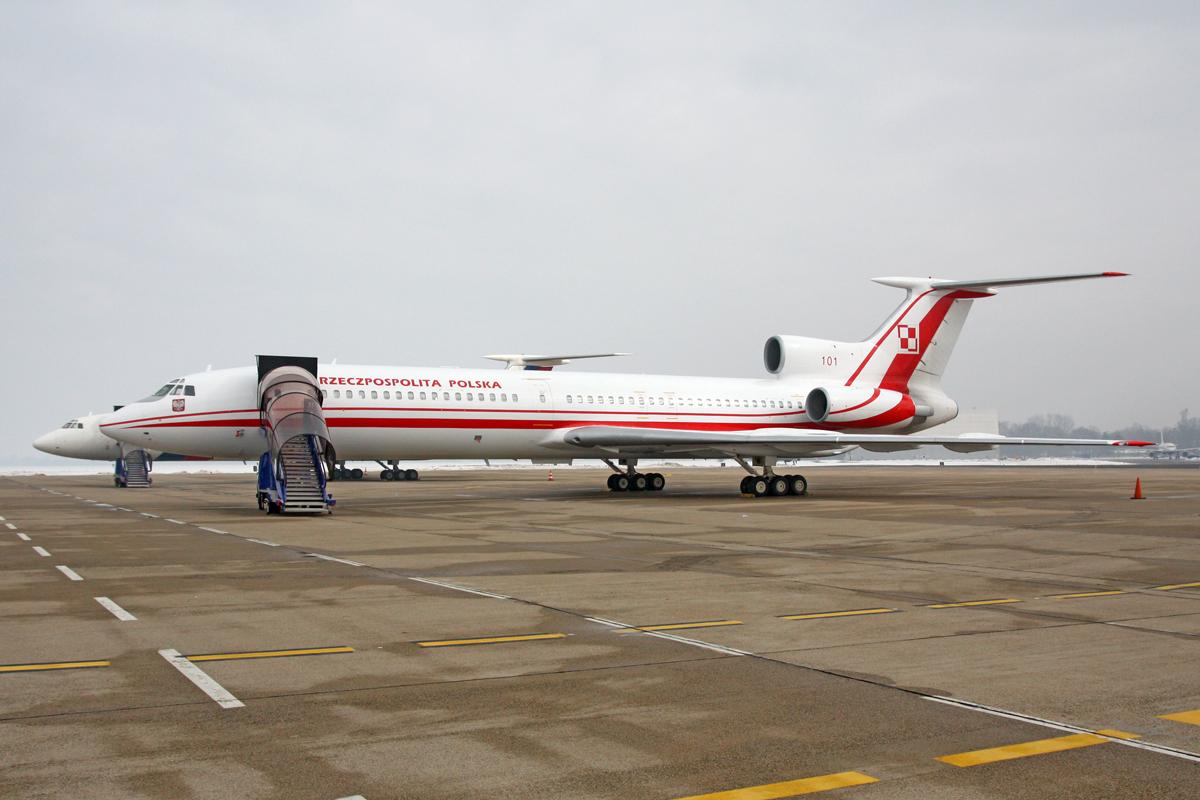
Image: Mulag · CC BY-SA 3.0 · via Wikimedia Commons
Polish Prosecutors' Expert Panel Finds Late Approach and Altimeter Error Doomed Smolensk Tu-154M
An international expert group set up by Poland's National Prosecutor's Office ruled out an explosion or technical fault in the 2010 Smolensk crash and blamed the approach, altitude data and Russian air traffic control.
The gist
Experts for Polish prosecutors say the Smolensk Tu-154M was airworthy and descended too fast on bad altitude data, ruling out an explosion.
Continuing coverage
All Air Traffic Control →- Duffy to Face Senate Panel Over Nov. 13 Nationwide Ground Stop That Canceled 18,000 Flights
- FAA Grants First U.S. Digital Tower System Design Approval to Frequentis
- FAA Makes Permanent Ban on Visual Separation for Helicopters Crossing Busy Terminal Traffic
- FAA Ground Stop and 10-Year-High Fares Push Thanksgiving Travelers From Planes to Cars, Buses and Trains
- Router Swap at Arkansas Radio Site Suspected in Nationwide US Air Traffic Ground Stop
An international panel of experts working for Poland's National Prosecutor's Office has concluded that the Tu-154M that crashed near Smolensk in 2010 was in good working order and under the crew's control until impact. The panel ruled out both a technical malfunction and an explosion as the cause. The findings were made public by Przemysław Nowak, a spokesperson for the Polish Prosecutor General's Office. The crash, on April 10, 2010, near the military airfield in Smolensk, killed all 96 people on board, including then-President Kaczyński and the first lady.
According to Nowak, the experts found that the aircraft began its final approach too late. As a result, it lost altitude faster than it should have. Instead of descending at roughly five meters per second, the Tu-154M was coming down at seven to nine meters per second.
The panel also determined that the crew was working with incorrect information about the aircraft's real height. About a minute before the crash, the settings on one of the altimeters were changed, and the instrument then showed an altitude about 150 meters higher than the actual figure. At the same time, the crew was reading an instrument that measured the distance to the ground directly beneath the aircraft, rather than height relative to the airfield elevation.
The experts identified as a key factor the decision to keep descending below 120 meters even though the pilots could not see the runway. In those weather conditions, they said, the pilot should have abandoned the landing and climbed away. The aircraft's onboard system warned the crew that it was dangerously close to the ground, and the highest-level alarm sounded about 20 seconds before the crash. The decision to abort the landing came too late. Nowak said the experts concluded that a safe landing at Smolensk was impossible under the conditions that day.
The findings also address the Russian air traffic controllers handling the flight. Nowak said the controllers told the crew the aircraft was on the correct course and at the correct altitude, information that was false. They also failed to order the crew to abort the landing, and that instruction was given only in the final second of the flight.
Beyond the cockpit, the panel pointed to problems in the air regiment responsible for organizing the flight, citing insufficient funding, a lack of proper training and a shortage of personnel. The pilots held the required certifications and had the necessary experience, but this was only their second flight together as this crew.
The expert group was created by decision of the National Prosecutor's Office in 2019 and tasked with preparing a report on the circumstances, causes and course of the disaster. Its members came from the United States, Ireland, the United Kingdom and Hungary. The crash has been the subject of conspiracy theories and speculation about its causes and circumstances for many years.
The new report follows an earlier statement from Polish prosecutors about the Russian handling of the victims. In April 2025, the Prosecutor's Office said that reports produced by Russian doctors after autopsies on the victims contained a great deal of false information.
Originally reported by LIGA.net
Read more
All Aviation Safety →
Surface Radar Outage Forces Second Ground Stop in Two Days at Chicago O'Hare During Thanksgiving Rush
The FAA halted some O'Hare-bound flights after a failure of the ASDE-X ground surveillance system, then replaced the stop with a delay program running to midnight on the busiest day of Thanksgiving travel.
Belgian Air Traffic Controllers File New Strike Notice Against skeyes From 9 December
Unions ACV-Transcom and VSOA have served notice of possible action running to 9 January 2027, a day after a nationwide strike forced 404 cancellations at Brussels Airport.
FAA Halts O'Hare Arrivals for Over an Hour as Chicago TRACON Runs Short of Controllers
A staffing shortfall at the radar facility that handles Chicago arrivals triggered a ground stop for O'Hare-bound flights on Monday, at the start of the Thanksgiving travel period.
White House Forms Tiger Team to Head Off Air Traffic Control Outages Before Thanksgiving
A multi-agency group drawn from the FAA, Transportation, Defense and the intelligence community has met daily since a five-hour nationwide ground stop halted US flights.
The Daily Touch & Go
Launching soon: the day's best aviation news in your inbox. Join the list, free.