

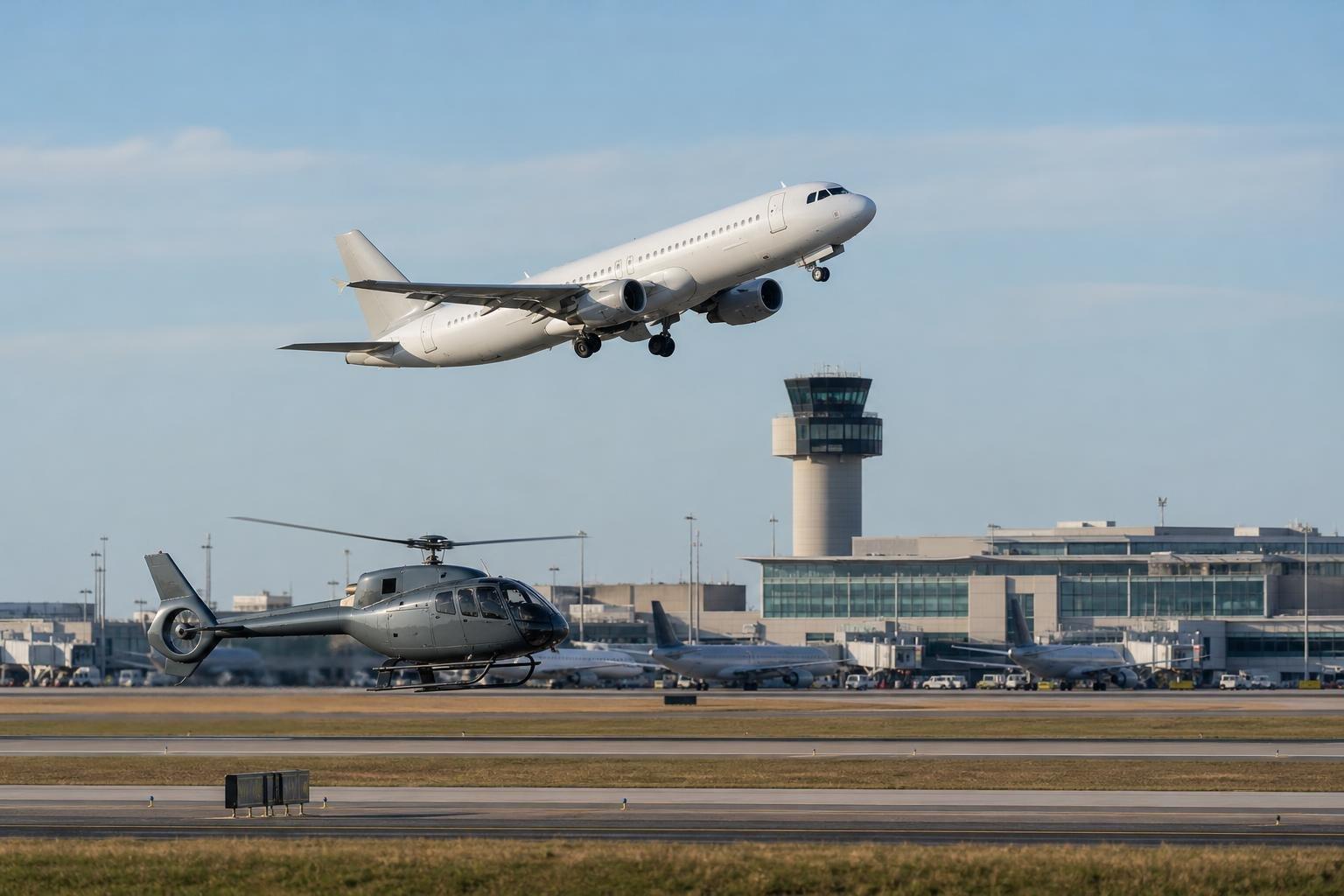
AI-generated illustration
FAA Makes Permanent Ban on Visual Separation for Helicopters Crossing Busy Terminal Traffic
Two FAA notices issued Nov. 24 lock in a March interim restriction on helicopter and powered-lift crossings and revise controller guidance on VFR traffic advisories, effective Dec. 24.
The gist
From Dec. 24, controllers can no longer use visual separation for helicopters crossing arrival or departure paths in Class B, Class C or TRSA airspace.
Continuing coverage
All Faa →- FAA Collects Reports After Piper Seminole Rolls 60 Degrees in Wings-Level Stall
- Router Swap at Arkansas Radio Site Suspected in Nationwide US Air Traffic Ground Stop
- American Airlines San Diego to Chicago Flight Diverts to Phoenix After Passenger Tries to Manipulate Door
- FAA Orders Pre-Flight Inspections of Boeing 757 Fuselage Repairs After Crack Reports
- Academy Report Says FAA Skipped Required Risk Assessment Before Closing DC Helicopter Route 4
The Federal Aviation Administration is turning a temporary limit on how air traffic controllers manage helicopters into a permanent rule. The restriction governs how controllers handle helicopters that cross paths with arriving and departing aircraft in busy airspace. The agency set out the change in two notices issued Nov. 24, both of which update air traffic control procedures. Both notices take effect Dec. 24, and the restriction they make permanent has been in place on an interim basis since March.
The first notice, JO 7110.808, carries the core change. It prohibits controllers from using visual separation when a helicopter or a powered-lift aircraft crosses the path of arriving or departing traffic. The ban applies in three types of airspace: Class B, Class C and Terminal Radar Service Area, or TRSA, airspace. The rule covers powered-lift aircraft as well as helicopters, so it reaches beyond conventional rotorcraft to any powered-lift aircraft crossing arrival or departure paths in those areas.
The FAA said it brought in the original restriction after identifying a safety risk involving helicopters and powered-lift aircraft crossing near other traffic. That interim measure took effect in March. The agency said the measure had been effective in addressing the concern. With JO 7110.808, what began as a stopgap in March becomes part of standing controller procedure for helicopter and powered-lift crossings in Class B, Class C and TRSA airspace.
The second notice, JO 7110.809, is a companion to the first and deals with aircraft flying under visual flight rules. It removes language from the controller handbook stating that no separation minimums apply to VFR aircraft outside Class B, Class C and TRSA airspace. In its place, the change updates the guidance controllers follow when issuing traffic advisories. That revised guidance applies to advisories given to both IFR and VFR aircraft.
Under the updated guidance, controllers are expected to provide traffic advisories when they believe aircraft are close enough that a potential conflict could develop. The FAA said the revision follows earlier changes to the handbook's basic radar services provisions. Those provisions now address VFR aircraft at both terminal and en route facilities. The handbook language that JO 7110.809 strips out had stated that no separation minimums applied to VFR aircraft outside the three airspace classes named in the first notice.
Taken together, the two notices touch two parts of controller practice. JO 7110.808 sets a firm limit on one separation method, visual separation, for a specific situation: a helicopter or powered-lift aircraft crossing the path of arriving or departing traffic in Class B, Class C or TRSA airspace. JO 7110.809 addresses VFR traffic outside those areas by removing the statement that no separation minimums applied and by revising how controllers issue advisories to IFR and VFR aircraft alike. The FAA issued both notices on Nov. 24.
Both procedural changes take effect on Dec. 24. On that date, the restriction first introduced in March as an interim measure becomes permanent under JO 7110.808, and the handbook language on VFR separation minimums is removed under JO 7110.809. The updated advisory guidance for IFR and VFR aircraft takes effect on the same date.
Originally reported by AVweb
Read more
All Regulatory →
Aviation Coalition Asks Congress for $30 Billion in ATC Funding, Short of White House $50 Billion Ask
More than 60 aviation groups urged lawmakers to approve at least $30 billion for air traffic control modernization, even as the Trump administration now seeks about $50 billion after this month's national ground stop.

Modern Skies Coalition Launches ACT NOW Ad Campaign Pressing Congress for ATC Modernization Money
A coalition of more than 50 aviation groups began a national ad push a week after a nearly five-hour nationwide ground stop, as DOT seeks another $50.1 billion for infrastructure.

Senator Moran Presses Duffy to Justify Jump to $50 Billion Air Traffic Control Request
The Kansas Republican who chairs the Senate aviation subcommittee says Transportation Secretary Sean Duffy must explain why his ATC modernisation ask rose from $30 billion to $50 billion after the 13 November ground stop.

Everett-Built 737 MAX Jets Added to Boeing Production Certificate as North Line Nears Deliveries
Boeing's new 737 line in Everett, Washington, has reportedly cleared a regulatory step toward handing over jets, with the planemaker working through the final stages of an FAA audit.
The Daily Touch & Go
Launching soon: the day's best aviation news in your inbox. Join the list, free.