


New Marine One Helicopters Cause Lawn Damage, FAA Reviews DC Crash Safety
Lockheed Martin funds White House helipad construction as new VH-92A helicopters cause turf damage; FAA evaluates post-2025 crash safety upgrades amid airline consolidation debates.
The gist
New Marine One helicopters scorch White House lawn; FAA weighs DC safety fixes after 2025 crash amid evolving airline market.
The White House is undergoing infrastructure changes to accommodate a new fleet of presidential helicopters, with Lockheed Martin confirming it is covering the cost of a recently constructed helipad. This follows President Trump's announcement that the company behind the Sikorsky Marine One helicopters, a Lockheed Martin subsidiary, would fund the helipad update. Sikorsky aircraft have served as the official presidential transport since the 1970s, with the latest model, the VH-92A Patriot, introducing significantly stronger engines and a redesigned exhaust system.
The VH-92A differs substantially from its predecessor, the VH-3D, in terms of propulsion and aerodynamic effects. Its exhaust vents are directed downward and rearward, whereas the older VH-3D models vented differently. The combination of the new helicopter's powerful engines and exhaust orientation generates more intense downwash and heat at touchdown. This has caused notable damage to the White House lawn, scorching and dislodging the sod due to the concentrated blast of hot exhaust mixed with rotor airflow.
These changes at the White House come amid a dynamic period for commercial aviation, with ongoing airline consolidation reshaping the U.S. market landscape. Notable carriers such as Continental Airlines, Northwest Airlines, and Spirit Airlines have merged or ceased operations, leaving the 'Big Four' U.S. airlines controlling about 75% of domestic market share. Opinions vary on the impact of this consolidation on passengers. Industry representatives claim greater route competition, while some experts argue that mergers boost operational efficiency at the expense of consumer choice in certain communities.
Safety considerations remain paramount in the aviation sector, especially following the tragic January 2025 midair collision near Washington, D.C., which claimed 67 lives. The National Transportation Safety Board (NTSB) issued nearly three dozen recommendations to improve airport safety and traffic management. The Federal Aviation Administration (FAA) has addressed a subset of these and is evaluating others, including reassessing the capacity limits at Ronald Reagan Washington National Airport (DCA), which were implicated in congestion-related risk factors during the incident.
Additionally, legislative debates continue over equipping aircraft with advanced safety technology such as ADS-B In (Automatic Dependent Surveillance-Broadcast). Two competing bills—the ROTOR Act and the ALERT Act—outline different approaches to mandatory ADS-B In compliance. Stakeholders including pilots unions and industry groups are divided, reflecting broader tensions between operational feasibility, technological advancement, and safety transparency demands. The FAA and Congress are closely monitoring these discussions for future regulatory action.
Other recent aviation incidents highlight ongoing safety challenges. A Ryanair Boeing 737-800 experienced an engine fan blade failure leading to window rupture, a rare but serious event that has prompted FAA directives mandating inspections and design changes. Meanwhile, a Kodiak 100 seaplane sustained substantial damage after a hard landing in New York’s East River but resulted in no injuries. This incident underscores known difficulties with seaplane operations in urban waterway environments where wake turbulence from other vessels complicates safe approaches.
In sum, the introduction of state-of-the-art Marine One helicopters is prompting infrastructure adaptations at the White House, reflecting evolving aviation technology and operational demands. Concurrently, the FAA pursues comprehensive safety improvements following a recent high-fatality accident, amid a consolidating airline industry and advancements in airborne surveillance technology. These developments collectively highlight the complex interplay of innovation, safety, and operational considerations shaping modern aviation.
The ongoing evaluations of airport capacity, advance in onboard safety systems, and industry consolidation effects suggest that regulatory and operational adjustments will continue to evolve. Public and industry scrutiny remains high, particularly given the stakes of passenger safety and efficient air traffic management around major metropolitan areas like Washington, D.C. How these factors coalesce will influence the future landscape of both governmental and commercial aviation sectors.
Frequently asked questions
- Why is the new Marine One helicopter causing damage to the White House lawn?
- The VH-92A Patriot helicopter's more powerful engines and downward-pointed exhaust combine to create intense downwash and heat at touchdown, scorching and ripping up the lawn sod.
- What is the FAA's current status on implementing safety recommendations after the 2025 D.C. midair collision?
- The FAA has addressed seven NTSB recommendations fully and is evaluating others, including the possibility of adjusting the arrival caps at DCA to reduce congestion risks, with further analysis expected by mid-2027.
- What controversy surrounds the ADS-B In mandate in U.S. aviation legislation?
- Two competing bills propose different ADS-B In equipment requirements; pilots unions and the NTSB support a stringent mandate, while industry groups favor a less rigorous approach involving integrated collision avoidance with concerns over current system readiness.
Read more
All Aviation Safety →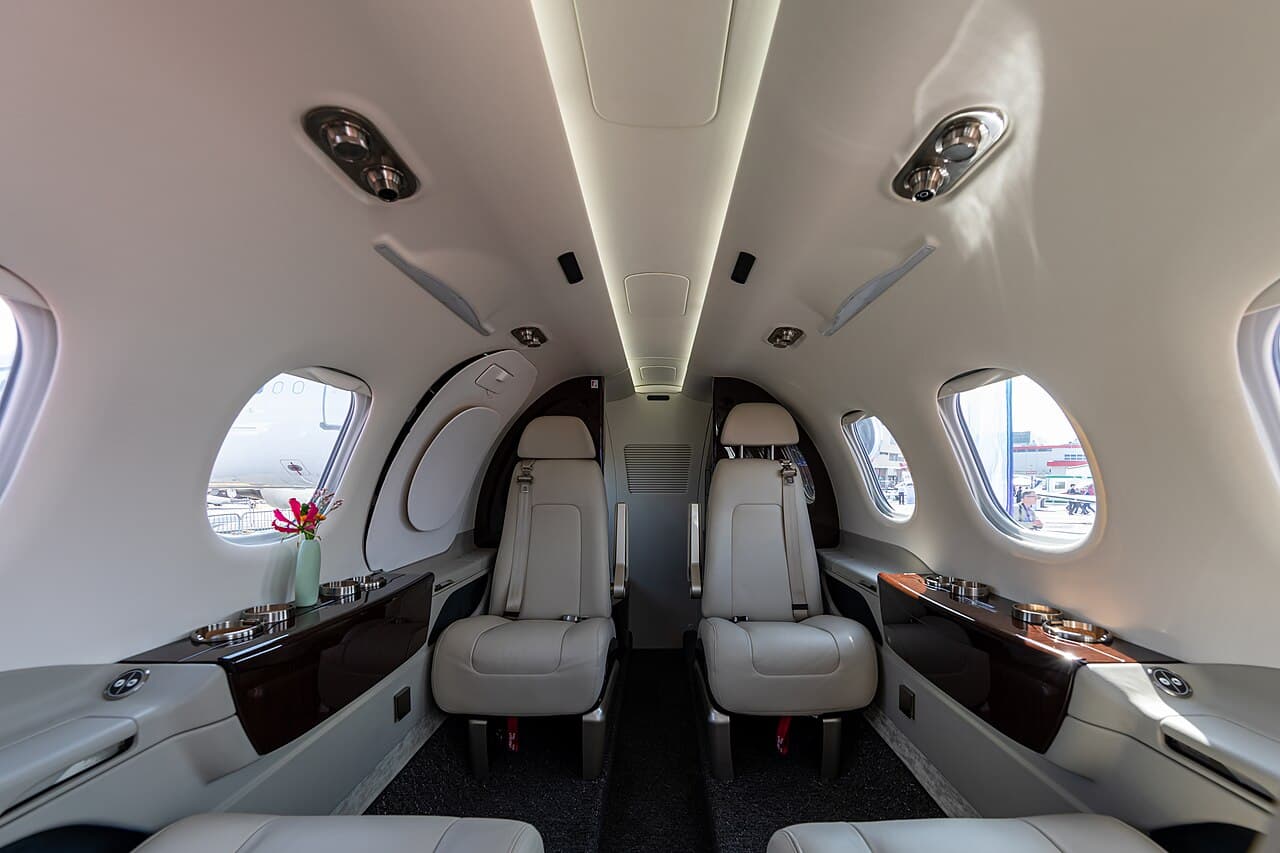
Embraer debuts Phenom 300EV light jet with Garmin Emergency Autoland and upgraded range
Embraer has launched the Phenom 300EV, the third generation of the planemakers best-selling light jet following the highly successful Phenom 300E and Phenom 300. On July 14, 2025, the Brazilian aircraft manufacturer said that the updated model arrives with intuitive safety technology, including Garmin Emergency Autoland. Embraer said the 'EV' designation stands for Evolution and deliveries of the new model are expected to begin in 2028. The latest executive jet "incorporates a series of performance and interior enhancements" from its predecessors such as Garmin G3000 Prodigy Touch, which includes runway and taxi situational awareness. PAUL BOWEN Landings and takeoffs are also supported by Autobrake and a new Embraer-developed Multi-Purpose Electronic Controller (MEC), integrates rudder-by-wire and other electronically controlled aircraft functions, contributing to reduced pilot workload and simplified maintenance. Michael Amalfitano, President and CEO of Embraer Executive Jets, said that for over a decade the Phenom 300 series have set the industry standard and the aircraft holds the "undisputed position as the category leader". "With the new Phenom 300EV, we are raising the bar once again," Amalfitano said. "Through purposeful innovations combining enhanced safety technology, amplified performance, and thoughtful cabin refinements, we have introduced meaningful advancements that make flying more intuitive, seamless and enjoyable. It is not only the evolution of the world's best-selling light jet, but a clear statement that the market leadership excellence benchmark continues to belong to Embraer." Embraer Performance updates include an extended range of up to 2,055 nautical miles and an increase in maximum zero fuel weight, adding approximately 430 pounds of payload capacity. The Phenom 300EV also introduces new True Blue Power lithium-ion batteries and LED taxi and landing lights designed to support improved reliability and dispatch performance. Starlink connectivity will also be available as an aftermarket solution through a Supplemental Type Certificate (STC). Introducing the Phenom 300EV, a bold evolution of the world's best-selling light jet for 14 consecutive years. There are light jets. And then there's the Phenom 300EV. Intuitive. Refined. Legendary. Read more: https://t.co/SD3KhYUZWx Phenom 300EV: https://t.co/2lTwriWz1C pic.twitter.com/UEMyMjJbiU — Embraer (@embraer) July 14, 2026 Additional enhancements include the introduction of an odorless vacuum lavatory, improved cabin temperature control, a redesigned refreshment center with the flexibility to bring a hot beverage machine of preference, and an air ionization system. RELATED India certifies multiple Embraer aircraft including E195 and E195-E2 jets
Mastering the First Dual Cross-Country Flight Requires Solid Prep and Navigation Skills
The first dual-instruction, cross-country flight is one of the most task-saturating lessons a student pilot can undertake. The flight is likely the longest lesson you'll have done to date, and it may be the first time you've had a lesson outside the practice area. When training is under Part 141, this flight is usually done a lesson or two after the first solo. Part 141 programs also have a list of "approved" airports that they are allowed to fly to. Part 61 doesn't require strict adherence to a syllabus, so there's really no rule about when cross-country training should take place. However, the learner gets more out of the experience when they have logged a few hours of local dual instruction so they understand how to use a checklist, the radio, and have some basic navigation and aircraft-handling skills. Without this base knowledge, the learner is little more than an enthusiastic passenger going for a ride. Under Part 61 there's more freedom when it comes to selecting an airport to fly to. To qualify as a cross-country flight, the distance between the starting point and terminus has to be at least 50 nm straight-line distance. Confirm this span using a plotter on a VFR sectional. Longer—even just by a few miles—is better. To count as a cross-country flight, you must land at the airport. READ MORE: When GPS Fails: Lessons From a Fatal Air Ambulance Crash READ MORE: Beat the Heat: Mastering Density Altitude Over 20-plus years as a CFI, I've learned that best practice for the first dual cross-country flight is to do a ground session with the learner to help them create the navlog. You might argue they learned how to do that in ground school. Maybe they did, or maybe they didn't. Either way you want this experience to be a good one, so it's a good idea to do a session on navlogs. If they know what they're doing, I ask them to teach it to me. Why did they choose that landmark? What altitude is appropriate? Etcetera. I'm a big believer in the paper navlog for the primary learner. While I know they'll use ForeFlight or another app later in their careers, on this day they will learn the basics—pilotage, dead reckoning, and aircraft performance calculated by hand. You can tell when this foundational knowledge has been skipped. One afternoon when the new-hire CFI and his learner returned from their first cross-country flight, you could tell by the looks on their faces as they walked off the ramp that it had not been a good day. I heard both sides of the story at different times. At this school primary learners were required to learn and use analog navigation (paper sectionals, pilotage, and dead reckoning) for the first few cross-country flights. Electronic apps and the GPS were not utilized until the final phase of training. The learner hadn't finished filling out the navlog because he couldn't remember how to do it. Private pilot ground school had been more than a year ago, and he hadn't used these skills since. He thought the CFI would help him finish filling it out, but the instructor was eager to get into the air, so they took off with a half-finished navlog. The CFI had been to the destination many times when he was attending the local Part 141 school in the area, so he was familiar with the route. The learner was not familiar with the route. He had difficulty finding landmarks and matching them to the VFR sectional— which he reported seemed to grow and take over the cockpit—and struggled to do ground speed checks with the E6-B. When he dropped the airplane to fly the navlog or the sectional, it resulted in altitude deviations, unwanted heading changes, and at least one missed radio call. When he asked the CFI for help, the instructor pointed out he was supposed to have learned how to do these things in ground school—a comment that wasn't helpful at all. After a few awkward moments of silence, the learner turned around the airplane, stating the lesson was over, and they were returning to the home airport. There was an extensive postflight debriefing. The CFI, who was relatively inexperienced (less than 400 hours total time, less than 50 hour dual given), said he was confused as to why the learner hadn't completed the navlog since he "learned it" in ground school. The student pilot had not learned it, and there's a big difference between having the information presented to you and filling out a navlog in the classroom and then performing the required navigation skills in the air. The learner hadn't reached that level of performance yet as no one had shown him how to do it. CFIs can introduce parts of cross-country flying during out-and-back lessons to the practice area. Note the distance between a landmark and the airport, give the learner an estimated ground speed, and have them use the E6-B to determine the time en route. It's quick and nonthreatening, and gives them an idea of what to expect. To the learners: Before you go on your first dual cross-country flight, insist on doing a ground session a few days before the scheduled flight to make sure you have the technical skills. Ask your CFI to go through filling out an analog (paper) navlog. While you'll likely be using an electronic flight bag (EFB) for a good portion of your training, learning the analog methods often provides a better understanding of the elements of navigation. Discuss the routing. Pick out landmarks that are no more than 10 to 15 nm apart and stick out like a frog in a baptismal fountain, such as cities, shorelines, other airports, football stadiums, large lakes with names, large factories, etc. Make note of the VOR frequencies and automated weather sources along the route. Note the airspace on the sectional, what the clearance requirements are (if any) and, using the winds aloft as culled from the weather briefing you get before the lesson, determine aircraft performance with the aircraft POH and E6-B. About the E6-B: The mechanical version doesn't have to be intimidating. It has the directions for each calculation printed on it. If you can follow the recipe on a box of instant mashed potatoes, you can perform calculations with a mechanical E6-B. You may find it's actually quicker to use the mechanical one rather than the calculator-style one—and it's one less thing in the airplane needing batteries. Pro Tip s Obviously it's a lot easier to perform calculations when sitting in a classroom at a desk than flying. To prepare for the cockpit, lose the desk. Sit in a chair with your kneeboard on one leg as if in the airplane and perform time, speed, and distance calculations. Practice unfolding and refolding the sectional. Do a little sectional origami if necessary to keep it from taking over the cockpit. Instructors: Be sure to demonstrate how to divert to another airport. Pick a suitable one other than the original destination and determine the distance, heading, time, and fuel required to get there. Select an airport that's hard to find. We have a few in the Seattle area that you swear have a cloaking device because they seem invisible unless you approach them from a specific angle. Emphasize the need to look out the window instead of hitting the "direct-to" button on the GPS. The latter becomes a crutch and can bite the learner when they are on the check ride and the examiner "fails" the GPS. Savvy instructors create a paper navlog for cross-country flights. There will probably be certain airports you always fly to for them. You can "preload" these with landmarks, distances, VOR and AWOS frequencies, etc. The day of the flight, you just have to add the winds and aircraft performance, per the POH. This instructor-made navlog comes in handy when the learner hasn't finished theirs, they've done creative math, or their calculations are way off. Using the CFI-created navlog, the learner can find the landmarks, perform the ground speed checks, and determine time en route and time to the next checkpoint. Often this practice g
SpaceX Prepares Starship Flight 13 with Upgrades After Booster Flaw Fix
SpaceX announced it made several hardware and software modifications to its massive Starship rocket as it prepares for what could be the vehicle's most critical test flight yet. The launch provider said over the weekend it is targeting a 90-minute launch window that opens at 6:45 p.m. EDT on Thursday for Starship Flight 13, which is a precursor to more ambitious missions the company has planned for 2026. SpaceX said the mission will have "similar objectives" to Flight 12 in May, which was the first test of Starship's larger, more powerful Version 3 (V3) configuration. SpaceX has flown Starship variants since 2023, but the V3 is its first designed to be capable of commercial, orbital deployments of Starlink satellites. It is also the vehicle around which the company's human landing system (HLS)—a candidate to deliver astronauts to the moon on future NASA lunar missions—is based. The first of those missions is scheduled for early 2028, putting pressure on SpaceX to deliver a viable spacecraft. The company validated some of the V3 upgrades on Flight 12. But the rocket's Super Heavy booster failed to complete its flip and boostback burn as intended, causing it to land hard in the Gulf of Mexico and prompting the FAA to ground it . The FAA closed the SpaceX-led Flight 12 mishap investigation on Monday, clearing the way for Starship to return to action—and to form. The rocket completed five suborbital test flights in 2025, with the final two in August and October being the most successful. But the seven-month gap between Flights 11 and 12 was the longest drought since Starship debuted in 2023. With the V3 Starship, SpaceX in 2026 aims to complete its first mission to low-Earth orbit (LEO), achieve full reusability, and demonstrate docking and propellant transfer on orbit. The key to hitting those milestones will be returning to regular flight cadence. SpaceX has bet that stressing Starship to its limits—as it did on Flight 12 and other missions—will eliminate future hiccups, with the tradeoff being more frequent groundings. If SpaceX can launch Flight 13 this week, the less than two-month turnaround from the prior mission would be a significant improvement. At the same time, delays are stacking up. What Went Wrong? Starship Flight 12 was a mixed bag. On one hand, the rocket successfully reached orbit, deployed 20 "dummy" Starlink satellites, and splashed down within a predetermined zone in the Indian Ocean. On the other, the ship lost one of its six Raptor engines, and the Super Heavy booster did not behave as predicted. Due to the booster anomaly, the FAA activated a debris response area (DRA) that placed five aircraft in holding patterns and delayed six departures. The mission was critical as the debut of Starship V3, which is expected to be capable of larger Starlink deployments than SpaceX's Falcon 9 or Falcon Heavy rockets. Compared to the V2 spacecraft, it has lower mass but more thrust—enough to carry 100 metric tons of payload to LEO, according to CEO Elon Musk. Further enhancements to the ship will enable orbital docking and propellant transfer, which in the future could open up commercial or NASA lunar missions. For those trips, Starship would need to fuel up at an orbital propellant depot due to its massive size and the power required to get it to the moon. That is the Starship HLS' planned profile for NASA's Artemis IV lunar landing scheduled for 2028, should the space agency select it over Blue Origin's Blue Moon HLS. The FAA said Monday that it accepted SpaceX's assessment of the booster anomaly's two most probable root causes—"heat effects on propulsion system components during the ascent and erroneous engine alarm system settings." It said there were no reports of injury or property damage and approved four corrective actions. "SpaceX can proceed with Starship Flight 13 launch operations provided all safety and other licensing requirements are met," the agency said in a statement. SpaceX over the weekend provided further clarity. It said that during Flight 12 stage separation, "slight differences in engine startup" caused a 90-degree deviation to Super Heavy's planned flip maneuver, which is intended to save fuel during the booster's descent. The vehicle's engine startup sequence has been modified, SpaceX said, to more reliably flip in the right direction. After the flip, five of the booster's 33 Raptor engines failed to relight. That brought a premature end to its boostback burn and led to a harder-than-expected splashdown. SpaceX said that the Super Heavy for Flight 13 received hardware modifications that are intended to prevent a repeat, as well as upgrades to its engine alarm and abort systems. The company also addressed the loss of one of Starship's three vacuum-optimized Raptor engines, which it said occurred about 40 seconds after stage separation. Still, the Flight 12 Starship successfully completed a flip, burn, and splashdown in the Indian Ocean. What's Next? With Flight 13, SpaceX will look to recreate the successful aspects of Flight 12 without incurring anomalies. Super Heavy's core objective is the same—a successful launch, ascent, stage separation, boostback burn, and landing burn ahead of a soft splashdown. For Starship, SpaceX aims to relight one of the vehicle's Raptor engines in space, which it failed to do on Flight 12 due to the engine loss. If the ship makes it to atmospheric reentry, the company plans to push its heat shield to the limit, as it has done before. Previous missions have experimented with different angles of attack and tile materials. For a few, SpaceX stripped heat shield tiles in certain locations to expose Starship's underbelly to maximum stress. This time, it will attach tiles to various portions of the ship to evaluate different options for the integration of catch hardware. Unlike the company's Falcon 9, which is fitted with legs, Starship and Super Heavy are designed to be snared out of the air by a pair of giant metal chopsticks at the Starbase launch pad in Texas. SpaceX does not plan to catch either stage on Flight 13, but it has successfully caught and reflown two boosters. Another change to Flight 13 is Starship's payload. This time, the Starlink satellites will be real rather than dummy versions. The satellites, which are expected to burn up about 20 minutes after being deployed, will try to connect with SpaceX's larger Starlink constellation using solar arrays and antennas. Six of the satellites are equipped with cameras that are designed to scan Starship's heat shield and beam imagery from orbit to mission control in Texas. Some heat shield tiles were painted white to simulate missing hardware and test the system's accuracy. The idea is to assess the heat shield's health before committing resources to a catch attempt. Two of the 20 dummy Starlinks deployed on Flight 12 had the same modifications and successfully collected imagery . SpaceX will stream the mission live on its website and X account, starting about 30 minutes before liftoff. Watching closely will be thousands of space enthusiasts, as well as NASA and the company's commercial customers who are depending on Starship. More anomalies could impact SpaceX's future ambitions, including landing American astronauts on the moon. NASA in June awarded a lunar cargo mission to its main rival, Blue Origin, which is vying to be the HLS provider for the Artemis IV moon landing.
Wisk Aero and NASA Demonstrate Ground Supervisor Managing Three Autonomous eVTOLs
Boeing's eVTOL (electric vertical takeoff and landing) air taxi unit Wisk Aero believes it has made a breakthrough in testing that it is conducting with NASA under a five-year Space Act agreement . Wisk said Wednesday that it simulated the simultaneous orchestration of three uncrewed aircraft, alongside regular air traffic, by a single ground-based supervisor. For autonomous models like Wisk's Generation 6 air taxi, the ability for one person to remotely oversee multiple aircraft is considered the unlock for operations at scale. However, with limited exceptions, the FAA does not permit operators to fly multiple small drones at once, let alone uncrewed aircraft that are designed to carry passengers. The Gen 6 lacks pilot controls but has four passenger seats. Wisk is the only American eVTOL developer that plans to integrate autonomy at launch. But others, including Joby Aviation, Archer Aviation, and Beta Technologies, view autonomous systems as critical to growing beyond a handful of daily operations. Wisk's Generation 6, a prototype of which made its first flight in December, is designed to coordinate with what the company calls multi-vehicle supervisors (MVSors). These personnel would oversee operations remotely and step in should the air taxi deviate from its predefined route. "This is an incredible milestone for Wisk as it's the first time we've successfully tested our 1:3 supervisor-to-aircraft ratio with NASA in a high-fidelity, high-workload environment that mirrors the complexity of the NAS," said Erick Corona, who heads system and operations integration for Wisk, in a statement. The company's Space Act agreement, awarded last year, is intended to study autonomous aircraft operations in the national airspace system (NAS) under IFR. Eventually, it is expected to combine actual flights with simulated airspace in NASA's Live Virtual Constructive (LVC) flight environment, which can layer live or historical NAS traffic over real-world aircraft. Goals of the collaboration include the development of standards for airspace and route design, aircraft and ground safety, and air traffic control (ATC) communications with uncrewed aircraft. Three For One Wisk said its Autonomy Lab in Mountain View, California, where the company studies human supervisors' interactions with the Gen 6's automated systems, was connected to ATC simulation laboratories at NASA's Ames Research Center in California's Silicon Valley. The partners used the NASA facilities, which can create full-scale, 360-degree simulations of the airport environment, to follow predetermined IFR routes between Moffett Federal Airfield (KNUQ) and San Martin Airport (E16) in California's San Francisco Bay Area. Wisk said its supervisors used the company's remote supervision system and autonomous systems to communicate with ATCs, who relied on existing tools and procedures. The researchers studied communication response times, task latency, situational awareness, and cognitive workload across both nominal and worst-case scenarios developed by NASA and Wisk. "Proving that a single ground-based supervisor can manage multiple flights safely and efficiently is paramount to making commercial air taxi operations scalable and affordable,” said Wisk’s Corona. Wisk said data and learnings from the simulation campaign could help to standardize communications and procedural frameworks designed to reduce ATC and pilot workload. It may also advance the company's vision for automated flight rules (AFR), a proposed policy framework that would define the role of its multi-vehicle supervisors. "AFR is designed to complement, not replace, VFR and IFR, and to be available to any properly equipped airspace user," Wisk wrote in a February blog post . "Whereas VFR and IFR rely on pilot visual awareness and ATC-provided services to keep aircraft safely separated, AFR will allow aircraft to use automation to perform conflict management functions." What's Next? Wisk's collaboration with NASA could produce tangible results. The space agency's UAS Traffic Management (UTM) project led directly to the FAA's development of the Low Altitude Authorization and Notification Capability (LAANC) for drone operations. The UTM team also devised the air traffic management framework that the FAA is using to facilitate drone operations in Dallas-Fort Worth. The city is the first to allow multiple operators to share airspace and fly beyond the visual line of sight (BVLOS) of personnel. Kurt Swieringa, deputy manager for technology for NASA's Air Traffic Management Exploration (ATM-X) project, told FLYING last year that his unit was shaping a version of the Airborne Collision Avoidance System (ACAS) that can accommodate uncrewed aircraft. NASA researchers have tested digitized communications between ATC and the flight deck and conducted many remotely piloted flights. They have also studied air taxi noise, traffic, ride quality, and crash scenarios. The space agency shares these findings with the FAA to inform new regulations that could unlock commercial service for Wisk, Joby, Archer, Beta, and more. Unlike competitors, Wisk's Gen 6 will be autonomous from the get-go and could benefit the most from NASA's work. "I think there's a hurdle of integrating an eVTOL into the airspace, and then there's the autonomous piece," said Cindy Comer, Wisk's vice president of SMS, safety, and quality, in a Q&A that appeared in the March 2026 issue of FLYING . "How do we best engage with air traffic control so that we don't increase their workload, but they're aware and engaged in our flights as much as they need to be?" Per Comer, the Gen 6 uses a combination of computers, predictive hardware and software, radar, sensors, and ground links to detect and avoid other aircraft on its own. Many of its systems are present on transport-category aircraft such as the Boeing 737 or Airbus A350. Wisk is even providing autonomous systems for future variants of Archer's Midnight air taxi, and Comer left the door open when asked if the company could sell them to other rivals. Should they adopt Wisk's autonomy, those competitors could rely on the same multi-vehicle supervisor framework that it and NASA are studying. Of course, the partners will eventually need to validate the strategy with real flying. Wisk's first Gen 6 prototype was joined by a second in May . Though it did not fly them during the recent NASA campaign, Wisk hopes to debut the prototypes publicly by the end of the FAA's eVTOL Integration Pilot Program (eIPP). The multiyear program will see Wisk work with the Texas Department of Transportation toward high-frequency Gen 6 flights. Dan Dalton, Wisk's vice president of commercialization and airline development, told FLYING in March that the FAA during the eIPP may even permit passenger carrying operations for revenue. The eIPP kicked off last week with organ delivery flights completed by Beta's all-electric Alia CX300. Activities under the multiyear program are expected to grow increasingly complex.
The Daily Touch & Go
The day's best aviation news in your inbox. Free, no spam.