

Illustration: The Touch & Go
Soviet-era carrier Kiev becomes Chinese naval museum and stunt show venue
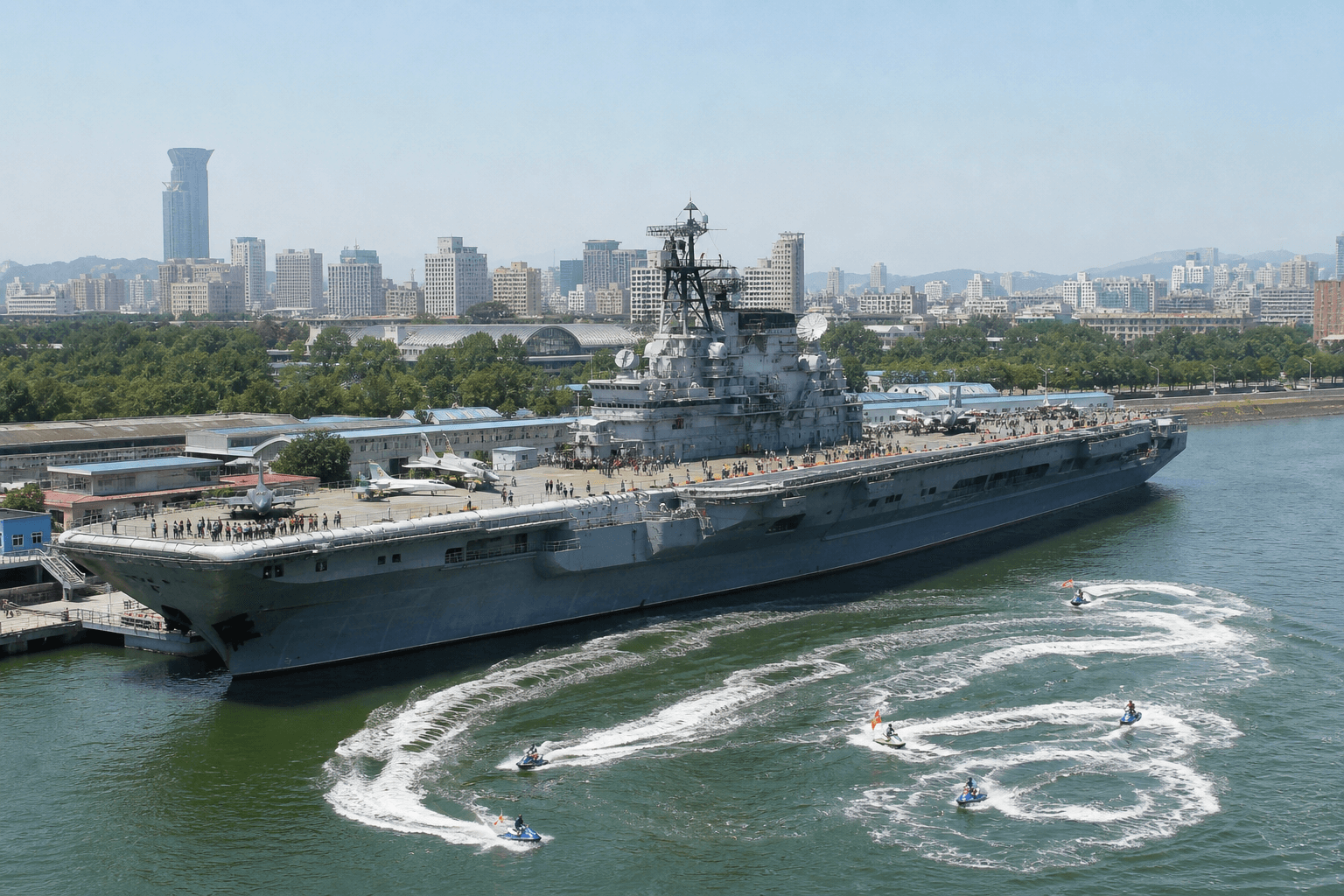
The former Soviet aircraft carrier Kiev, flagship of the Pacific Fleet in 1975, now serves as a unique maritime museum and entertainment resort near Beijing with jet ski stunt shows.
The gist
The Soviet aircraft carrier Kiev, once a Cold War naval threat, is now a floating museum and stunt show destination in China.
Near Beijing, the former Soviet aircraft carrier Kiev has been transformed from a Cold War warship into a seaside resort and naval aviation museum open to tourists. Visitors can stay overnight in the ship’s interior, and the vessel now hosts jet ski stunt shows inspired by cinematic post-apocalyptic themes. This unusual reuse of a military capital ship underscores how naval assets sometimes find entirely new roles after their service life ends.
Commissioned in 1975, the Kiev was originally the flagship of the Soviet Pacific Fleet and was designed as a heavily armed aircraft-carrying cruiser. The ship combined vertical takeoff Yakovlev Yak-38 jets with missile systems for anti-ship and anti-submarine warfare. Despite its intimidating design, the hybrid concept limited the Kiev’s combat effectiveness compared to American supercarriers, and it never fully matched US naval aviation capabilities.
Following the Soviet Union’s collapse in 1991 and Ukraine’s independence, the Kiev and other ships of its class became excess to Russian naval requirements. The 67,000-ton vessel was sold to Chinese investors in the mid-1990s. Unlike its sister ships, which were scrapped or mothballed, the Kiev was repurposed into a tourist attraction, reflecting China’s growing interest in naval power and maritime history.
China’s People’s Liberation Army Navy (PLAN) has since evolved from operating a converted Soviet hull to developing modern aircraft carriers such as the domestically made Fujian, which uses electromagnetic catapults though lacks nuclear propulsion. The Kiev offers a tangible link to the beginnings of Chinese carrier aviation though it was not part of PLAN’s active fleet. It remains the only Soviet-era carrier preserved outside the United States as a floating museum.
The museum’s exhibits include Yak-38 jets and various Chinese fighter aircraft such as the Nanchang Q-5, Shenyang J-6, and Chengdu J-10. Onshore, a replica Russian street complements the naval displays with traditional food and gifts. The ship’s flight deck, once engineered with heat-resistant tiles to withstand jet exhaust, now serves as an observation platform overlooking the stunt shows on the water below.
The Kiev class carriers were designed uniquely as 'aircraft cruisers' to evade the Montreux Convention restrictions that barred large aircraft carriers from passing the Turkish Straits. Their production ceased in 1987 with the fourth ship, Admiral Gorshkov, which was later sold to India and transformed into the INS Vikramaditya. The Kiev class experienced curtailed service lives due to geopolitics and the Soviet dissolution.
The vessel’s sale to Chinese investors and its metamorphosis into a museum parallels China’s acquisition of the unfinished sister ship Varyag. Bought under the pretense of entertainment use, the Varyag was later completed as China’s first active carrier, renamed Liaoning. This acquisition marked the foundation of China’s ambitious aircraft carrier program that continues to expand today with nuclear-powered designs.
Inside the Kiev, renovated sections pay homage to its Soviet naval heritage with authentic restorations of missile magazines and sailor mess areas adorned with mannequins dressed as Soviet troops. The Binhai Aircraft Hotel occupies part of the hull, providing visitors with a luxury lodging experience inside the historic warship, blending military history with leisure tourism.
Now over 50 years old, the Kiev stands as a symbol of naval transition—from Cold War Soviet power to modern Chinese maritime ambitions—while offering aviation enthusiasts a rare glimpse into aircraft carrier evolution. Its status as a floating museum and entertainment venue marks a unique chapter in the afterlife of historic warships.
Frequently asked questions
- What is the current function of the Soviet aircraft carrier Kiev?
- The Kiev has been converted into a maritime museum and tourist resort near Beijing, featuring guest rooms and jet ski stunt shows.
- How did the Kiev contribute to the development of China's naval aviation?
- After being sold to Chinese investors, the Kiev became a stepping stone in China's naval aviation history, preceding modern PLAN carriers like the Fujian.
- Why was the Kiev designed as an 'aircraft cruiser' rather than a traditional carrier?
- To comply with the Montreux Convention restrictions on aircraft carrier passage through the Turkish Straits, the Kiev was designed as a heavy aircraft-carrying cruiser.
Read more
All Military/Defense →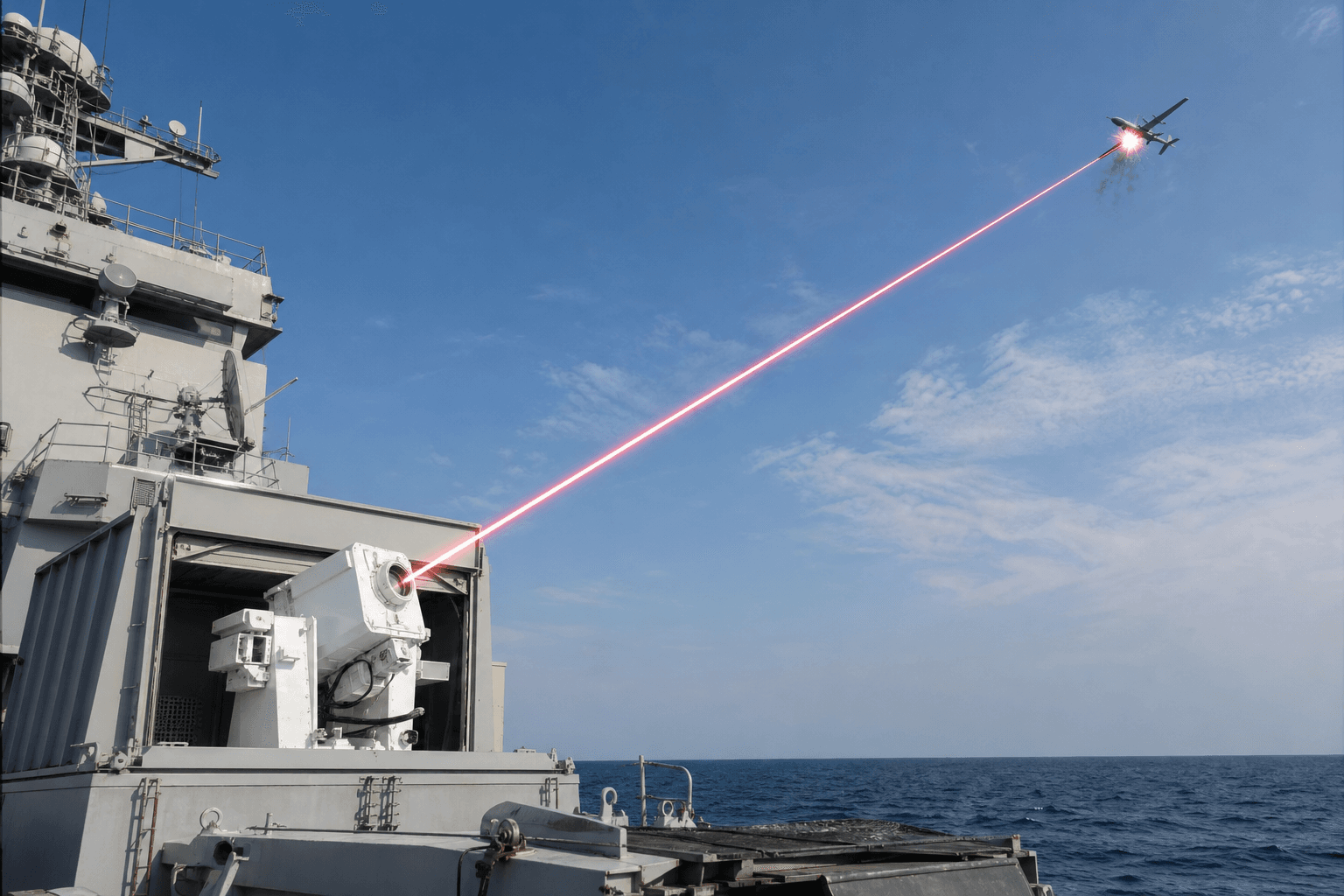
Pentagon awards $847M deals to develop scalable laser weapons against drones and cruise missiles
The US Department of War announced on July 9, 2026, that two Joint Laser Weapon System (JLWS) agreements had been awarded to nLIGHT Defense and Lockheed Martin Aculight, aimed at turning high-energy laser prototypes into field-ready systems against drones and cruise missiles. The Other Transaction Authority (OTA) agreements carry an initial value of $86 million and a total program ceiling of $847 million. They were executed by the Scaled Directed Energy (SCADE) Critical Technology Area, which operates under the Office of the Under Secretary of War for Research and Engineering. According to the department, the program seeks to transition directed energy capabilities from demonstration prototypes into production-oriented platforms. This is intended to give combatant commanders scalable intercept options against both asymmetric and high-tier threats. Scaling from 150 kW to cruise missile defense Initial JLWS prototypes will be rated at approximately 150 kW, a power level suited to countering unmanned aerial systems. Subsequent iterations will be scaled to the 300-500 kW range considered necessary for robust cruise missile defense. A 500 kW integrated system, built around a laser source developed under the High Energy Laser Scaling Initiative (HELSI), will also be developed in parallel. The systems will use containerized form factors designed for modular integration on both ground and naval platforms, allowing rapid fielding across geographic combatant commands. "We must actively defend the homeland against emerging threats," said Emil Michael, Under Secretary of War for Research and Engineering, adding that the department was partnering with industry to deliver deep magazine directed energy capabilities across multiple domains. Rebalancing the cost of air defense These awards come amid a wider push to rebalance the cost equation of air defense, after the wars in Ukraine and Iran saw interceptors worth millions of dollars expended against drones costing a few thousand each . Lasers promise speed-of-light engagement, deep magazines and a cost-per-shot measured in dollars of electricity, attributes seen as essential against high-volume drone swarms , though weather and beam stability remain limiting factors. The announcement follows a series of directed energy milestones in the United States, including the first Golden Dome test, which reportedly used directed energy to defeat drones and cruise missiles . The Pentagon is also deliberating over deploying laser-based counter-drone systems at sensitive US locations after repeated incursions near military installations. The push is not limited to the United States. On the same day, July 9, 2026, Germany's procurement agency BAAINBw signed a contract with MBDA Deutschland and Rheinmetall to develop a containerized high-energy laser weapon system for the German Navy, building on a demonstrator tested aboard the frigate Sachsen. The contract targets an operational system by 2029.

Airbus and MTU Launch Joint Venture to Develop Hydrogen Fuel Cell Engines for Commercial Aircraft
As developers of electric and hybrid-electric aircraft experience growing pains , Airbus is doubling down on its ambition to produce a hydrogen-powered commercial aircraft. The European manufacturer on Tuesday revealed its plans to form a joint venture with Germany's MTU Aero Engines, which per its website claims its engine technology is found on one-third of the world's commercial aircraft. The new company will aim to develop a fully electric, hydrogen fuel cell-powered engine, with the objective of providing the first such system for a commercial aircraft. The nonbinding agreement follows a memorandum of understanding (MOU) the partners signed at the 2025 Paris Air Show. Airbus said it expects the joint venture to begin operations in 2027. The manufacturer said combining forces with MTU will create a "dedicated and highly agile" organization that is capable of accelerating the development, test, design, and certification of the fuel cell system. Bruno Fichefeux, head of future programs at Airbus, in a statement called it the "next logical step" toward the partners' shared vision of hydrogen-based propulsion. Per a news release, Airbus believes hydrogen could bring aviation's environmental impact more in line with that of electric ground vehicles. The only byproduct of the reaction between hydrogen and oxygen that occurs in the fuel cell is water vapor, which the manufacturer said will eliminate in-flight emissions. "By pooling our respective technology and expertise into a dedicated entity, we are establishing a European powerhouse capable of transforming advanced research into industrialised, certifiable electric propulsion systems," Fichefeux said. Stefan Weber, senior vice president of engineering and technology for MTU, added that "we want to create a company that covers the entire life cycle of fuel cell powertrains—from development and testing through certification to commercialisation." Regarding hydrogen, Airbus stands in stark contrast to its largest rival, Boeing. The American manufacturer has acknowledged hydrogen's potential as an alternative fuel source. But it has neither committed to incorporate the technology into its aircraft nor unveiled a hydrogen-powered concept. The agreement to form a hydrogen engine joint venture comes amid broader struggles for developers of sustainable propulsion technology. In the past few years, many have either folded, scaled back their ambitions, or been acquired by larger players. Airbus' Hydrogen Vision Airbus is king of the airframe, having led 2025 in commercial aircraft deliveries with 793, beating Boeing's 600. With MTU, it aims to lead the way in next-generation propulsion. The German company claims its engine technology powers one-third of the world's commercial aircraft, from corporate jets to widebody passenger airliners. It is also a primary industrial partner of the German Armed Forces, contributing to the engine for a next-generation European fighter jet. MTU does not build entire engines. Rather, it produces specialized components such as compressors and turbines in partnership with manufacturers. The firm also offers maintenance, repair, and overhaul. MTU's portfolio covers over 30 engine types, including the Pratt & Whitney Geared Turbofan (GTF) family that powers the A320neo. It also contributes to General Electric's CF6, which powers the A300 and Boeing 747, and GE9X, the intended engine for Boeing's long-haul 777X. Other projects include the NGFE, developed in partnership with Safran Aircraft Engines for a sixth-generation fighter, and the EJ200 engine for the Eurofighter Typhoon. MTU is also developing what it has dubbed the "Flying Fuel Cell." Per the company's website , the device is fully electric and uses a hydrogen fuel cell to power an electric motor, which drives the propeller using a gearbox. It is unclear whether the Flying Fuel Cell is intended to power the Airbus-MTU concept. But Airbus on Tuesday shared several updates to the program, including that MTU has "nailed down" the system's design and begun building a demonstrator. Airbus said MTU put its first test cell into operation this year and conducted the first test of the electric motor that will power it. Airbus in February 2025 reportedly scrapped its original 2035 target for flying a hydrogen-powered airliner. The aircraft manufacturer had been exploring four hydrogen-based "ZeroE" concepts since 2020. But in March 2025, it pivoted to focus solely on the hydrogen fuel cell architecture, finding it to be the most viable after fuel cell prototype and powertrain testing. Airbus shared a concept that features four electric propulsion engines, each powered by an independent fuel cell stack. It said in March 2025 that it aims to begin integrated ground testing of the system as soon as 2027. That same month, CEO Guillaume Faury cast doubt on the aviation industry's ability to meet its net-zero by 2050 targets. Sustainable aviation fuels (SAF) are viewed by experts as a more impactful solution than hydrogen, and Airbus is targeting a 100 percent SAF capability for all of its aircraft and helicopters by 2030. Since Airbus' pivot to the hydrogen fuel cell concept, other developers of novel propulsion systems have struggled. ZeroAvia—a leading developer of hydrogen-electric powertrains that could be retrofit on existing airframes—recently halved its workforce and delayed certification of its commercial ZA600 powertrain in favor of pursuing applications in autonomy and defense. In May, Dutch hybrid-electric regional aircraft developer Maeve Aerospace—a partner of Delta Air Lines, Skywest, Japan Airlines, and others— went bankrupt . In June, Switzerland's H55, the developer of an electric propulsion system that could be installed on multiple airframes, laid off about half of its workforce.
Trump's Interim Boeing 747-8 Air Force One Flies First International Mission to Turkey NATO Summit
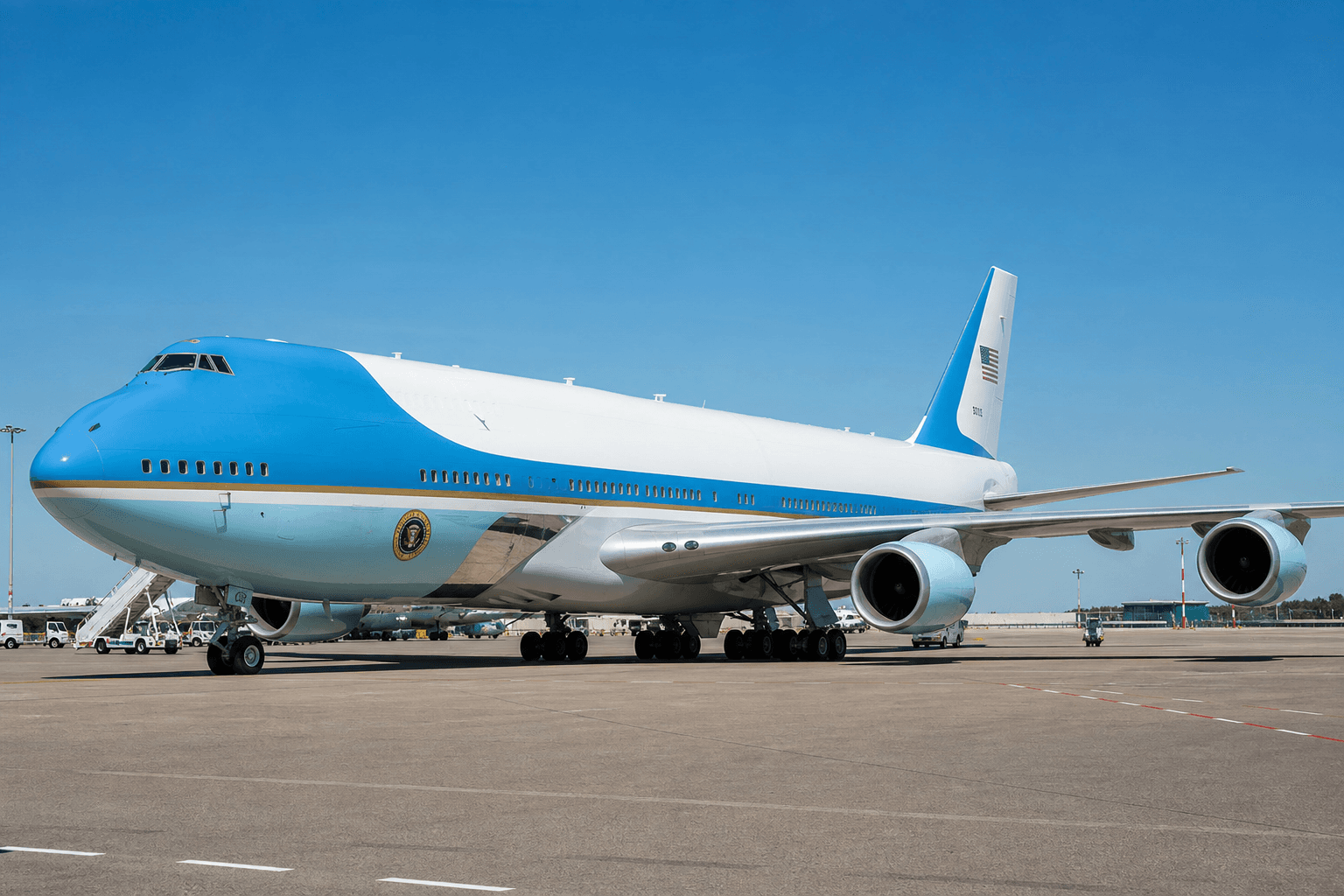
President Donald Trump's interim presidential aircraft has completed its first international mission, carrying the president to Türkiye for the 2026 NATO Summit. The Boeing 747-8 , widely referred to as the "$400 million bridge" Air Force One , departed the United States this week as Trump traveled to meet NATO leaders for talks expected to focus on defense spending, Russia's war in Ukraine, and alliance priorities.
RAAF's Australian-Built CT4A Trainer Retires After Nearly 50 Years
The Royal Australian Air Force's (RAAF) CT4A trainer aircraft has completed its final flight after nearly five decades of service, retiring the aircraft type that introduced generations of military pilots to the skies. The final display flight took place on June 18, 2026, over RAAF Base Point Cook in Victoria, the same location where both the Air Force and the CT4A's service began. An Australian-made legacy Introduced into Air Force service in 1975, the Australian-built CT4A was the first powered military aircraft that thousands of aviators would fly. For decades, it served as the foundation for operational careers across the Australian Defence Force. Wing Commander David Chaplin, who piloted the final display flight, said the aircraft's influence on Australian air power is hard to overstate. "There's a whole lot of air power that has come from this aircraft," Chaplin said. "It was the first powered aircraft I flew. I joined the Air Force here at Point Cook in January 1980, and when we arrived on base, all we could see were CT4s flying around." The @AusAirForce will withdraw eight aircraft from its heritage fleet as part of a program to ensure the long-term sustainability of preserving Australia's aviation history. The aircraft being withdrawn include the: RE8 CT4A Ryan STM-S2 English Electric Canberra… pic.twitter.com/oX8ajxC3F4 — Defence Australia (@DefenceAust) January 17, 2026 One aircraft, three branches The CT4A trained pilots across all three branches of the Australian military, serving as the starting point for aviators who would go on to fly air combat, air mobility, maritime patrol, and rotary-wing aircraft. "Pretty much everybody who came through the services completed training on that aeroplane – Army, Navy and Air Force," Chaplin said. Squadron Leader Peter Grieves, a reservist who completed his first military flight in the same aircraft now entering retirement, said the occasion brought back memories. "There'll be a lot of people catching up and sharing memories," Grieves said. "Some of them were stressful memories but still fond memories, especially here at Point Cook which teaches you to fly in just about every type of weather you can get." Closing a chapter For Chaplin, conducting the final display flight carried personal significance. "When the commanding officer asked me to conduct the flying display for the CT4's final day, it was a little emotional," he said. "After the display, I started thinking about all the people who had trained on the aircraft and all those who had supported it over the years – engineers, administrators, air traffic controllers and instructors." The final flight served as a tribute not just to the aircraft itself, but to the instructors who taught from its cockpit, the engineers who maintained it, and the generations of aviators who took their first steps toward operational service behind its controls. RELATED RAAF deploys P-8A Poseidon and E-7A Wedgetail to RIMPAC 26 exercise in Hawaii
The Daily Touch & Go
The day's best aviation news in your inbox. Free, no spam.