

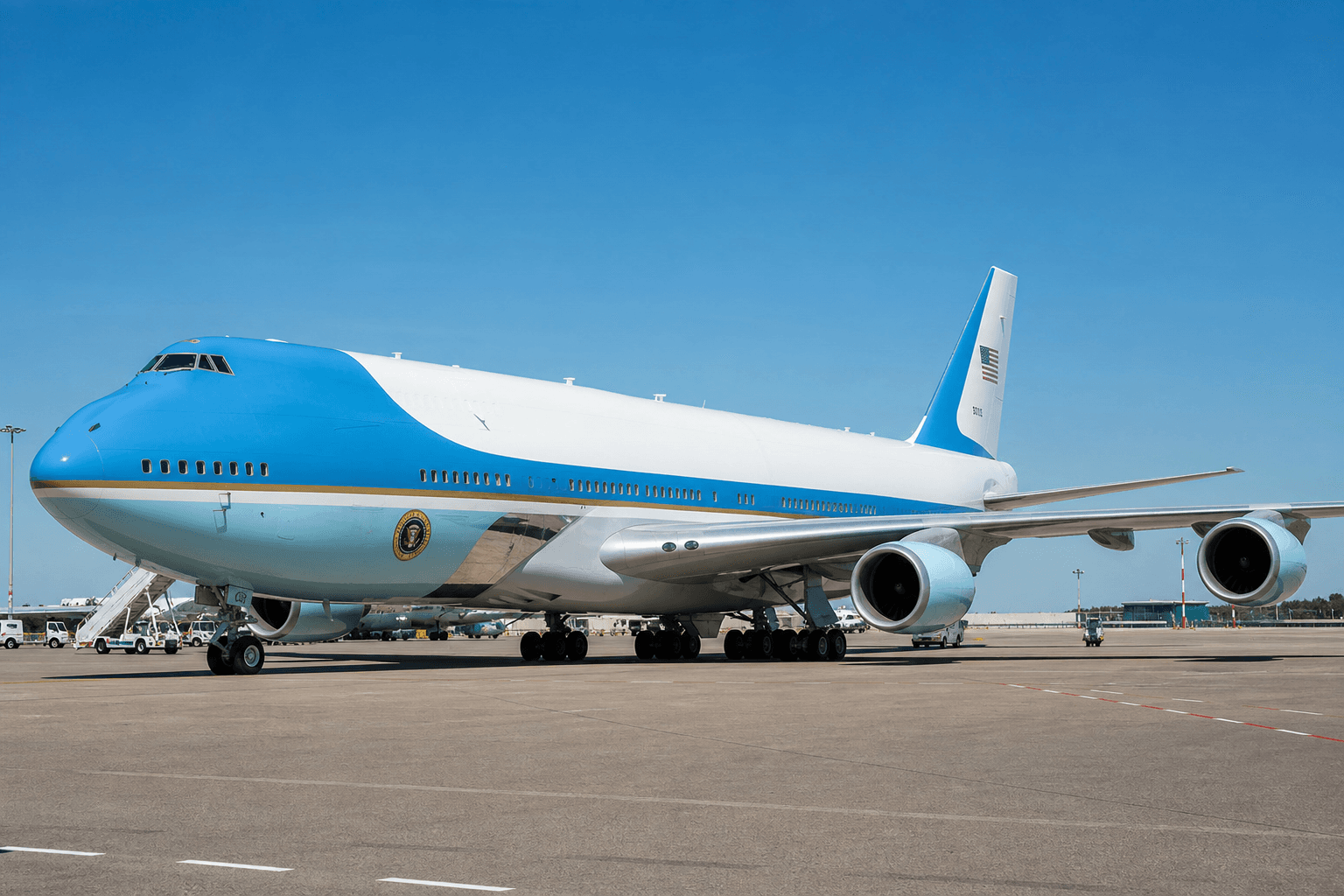
Illustration: The Touch & Go
Trump's Interim Boeing 747-8 Air Force One Flies First International Mission to Turkey NATO Summit
The $400 million Boeing 747-8, serving as a temporary Air Force One, completed its debut overseas trip carrying President Trump to the 2026 NATO Summit in Turkey.
The gist
The interim Boeing 747-8 Air Force One undertakes its first international flight, ensuring presidential travel continuity ahead of the new fleet arrival.
Continuing coverage
All Air Force One →- Trump Flies Older Air Force One to U.K., Sidelines New VC-25B Bridge Aircraft Temporarily
- EAA AirVenture Oshkosh 2026 to Showcase Cutting-Edge Aviation Technology and Historic Warbirds
- Trump's $400M Qatari-Gifted Boeing 747-8 Faces Uncertain Future at Miami Presidential Library
- VC-25A Air Force One Retires After 35 Years as New 747-8 'Bridge' Model Prepares for Service
- Trump takes first presidential flight on Qatar-donated VC-25B Air Force One
The Boeing 747-8 aircraft, acquired as an interim presidential transport during delays in the VC-25B Air Force One replacement program, has recently completed its inaugural international mission. This journey took the aircraft and President Donald Trump to Turkey for the 2026 NATO Summit, marking a key operational milestone for this bridge Air Force One. Valued at approximately $400 million, the Boeing 747-8 provides a modernized platform for presidential travel while the new VC-25B fleet is still under development.
Originally modified to serve executive transport duties, this 747-8 is temporarily filling the role left by the aging VC-25A planes that have long been synonymous with Air Force One. Although it lacks some of the permanent enhancements planned for the forthcoming VC-25B replacements, the aircraft delivers critical long-range capabilities and upgraded systems necessary for overseas missions. Prior to this trip, the 747-8 had only operated domestically, including participation in America 250 celebrations across the United States.
The NATO Summit in Turkey presented a complex environment requiring extensive logistics and coordination. The aircraft's deployment involved managing security protocols, diplomatic schedules, and multiple time zones. It effectively supported President Trump as he joined fellow alliance leaders in discussions focused on defense spending commitments, ongoing support for Ukraine amid the Russia conflict, and broader European security challenges. The summit’s agenda also included bilateral meetings, underscoring the aircraft’s role beyond mere transport, facilitating crucial diplomatic engagement.
Observers tracking the aircraft welcomed the arrival, capturing photos and videos that confirmed the 747-8’s readiness for international presidential duties. This mission demonstrated the aircraft’s capability to fulfill long-haul flights necessary for global diplomacy. The U.S. Air Force’s strategic acquisition of these Boeing 747-8s aims to ensure uninterrupted presidential airlift capacity during the protracted timeline of the VC-25B program development.
The significance of this flight extends beyond a simple presidential trip; it reflects a practical solution to fleet capability gaps. The extended service of the interim 747-8 allows the current U.S. presidential air transport to remain reliable and modernized. Although intended as a stopgap, the aircraft’s integration into official operations highlights the necessity of maintaining seamless executive mobility and national security standards in presidential travel.
While the permanent VC-25B Air Force One program remains the primary objective, this interim solution confirms the adaptability of U.S. Air Force resources. The aircraft’s successful international deployment may influence future decisions regarding fleet modernization and contingency planning for presidential transport. Until the delivery and commissioning of the next-generation aircraft, the Boeing 747-8 will continue to play an essential role in U.S. diplomacy and executive logistics.
Read more
All Military/Defense →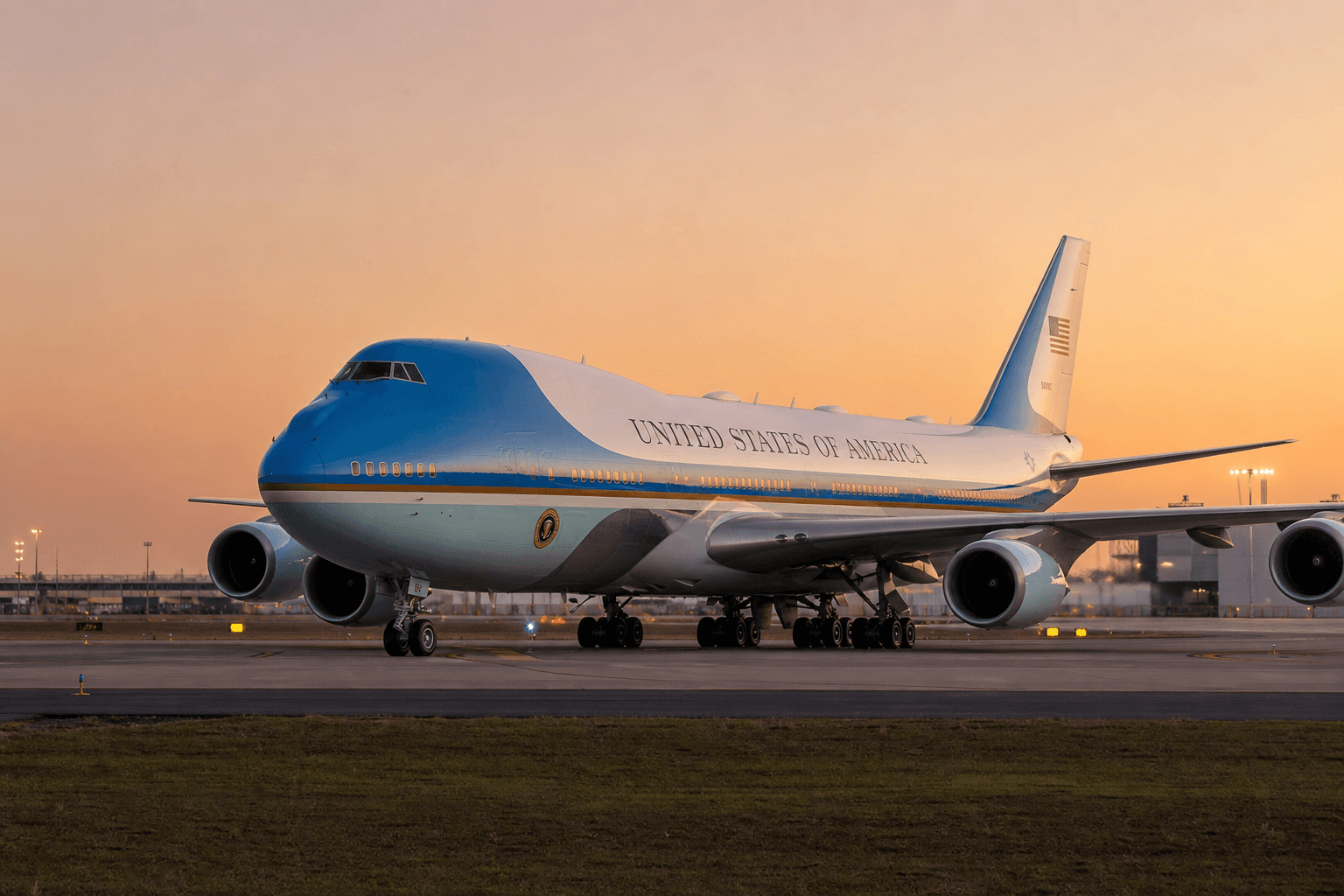
Trump's $400M Qatari-Gifted Boeing 747-8 Faces Uncertain Future at Miami Presidential Library
Trump's $400M Boeing 747-8 Air Force One faces legal, political, and logistical hurdles that could block its Miami presidential library future.
EAA AirVenture Oshkosh 2026 to Showcase Cutting-Edge Aviation Technology and Historic Warbirds
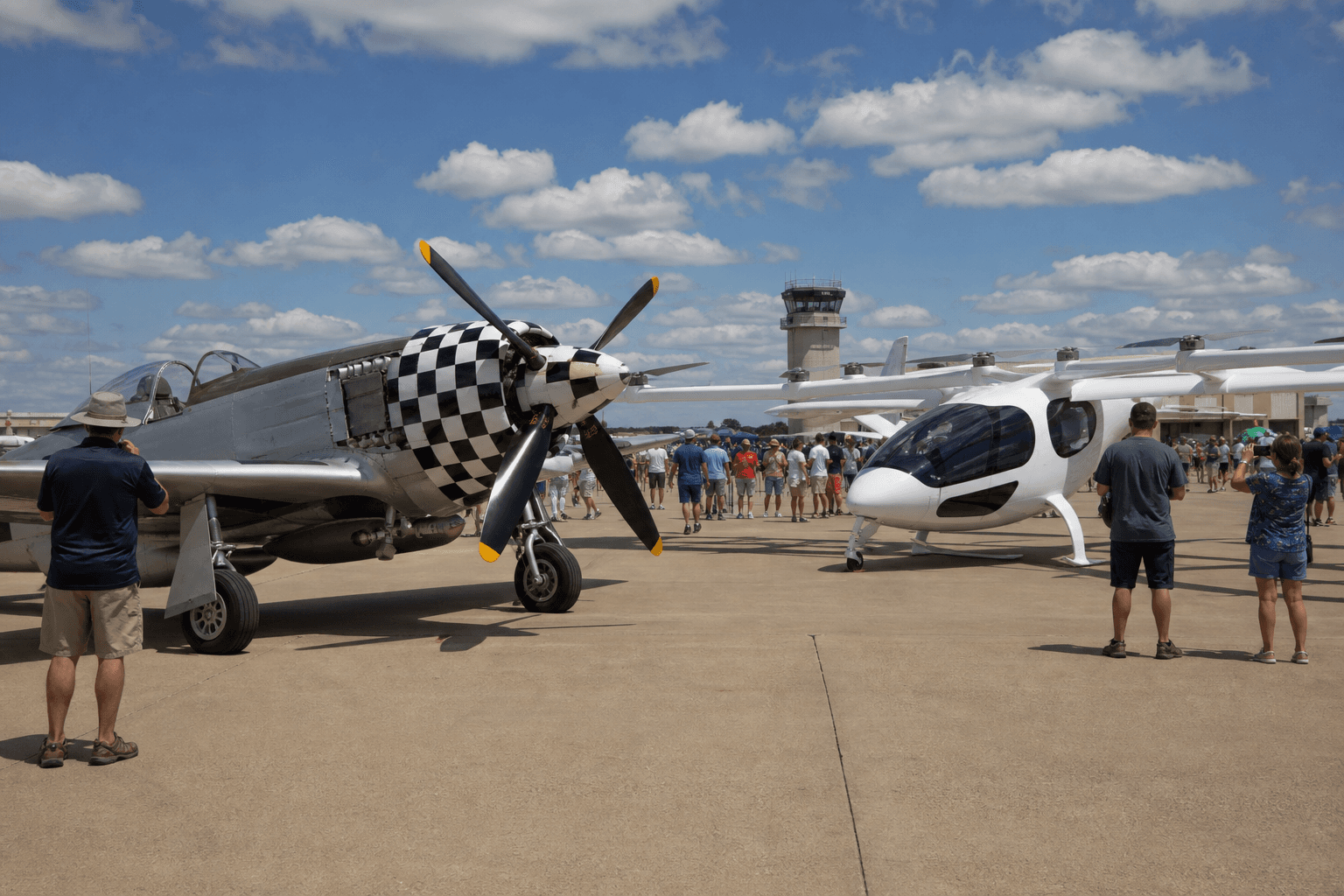
What to expect at EAA AirVenture Oshkosh 2026 and an interview with the Manager of Onsite Learning at the Smithsonian's National Air & Space Museum. Also, how L3Harris converted the Qatari-gifted 747 into Air Force One, the Cirrus TRAC10, window seat lawsuits, a rule change to allow supersonic flight over the United States, and an update on Boom Supersonic's strategy for its self-developed Symphony engine. Image by Linda and Lily. Guest Dick Knapinski is Director of Communications for the Experimental Aircraft Association ( EAA ). He has served in that capacity since 2010 and has been with the organization since 1992. Dick serves as the liaison between the media and EAA throughout the year, particularly during EAA AirVenture Oshkosh , the world’s largest fly-in convention. The event runs July 20-26, 2026. Dick Knapinski Boeing Plaza will be packed with aircraft to celebrate the aviation technology theme. Currently planned innovation displays for July 21 include BETA Technologies, Bye Aerospace, Jetson, American Drone, MagniX, Zipline, Embry-Riddle Aeronautical University, Airhart Aeronautics, Merlin Labs, Amazon Delivery, and Starlight Productions. In addition to the displays on Boeing Plaza, Bye Aerospace, Jetson, BETA Technologies, American Drone, and ScaleWings plan to fly during the afternoon air show. Drone delivery company Wing will display the latest developments in its operations at Twilight Flight Fest. Learn more about the AirVenture Airshows and performers , Aircraft Anniversaries & Gatherings , Authors Corner , AviationTech , KidVenture , and the Fly-In Theater . Rare warbird static/flying displays will include the B-29 “Doc,” as well as a rare Consolidated PB4Y and the CAF’s B-24 Liberator on static display at Boeing Plaza. Vicky Benzing will fly her P-51 “Plum Crazy,” and Bernie Vasquez will demo a Republic P-47 Thunderbolt in afternoon shows. The Aviation Gateway Park will spotlight helicopters, advanced vertical lift platforms, and eVTOL aircraft through static displays and interactive exhibits. Before joining EAA, Dick built a broadcasting career in Wisconsin, including stints as Program Director at WNBI Radio, News Director at WMGV Radio, and Station Manager at WLFM-FM/Wisconsin Public Radio. He also spent years as a sportswriter for the Appleton Post-Crescent. Dick holds a private pilot certificate and remains active as a writer and spokesperson for EAA. Aviation News How was the new Air Force One prepared for flight? The two permanent VC-25 replacements were selected in 2015, and the $3.9 billion fixed-price contract was signed in February 2018. Boeing began physical refurbishment work in February 2020 on two 747-8I airframes originally built for the bankrupt Russian carrier Transaero. Boeing has already reported $2.5 billion in losses on the program. The current delivery target for the first jet is between 2027 and 2028, with the second jet to follow later. The ex-Qatari 747-8 “bridge” aircraft was gifted to the U.S. Air Force in May 2025 and entered service on July 1, 2026. L3Harris did the conversion in about 10 months. The quick conversion was accomplished due to several factors: Pre-staged employees operated on a 24/7, three-shift structure. (Boeing has worked a normal single-shift industrial pace, with no incentive to surge, staff once costs started ballooning.) The bridge aircraft came with a luxury interior. (Boeing's jets had incomplete interiors – basically shells.) Missing VC-25 elements. Reports (unconfirmed by the government) include no evidence of defensive countermeasures and a lack of EMP hardening. L3Harris didn’t out-engineer Boeing. They ran a 24/7 surge crew on a plane that already had a finished VIP interior, targeted a much narrower requirement (“executive airlift” vs. full presidential command-post survivability), and the government has not been forthcoming about which hardened-aircraft features (EMP shielding, missile countermeasures, full secure comms suite) were omitted. See also: Trump wants the $400M Qatari-gifted new Air Force One to be the centerpiece of his presidential library. But there's a problem . Cirrus launches TRAC10, a new light aircraft for the flight training market Purpose-designed for flight schools and to be powered by a turbocharged Rotax 916 iSc FADEC engine, the plane has a three-seat interior, a Garmin flight deck, and the Cirrus Airframe Parachute System. Cirrus says they have 100 orders from 13 flight schools. United Airlines must face lawsuit over ‘window seats’ that lack windows Not every "window seat" has a window. Sometimes it has a wall. That's just the way it is. But last August, some passengers filed class actions against United Airlines and Delta Air Lines, claiming that the carriers failed to properly disclose the lack of a window during the booking process. United claimed that “window seat” described the seat’s location and did not contractually promise that the seat would, in fact, have a window. In San Francisco, U.S. District Judge James Donato rejected the airlines' request to dismiss the suit. New Rule Clears Way for Quiet Supersonic Flights By way of history: The FAA issued 14 CFR § 91.817 in April 1973, prohibiting civil aircraft from flying at speeds exceeding Mach 1 over land in the United States. The ban came as a result of early Air Force and NASA-controlled boom tests over cities, concerns over the Boeing 2707 SST program, and the impending arrival of the Concorde. NASA’s X-59 QueSST is flying specifically to gather community-response data on its “quiet boom” design. In a Notice of Proposed Rulemaking ( Proposed rule: Enabling Supersonic Overland Flight ), the FAA is looking to replace the blanket Mach-1 ban with a noise-based standard. Supersonic flight over land would be permitted if the boom signature falls under a certain loudness threshold. The NPRM states, "Manufacturers have demonstrated it is possible to fly supersonic aircraft without sonic booms reaching the surface by using sonic boom abatement techniques, making complete prohibition on civil supersonic flight outside of test areas no longer appropriate and an unnecessary restraint on the growth of the U.S. aviation sector." The NPRM shifts the regulatory trigger from speed to noise. Right now, § 91.817 just bans anything faster than Mach 1 over land. The proposed rule keeps that structure but adds an exception: an operator may exceed Mach 1 if it can demonstrate that the sonic boom’s overpressure at the surface does not exceed 0.11 pounds per square foot (psf). This NPRM only covers en-route/overland boom noise. A separate rule on takeoff/landing noise is expected later this year, with both rules targeted for finalization by mid-2027. The comment period ends August 17, 2026, at 11:59 PM EDT. Boom Supersonic Q2 2026 Update The FAA proposal to change from speed regulation to noise regulation is something Boom Supersonic and others have been seeking. In the Boom Supersonic Q2 2026 Update video, Blake Scholl reveals Boom's strategy for the Symphony engine. The company intends to market a variant of the engine for behind-the-meter power generation that AI companies can utilize for power. In large part, the engine OEMs wouldn’t develop an engine for the Overture because the huge development cost couldn’t be covered by the expected engine volume. So when Boom announced it was developing its own engine, the business case was unclear. But by focusing on the ground power generation market, Boom can spread development costs over a greater number of engines. Also, that revenue stream would generate cash flow for the Overture program. National Air and Space Museum Celebrates 50 Years With Opening of Five New Galleries Hillel attended the Smithsonian's National Air & Space Museum media preview of the opening of the five galleries. Last episode, we listene

Airbus and MTU Launch Joint Venture to Develop Hydrogen Fuel Cell Engines for Commercial Aircraft
As developers of electric and hybrid-electric aircraft experience growing pains , Airbus is doubling down on its ambition to produce a hydrogen-powered commercial aircraft. The European manufacturer on Tuesday revealed its plans to form a joint venture with Germany's MTU Aero Engines, which per its website claims its engine technology is found on one-third of the world's commercial aircraft. The new company will aim to develop a fully electric, hydrogen fuel cell-powered engine, with the objective of providing the first such system for a commercial aircraft. The nonbinding agreement follows a memorandum of understanding (MOU) the partners signed at the 2025 Paris Air Show. Airbus said it expects the joint venture to begin operations in 2027. The manufacturer said combining forces with MTU will create a "dedicated and highly agile" organization that is capable of accelerating the development, test, design, and certification of the fuel cell system. Bruno Fichefeux, head of future programs at Airbus, in a statement called it the "next logical step" toward the partners' shared vision of hydrogen-based propulsion. Per a news release, Airbus believes hydrogen could bring aviation's environmental impact more in line with that of electric ground vehicles. The only byproduct of the reaction between hydrogen and oxygen that occurs in the fuel cell is water vapor, which the manufacturer said will eliminate in-flight emissions. "By pooling our respective technology and expertise into a dedicated entity, we are establishing a European powerhouse capable of transforming advanced research into industrialised, certifiable electric propulsion systems," Fichefeux said. Stefan Weber, senior vice president of engineering and technology for MTU, added that "we want to create a company that covers the entire life cycle of fuel cell powertrains—from development and testing through certification to commercialisation." Regarding hydrogen, Airbus stands in stark contrast to its largest rival, Boeing. The American manufacturer has acknowledged hydrogen's potential as an alternative fuel source. But it has neither committed to incorporate the technology into its aircraft nor unveiled a hydrogen-powered concept. The agreement to form a hydrogen engine joint venture comes amid broader struggles for developers of sustainable propulsion technology. In the past few years, many have either folded, scaled back their ambitions, or been acquired by larger players. Airbus' Hydrogen Vision Airbus is king of the airframe, having led 2025 in commercial aircraft deliveries with 793, beating Boeing's 600. With MTU, it aims to lead the way in next-generation propulsion. The German company claims its engine technology powers one-third of the world's commercial aircraft, from corporate jets to widebody passenger airliners. It is also a primary industrial partner of the German Armed Forces, contributing to the engine for a next-generation European fighter jet. MTU does not build entire engines. Rather, it produces specialized components such as compressors and turbines in partnership with manufacturers. The firm also offers maintenance, repair, and overhaul. MTU's portfolio covers over 30 engine types, including the Pratt & Whitney Geared Turbofan (GTF) family that powers the A320neo. It also contributes to General Electric's CF6, which powers the A300 and Boeing 747, and GE9X, the intended engine for Boeing's long-haul 777X. Other projects include the NGFE, developed in partnership with Safran Aircraft Engines for a sixth-generation fighter, and the EJ200 engine for the Eurofighter Typhoon. MTU is also developing what it has dubbed the "Flying Fuel Cell." Per the company's website , the device is fully electric and uses a hydrogen fuel cell to power an electric motor, which drives the propeller using a gearbox. It is unclear whether the Flying Fuel Cell is intended to power the Airbus-MTU concept. But Airbus on Tuesday shared several updates to the program, including that MTU has "nailed down" the system's design and begun building a demonstrator. Airbus said MTU put its first test cell into operation this year and conducted the first test of the electric motor that will power it. Airbus in February 2025 reportedly scrapped its original 2035 target for flying a hydrogen-powered airliner. The aircraft manufacturer had been exploring four hydrogen-based "ZeroE" concepts since 2020. But in March 2025, it pivoted to focus solely on the hydrogen fuel cell architecture, finding it to be the most viable after fuel cell prototype and powertrain testing. Airbus shared a concept that features four electric propulsion engines, each powered by an independent fuel cell stack. It said in March 2025 that it aims to begin integrated ground testing of the system as soon as 2027. That same month, CEO Guillaume Faury cast doubt on the aviation industry's ability to meet its net-zero by 2050 targets. Sustainable aviation fuels (SAF) are viewed by experts as a more impactful solution than hydrogen, and Airbus is targeting a 100 percent SAF capability for all of its aircraft and helicopters by 2030. Since Airbus' pivot to the hydrogen fuel cell concept, other developers of novel propulsion systems have struggled. ZeroAvia—a leading developer of hydrogen-electric powertrains that could be retrofit on existing airframes—recently halved its workforce and delayed certification of its commercial ZA600 powertrain in favor of pursuing applications in autonomy and defense. In May, Dutch hybrid-electric regional aircraft developer Maeve Aerospace—a partner of Delta Air Lines, Skywest, Japan Airlines, and others— went bankrupt . In June, Switzerland's H55, the developer of an electric propulsion system that could be installed on multiple airframes, laid off about half of its workforce.
RAAF's Australian-Built CT4A Trainer Retires After Nearly 50 Years
The Royal Australian Air Force's (RAAF) CT4A trainer aircraft has completed its final flight after nearly five decades of service, retiring the aircraft type that introduced generations of military pilots to the skies. The final display flight took place on June 18, 2026, over RAAF Base Point Cook in Victoria, the same location where both the Air Force and the CT4A's service began. An Australian-made legacy Introduced into Air Force service in 1975, the Australian-built CT4A was the first powered military aircraft that thousands of aviators would fly. For decades, it served as the foundation for operational careers across the Australian Defence Force. Wing Commander David Chaplin, who piloted the final display flight, said the aircraft's influence on Australian air power is hard to overstate. "There's a whole lot of air power that has come from this aircraft," Chaplin said. "It was the first powered aircraft I flew. I joined the Air Force here at Point Cook in January 1980, and when we arrived on base, all we could see were CT4s flying around." The @AusAirForce will withdraw eight aircraft from its heritage fleet as part of a program to ensure the long-term sustainability of preserving Australia's aviation history. The aircraft being withdrawn include the: RE8 CT4A Ryan STM-S2 English Electric Canberra… pic.twitter.com/oX8ajxC3F4 — Defence Australia (@DefenceAust) January 17, 2026 One aircraft, three branches The CT4A trained pilots across all three branches of the Australian military, serving as the starting point for aviators who would go on to fly air combat, air mobility, maritime patrol, and rotary-wing aircraft. "Pretty much everybody who came through the services completed training on that aeroplane – Army, Navy and Air Force," Chaplin said. Squadron Leader Peter Grieves, a reservist who completed his first military flight in the same aircraft now entering retirement, said the occasion brought back memories. "There'll be a lot of people catching up and sharing memories," Grieves said. "Some of them were stressful memories but still fond memories, especially here at Point Cook which teaches you to fly in just about every type of weather you can get." Closing a chapter For Chaplin, conducting the final display flight carried personal significance. "When the commanding officer asked me to conduct the flying display for the CT4's final day, it was a little emotional," he said. "After the display, I started thinking about all the people who had trained on the aircraft and all those who had supported it over the years – engineers, administrators, air traffic controllers and instructors." The final flight served as a tribute not just to the aircraft itself, but to the instructors who taught from its cockpit, the engineers who maintained it, and the generations of aviators who took their first steps toward operational service behind its controls. RELATED RAAF deploys P-8A Poseidon and E-7A Wedgetail to RIMPAC 26 exercise in Hawaii
The Daily Touch & Go
The day's best aviation news in your inbox. Free, no spam.