

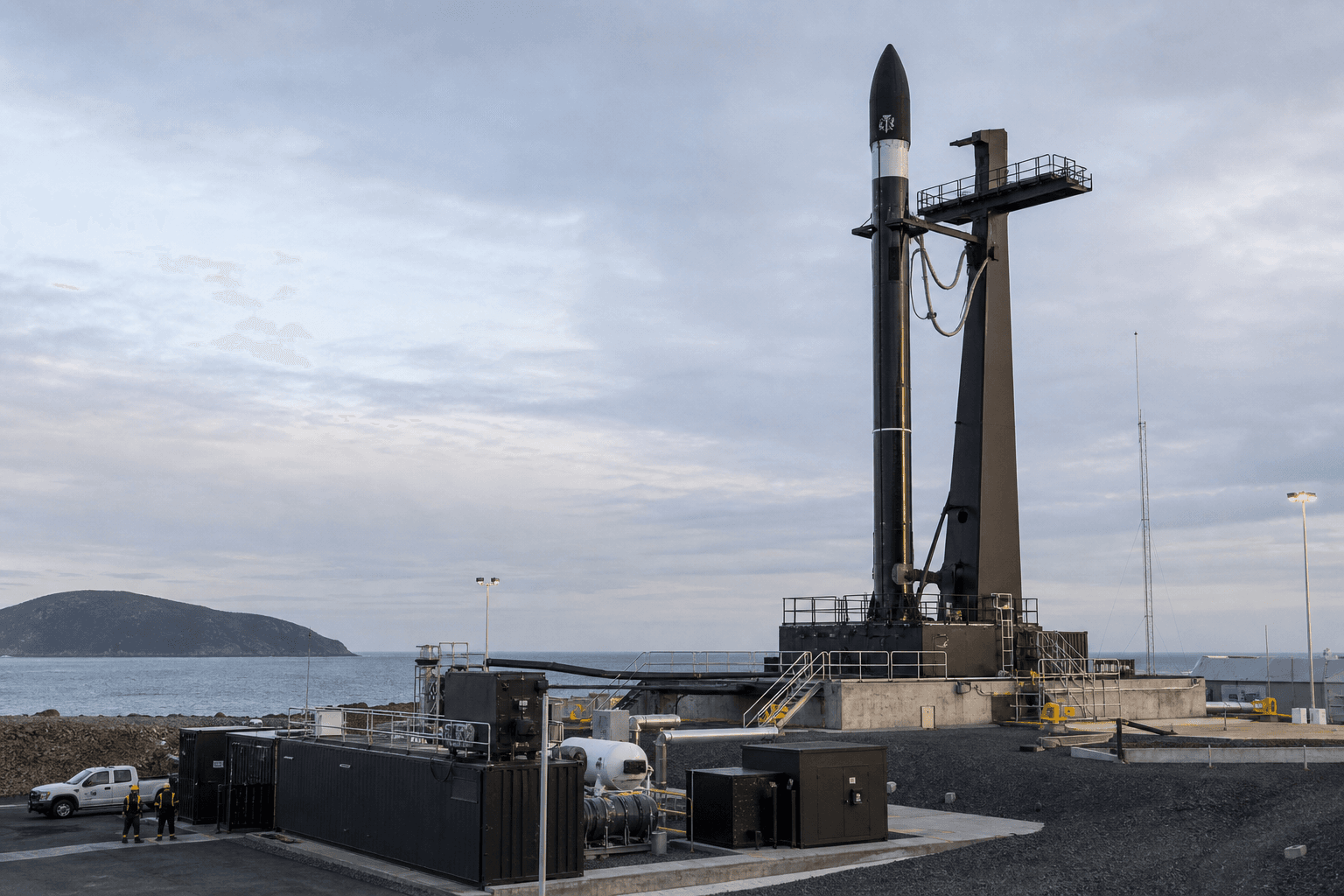
Illustration: The Touch & Go
Rocket Lab debuts GHOST containerized launch system with Alaska pads planned for 2027
Rocket Lab reveals GHOST, a modular container-based launch system enabling Electron and HASTE rocket operations worldwide, with first deployment at Kodiak Island in 2027.
The gist
Rocket Lab's GHOST containerized launch system will enable rapid deployment of Electron and HASTE rockets globally, starting with two pads in Alaska next year.
Rocket Lab has introduced its innovative GHOST system—Global Hypersonic & Orbital Spaceport Technology—a containerized launch platform designed to facilitate rapid deployment of its small orbital and suborbital rockets from various global locations. This pioneering approach integrates rockets, launch infrastructure, ground support equipment, and range control within standard shipping containers. The initiative aims to support multi-launch campaigns and time-sensitive national security missions, expanding Rocket Lab's operational flexibility and reach.
The GHOST concept prioritizes modularity and mobility, allowing deployment of orbital and suborbital launch capabilities without the need for permanent, large-scale spaceport facilities. The company announced the first planned GHOST launch complex, Launch Complex 4, located at the Pacific Spaceport Complex in Kodiak, Alaska. This facility will feature two pads to enable simultaneous or closely timed launch operations, targeting the system’s operational debut with a suborbital mission in 2027.
With these new pads in Alaska, Rocket Lab will expand its network to six launch sites worldwide. Currently, the company operates Electron launch pads at Launch Complex 1 in New Zealand and Launch Complex 2 in Virginia, USA. Additionally, Launch Complex 3 in Virginia is being prepared to support Rocket Lab's forthcoming Neutron rocket. The Alaska site represents a strategic extension of their launch infrastructure, particularly catering to missile defense and national security sectors.
Founder and CEO Peter Beck highlighted Rocket Lab’s leadership in small launch services tailored to missile defense and national security applications. He framed GHOST as a game-changing solution to enable allied countries to establish their own launch capabilities rapidly, circumventing the need for traditional permanent spaceport construction. However, Rocket Lab has not disclosed specific timelines or extent of fixed infrastructure required to activate GHOST at new locations.
GHOST supports two of Rocket Lab’s rocket families: Electron, a small orbital launch vehicle capable of deploying satellites to orbit, and HASTE, a suborbital derivative designed for hypersonic research and missile defense testing. By sharing much of the design and ground infrastructure between both vehicles, a single GHOST installation can accommodate orbital satellite launches alongside suborbital test flights.
The HASTE rocket leverages Electron’s carbon composite structure and Rutherford engines but replaces the orbital kick stage with a suborbital payload release system. It can carry up to 700 kilograms to speeds exceeding 7.5 kilometers per second and is compatible with various test payload configurations including air-breathing, boost-glide, and ballistic reentry platforms. HASTE first flew from Virginia in June 2023 and has supported technologies such as Australia’s DART AE scramjet demonstrator.
The unveiling of GHOST comes amid Rocket Lab’s significant $266 million contract from the US Space Force awarded in July 2026. This deal covers twelve dedicated suborbital launches, primarily from Kodiak Island, with options for additional missions. These launches are intended to bolster US missile defense capabilities, a sector where Rocket Lab is also collaborating with Raytheon on space-based interceptors operating under the Golden Dome program.
Further expanding its global footprint, Rocket Lab announced the establishment of Rocket Lab Germany GmbH in Munich. This subsidiary will focus on supporting European satellite manufacturing and provide launch services for Electron and the Neutron rocket. This move coincides with the company’s acquisition of Mynaric, a specialist in laser communications, reinforcing Rocket Lab’s integrated approach to space systems.
GHOST’s introduction signals a shift in how responsive, distributed launch operations might be performed, enabling rapid establishment of launch sites with reduced infrastructure footprints. The system’s debut in Alaska next year will be a critical milestone demonstrating the feasibility and operational capability of containerized space launch facilities for strategic defense and commercial applications.
Frequently asked questions
- What is Rocket Lab's GHOST launch system?
- GHOST is a containerized, deployable launch site system that packages rockets, launch infrastructure, and ground support equipment inside shipping containers to enable launches from flexible, new locations worldwide.
- Where and when will GHOST first be deployed?
- The first GHOST installation will be at the Pacific Spaceport Complex-Alaska on Kodiak Island, featuring two pads planned for operation starting with a suborbital launch in 2027.
- Which rockets are supported by the GHOST system?
- GHOST supports Rocket Lab's Electron small orbital launch vehicle and the HASTE suborbital rocket used for hypersonic and missile defense testing, sharing common infrastructure to support both types of launches.
Read more
All Military/Defense →
Archer Aviation Acquires Boeing's Wisk, Insitu, and SkyGrid to Expand Aerospace AI Platform
Archer Aviation is set to acquire Boeing’s Wisk Aero, Insitu and SkyGrid subsidiaries. The deal aims to create an end-to-end physical AI platform for aerospace and defense. Boeing will also invest in Archer and form a strategic partnership. ezstandalone.cmd.push(function () { ezstandalone.showAds(119); }); The companies announced definitive agreements on August 10, 2026. Archer will take ownership of the three Boeing units. Together, they combine decades of work in autonomy, electric vertical takeoff and landing ( eVTOL ) aircraft, and unmanned aircraft systems (UAS). This move adds a profitable defense business to Archer’s portfolio. Insitu alone generates more than $200 million in annual revenue and operates across 35 countries. The combined entities bring nearly two million flight hours of experience. ezstandalone.cmd.push(function () { ezstandalone.showAds(127); }); Combining Autonomy Expertise with Archer’s AI Wisk, SkyGrid and Insitu have developed core autonomous flight technologies. These will integrate with Archer’s purpose-built AI foundation model, called ZEE. The result positions Archer to deliver solutions across commercial aerospace, defense and air traffic management. Wisk stands out as the only company to design, build and fly six generations of eVTOL aircraft. It has completed more than 1,700 flight tests over 16 years. ezstandalone.cmd.push(function () { ezstandalone.showAds(128); }); Its team built advanced autonomy tools, including a next-generation flight-control computer, sensor suite and radar system. These support certification for both civil and potential defense uses. SkyGrid offers a ground-based, aircraft-agnostic air traffic management system. It creates a digital foundation for automated airspace. This enables safe integration, scalable automation and coordinated traffic management needed for wider aviation commercialization. ezstandalone.cmd.push(function () { ezstandalone.showAds(129); }); Insitu pioneers uncrewed aircraft systems for intelligence, surveillance and reconnaissance. Its portfolio includes high-performance, cost-effective, resilient and VTOL-capable UAS plus AI-enabled software. Insitu has manufactured and fielded more than 3,500 UAS. Its technology supports the armed forces of 35 nations. The company maintains offices in the US, Australia, the UK and the UAE, with support networks worldwide. Leadership Views on the Partnership Archer Founder and CEO Adam Goldstein called the deal a watershed moment. “This is the next big step forward in becoming a diversified platform, rapidly growing our revenue base and bringing scale to our business,” he said. ezstandalone.cmd.push(function () { ezstandalone.showAds(130); }); Boeing Vice President Brian Yutko, of Commercial Airplanes Product Development , described it as a win-win. “It allows Wisk, SkyGrid and Insitu to accelerate capability development and time to market while ensuring Boeing capitalizes on its investments in these technologies over the past two decades,” Yutko noted. He added that the transaction creates an industry leader in advanced aviation. Boeing looks forward to ongoing collaboration on innovation in aerospace, defense and autonomy. As part of the agreement, Boeing and Archer will share technology. Boeing keeps access to Wisk’s core autonomous flight technology for its current and next-generation commercial and defense aircraft. ezstandalone.cmd.push(function () { ezstandalone.showAds(131); }); The stake in Archer also lets Boeing retain strategic upside while focusing investments on its core businesses. Photo Credit: Archer Aviation Transaction Timeline The deal remains subject to closing conditions. These include expiration or termination of the waiting period under the Hart-Scott-Rodino Antitrust Improvements Act. It is expected to close by the end of 2026. Additional details appear in Archer’s Form 8-K filed with the Securities and Exchange Commission. Moelis & Company LLC serves as financial advisor to Archer, with Fenwick & West LLP as outside counsel. J.P. Morgan Securities LLC advises Boeing, and Mayer Brown LLP acts as its outside counsel. ezstandalone.cmd.push(function () { ezstandalone.showAds(132); }); This combination equips Archer to lead the next generation of aviation. It unites proven autonomy systems, airspace intelligence and a strong defense revenue base with its own AI and aircraft technologies. Archer aims to deliver innovative solutions across multiple markets. Boeing gains a focused path to advance its core work while sharing in the growth of physical AI applications.
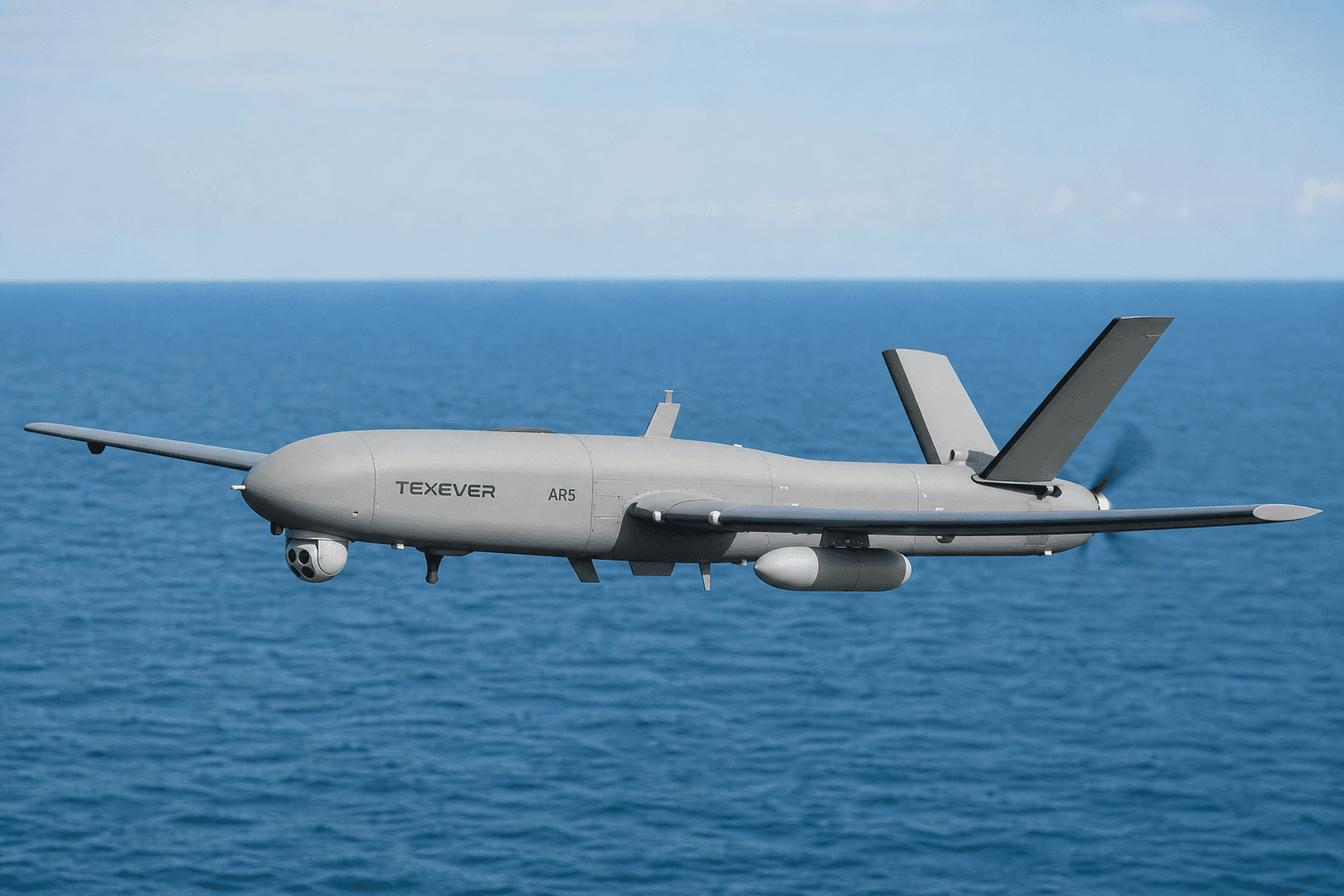
Portuguese Air Force to Launch Operations with Tekever AR5 MALE Drones in September
The long-endurance platform can remain airborne for up to 20h with a 50kg sensor payload. The Portuguese air force will begin operations with Tekever AR5 medium-altitude, long-endurance (MALE) uncrewed aerial systems (UAS) from next month, under a contract announced on 11 August. "Delivery of the systems and the achievement of initial operational capability [is] scheduled for this coming September," the company says. That will coincide with the completion of its delivery of an initial package of personnel training, it adds. The number of UAS covered by the deal has not been disclosed, but Tekever says it also includes the delivery of ground control station equipment and its Atlas mission system. The twin-engined AR5 can carry a mission and sensor payload weighing up to 50kg (110lb). "A second phase of training will take place in October, consolidating full operational readiness and the development of new skills among the operational teams," the Portuguese company says. Tekever cites expected operational tasks for the up-to-20h-endurance platform as including "maritime surveillance, security and defence missions", along with coastal and exclusive economic zone monitoring, and "public interest missions", such as providing support for firefighting and environmental protection operations. "This contract puts an autonomous capability developed and produced in Portugal to work in protecting our airspace and maritime capability," says Tekever director of strategic development Pedro Petiz. The Portuguese customer, meanwhile, notes that the new capability will "contribute to an air force that is better prepared to respond to present and future challenges". Lisbon's selection of the AR5 comes just weeks after the UK Ministry of Defence also picked the model to replace the Watchkeeper UAS operated by the British Army. Aircraft to be operated by the UK service will be produced at a Tekever factory in Swindon, Wiltshire, with the company expecting to make first deliveries before year-end.
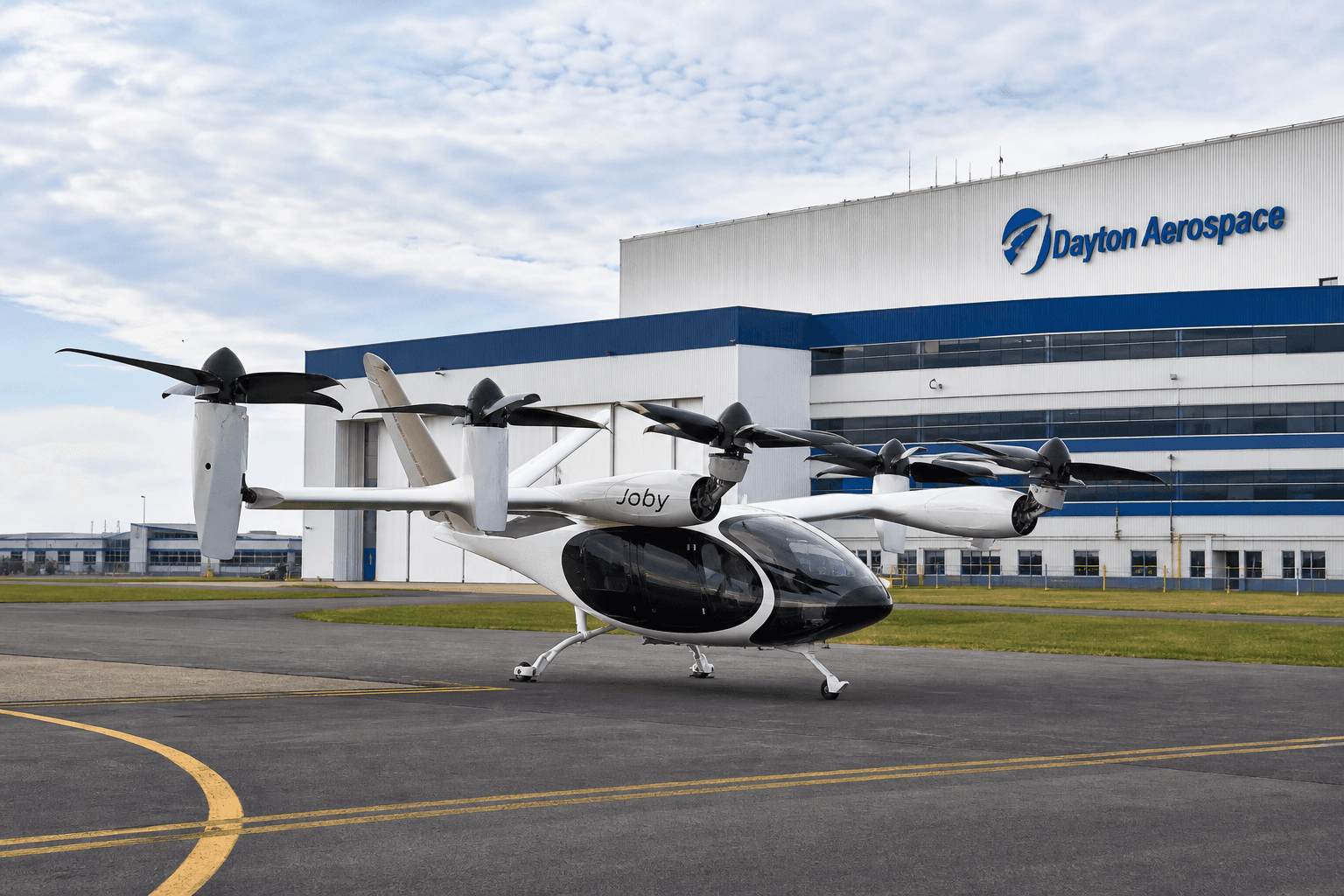
Joby Aviation to acquire Resonant Sciences for $500M to boost defense capabilities
Joby Aviation announced on August 11, 2026, that it has entered into a definitive agreement to acquire Resonant Sciences, a Dayton, Ohio-based defense technology company, for approximately $500 million. The deal gives the California eVTOL developer immediate scale in the defense sector through an already profitable business supporting active US national security programs. Founded in 2015, Resonant designs, manufactures and delivers radio frequency (RF) and mission systems for US national security customers and is a global leader in low-observability technologies, structures and subsystems. The roughly 250-person company also works in advanced sensing, electronic countermeasures, communications and autonomous systems. A profitable defense business Resonant generated more than $100 million in trailing-12-month revenue, up approximately 40% year over year, with adjusted EBITDA margins in the high teens. Bookings in the first half of 2026 were more than three times higher than in the same period of 2025, and backlog more than doubled year over year. Upon closing, Resonant will become Joby's dedicated defense business, continuing to operate under its own name and led by co-founder and CEO J. Micah North. Joby's existing defense initiatives, including the dual-use turbine-electric hybrid aircraft it has been developing with L3Harris since 2025, and its dual-use autonomy stack, will be folded into the new unit, while Joby's commercial organization keeps its focus on certifying and manufacturing its electric air taxi. Joby expands its Ohio footprint Resonant operates approximately 105,000 square feet across seven buildings in the Dayton area, with a further 125,000 square feet under construction, alongside facilities in Virginia, West Virginia, Michigan, Colorado and North Carolina. Combined with Joby's own manufacturing footprint in Ohio , the acquisition will give the companies close to one million square feet of manufacturing, integration and testing space in the Dayton region. JoeBen Bevirt, founder and CEO of Joby Aviation, described the deal as pairing "Resonant's established capabilities with Joby's globally leading aircraft propulsion technologies." North said joining Joby gives his team "additional engineering depth, aircraft platforms, autonomy technology and production expertise." Joby plans to fund the acquisition with approximately $450 million in cash and $50 million in Joby common stock, with certain Resonant employee stockholders retaining an ongoing equity stake. The transaction is expected to close in the first half of 2027, subject to regulatory approval. Joby and Archer go defense shopping The announcement comes a day after Joby's closest rival made an almost identical move. Archer Aviation agreed to acquire Boeing's Wisk Aero, Insitu and SkyGrid subsidiaries on August 10, 2026, a deal built around Insitu, the profitable ScanEagle and Integrator drone maker that generates more than $200 million in annual revenue. Within 24 hours, both leading eVTOL developers had moved to buy their way into established, revenue-generating defense businesses rather than wait for their own military programs to mature.
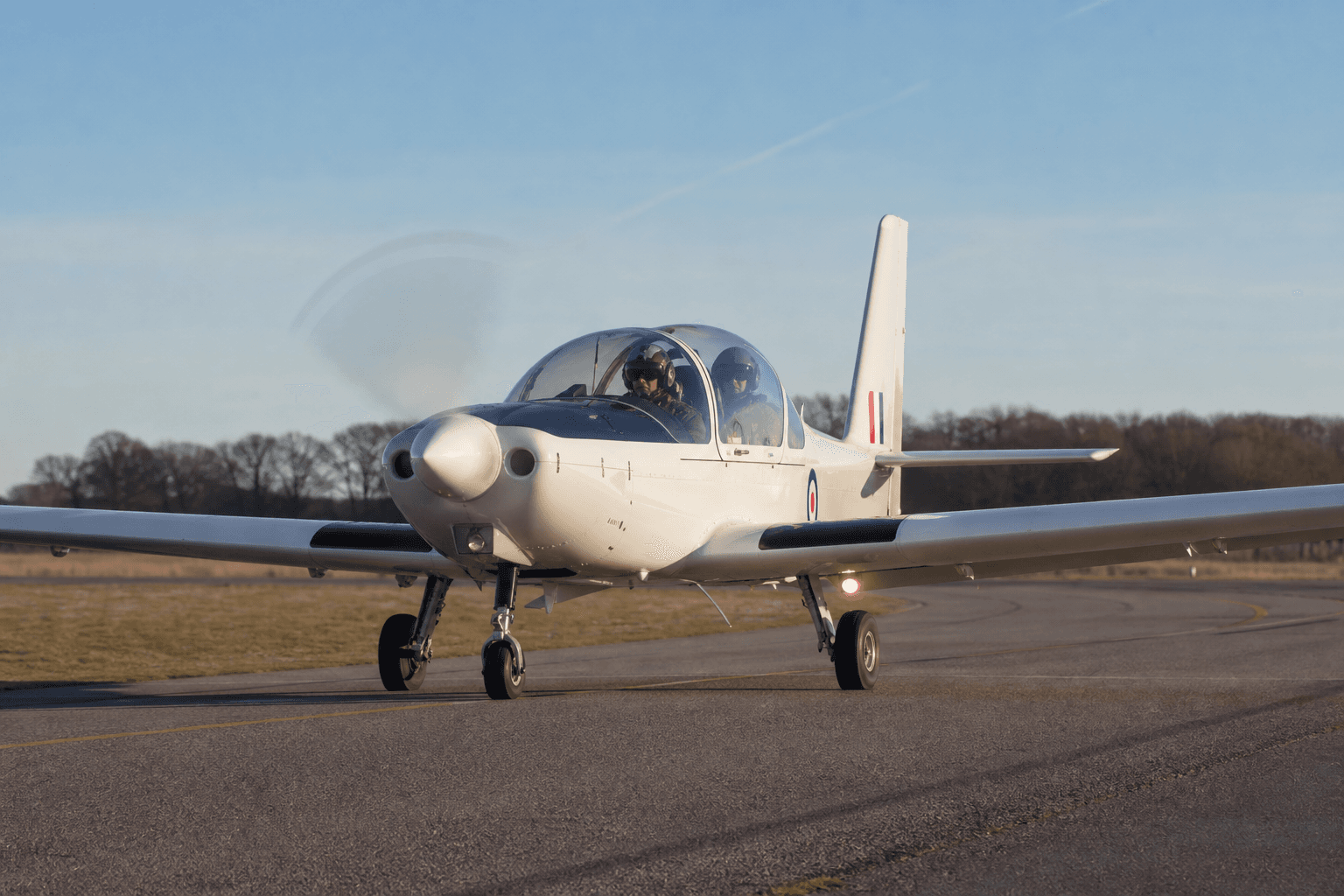
UK military flying training system approaches decade milestone with 110-aircraft fleet
UK Military Flying Training System providers detail current activities with 110-strong fleet. With the Royal Air Force's (RAF's) BAE Systems Hawk replacement need placed firmly in the news spotlight, what does the wider future of military pilot training look like in the UK? The current tri-service UK Military Flying Training System (MFTS) uses 110 aircraft across five fixed- and two rotary-wing types, employed from multiple bases, with its delivery led by Ascent Flight Training. FlightGlobal recently visited RAF Cranwell in Lincolnshire to get an overview of the now well-established MFTS programme, which has a current contract term running until 2033. Having acquired and introduced a fleet of 42 fixed-wing aircraft as a delivery partner on MFTS, Affinity Flying Training Services has to date provided just over 100,000 pilot training hours for the programme. Stood up in February 2016, the Elbit Systems UK and KBR joint venture company has provided 23 Grob Aircraft G120TP Prefects, 14 Beechcraft T-6C Texan IIs and five Embraer Phenom 100s, respectively operated in the elementary, basic and multi-engine pilot training roles. Service entry began in the 2018-2019 period. Affinity delivers services under a private finance initiative (PFI) model through which the Ministry of Defence (MoD) paid to take ownership of all the new training aircraft within five years. G120TPs are primarily flown from Cranwell, with typically around seven of the Prefects also operating from a nearby satellite base at RAF Barkston Heath. The Phenoms operate from Cranwell only, and the T-6Cs are located at RAF Valley on Anglesey, North Wales. The UK’s G120TP elementary trainers are mainly operated from RAF Cranwell in Lincolnshire. Source: Affinity Flying Training Services Announcing its latest major flight hours milestone in mid-July, Affinity noted that "half of the 100,000 figure was achieved in the last three years alone". "We are about aircraft on the flight line to meet customer demands," says Affinity managing director Iain Chalmers. Of its just shy of 210 employees, which include ex-military personnel and others with a background in civil aviation, roughly 140 are located in Lincolnshire, with the others in Wales. Affinity business director Alex Davison says the company has 75 engineers and technicians in Lincolnshire, along with operations staff, while the entire cadre of almost 70 personnel working at RAF Valley are from the former categories. With pilot throughput rising, the company and Ascent – a joint venture formed by Babcock and Lockheed Martin – are eyeing an opportunity to potentially boost the size of the T-6C inventory. The MFTS fleet was initially scaled as having 10 of the single-engined turboprops, before a follow-on batch of four was secured in 2022. "It's a demand issue, as there has been a bit of 'download' of some types of flying from [the BAE Systems] Hawk [T2], which is getting towards the end of its life," Chalmers says. "It's to make sure we've got enough capacity in there to guarantee getting students through." A new deal could potentially be for around four more of the aircraft. "This is a very live conversation," says Ascent managing director Chloe Barker. "We have been working really hard as industry with the MoD to find a way through this. There was an intention initially to bid for some MoD underspend. A few months down the line from that we have got some different [acquisition] models that we are exploring that are looking very positive." Phenom-enal performer With one Phenom in-depth maintenance at the time of our visit, the small business jet-based fleet is currently down to four operational examples only, but Chalmers notes, “We are flying more hours than we've ever flown on the Phenom despite that. "It's honestly brilliant," he says of the twinjet. "Up, down, as many times as you like a day, with something like a 98% dispatch rate." That includes meeting air force-specific needs such as formation flying and low-level instruction, he notes. Embraer’s Phenom 100 serves in the multi-engine pilot training role. Source: AirTeamImages Notably, the MFTS Phenoms do not feature modifications for their military role, beyond the aircraft's galley being used to accommodate additional avionics equipment. With its landing gear and engines removed – with the latter sent away for inspection and overhaul – the example currently in the hangar is the third of the fleet to undergo this major work. Meanwhile, Chalmers says: "The MoD is outsourcing for a two-year period to get an additional capacity hump" for multi-engine training provision, enabling it to support the RAF's Boeing RC-135 Rivet Joint and P-8A Poseidon fleets. Elsewhere within the same hangar at Cranwell, a trio of G120TPs are undergoing scheduled maintenance. The most intensive of those activities – performed after every 3,000 flight hours – involves removing the engine and wings, with maintenance work lasting between nine and 12 weeks. Other checks are required after intervals of 150h and 600h. In another recent milestone, May saw the 10th anniversary of rotary-wing training provision by Ascent at RAF Shawbury in Shropshire. Supporting that work, the MFTS fleet includes 29 Airbus Helicopters H135s and seven larger H145s, with the twin-engined models respectively named Jupiter and Juno for military use. Ascent – which has around 400 employees – also delivers rear-crew and observer training for the Royal Navy at RNAS Culdrose in Cornwall using four Beechcraft King Air 350-based Avengers. The highest-profile assets within the MFTS fleet are 28 Hawk T2s. Flown from Valley, those jets were acquired by the MoD outside of the PFI mechanism used for the rest of the programme. A long-awaited replacement process got under way in early August, when the MoD's National Armaments Director (NAD) Group issued a request for information linked to the Jet Training System (JTS) opportunity. That will deliver replacements not only for the Hawk T2 fleet but also for the aged Hawk T1s used by the RAF's Red Arrows aerobatic display team. A contest to replace the RAF’s Hawk T2s is entering its initial stage. Source: Crown Copyright The UK's Defence Investment Plan (DIP) of 30 June detailed an initial financial commitment of £360 million ($486 million) through the end of this decade in support of "full recapitalisation of the jet training system". Responding to that publication, Ascent said it "stands ready to work in partnership with the MoD to design and deliver the JTS, ensuring future pilots are equipped with the skills required to operate the most advanced combat aircraft… while sustaining high-value UK jobs and strengthening sovereign training capability for the long term". JTS rivals Likely contenders include a BAE-led offer of the T-7A Red Hawk, to be advanced in conjunction with Boeing and Saab; Korea Aerospace Industries' T-50; Leonardo's M-346; and the Turkish Aerospace Hurjet. It is unknown whether the selected JTS could also be required to conduct additional tasks such as serving as a companion light fighter or to perform adversary training duties. To be operated within a future structure dubbed "MFTS 2.0", the JTS aircraft are likely to be acquired directly by the MoD, with a contractor then paid to deliver a service against a set number of flight hours or sorties per day. "Ascent are absolutely keen to work with our customer to ensure that we get to the best, most effective, most integrated [training] model going forward," Barker says. "I expect that there will be a competition for a Future Flying Training System, or FFTS," she adds. "There are teams being set up within the MoD to start looking at that now. "From an Ascent point of view, I'm not resting on any laurels and expecting the current [MFTS] model to continue. There are a lot of things that we could do quite differently moving forward and should look to explore those." Unlike the current system, that could mean building a t
The Daily Touch & Go
The day's best aviation news in your inbox. Free, no spam.