

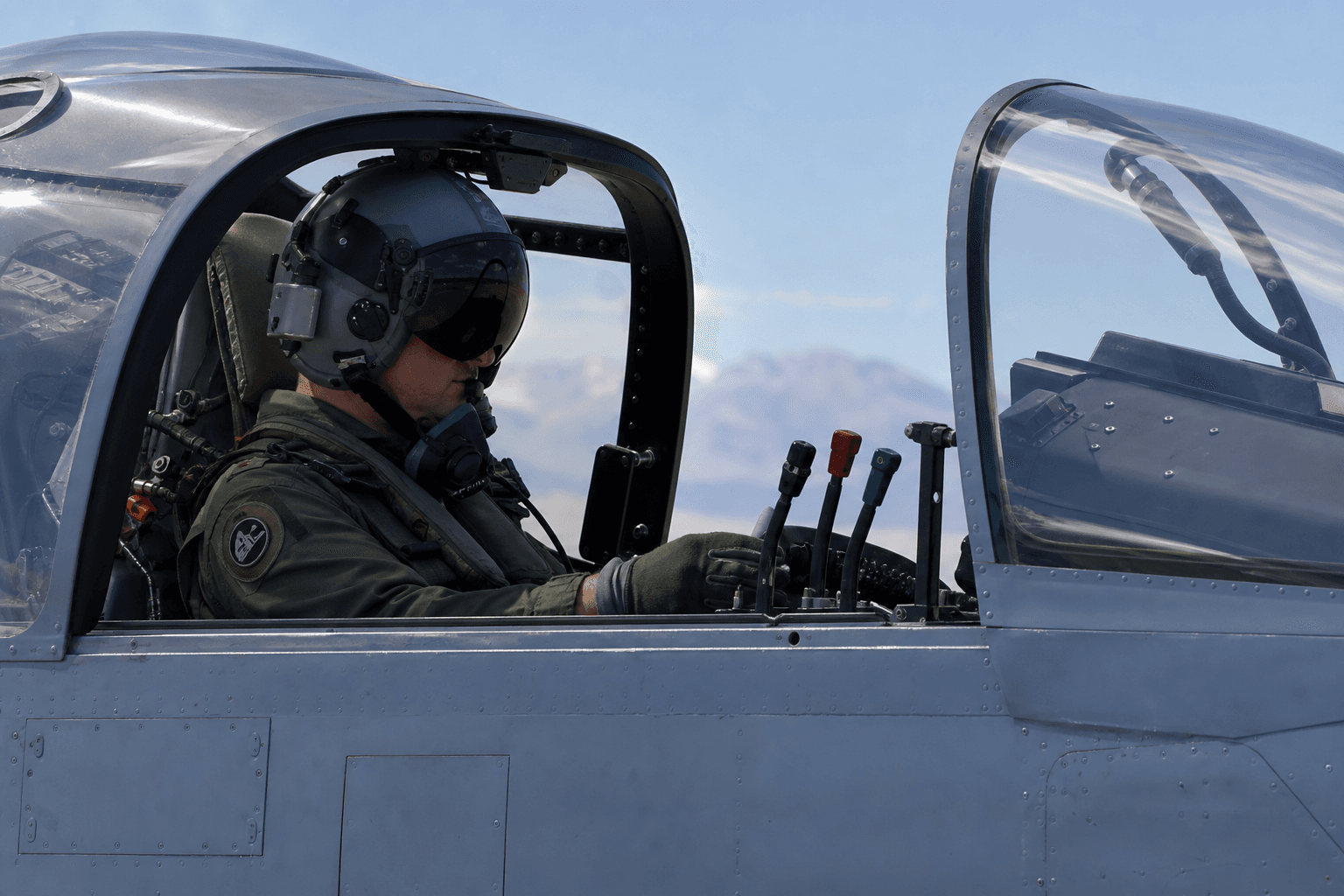
Illustration: The Touch & Go
Fuel Valve Design Confusion Leads to $17.9M Loss of Air Force OA-1K Skyraider II
A fuel control mishap caused by cockpit layout and pilot error ended in a crash of an Air Force OA-1K Skyraider II trainer, leading to the aircraft being written off.
The gist
Cockpit fuel valve confusion caused an Air Force OA-1K Skyraider II crash, destroying a $17.9 million aircraft with no injuries.
The U.S. Air Force Special Operations Command (AFSOC) has lost an OA-1K Skyraider II trainer valued at $17.9 million after a student pilot mistakenly shut off the emergency fuel valve during a training flight. The aircraft immediately lost engine power, resulting in a forced crash landing. The student pilot and instructor onboard survived without injuries, and an official Accident Investigation Board (AIB) released details pointing to a cockpit design flaw combined with human error as the root causes.
The mishap occurred when the student pilot, during their initial control time in the OA-1K, erroneously rotated the emergency red fuel shutoff valve clockwise to the OFF position instead of pulling the silver fuselage fuel tank valve lever. This single action cut off fuel to the Pratt & Whitney PT6A turboprop engine, causing an instantaneous engine failure. The pilot, who had 2,300 hours on a related platform (Pilatus U-28 Draco), had less than 40 total hours logged on the OA-1K, including about three in the specific Block 1 variant involved.
The AIB highlighted several compounding factors. Task saturation was significant: the student pilot was dividing attention among adjusting helmet volume knobs, flying the aircraft, handling autopilot functions, and executing checklist items. The critical fuel valve controls were mounted only inches apart on the panel, with poor visibility and markings. The larger power lever in the Block 1 variant obscured the silver fuel valve, while the red emergency shutoff handle was fully visible and more prominent, increasing the chances of confusion under pressure.
Flight deck communication breakdown further exacerbated the situation. The student pilot struggled with intercom audio issues throughout the flight, degrading crew resource management (CRM) during the emergency. After closing the fuel valve by mistake, the student did not immediately inform the instructor. They later reset the valve without notification. This delayed recognition and correction of the fuel cutoff reduced the available time to attempt in-flight engine restart procedures recommended by the emergency checklist.
Moreover, the investigation found missed opportunities in emergency handling. The crew failed to feather the propeller in time to improve glide characteristics, a critical step given the OA-1K's poor glide ratio and high drag from its large cowling and external equipment. The aircraft, a derivative of the Air Tractor 802 crop dresser, is a taildragger with limited forward visibility at low altitude, complicating forced landing efforts. The engine loss at only 2,300 feet left a narrow margin for response, and confusion about who was flying prevented timely control inputs.
The investigation concluded that the crash was entirely avoidable had emergency procedures been properly followed. The fuel starve was fully reversible by reopening the fuel valve and attempting an engine restart. Additionally, deploying the propeller feathering capability would have reduced drag, allowing a more controlled glide and more time to troubleshoot. The AIB faulted primarily the student pilot for the error but recognized how design deficiencies in crash cockpit layout contributed significantly.
This incident underscores the critical importance of cockpit ergonomics and clear, differentiated controls, especially during training phases with inexperienced pilots. While the OA-1K Skyraider II is designed as a rugged attack platform built around a powerful turboprop, the arrangement of fuel controls places crucial levers in close proximity, increasing risk under task saturation. The investigation’s imagery shows the red emergency lever clearly visible and immediately in sight, while the correct silver valve is obscured behind the larger throttle lever.
The outcome is an instructive example of how even a highly experienced pilot in one type (2,300 hours on a related platform) can be undone by subtle differences in cockpit layout and configuration between aircraft variants. The mishap is a costly lesson revealing the performance risk posed by control misidentification in high workload environments and the imperative to improve design and training to prevent such errors.
Frequently asked questions
- What caused the engine failure in the Air Force OA-1K Skyraider II crash?
- The student pilot mistakenly rotated the red emergency fuel shutoff valve to off, cutting fuel supply and causing the engine to fail instantly.
- Were there any mechanical faults found with the OA-1K aircraft after the crash?
- No mechanical faults were found; the engine failure was due to pilot error interacting with cockpit fuel valve placement.
- How did cockpit design contribute to the crash?
- Poor visibility and proximity of fuel control levers, with the silver fuel valve partially obscured and the red emergency valve prominent, led to the pilot selecting the wrong valve in a high workload situation.
Read more
All Aviation Safety →
Frontier Airlines Faces Data Breach Investigation Amid Cybersecurity Concerns
Lawyers are already searching for potential victims in a data breach at Frontier Airlines after the Denver-based ultra-low-cost carrier disclosed a potential cybersecurity incident to the Vermont Attorney General late last week. So far, Frontier Airlines has not provided any specific details about the nature of the data breach, including how many customers may have been affected, and what data has been compromised. That lack of information, however, has not stopped national class action law firm Edelson Lechtzin LLP from opening its own investigation into the data breach with a view to potentially suing Frontier for failing to keep its customers’ data secure. A slew of international airlines have been hit by cybersecurity incidents in the last couple of years, the majority of which were linked to a third-party customer service IT platform that was used by numerous high-profile companies. Two of the airlines affected by this widespread breach were Air France and KLM Royal Dutch Airlines, which informed customers last August that anyone who had recently been in touch with their customer service departments could have had their personal data compromised, including their full name, contact details, and frequent flyer status, and the subject line of service request emails. Australian flag carrier had earlier announced that it was also caught up in the same data breach of the software supplied by the US-based company Salesforce. In all of these recent cases, the hackers are not believed to have accessed data such as credit card information or passport numbers, but privacy experts have warned that the stolen data could still be used in a sophisticated identity theft scam. The hack attacks occurred at a time that the entire airline industry was put on alert to the threat posed by international hacking groups, including the infamous Scattered Spider group. Rather than using computer code to hack computer systems, Scattered Spider often uses 'social engineering' to gain access to restricted databases, convincing IT helpdesks to grant them access to sensitive computer systems by pretending they are a real employee who has been locked out of their account. Other airline victims of recent data breaches include Hawaiian Airlines and WestJet. While all of these attacks didn’t have any operational impact, last September, a major cyber attack took down check-in systems at several European Airports, including London Heathrow, Berlin Brandenburg, and Brussels Airport. The check-in system was the Collins Rockwell Muse system, which is owned by Collins Aerospace, a US-based aerospace company. It took days for Collins Aerospace engineers to fix the system, leading to hundreds of flight cancellations and delays. In 2024, Seattle-Tacoma International Airport fell victim to a major ransomware attack that took down check-in and baggage handling systems, as well as information display screens across its terminals for days on end. The Port of Seattle later said that a cyber hacker group known as Rhysida was behind the attack and had threatened to release stolen data from the airport onto the dark web unless a ransom was paid. Officials refused to pay the ransom and promised to beef up its IT security to prevent a similar outage in the future. Frontier Airlines did not immediately respond to a request for comment.
Deaf Man Sentenced to 18 Months for Targeting Delta Pilot with Laser Pointer Near Buffalo Airport
A deaf man from Cheektowaga, New York, has been sentenced to 18 months in a federal prison after he pleaded guilty to aiming a laser pointer at the pilot of a Delta Air Lines plane, which was on its final approach to land at Buffalo Niagara International Airport. 31-year-old Joseph L. Crapsi had been fighting the prosecution brought by the Assistant U.S. Attorneys Charles M. Kruly and Craig R. Gestring following an investigation by the Niagara Frontier Transportation Authority Police Department and the FBI. Crapsi’s attorneys had asked the court to suppress evidence that the laser pointer was found in his bedroom and objected to a finding that police had probable cause to arrest him. In the end, however, the court found that the police were within their rights to arrest him, and the laser pointer was used in evidence. The case stemmed from an incident on the night of March 2, 2024, when Delta flight DL-2334 was coming into land. The final approach path saw the jet fly close to Crapsi’s house in Cheektowaga, just a few miles from Buffalo Niagara Airport. Following the incident, the pilot reported the ‘laser strike’ to police, who started making enquiries in the area that the crew said the laser was coming from. One of Crapsi’s neighbors told officers that they saw a laser shining through his window on ‘multiple occasions.’ Given that the laser was seen shining into the sky, the court ruled that this was sufficient to meet the low standard of probable cause. Officers knocked at Crapsi’s address and were invited inside. They went with him to his bedroom, where they noticed a laser pointer ‘in plain sight.’ The laser pointer was seized as evidence, and Crapsi was arrested. Crapsi eventually pleaded guilty to aiming a laser pointer at an aircraft contrary to 18 U.S. Code § 39A, which carries a maximum sentence of five years imprisonment. Late last week, U.S. District Judge Lawrence J. Vilardo sentenced Crapsi to 18 months’ imprisonment. In 2023, there were a record 13,304 laser pointer incidents reported across the United States – an increase of nearly 80% compared to 2016. The number of incidents have, however, slightly decreased in recent years. In 2024, there were 12,840 reported laser incidents, and 10,993 were reported in 2025. So far this year, there have been 3,325 incidents up to the end of June. It was made illegal to aim a laser pointer at aircraft in 2012, following a dramatic rise in the number of incidents being reported by pilots. The Federal Aviation Administration (FAA) reports that the vast majority of laser strikes occur on Fridays and Saturdays, with a noticeable increase in reports during the months of October and November. Laser incidents can temporarily blind and injure pilots. In one incident involving a Virgin Atlantic flight from London to Tel Aviv, Israel, the pilots had to return to London because the pilot’s vision got progressively worse and he was only able to see out of one eye.

Cirrus Debuts SF50 G3 Vision Jet With Advanced Avionics and Enhanced Comfort
It was in the middle of a flight to explore the capabilities, handling, and operating envelope of the Cirrus SF50 G3 Vision Jet that it happened. Ensconced at FL 220, a modest height for a jet with a max operating altitude of FL 310, with the features of the Garmin Perspective Touch+ automation gracefully keeping the aircraft in the proper groove in the sky, I finally had time to simply look around and enjoy the experience. My overall impression was that the large flight deck and cabin windows allowed me to see much more of the sky, the world, and the airframe of this jet than I ever have in an airplane that didn't have a bubble canopy. The air was dead smooth, and despite a ground speed north of 300 knots, it felt as if the flying machine were suspended in the sky, with the earth turning beneath us. I was seated as comfortably as I have been in any aircraft, savoring the extent of the view when it hit me. This Article First Appeared in FLYING Magazine If you're not already a subscriber, what are you waiting for? Subscribe today to get the issue as soon as it is released in either Print or Digital formats. Subscribe Now I was on a magic carpet, every bit as luxurious and capable as those of ancient tales. All that remained was for adventures to begin as it carried me forward. Vision Jet Development How did a general aviation manufacturer get here, delivering over 700 of the first general aviation, single-engine, single-pilot personal jets with the Cirrus Airframe Parachute System (CAPS)? Cirrus did it the same way musicians get to Carnegie Hall, with practice, hard work, progressive thinking, and a plan for the future. Cirrus succeeded where at least seven other companies did not. Even before the Vision Jet became hopeful drawings, the manufacturer was designing its SR Series (SR20, SR22, SR22T) with flight decks, performance profiles, and sophisticated avionics with the goal of making it realistic for a competent SR pilot with significant IFR experience to step up into its planned but as yet undesigned jet. In 2007 Cirrus principals Dale and Alan Klapmeier began publicly talking about "the jet" that was being designed in what they called the company's "Moose Works" in Minnesota. It was to be similar to the SR series and capable of being stored in the same 40-by-40 hangar that could house a Cirrus SR22. READ MORE: We Fly: ScaleWings SW-51 Is So Real, It's Surreal READ MORE: We Fly: Pilatus PC-12 Pro An early prototype was flown in 2008, a bad time for general aviation overall, so it was not until 2014 that there was enough capital to build and fly a conforming prototype. In 2016 the first production SF50 flew, the jet received FAA type-certification, and deliveries began. Since then, Cirrus has shown that pilots with experience in high-performance, piston-engine airplanes can step up into the SF50, pass the type rating practical exam on the first try, and safely operate the jet in the real world. Cirrus has also made upgrades to the Vision Jet, most notably with the G2 in which it upped its maximum altitude from FL 280 to FL 310, bumped max cruise up to 317 ktas, and installed the Garmin Perspective Touch+ integrated flight deck. Along the way, "Safe Return Emergency Autoland," Garmin's Autoland, was added and payload and performance boosted. G3 Vision Jet Model In February, Cirrus announced and began deliveries of the G3 Vision Jet with some 30 enhancements, primarily to increase the capabilities of the avionics, visibility of the plane, and comfort for those in the cabin. Without attempting to go into all the G3 improvements, I'll look at some that grabbed my attention. From an operational and pilot workload perspective, the ATC Data Link (Cirrus also uses the acronym CPDLC for Controller-Pilot Data Link Communication) system, allowing text communications between a controller and the jet, is way up there in providing support to a pilot. The pilot initiates contact with ATC through the CPDLC and starts receiving clearances, new radio frequencies, altitudes and routes via text message. A tone alerts the pilot to an incoming message. The pilot reads it, decides if it can be complied with and, if so, taps the Wilco and send buttons. If unable to comply, the pilot can say so and explain why, just as we do now via voice—except this is faster. Plus, the message is saved, so the pilot has, for example, the route clearance written out in much better handwriting of their own. Ergonomic leather seats are notably comfortable on the Cirrus SF50 G3 Vision Jet. [Credit: Erin Armstrong] If desired, the pilot can tell the system to load the clearance into the Garmin automation, setting up the route, initial altitude, and additional information. The pilot then just confirms that everything loaded correctly and activates the change. En route, a call to change frequencies doesn't take up airtime, the pilot sees the frequency written (less chance of loading it incorrectly), punches Wilco and send to confirm receipt and compliance, and has the new frequency loaded into the appropriate comm radio in either the standby or active position. It's delightfully easy, and there's no back and forth with a controller trying to get the numbers right. Another new feature is a time-saver anyone operating an aircraft should like—all databases are automatically updated while the Vision Jet is parked with Cirrus IQ Pro Advanced. Alerts-linked checklists are almost a third hand for a single pilot when something out of the ordinary pops up. In the event the electronic alerting system advises them of an abnormal or emergency event, it also pulls up the appropriate checklist—no more pulling out a thick binder and finding the appropriate one. As the pilot deals with each checklist item, they use the scroll wheel to track and then click on it, and the cursor moves to the next item. That continues until the checklist is complete and the situation has been handled or it's time to put the jet on the ground—and the electronic checklist provides guidance for that as well. Having used Garmin's Taxiway Routing and 3D SafeTaxi in other aircraft, I'm glad to see that safety feature in the Vision Jet. No matter how many times I've gotten into a Vision Jet, I am always mildly surprised how big the cabin is. For the G3, Cirrus has made even better use of the space. Until now, the SF50 could hold five adults and two kids—one adult in the center of the rear bench seat flanked by the two children. All the passenger seating has been reworked. The rear bench seat now holds two adults, one on each end, with space and a restraint system for a child between them. Although the passenger seats still use the same attach points, they have been upgraded in a fashion that gives 2 inches more legroom for the rear seat and smoother operation of the middle seats. Use of new foam makes what I always thought were comfortable seats even more so. As Cirrus was developing the SF50, it was also considering appropriate training for the required type rating. If it's a jet, the PIC must have a type rating in it, which involves a check ride to ATP performance standards with an examiner satisfactory to the FAA. Planning for pilots stepping up from its SR series, Cirrus decided to keep the Vision Jet training in-house, at its Knoxville, Tennessee, Vision Center containing two full-motion Level D flight simulators. Cirrus personalizes type training by working with the new owner-to-be beginning several months before the formal type rating training is to begin. Delivery of the aircraft is not tied to the training schedule, reducing pressure during training. The Basics Powering the SF50 is a Williams International FJ33-5A jet engine developing 1,846 pounds of thrust. Maximum operating altitude is FL 310, where its max cruise is 317 ktas while burning 65 gph. At that height the pressurization system generates an 8,000-foot cabin altitude. Maximum ramp weight is 6,040 pounds with max

Man sentenced to 18 months for shining laser at Delta flight nearing Buffalo airport
A man who aimed a green laser pointer at a Delta Air Lines flight on approach to Buffalo Niagara International Airport (BUF) has been sentenced to 18 months in prison. During the March 2024 incident, Joseph L. Crapsi, 31, of Cheektowaga, repeatedly aimed the laser at the aircraft during the critical phase of flight.
The Daily Touch & Go
The day's best aviation news in your inbox. Free, no spam.