

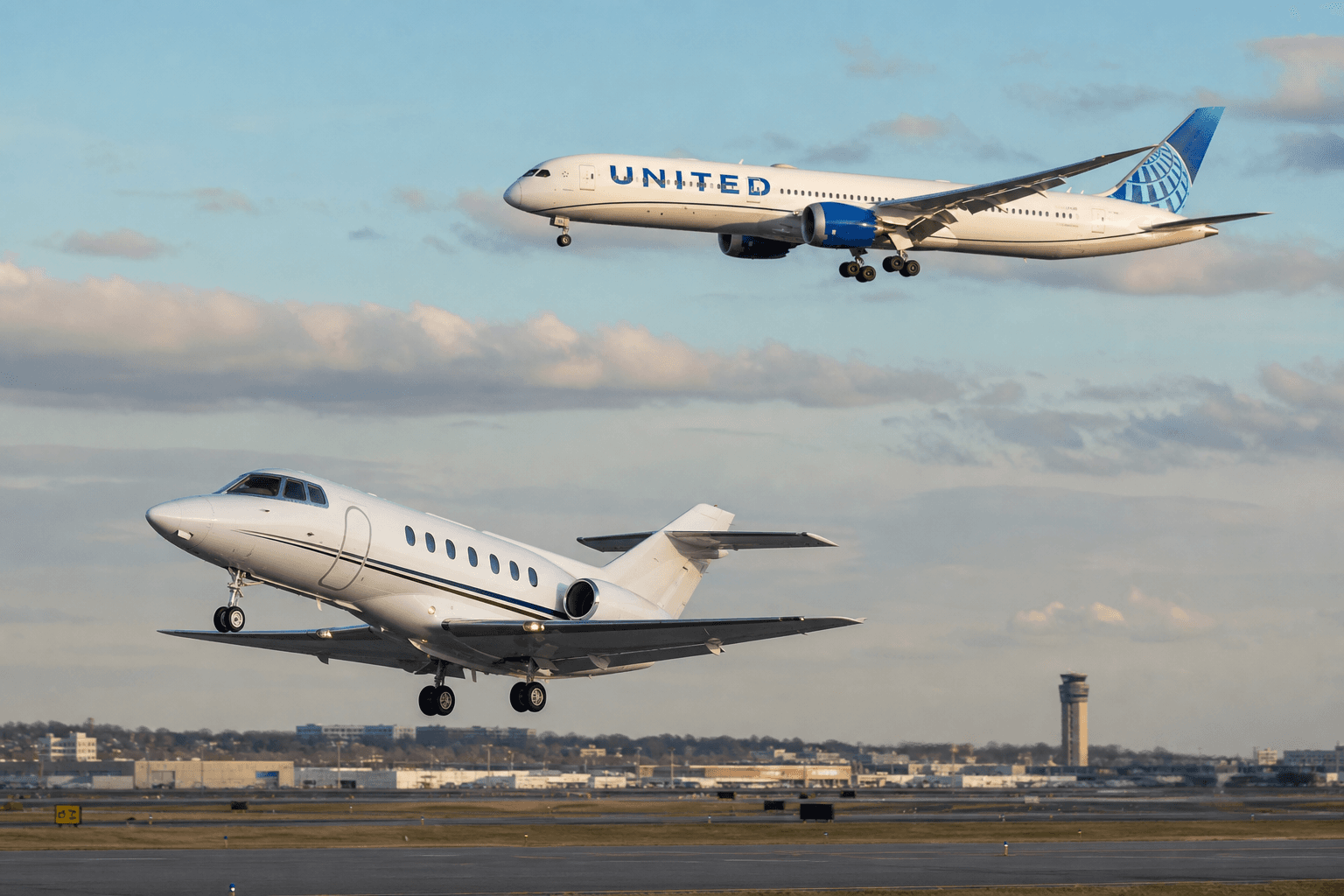
Illustration: The Touch & Go
Private Jet Pilot Flies Into Path of United 787 Over Newark Amid ATC Confusion
A private Hawker 800XP departing Teterboro nearly collided with a United Airlines Boeing 787 approaching Newark, exposing critical miscommunications between pilot and air traffic control.
The gist
Misread instructions and unclear ATC communications nearly caused a midair collision between a private jet and a United 787 over Newark airspace.
Continuing coverage
All Private Jets →On the evening of July 8, 2026, a potentially dangerous near-miss occurred in the congested airspace around Newark Liberty International Airport involving a private Hawker 800XP and a United Airlines Boeing 787-10. The Hawker 800XP, registered N58DH, was departing Teterboro Airport bound for Merida, Mexico, while the United flight, UA1981, was arriving from Los Angeles. The two aircraft converged unexpectedly, causing the United flight crew to receive a Traffic Collision Avoidance System (TCAS) Resolution Advisory, prompting evasive maneuvers to maintain safe separation.
The incident was captured in detail through air traffic control (ATC) audio and visualization footage, revealing a sequence of miscommunications that significantly contributed to the risky situation. The private jet pilot repeatedly failed to comply with ATC instructions, which included heading and altitude directives critical to maintaining safe traffic flow in the busy airspace shared by regional departures and major airline arrivals.
Initial instructions from the ATC directed the private jet pilot to maintain a heading of 260 degrees, but the pilot read back 200 degrees instead. The controller did not catch this discrepancy immediately, allowing the jet to veer into the path of the inbound United 787. This failure in cross-checking the pilot’s readbacks allowed errors to compound over the following minutes.
Complicating matters further was the pilot’s apparent lack of situational awareness and possible language barriers, as English was not his first language. The controller’s verbose communication style and fast-paced instructions did not assist clarity, leading to prolonged and confusing exchanges. At one point, the pilot inquired about climbing to 15,000 feet instead of maintaining the instructed 6,000 feet, but the controller did not provide clarification or correction.
Responsibility for the incident does not lie solely with the private jet pilot. The ATC's failure to promptly identify and correct the pilot's misread heading was a critical lapse. Moreover, allowing an extended communications exchange on the same frequency with United’s crew, while the private jet pilot was evidently struggling to follow instructions, may have distracted the controller from effectively managing the developing conflict.
Despite the tense situation, the professionalism of the United flight crew deserves recognition. They responded proactively to the TCAS Resolution Advisory, making the necessary avoidance maneuvers to prevent a collision. The incident underscores the vital role of accurate pilot-controller communication and vigilant air traffic monitoring, especially in highly trafficked airspaces near major metropolitan airports.
This event highlights ongoing safety challenges faced in mixed civil airspace environments, where business jets operating under different levels of experience and language proficiency intersect with high-capacity commercial airliners. It calls attention to the need for ATC protocols that ensure clarity and confirm critical readbacks instantly, particularly with pilots operating in a non-native language or less familiar with complex airspace.
The Federal Aviation Administration and other regulatory authorities may consider this case as an example for reviewing controller training and communication protocols, especially in congested airspace corridors like those surrounding New York City. Improved training on error detection and remediation by controllers could mitigate similar occurrences in the future.
Frequently asked questions
- What caused the near-miss between the private jet and the United Airlines Boeing 787?
- The near-miss was caused primarily by the private jet pilot misreading and disregarding ATC instructions combined with the controller failing to catch the incorrect heading readback, leading to the jet flying into the path of the inbound United 787.
- Did the language barrier affect the communication between the private jet pilot and ATC?
- Yes, as English was not the pilot’s first language, the controller’s verbose and fast instructions complicated understanding, contributing to the confused and prolonged communication.
- How did the United Airlines pilots respond to the potential collision threat?
- The United flight crew received a TCAS Resolution Advisory and responded professionally by taking prompt evasive action to maintain safe separation from the private jet.
Read more
All Aviation Safety →
Flamingo Air grounded after fatal Cessna 402 crash at San Andros airport
No survivors after twin-engined aircraft came down near San Andros airport. Bahamian authorities have suspended the air operator's certificate of regional carrier Flamingo Air after a fatal Cessna 402 accident. The Royal Bahamas Police Force says 10 occupants were on board the aircraft, only one of whom survived the initial crash at San Andros airport before succumbing to injuries. "Upon arrival, officers found the aircraft engulfed in flames," it states, adding that the fuselage, tail and right wing sustained "extensive" fire damage. Civil Aviation Authority Bahamas says Flamingo Air's AOC has been "temporarily suspended" following two safety occurrences involving the operator on 10 July, the Caribbean region state's anniversary of independence. "The suspension will remain in effect pending the outcome of the authority's investigation," it adds. "The authority emphasises that this is a precautionary regulatory measure intended to ensure the continued safety of the travelling public." Investigators in the Bahamas have commenced preliminary work to preserve evidence and collect technical information after the accident. The aircraft "encountered difficulties" and "crashed into bushes" prior to landing, says the Bahamas aircraft accident investigation authority. It identifies the airframe involved as C6-FLX and says it was en route to San Andros after departing Nassau's Lynden Pindling airport. There are indications, yet to be confirmed, that the aircraft crashed short of runway 12 while on approach. Initial investigative activities already completed include securing and documenting the accident site, it says. "The investigation remains in its preliminary stage," it adds. "Investigators will continue to gather and analyse factual information relating to all aspects of the occurrence." The authority has asked individuals to contact the inquiry if they have any relevant photographs or video recordings. It stresses that "no determination" has been made regarding the cause of, or contributing factors to, the accident.
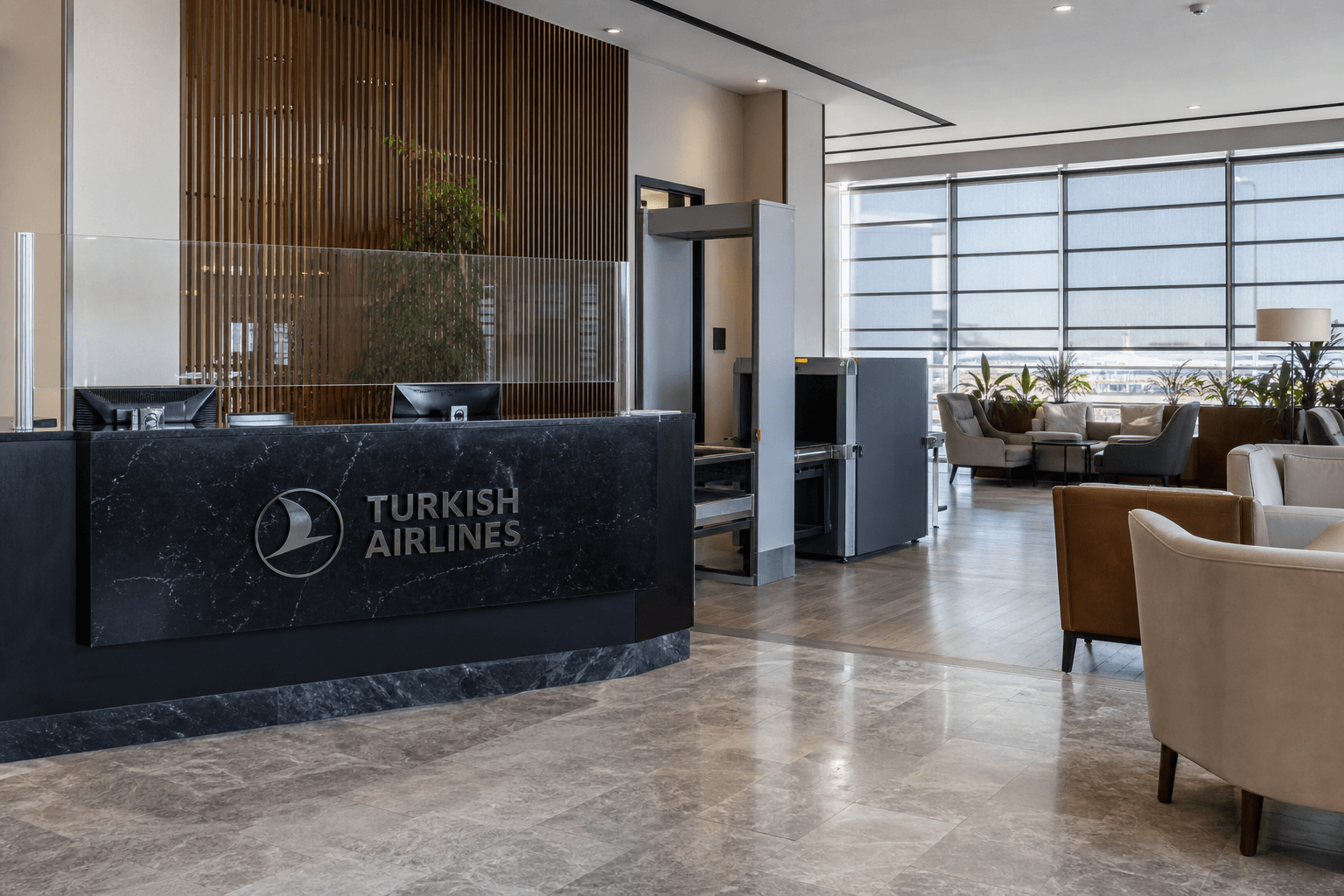
Passenger Reports Sexual Assault by Security Guard in Turkish Airlines Lounge at Kayseri Airport
OMAAT reader Ivan shared a bizarre experience with me, whereby he was sexually assaulted in a domestic Turkish Airlines lounge by a security guard… with multiple interactions! He asks for my take on this, and I find this to be so shocking that I'm not even sure what to think. Predator security guard in Turkish Airlines lounge Kayseri At around 4PM on July 4, 2026, Ivan was traveling out of Kayseri, Turkey (ASR). Let me just share his claims in full, since I want to be as accurate as possible: My family (wife and two kids) and I were in the Turkish Business Class Lounge at the airport. I'm not sure how familiar you are with Turkish domestic lounges, but the ones we visited had their own security and agents, apart from the main terminal. After we were seated, I noticed there was an issue with our connecting flight in Istanbul, so I went to clear up the matter with the agent in the lounge. When I exited the doors to discuss the issue with the agent, I realized that the agent was not there. There were two security agents nearby, and the male security agent must have seen a confused look on my face, and must have thought I needed to use the the bathroom. I told him three times that I did not need to use the restroom, I need to talk to an agent. At this point he stood up and walked over to me. When he got near me he asked what I needed. At this point he got very close to me but I didn't think much of it, as I assumed he was trying to look at my tickets. At the same time, I felt a hand or something brush against the front of my pants, and I backed up. Again, I thought this was an accident, and it wasn't intentional. This was all happening in a wide open space that was within eye shot of the other security person, a female, if she were paying attention, so I had no reason to think it was malicious. The next thing that happened, which I then began to question internally, was that he got closer while looking at our tickets. One hand was near the tickets in my hand, as I was explaining what was going on, and the other hand was down near my crotch, and he had a finger pressed against my private area. I thought to myself, "ok, this is strange but I don't want to make a scene here because I'm just trying to fly to the beach with my family and I just need this sorted out." This entire interaction lasted about one to two minutes, and the the Turkish agent was back and we got all of our ticketing issues sorted out. That brings us to the second interaction, which happened just shortly thereafter: After that interaction, I went back to join my family in the lounge, and didn't make mention of it, since it was odd and brief and not worth alarming my wife about, though in hindsight I should have said something. About 15 minutes before boarding, I figured it'd be best to use the bathroom in the lounge before getting on the flight. The way the lounge is set up, you have to "leave" the lounge to use the bathroom, but it's before the business class security station ,and the bathroom is right next to the security station. The airport is very small, so security doesn't have much to do most of the time. I walked out of the lounge and walked towards the bathroom, passing the security station in the process. As soon as I walked by the security station, I noticed the male security agent stand up and walk towards the bathroom. At this point I thought it was weird, but it got really weird right after that. The main door to the bathroom was propped open, not too dissimilar to bathrooms all over the world. After I walked in the main door, the security guard came in after me, maybe five seconds or so later, and closed the door behind him. This bathroom was small, two urinals and two stalls. When he came in, he closed the door, and I immediately got nervous and knew I was in a bad situation. As I was standing at the urinal attempting to do my business, I noticed him behind me checking to see if anyone was in any of the stalls. At this point I was frozen and did not know what to do. After he realized that no one was in the stalls, he goes to the urinal next to mine. The urinals have those half walls so that you can't really see anything below the shoulder/neck of the person next to you. He puts his chin on the half wall and looks at me, down there. I did not look over at him or make any eye contact. I was thinking to myself, "how in the hell am I going to get out of this situation?" Maybe about 20-30 seconds into this encounter another passenger walks into the bathroom, and by the time the other passenger comes around the corner, the security agent "zipped up" and was on his way over to "wash his hands." I had an immediate wave of relief come over me, and was unbelievably happy that someone else walked in and saved me from whatever was about to happen. They had no idea. For what it's worth, I did not use the bathroom at all. Once I realized what was going on, nothing was happening and I just stood there. In hindsight, the security agent was probably wondering what was going on since he was so into what I was doing. Then when he returned to the lounge, here's the conversation he had with his wife, along with the questions he asks me: I walked back to the lounge and told my wife EVERYTHING. I told her about both interactions, and she was shocked, pissed, floored, and wanted to do something about it. I told her that I didn't even end up going to the bathroom at all, and the reasons for it. She asked if I wanted my son (13) to go with me so that I could use the bathroom, but I told her no, because if he was that brazen to do that to me, I don't want him anywhere near my son. She asked why I didn't say or do anything, and my response was that we're not in America. Every country has different rules. I dont know what would have happened I stepped up to the guy. Perhaps we were in a country where they heavily side with security and any mention from to authorities that I did anything wrong could result in my being in jail or detained for a few days. If this occured in the US, I would have most likely told him off during the first interaction, and definitely in the second interaction. Lastly, I looked up reporting it to Turkish authorities, but wanted to wait until after I left the country. It's not a straightforward process so I just let it go. How would you have handled this situation? Although it was traumatizing and infuriating, I think I handled it as best I could, based on the factors mentioned above, especially the fact that I was traveling with my family and we were in a foreign country. This guy is a predator and I know for a fact that he has done this before, and will do it again. It's extremely unfortunate but not sure what can be done about it. This all happened inside a Turkish Airlines lounge How does one even approach a situation like this? I think Ivan handled this situation incredibly well, all things considered. A few initial thoughts come to mind: I can see how at first Ivan thought the situation was strange, but didn't want to draw any conclusions, but when the second incident played out, there was no denying what was going on here I agree with Ivan that if the details in this post are as presented, this wasn't the first time that this guy has done something like this I don't blame Ivan for being cautious about reporting this to authorities, especially when traveling with family in a foreign country, because who knows how they'd respond, especially in a country where you're not so familiar with the laws, the approach police take in such situations, etc. I think I would've handled the situation the way Ivan did, and I don't think I would've tried to get "authorities" involved, since I could see situations where that wouldn't end well for me. I think Ivan is taking the right approach here — he's sharing his story after leaving the country, and I'm writing about it, and hopefully this gets forwarded to the right person to be addressed (or maybe I just get banned from Turkey, I du
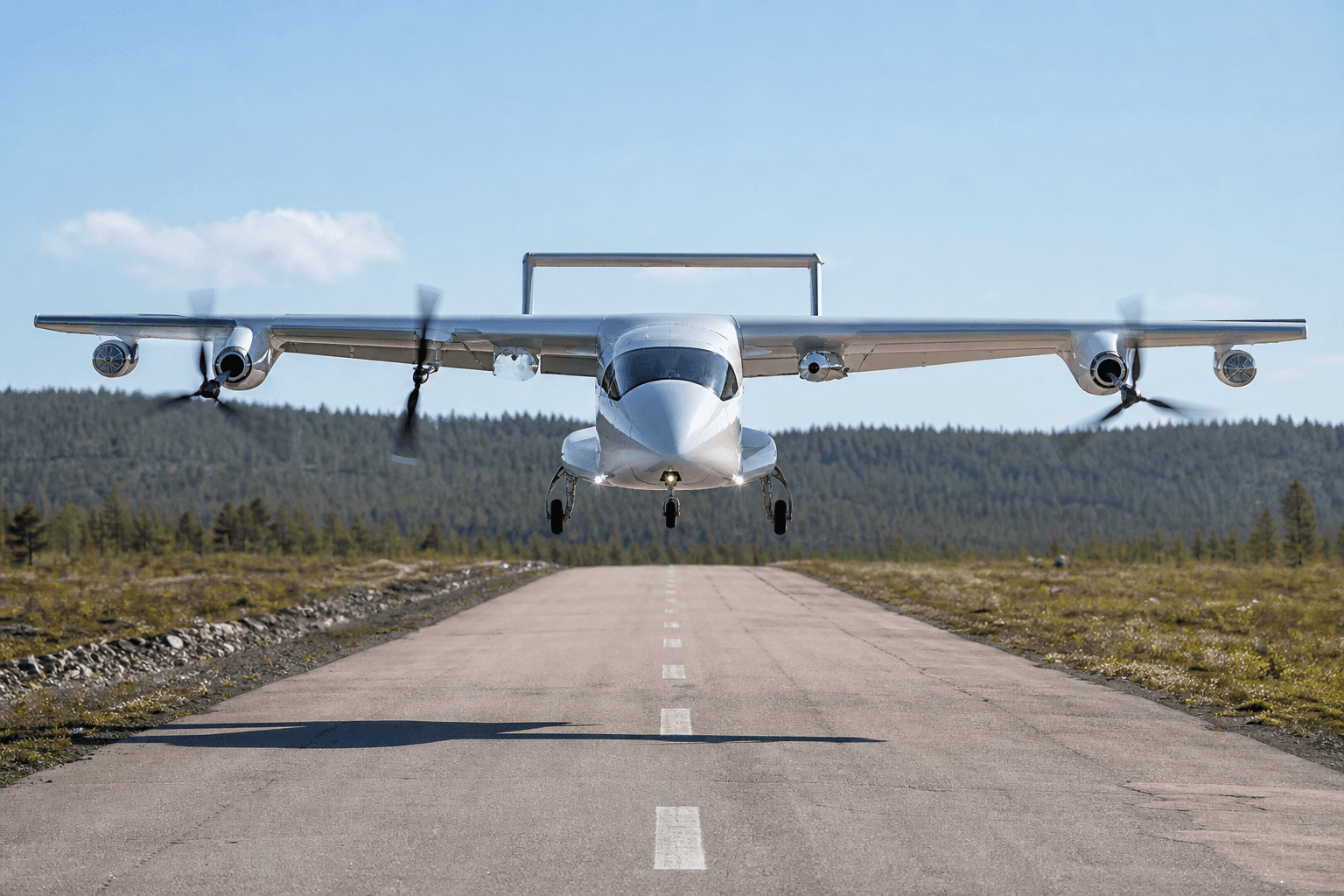
Electra achieves key FAA certification step for EL9 hybrid-electric ultra-STOL aircraft
US-developer Electra has secured approval from the Federal Aviation Administration (FAA) for a critical stage of commercializing its hybrid-electric ultra short-takeoff and landing (STOL) aircraft. On July 10, 2026, Electra announced that the US regulator has closed the G-1 Issue Paper, formally establishing the certification basis for the nine-seater EL9 aircraft. Electra said the latest milestone came after the company submitted its Part 23 type certification application in November 2025. According to the start-up, the G1 certification "determines how new technologies will be evaluated and provides the framework for proving that the aircraft meets the safety standards required for commercial passenger and cargo operations". Marc Allen, CEO of Electra, said that with this "strong momentum" it can move into the G-2 phase of its work with the FAA . Electra "In the G-2 phase of the certification process, Electra and the FAA will take the next step and focus on defining the EL9's means of compliance," JP Stewart, Electra's Senior Vice President for Product Development, said. "This stage will guide how Electra demonstrates that the aircraft meets the FAA-approved certification basis through engineering analysis, ground and flight testing, inspections, conformity activities, and certification data." The EL9 can take off and land in 150 feet or less and is designed to operate on routes up to 330 nautical miles. The EL9 is designed to create a transport industry that is less reliant on large airports with a network of ultra-short access points, including novel access points, general aviation airports, and congestion-free airport integration. "The next era of aviation depends on more than designing a breakthrough aircraft," Allen said. "It depends on assuring commercial levels of safety for those aircraft. As we move the EL9 through the certification process, we remain laser focused on translating its novel capabilities into safe, scalable operations that will make Direct Aviation a reality." RELATED Has Boeing quietly updated the advertised performance of its B777X aircraft?
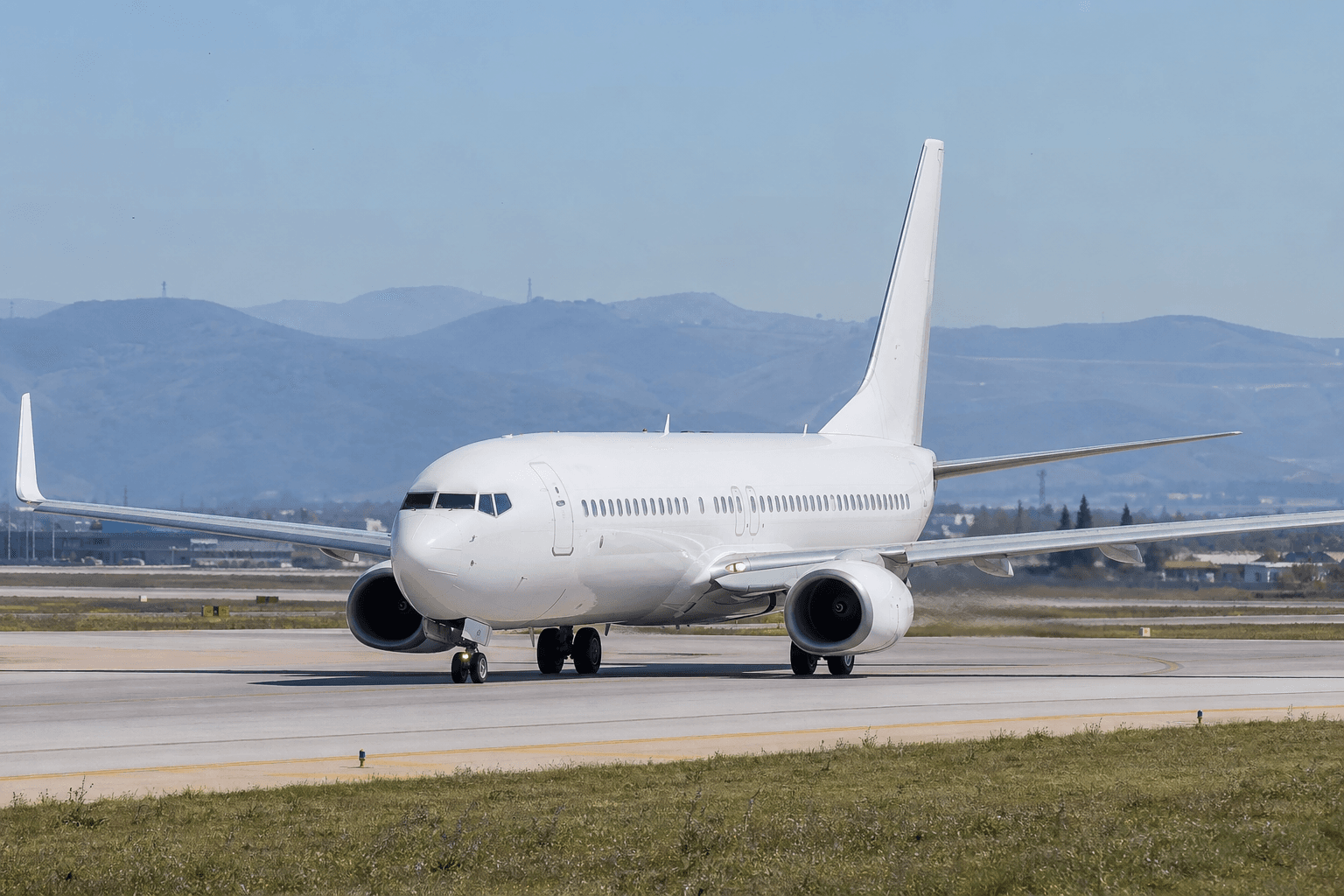
Failure of Ryanair 737-800 Engine Fan Blade Preceded Cabin Window Rupture
Air safety reporting is made accessible without a subscription as a public service. Subscribe to The Air Current for full access to our scoops, in-depth reporting and industry analysis. The rupture of a Ryanair Boeing 737-800 window Friday morning was preceded by an apparent failure of a fan blade from its right engine, a CFM International CFM56-7B, people familiar with the accident told The Air Current. A fan blade failure is a rare but serious safety issue that aircraft manufacturers […]
The Daily Touch & Go
The day's best aviation news in your inbox. Free, no spam.