

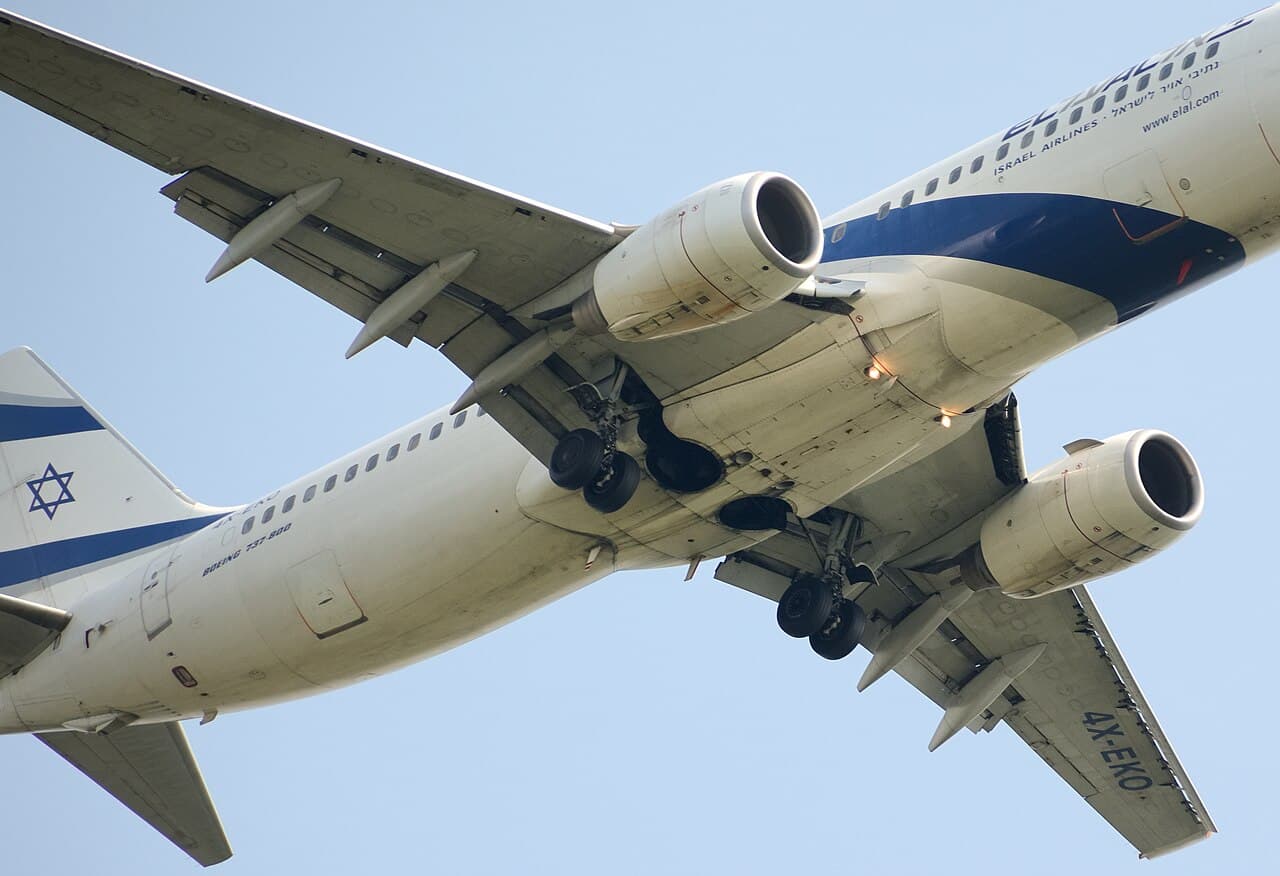
Image: Peter Haas · CC BY-SA 3.0 · via Wikimedia Commons
United Airlines Passenger Occupies Entire Boeing 737 Alone After British Airways Incident
On July 4th, a United Airlines passenger was left alone on a Boeing 737 at Cincinnati Northern Kentucky Airport after British Airways abandoned him, leading to an unusual solo flight experience.
The gist
A passenger found himself as the sole occupant on a United Boeing 737 after British Airways left him stranded at Cincinnati Northern Kentucky Airport.
On July 4th, a unique aviation incident unfolded at Cincinnati Northern Kentucky Airport involving a United Airlines passenger who ended up as the only individual aboard a Boeing 737 aircraft. The situation arose after British Airways reportedly abandoned the passenger, leaving him stranded at the airport. Instead of being left to navigate the logistical difficulties, the passenger was able to take possession of the entire Boeing 737 operated by United Airlines, resulting in a singular aviation experience rarely seen in commercial flight operations.
This occurrence took place at Cincinnati Northern Kentucky Airport, an important hub serving several major airlines and accommodating a wide range of domestic and international flights. On the day in question, the passenger faced unexpected abandonment by British Airways, a situation that led to his unusual travel circumstances. The events disrupted normal passenger flow and raised questions about airline coordination and passenger handling in multi-carrier transit scenarios.
The Boeing 737 involved in this episode is a mainstay of United Airlines' narrow-body fleet, widely utilized for its efficiency and range on short and medium-haul routes. United Airlines operates the type across its network, making it a familiar sight for passengers traveling within and beyond the domestic United States market. Having a passenger alone on a Boeing 737 is highly irregular given the aircraft's seating capacity, which typically ranges between 130 and 160 passengers depending on configuration.
Circumstances leading to the passenger's status as the sole occupant are not extensively documented, but they underscore challenges in airline passenger management when multiple carriers intersect at a single airport. Situations of abandonment, though rare, demonstrate vulnerabilities in passenger experience and coordination in the travel chain. The incident received attention for its oddity and the passenger's unexpected full access to a commercial jet, a space usually crowded and busy with fellow travelers.
United Airlines has not released detailed statements about the incident, but the event highlights operational and customer service aspects at shared airports where codeshare and interline partnerships are common. Such partnerships aim to streamline passenger journeys, but breakdowns can lead to scenarios reminiscent of this unusual solo flight episode. Meanwhile, British Airways’ role in the passenger's abandonment remains a focal point for inquiries into procedural responsibility.
This episode on America’s Independence Day adds an unusual narrative to airline passenger stories, deviating from the norm of crowded flights and bustling terminals. Solo occupancy of a commercial aircraft accentuates the sometimes unpredictable nature of air travel logistics and the human stories embedded within aviation operations. Moreover, it shines a light on potential gaps in passenger support and airline collaboration during disruptions.
As the public reflects on this incident, it serves as a vivid example of how airline operational challenges can manifest in dramatic and unanticipated ways. Passengers depending on seamless connections might encounter unexpected hurdles, including being stranded by one carrier and finding refuge with another. The singular Boeing 737 flight in this case stands as a metaphor for the solitary journeys some travelers unexpectedly endure within the complex aviation network.
Frequently asked questions
- Why was the United Airlines passenger alone on the Boeing 737?
- The passenger was reportedly abandoned by British Airways at Cincinnati Northern Kentucky Airport, which resulted in him being the only occupant aboard a United Airlines Boeing 737.
- Where did this incident involving the United Airlines passenger occur?
- The event took place at Cincinnati Northern Kentucky Airport on July 4th.
- What aircraft was involved in making the passenger the sole occupant?
- A United Airlines Boeing 737 was the aircraft the passenger occupied alone after the incident.
Read more
All Airports →
United Airlines Offers Free Flight Changes to Avoid Donald J. Trump International Airport in Palm Beach
The newly renamed Donald J. Trump International Airport in Palm Beach, Florida, is proving so unpopular with passengers that United Airlines has decided to give reservation agents carte blanche authority to rebook flyers with existing tickets onto flights to nearby airports at no extra cost. The name change from Palm Beach International Airport to Donald J. Trump Airport officially took effect on July 9, just a few months after Florida Governor Ron DeSantis signed a new law that allows the state to name major commercial airports. Before the airport could be renamed, however, Palm Beach County had to enter into a licensing agreement with the President because he has trademarked his name. The board of commissioners approved the licensing agreement 4-3 in a highly contested vote. Public backlash to the renaming has been fierce, and many people have openly vowed to boycott the airport. Given the prevailing mood then, it appears that United Airlines has decided that it will offer existing customers who have booked flights to Palm Beach “unusual flexibility” to avoid the airport, and instead fly to an alternative nearby airport like Fort Lauderdale or Miami. In an internal memo sent to reservation agents and obtained by Live and Let’s Fly , United tells workers: “If a customer does not want to fly to the airport, use your empowerment to offer acceptable alternatives such as Fort Lauderdale Airport (FLL) or Miami International Airport (MIA)." Should passengers call United’s reservations line to proactively ask about switching flights to an alternative airport, agents have been instructed to say: “I understand that you'd rather not fly to this airport anymore. We can look at nearby airports like Fort Lauderdale or Miami instead. Is that an acceptable alternative?” Flight changes will be processed for free, and agents don’t need to obtain permission from a supervisor before rebooking passengers. United Airlines chief executive Scott Kirby has been regarded as a Trump supporter, aligning himself with the administration, and courting the President in an attempt to win support for a now-abandoned merger with American Airlines. This rebooking policy is not advertised on United’s website, where the airline normally posts flexible rebooking policies, such as the current rules for passengers looking to avoid flights through the Middle East. How long this flexibility will remain in force remains to be seen. Presumably, the policy will apply to all existing customers but won’t be extended to customers who booked flights after the name change came into effect. That being said, United’s online booking tool still doesn’t accurately reflect the name and airport code change. At the time of publication, a dummy booking allowed us to search for flights from PBI, which is now officially known by the airport code DJT. When you click on any given flight for additional information, the flight is shown as operating from West Palm Beach, FL, US (PBI) and not from Donald J. Trump Airport (DJT). For those in the know, customers can search for flights to and from DJT via United’s website, with the online booking tool correctly recognizing the airport code, but it then directs users to a results page that shows PBI.
United Airlines Lets Passengers Switch Away from Trump-Named Palm Beach Airport Without Fees
United will let passengers who object to Palm Beach airport's new Trump name switch to Miami or Fort Lauderdale without repricing amidst passenger complaints.
United Airlines Lets Passengers Switch from Trump-Named Palm Beach Airport Without Fees
We recently saw Palm Beach International Airport (PBI) be renamed and get a new IATA code , as it's now officially known as President Donald J. Trump International Airport (DJT). As you'd expect, opinions on that are mixed — some people are overjoyed to be able to fly into an airport named after Trump, while others are horrified. Along those lines, United Airlines has quietly introduced an interesting policy internally, and it potentially creates an opportunity for passengers, which I find to be sort of hilarious. United offers free changes for customers who don't like Trump Live and Let's Fly reports on an internal memo that United Airlines reservations agents have been given, regarding the renaming of Palm Beach Airport. United is currently in the process of updating all of its systems to reflect the airport name and code change, and that also comes with some interesting guidance. United is telling reservations agents that "if a customer does not want to fly to the airport, use your empowerment to offer acceptable alternatives such as Fort Lauderdale Airport (FLL) or Miami International Airport (MIA)." The idea is that customers can change their flights to those airports without a fare difference, though there's an element of discretion to all of this. The memo even gives reservations agents a suggested response if someone expresses concern, telling them to say "I understand that you'd rather not fly to this airport anymore," and "we can look at nearby airports like Fort Lauderdale or Miami instead, is that an acceptable alternative?" United is allowing changes to President Trump airport tickets This policy strikes me as being… overly customer friendly? Airlines typically don't allow flight changes simply because a customer doesn't like the name of an airport. I have to say, even as someone who objects to naming airports after politicians, not wanting to fly into the airport because of the name strikes me as a bit much… but that's just me. We'll see how long this policy sticks around, but to state the obvious, there might even be some creative opportunities here, if you see a cheaper fare into Palm Beach, but actually want to fly to Fort Lauderdale or Miami. I imagine this policy will only stick around for so long, presumably covering the transition period. Also, I'm curious how long until we see the first confrontation on a plane regarding the airport's name. I'm envisioning something like the flight attendant still announcing the name as Palm Beach Airport, and then an angry passenger confronting them with their camera upon deplaning, asking them why they aren't referring to the airport by the proper name. Not to give anyone any ideas, but that's bound to happen soon… right? Not flying into an airport over a code seems extreme Bottom line We've just seen Palm Beach Airport renamed after President Trump, and the code has been updated from PBI to DJT. While people have mixed feelings about the name change, United is sure coddling customers, allowing changes with no fare difference to Fort Lauderdale or Miami. We'll see how long this policy sticks around, but that's quite something.
United Airlines Agent at San Francisco Airport Threatens Passenger with ICE Call in Heated Exchange
A United Airlines agent at San Francisco International Airport (SFO) got into a nasty confrontation with a customer on Wednesday after she allegedly threatened to call ICE on the passenger and said, “You don’t act like a citizen.” A video of the confrontation has gone viral on the social media platform Reddit, although the full events leading up to the altercation weren’t caught on camera. Instead, the footage starts with the agent saying to the passenger: “Maybe we should call ICE on you… because you don’t act like a citizen, get away.” United Airlines threatens to call ICE on customer then walks up to him and pushes phone away by u/666TripleSick in unitedairlines While the passenger is filming the interaction, the agent is also holding up her own company-issued smartphone, apparently recording the passenger as well. A desperate attempt by a second agent to calm the situation down proved little more than fruitless. The agent says the police might be called if he doesn’t calm down, but this further enrages him. He demands that ICE be called. “I dare you to call ICE on me,” the man screams. The first agent isn’t having any of it. She tells the man to “get out my face!” When he demands she repeat it, she is more than willing to say it, several times over. The man calls her a racist and claims she will be fired, and that he will sue her. It’s an ugly confrontation, and the video cuts off when the agent reaches for the man’s phone, only for him to tug on her arm. Of course, as previously stated, we don’t know what happened in the moments before the video started. Was the passenger incredibly rude and hostile to the agent? Or, potentially, was the agent out of line? The comments on the video are certainly worth a read. In any case, this is not the kind of image a major U.S. airline wants portrayed, especially when the country is currently co-hosting the FIFA World Cup, which has drawn tens of thousands of soccer fans to the United States from around the world. And it’s interactions like this where claims by Chief Executive Scott Kirby that United is the best airline in the world, bar none, don’t match the reality. Remaining calm when confronted by a rude customer can be incredibly difficult, but suggesting you might call ICE on someone, while being filmed, is an odd choice.
The Daily Touch & Go
The day's best aviation news in your inbox. Free, no spam.