


Electra inks production deal with Safran for 250 TG600 turbogenerators powering EL9 hybrid aircraft
Safran Helicopter Engines will supply its TG600 turbogenerator, based on the Arrano engine, to power Electra's EL9 Ultra Short hybrid-electric plane, with an initial 250-unit order targeting 2030 service entry.
The gist
Electra secures 250-unit Safran TG600 turbogenerator order to power EL9 hybrid-electric aircraft, aiming for 2030 launch.
Continuing coverage
All Hybrid-Electric →- Safran to Power Electra's EL9 Hybrid Ultra-STOL Aircraft with New TG600 Turbogenerator
- Safran Commences Hybrid-Electric Testing on Modified Silvercrest Engine
- Safran's TG600 Turbogenerator Powering Electra EL9 Hybrid-Electric Aircraft
- FAA Sets Certification Basis for Electra EL9 Hybrid-Electric Aircraft
- Five Regional Aircraft Makers Drive Innovation In Sub-100-Seat Market In 2026
Electra has finalized a production agreement with Safran Helicopter Engines (SHE) to supply its TG600 turbogenerator system for the EL9 Ultra Short hybrid-electric aircraft. This deal follows a memorandum of understanding signed in 2023 and includes an initial firm order for 250 TG600 units. Electra targets the EL9 to enter service by 2030, with hopes to complete the first flight in late 2027 or early 2028. Key to this timeline is a recently secured certification basis set by the US Federal Aviation Administration under the Part 23 commuter aircraft category.
The TG600 turbogenerator combines a 1,300 shp (970 kW) Arrano-class turboshaft engine — the same engine model used in the Airbus Helicopters H160 medium-twin — with a pair of GENeUS generators from Safran Electrical & Power, SHE's sister company. This setup produces an output of 600 kW, which energizes the eight Evolito electric motors arranged along the EL9’s wings, facilitating its hybrid-electric propulsion.
In July, Safran Helicopter Engines successfully completed the first bench test of the TG600 system designed specifically to power the EL9's maiden flight. This milestone is crucial not only in validating the turbogenerator’s performance but also in advancing Electra’s distributed propulsion technology. The EL9’s configuration leverages this system alongside a blown-wing design, enabling impressive short takeoff and landing capabilities, with an estimated ground roll as short as 45 meters (150 feet).
Marc Allen, Electra’s chief executive, described the agreement as a pivotal advancement for the company and the larger field of advanced air mobility. He highlighted that securing a production contract for the turbogenerator marks a defining moment in Electra's development path. This step confirms the transition from prototype collaboration to full-scale industrial deployment of the EL9’s powertrain components.
Cedric Goubet, head of Safran Helicopter Engines, noted that this contract launch signifies SHE’s official entry into turbogenerator production activities. He emphasized SHE's ongoing leadership in turboshaft technology and described this expansion into turbogenerators as a promising new chapter. The synergy between Safran's expertise in turboshaft engines and its electrical power solutions via GENeUS generators underpins the TG600’s capability.
The collaboration highlights the trend toward hybrid-electric propulsion in regional and commuter aviation sectors, where increased efficiency, reduced emissions, and enhanced short-field performance are priorities. The EL9’s design allows integration of the turbogenerator with multiple electric motors to distribute thrust across the wings, resulting in better control and aerodynamic benefits compared to traditional single-engine designs.
Electra’s ambition to certify the EL9 within the FAA’s Part 23 commuter category indicates a strategic approach to regulatory approval, facilitating entry into the regional market. The combination of turbomachinery and electric systems reflects a hybrid strategy to meet evolving environmental regulations and airport community noise restrictions.
The planned production quantity of 250 TG600 units for the EL9 demonstrates significant confidence in the program’s market potential. This volume suggests Electra and Safran anticipate strong commercial demand for ultrashort takeoff and landing aircraft powered by hybrid-electric architectures. The EL9 aims to meet growing regional transportation needs where runway length and community impact limit traditional aircraft.
By leveraging established turbomachinery in the form of the Arrano engine and combining it with proprietary generator technology, Safran is positioning the TG600 as a scalable powerplant solution for hybrid-electric aviation. This agreement with Electra could set a precedent for further turbogenerator applications across the emerging advanced air mobility ecosystem.
Frequently asked questions
- What is the TG600 turbogenerator and how does it power the EL9 aircraft?
- The TG600 combines a 1,300 shp Arrano turboshaft engine with two GENeUS generators to produce 600 kW of electrical power, driving eight electric motors on the EL9's wings.
- How many TG600 units has Electra ordered and what is the production agreement?
- Electra has placed an initial firm order for 250 TG600 turbogenerators under a life-of-programme production agreement with Safran Helicopter Engines.
- When is the EL9 expected to enter service and what certification does it have?
- The EL9 is targeting service entry in 2030, with FAA Part 23 commuter aircraft certification basis established recently to support this timeline.
Read more
All Technology/eVTOL →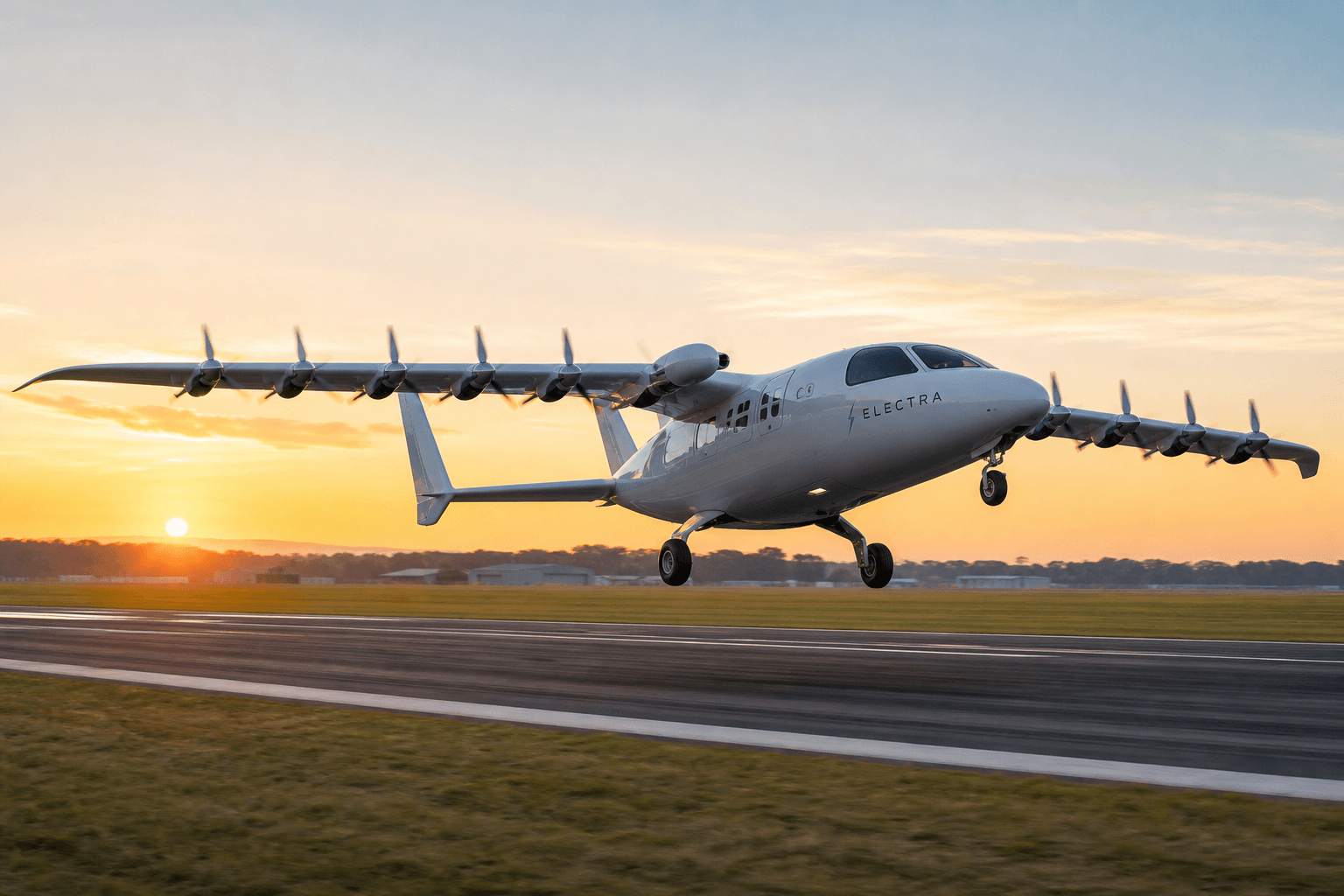
FAA Sets Certification Basis for Electra EL9 Hybrid-Electric Aircraft
Electra announced Friday that the FAA has closed the G-1 issue paper for its EL9 Ultra Short aircraft, formally establishing the certification basis for the nine-passenger hybrid-electric design. The milestone does not constitute type certification but sets the regulatory requirements the company must meet to obtain it. Certification Framework The company submitted its Part 23 type certification application in November 2025. Closing the G-1 issue paper after seven months establishes an agreed regulatory foundation for the EL9's distributed hybrid-electric propulsion, blown-lift system and fly-by-wire controls. "The swift G1 achievement reflects the hard work and productive collaboration between Electra and the FAA," Electra CEO Marc Allen said. Allen said the company will now carry that work into the G-2 phase of the certification program. Compliance Planning The G-2 phase will focus on the EL9's means of compliance, or how Electra will demonstrate that the design meets the certification basis. Electra Senior Vice President for Product Development JP Stewart said that work will include engineering analysis, ground and flight testing, inspections, conformity activities and certification data. Electra said the EL9 is designed to take off and land in 150 feet or less and carry up to nine passengers on routes of up to 330 nautical miles. The aircraft uses a small turbine-powered generator, battery packs and eight electric motors distributed along the wing to produce lift at low airspeeds.
Electra Achieves FAA Certification Basis Using Desired Path for EL9 eVTOL
Electra announced on Friday that the Federal Aviation Administration has closed the G-1 issue paper for its nine-passenger EL9 "Ultra Short" aircraft, a major regulatory milestone that the company said confirms its ability to use the comparatively straightforward certification path that other advanced air mobility entrants were denied. G-1 issue papers are used by the FAA to define the certification basis for aircraft undergoing type certification. Until leading electric vertical take-off and landing […]
Aura Aero acquires VoltAero assets, boosting hybrid-electric aircraft innovation in France
Jean Botti's start-up was developing all-electric Cassio family before insolvency last year. Electric aircraft pioneer Aura Aero is acquiring the assets of VoltAero in a move that ends months of speculation about the future of its troubled fellow French start-up. VoltAero – founded by former Airbus technology chief Jean Botti – has spent much of…
EU to Extend Aviation Emissions Trading System to Some Flights Beyond Europe by 2029
Commission proposes to include flights up to 5,000km from centre of EU in its emissions trading system. European Commission regulators have proposed extending the scope of its emissions trading system (ETS) to cover some flights beyond the European Economic Area from 2029. The proposals, which would apply on flights to third-countries located up to 5,000km from the geographic centre of the European Union, stop short of including transatlantic services. The wide-ranging proposals also include initiatives to boost sustainable aviation fuel (SAF) usage, measures to avoid double-counting with the global carbon offsetting and reduction scheme for international aviation (CORSIA), as well as a review of the latter's implementation in 2032. It forms part of the Commission's wide-ranging review of its ETS system , published today. The Commission had more than a decade ago proposed including all flights within, to and from Europe in the ETS, before reducing the scope of the scheme to apply just to intra-European Economic Area (EEA] flights when agreement was reached for the global CORSIA programme at the 2013 ICAO General Assembly. The move to expand the scope of the ETS comes after the Commission completed an assessment of CORSIA, which concluded that the latter has not been" sufficiently strengthened yet". "It expands the scope of the ETS to flights departing to the neighbourhood of the [European] Union," the Commission says in supporting documentation released today. "The scope will be extended to cover all flights departing from an airport situated in the European Economic Area (EEA) and landing in third countries no further than 5,000 kilometres from the largest aerodrome in the geographical centre of the Union.” It notes the scope of the application, which notably means it will not apply to transatlantic flights and averts a potential collision course with the US Trump Administration, is around half the maximum distance of flights from the centre of Europe, and the Commission says takes account of analysis which indicates such routes are "most susceptible to potential hub leakage" – ie, connections where passengers might use different routings to avoid incurring ETS costs. The extended coverage will apply from 2029 rather than 2027 – the current 'stop the clock' legislation freezing ETS application to third-country flights ends this year. Under the proposals, the new application for ETS would run for four years and be dependent on a review of CORSIA's implementation in 2032. It says in the event CORSIA "is proving to be ambitious, efficient and successful", the scope of effective carbon pricing under the EU ETS should be reduced to flights within the EEA and departing to the UK, Switzerland and Gibraltar. But it adds: "If CORSIA still does not deliver by then, the Commission may consider extending the scope to full departing flights." The EC says its proposals maintain "close alignment" with CORSIA. "It avoids double carbon pricing where both systems apply, while continuing to support the development of an effective global approach to reducing aviation emissions," the Commission says. It will also increase the total number of allowances available in respect of aviation activities in proportion to the emissions newly included in the scope. "Today’s proposal significantly reinforces the support for the uptake of sustainable aviation fuels, cleaner propulsion technologies, hydrogen and electrification," the Commission says, noting it extends ETS-funded support for production of these technologies. Reacting to the proposals, Aoife O'Leary, chief executive of environmental NGO Opportunity Green, hit out at the 5,000km limit. "Today the Commission showed very clearly that when it comes to making EU legislation, it will allow the US and China to dictate the outcome, regardless of what the science and economics show is best for Europe. By excluding flights over 5,000km from the ETS, the Commission is signalling that it understands the science is clear: aviation is hugely damaging to the climate. And the basic economics of asking airlines to pay for their climate pollution are sound. “It’s just that the Commission has given in to bullies, allowing the airlines doing the most damage – those flying the longest routes from Europe – to keep polluting with no consequences,” she says.
The Daily Touch & Go
The day's best aviation news in your inbox. Free, no spam.