

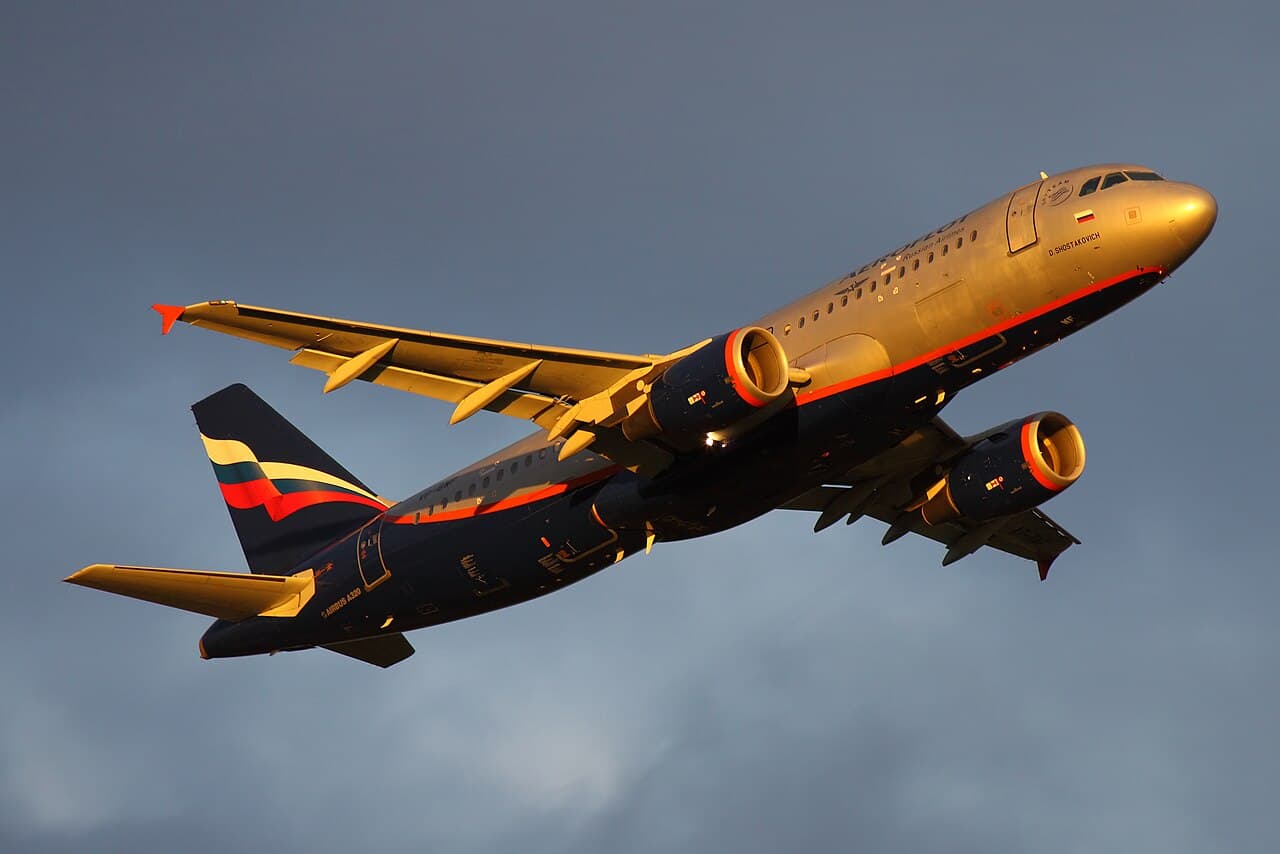
Image: Sergey Kustov · CC BY-SA 3.0 · via Wikimedia Commons
British Airways A320 Disabled on Gatwick Runway Triggers Fuel Emergencies and Diversions
A British Airways Airbus A320 developed nose wheel issues and became stranded on London Gatwick's sole operational runway, causing 14 flights to divert and multiple fuel emergencies.
The gist
A disabled British Airways A320 on Gatwick's only runway led to widespread diversions and fuel emergencies for incoming flights.
Continuing coverage
All Airbus A320 →- British Airways A320 Nose Gear Failure Blocks Gatwick Runway Causing 14 Flight Diversions
- Aer Lingus cuts three US routes and trims fleet amid rising transatlantic rivalry
- SpiceJet Struggles to Rebuild Amid Fleet Groundings and Financial Strains
- Pilots actively manage autopilot systems instead of just monitoring during flight
- Finnair advances plans to acquire up to 12 used A320s, considers wet-leases for fleet flexibility
A British Airways Airbus A320 encountered a nose wheel steering failure after landing at London Gatwick Airport, leaving the aircraft stranded on the airport’s only operational runway and triggering a cascade of operational disruptions. The flight, BA-2673, had just returned from Palma Mallorca when the pilots reported issues with the nose wheel to Air Traffic Control (ATC). After circling in a holding pattern over South East England attempting to troubleshoot, the aircraft was cleared to land on runway 8L. Upon touchdown, the nose wheel steering failure became evident, disabling the plane on the runway and blocking all traffic.
London Gatwick operates with only one active runway at a time due to international safety rules, despite having two parallel runways (8L/26L and 8R/26R). Normally, the southern runway (8R/26R) handles departures and arrivals while the northern runway (8L/26L) functions as a taxiway. On this occasion, the southern runway was closed for maintenance, leaving runway 8L as the sole operational surface at the airport. With the British Airways A320 immobilized there, no other planes could land or take off on that runway until the incident was resolved.
The stranded aircraft’s position forced ATC to instruct numerous inbound flights to enter holding patterns. Nine of those flights soon declared fuel emergencies, signaling they had limited extra fuel reserves and requesting priority landing clearance. A fuel emergency code does not indicate imminent danger but alerts controllers that the aircraft cannot safely continue prolonged circling without landing promptly.
The disruption escalated as it became unclear how long the British Airways plane would remain on runway 8L. This forced ATC to redirect 14 flights originally scheduled to land at Gatwick to alternative airports across England. Five flights diverted to London Luton, four to London Stansted, three to Birmingham, one to Bristol, and another was permitted to land at London Heathrow despite the airport’s nighttime curfew.
The affected British Airways Airbus A320, registration G-GATS, was subsequently removed from service, leading to the cancellation of a planned round trip to Alicante, Spain, the following day. This incident highlights vulnerabilities in Gatwick’s runway operational capacity, especially when one runway is offline, given that it ranks as the world’s second busiest single-runway airport after Mumbai.
The event comes shortly after a High Court ruling upheld a government decision permitting Gatwick to bring its northern runway into routine use. To comply with international standards, the centerline of the northern runway will need to be shifted 12 meters north to ensure sufficient separation from the southern runway. Despite seeming straightforward, Gatwick does not anticipate this change will be implemented before 2030, meaning single-runway operations will persist for some years.
Given Gatwick’s critical position within the UK’s air travel infrastructure, incidents like this underscore significant operational challenges. Runway unavailability at such a busy airport causes broad disruptions, with fuel emergencies an acute consequence for aircraft holding in congested airspace. The delayed activation of Gatwick’s second runway will continue to pose risks of similar occurrences during maintenance or emergencies on the primary runway.
Frequently asked questions
- What caused the British Airways Airbus A320 to become stranded on the Gatwick runway?
- The Airbus A320 experienced a nose wheel steering failure after landing, which disabled the aircraft on runway 8L at Gatwick Airport.
- How did Gatwick airport's single-runway operation affect the situation?
- With the southern runway closed, Gatwick was operating on only one runway. The disabled British Airways aircraft blocked this sole operational runway, halting all arrivals and departures.
- What was the impact on other flights scheduled to land at Gatwick?
- Fourteen flights were forced to divert to other airports, including Luton, Stansted, Birmingham, Bristol, and Heathrow, and nine aircraft declared fuel emergencies due to extended holding patterns.
Read more
All Aviation Safety →
Thun Field Runway Shutdown Forces Flight Schools and Tenants to Shift Operations
Facing a critical four-month shutdown starting July 27, tenants and flight schools at Pierce County Airport-Thun Field (KPLU) in South Hill, Washington, are rushing to relocate as the facility begins a $7.18 million federally funded project to replace its aging runway. "[Runway 17-35] is reaching the end of its lifespan and needs to be reconstructed to remain operational," said Trent Smith, airport manager with the Pierce County Planning and Public Works Department. "This project safeguards a critical county asset. By securing a new 20-to-30-year runway lifespan, this investment eliminates costly emergency repairs and preserves runway access for airport businesses, tenants, pilots, and emergency services." The closure was not a surprise to anyone at the airport, but that doesn't mean the impact won't be felt. For months businesses, tenants, and pilots have been wondering where they will go and what they will do during the temporary closure. Part of the challenge was that Pierce County, the airport sponsor, had discussed the project for several years. It would surface, then be put on the back burner when more pressing matters came up. Airport tenants began to doubt the project would happen in their lifetime. READ MORE: Airport Spotlight: Homeowners Reclaiming Crest Airpark READ MORE: When the Airport Is the Destination As part of the long-term planning the county discussed the need to replace the 3,651-foot-by-60-foot runway. The county told airport users that the runway's length will remain the same, but it will be widened to 75 feet, and the airport hangar's electrical infrastructure will be rehabilitated. Additionally, the field drainage will be improved, new PAPI (precision approach path indicator) lighting will be installed, two taxiway connectors will be realigned and repaved, and the windsock, segmented circle, and wind tee will be relocated. The trees and brush that obstruct pilot sightlines and block the Automated Weather Observing System (AWOS) will also be removed. The construction is being funded by a $7.18 million FAA Airport Improvement Program (AIP) grant. On-site work will kick off with hangar electrical rehabilitation beginning July 24. With fixed-wing operations suspended, flight schools and tenants at Washington's Pierce County Airport-Thun Field (above) are navigating a total facility shutdown. [Credit: Meg Godlewski] During the months of planning the county heard a great deal of concern about the impact a total runway shutdown would have on airport tenants, businesses, and flight schools. Some of them offered the following suggestions to mitigate the impact: • Perform the work in the winter when there is less flyable weather. However, that idea was shot down immediately as it was noted that weather delays would stretch out the project and increase the cost. • Perform the work in phases that would allow part of the runway to remain open or at night so that it could be open during the day. This also was rejected. "While we explored alternatives to minimize disruptions, a phased approach or night work is not feasible for this project," Smith said in a statement to FLYING . "Due to the runway's specific length requirements and strict budget constraints, the reconstruction must be completed in a single, non-phased timeline during daylight hours." • A proposal to use the taxiway on the west side of the runway as a temporary one was nixed as too risky because it is in close proximity to the hangars. The county website notes that "monthly fees for hangars and tie-downs remain in effect as these cover the exclusive use of the storage space, which remains accessible. Tenants are encouraged to review their individual lease for any exceptions." Hangar tenants, some paying $373 per month for one with electricity, were told they would need to continue to make the payments while the runway is closed or risk losing their space. They were also advised to expect an increase in hangar rent in 2027. In airport advisory meetings a few business owners who depend on fly-in traffic asked if they would still have to pay rent during the closure. When the answer was yes, it sent a murmur of displeasure through the audience. "While the runway will be closed to fixed-wing operations during construction, the airport grounds, hangars, and facilities will remain accessible, allowing businesses to continue operating," Smith said. "Lease agreements remain in effect, and Pierce County does not anticipate offering rent reductions or adjustments during this period." Spencer Aircraft, one of the larger businesses at the airport with a pilot supply store, maintenance, and avionics department, has spent several months adjusting logistics to prepare for the shutdown. "Avionics is working out of Auburn [Municipal Airport/S50], and Spencer Aircraft will still be working from our location," said Duane Wetherbee, vice president of Spencer Aircraft. "We will also have a few planes working in our hangar that are staying on the field." Some tenants who requested anonymity stated the extended closure would kill their businesses, some of which have not completely recovered from the COVID-19 pandemic that choked supply chains and made it difficult to get parts for aircraft repair. Field maintenance providers have been looking for temporary locations from which to operate. Flight Schools KPLU is one of the busiest training airports in the Seattle area, with no fewer than three robust flight schools—Safety in Motion (the sister company to Spencer Aircraft), Spanaflight, the oldest flight school in Pierce County, and Clover Park Technical College. As of Friday morning, all three were preparing to temporarily relocate to Olympia Regional Airport (KOLM), 27 nm to the southwest. The airport is a towered Class D facility with a VOR on the field. Spanaflight and Safety in Motion have operated satellite schools out of KOLM for several years. During the work Spanaflight will also operate a temporary facility out of Auburn Municipal, a non-towered airport some 14 nm to the north of KPLU. Clover Park Technical College (CPTC), which has its aviation campus on KPLU’s southeast corner, is also temporarily moving to KOLM. CPTC has been at KPLU since 2000 when a purpose-built facility known as the South Hill campus was constructed to house the flight training and aviation maintenance programs. The main campus for the school is in Lakewood, Washington. CPTC traces its roots back to 1942 when it was established to train people to support the war effort. Claire Korschinowski, CPTC dean of instruction, aviation and advanced manufacturing, said the relocation of the flight program to KOLM is temporary. "Training will be done in our fleet with our employees," Korschinowski said. "We are working under a Part 141 certificate, and the FAA gave us a letter of understanding to allow us to operate in the temporary location. The FAA recognizes this is a set of circumstances that we cannot control, and we want to remain providing service to the community." The CPTC program has 47 students enrolled at this time. Usually there are as many as 60, but some students chose not to return for summer quarter because of the impending closure. Many of them are using their Veterans Administration benefits to pay for training. Korschinowski said it has been careful about keeping the students, as well as VA administrators, informed. "The students will still do their ground school on the CPTC South Hill campus," said Korschinowski, adding that A&P and avionics technician courses will not be interrupted by the closure. She said the school has spent years preparing for this. "This is our busiest flying time of year," she said. "We have been doing lots of strategic planning just waiting for this to happen. A few years ago we heard it was going to happen, and then it didn't, and then it did, and we hired extra staff to keep up with the demand for training and we kept the students in

uAvionix and Jeppesen ForeFlight Launch SkyPlay Integration for Seamless Cockpit Flight Planning
Pilots tired of translating flight plans, checklists, and charts between electronic flight bags (EFBs) and the instrument panel will soon have reason to rejoice. uAvionix and Jeppesen ForeFlight on Tuesday introduced SkyPlay , a new integration that will embed the popular flight planning platform directly within panel-mounted avionics. Attendees of EAA AirVenture in Oshkosh, Wisconsin, on July 20-26 will have the opportunity to experiment with SkyPlay using interactive, live flight simulators at both companies' exhibits. Oshkosh will mark the integration's public debut. The partners said they will share information on pricing and shipping dates in the future. By integrating ForeFlight's familiar mapping, routing, and workflows into the instrument panel, SkyPlay would allow a pilot to plan a flight remotely using an iPad or other tablet, then synchronize it to digital screens in the cockpit. That would let them use either interface to monitor and manage their route in the air. The idea is to eliminate the learning curve that comes with a new avionics suite, the partners said. "Pilots have routinely found themselves translating workflows back and forth between the [electronic flight bag] on their knee and the glass in their panel," per a news release shared Tuesday. SkyPlay's digital interface is paired with physical, multifunction control knobs that function under heavy turbulence and are compatible with flight gloves. The partners said certified and experimental aircraft will not require a panel redesign to install the system. Soon, they plan to introduce a "suite of panel applications anchored entirely in the ForeFlight environment." Earlier this year, Jeppesen introduced a ForeFlight Emergency Glide Mode and partnered with Tecnam , allowing owners and operators of aircraft such as the P2012 and P-Mentor to integrate its data into the models' Garmin avionics systems. The agreement gives owners a one-year subscription to Jeppesen NavData and Jeppesen Charts as well as one ForeFlight premium subscription. Earlier this week, the company introduced the AI-powered ClearNOTAMs app, which translates raw, convoluted NOTAMs into plain English and conveys the real operational impact of each notice.
Pilots Urged to Rely on Airmets and Sigmets for Weather Safety
Most pilots can tell at least one story about a flight that did not go as planned because of unpredicted weather along the route. We all know that weather forecasts aren’t perfect, but that can lead to concerns regarding the safety of the flight.
New Marine One Helicopters Cause Lawn Damage, FAA Reviews DC Crash Safety
New Sikorsky Marine One helicopters damage the White House lawn, the airports renamed for U.S. presidents, airline consolidation, DCA crash safety recommendations, controversy over ADS-B In regulations, Air France and Airbus manslaughter verdict, passengers sue Delta over turbulence injuries, a Ryanair window ruptures, and a seaplane makes a hard landing in New York's East River. Also, interviews from the Spurwink Farm fly-in. Aviation News Lockheed Martin Is Covering the Cost of Trump's White House Helipad President Trump said that Sikorsky, part of Lockheed Martin, would cover the cost of building a new helipad at the White House. Lockheed Martin confirmed the report. Sikorsky helicopters have been used to transport the president since the 1970s. The new VH-92A Patriot helicopter has propulsion exhaust vents located toward the rear of the airframe and pointed downward, unlike the VH-3D’s configuration. Also, with much more powerful engines, the VH-92A generates significantly more downwash than the VH-3D. The hot exhaust gets combined with the intense rotor downwash at touchdown, and the combined heat-and-airflow effect scorches the turf and can physically rip sod loose. Airline consolidation now rules the skies. Has it been good for passengers? Continental Airlines, Northwest Airlines, and US Airways are gone. Spirit Airlines is gone as well. Now, the Big Four U.S. airlines control roughly three-quarters of the U.S. market. Has this been good for the flying public? It depends on who you ask. Former governor Chris Sununu, now the head of Airlines for America, said at a Capitol Hill hearing, “We have more competition per route than ever before. When I go to buy a ticket, I have four, five, or six carriers going from Wichita to Dallas. So now they’re all competing on that exact same route." There are six airlines serving Wichita Dwight D. Eisenhower National Airport, but there’s only one that flies nonstop to Dallas. Past guest Ganesh Sitaraman, a professor at Vanderbilt Law School and the author of the book Why Flying Is Miserable and How to Fix It said, “From the airlines’ perspective, it makes sense. Bigger is better, and it’ll be more efficient for them, even if there’s a lot of drawbacks for communities and passengers.” A Florida airport is officially renamed for Trump. What does he stand to gain? FAA Details First Official Response to DC Crash Safety Recommendations After the January 2025 midair collision near Washington, D.C., that killed 67 people, the NTSB issued nearly three dozen recommendations. As is always the case, the FAA is not obligated to implement the NTSB’s recommendations. Earlier this year, the FAA said it had fully addressed seven of the recommendations and that it would evaluate the others, with further updates to come by May 31, 2027. The Air Current reported that the FAA indicated it is evaluating whether the number of arrivals permitted per hour at DCA is appropriate. This is a key metric that the NTSB said contributed to the airport’s congestion at the time of the crash. Also, any adjustments will be determined after an official analysis in 2027. This $50,000 Safety Fix Is Dividing the Aviation Industry and Washington This could be characterized as a conference-committee fight over how strong an ADS-B In mandate should be, not whether there will be one. ALPA and NTSB are on one side (ROTOR Act), and industry groups like A4A/AOPA/NBAA on the other (ALERT) side. Senate: ROTOR Act (Rotorcraft Operations Transparency and Oversight Reform Act) Would require all aircraft to be equipped with ADS-B In and repeal certain military exemptions from the technology requirements. Passed the Senate by unanimous consent in December, with strong support, including from ALPA. The House rejected it on February 24, 2026, falling one vote short of the two-thirds majority needed after the Defense Department raised national security concerns House: ALERT Act (Airspace Location and Enhanced Risk Transparency Act) House lawmakers revised the bill to explicitly include an ADS-B In mandate after the earlier version was criticized for failing to clearly require it. The updated version requires that aircraft carry both ADS-B In and ACAS X (Airborne Collision Avoidance System X), integrated so ADS-B In data feeds the alerting function. Opposition: ALPA doesn’t endorse it, arguing that ACAS Xa (the large-commercial-aircraft variant) isn’t yet commercialized, that no integration standards exist, and that the system suppresses alerts below 1,000 feet when situational awareness matters most. The NTSB also declined to support it, saying it falls short of requiring ADS-B In for all aircraft operating in airspace where ADS-B Out is already required, even though it allows compliance via portable receivers with line-of-sight limitations. Air France and Airbus found guilty of manslaughter over 2009 plane crash A Paris Appeals Court found Air France and Airbus “solely and entirely responsible” for the 2009 AF447 accident, which killed 228 people when it crashed into the Atlantic Ocean. The companies were cleared in April 2023 but were found guilty after an eight-week trial. Both Air France and Airbus have denied the charges and say they will appeal. In 2012, French investigators found a combination of technical failure involving ice in the pitot tubes and pilot confusion over faulty air-speed readings. Pilot training has since been modified, and pitot tube sensors have been replaced. 20 Sue Delta Over 2.5 Minutes of Terror on Flight Out of Utah A lawsuit has been filed against Delta Air Lines on behalf of 20 passengers of Delta Flight 56, claiming that pilots “recklessly flew” too close to thunderstorms, where severe turbulence caused multiple injuries. The turbulence lasted 2 1/2 minutes over Wyoming, and the flight was diverted to Minnesota. Twenty-five people were transported to local hospitals. The NTSB said the pilots were caught by surprise. In the lawsuit, the plaintiffs allege that the National Weather Service issued an advisory warning that turbulent conditions were present in the mountains east of Salt Lake City and that thunderstorms were present along portions of the flight path. Apparent engine fan blade failure preceded rupture of Ryanair 737 window The Air Current reports that the rupture of a Ryanair Boeing 737-800 window resulted from a fan blade failure on the right CFM56-7B engine. Fan blade failures are serious but rare. Aircraft engines are designed to contain fan blade failures and are tested during the certification process. The FAA issued airworthiness directives to mitigate the risk of fan blade failure through inspections and an engine inlet redesign to ensure containment. The FAA set a July 31, 2028, deadline for compliance. Small plane makes hard landing into New York's East River, officials say A Kodiak 100 seaplane with eight people on board made a hard landing in the East River between Brooklyn and Manhattan. There was "substantial damage" to the plane, but there were no injuries. The plane bounced three times, and the pilot subsequently told the passengers that a pontoon had broken. A pattern of progressive porpoise leading to structural failure appears in NTSB seaplane accident reports across various types, including Cessna 206 and 208 Caravan floatplanes, de Havilland Beavers, and Twin Otters on floats. A few East River/urban seaplane-specific factors that might be in play: Wake and chop from harbor traffic (ferries, tour boats) create a much less predictable water surface than open lake/bay operations. Confined approach corridors near Skyport limit go-around and abort options if the pilot senses a bad touchdown developing. The area has had at least one other recent seaplane mishap (a two-seater damaged by a wave three weeks prior), suggesting water-surface conditions have been a recurring operational challenge
The Daily Touch & Go
The day's best aviation news in your inbox. Free, no spam.