

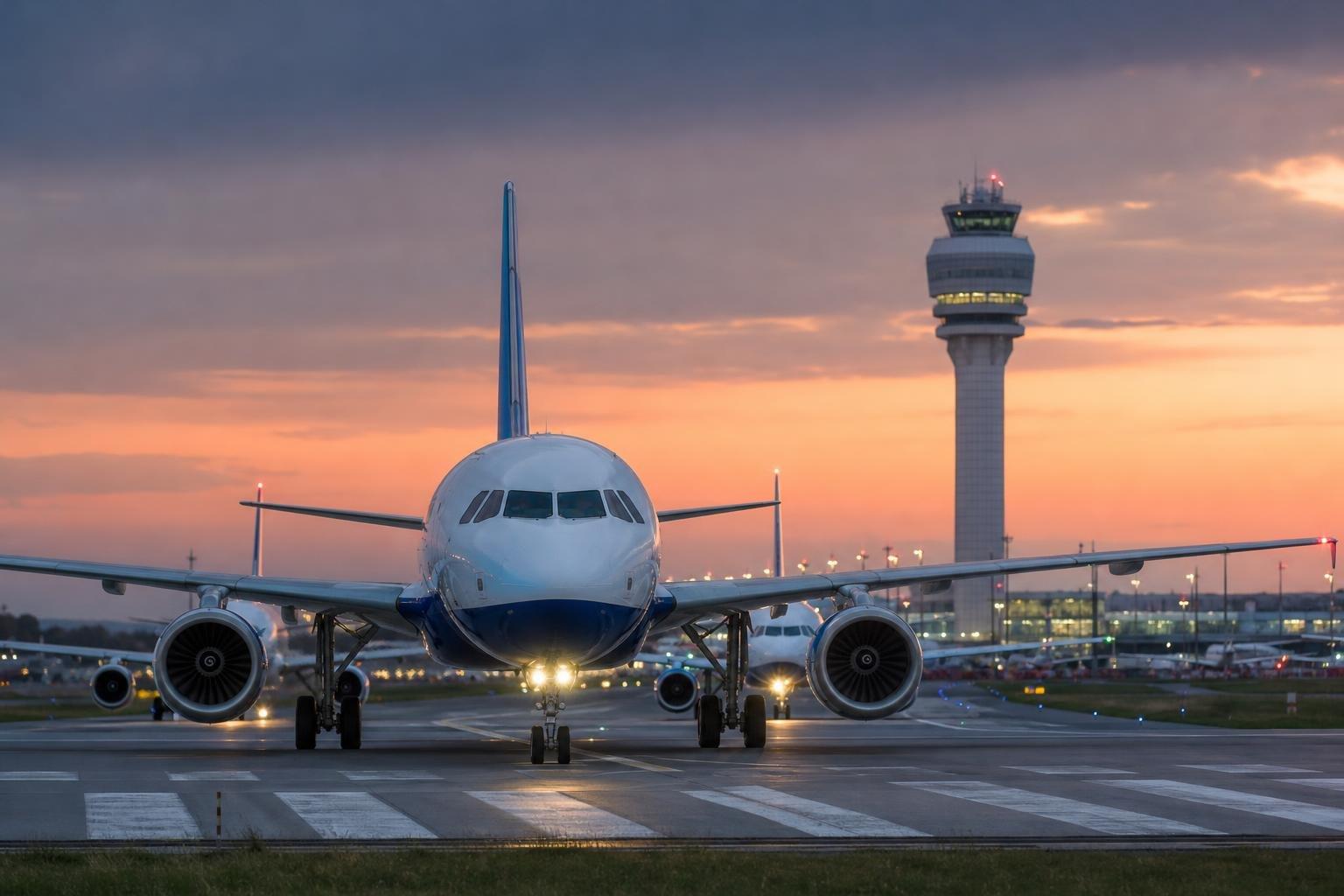
AI-generated illustration
FAA Requires Stand-Alone Tower Supervisors for Line Up and Wait as Thanksgiving Rush Begins
A new FAA staffing rule bars towers from using Line Up and Wait unless a dedicated supervisor is on duty, and controllers are already warning pilots of possible departure delays.
The gist
From Nov. 24, US towers can only use Line Up and Wait with a dedicated supervisor on duty, a rule controllers say could slow holiday departures.
Continuing coverage
All Faa →- Academy Report Says FAA Skipped Required Risk Assessment Before Closing DC Helicopter Route 4
- FAA Ground Stops Hit O'Hare and Atlanta on Three Straight Days of Thanksgiving Week
- Surface Radar Outage Forces Second Ground Stop in Two Days at Chicago O'Hare During Thanksgiving Rush
- Army Seeks to Restart Helicopter Training Flights Near Reagan National as FAA Approval Remains Pending
- FAA Follows Canada in Ordering Bell 429 Tail Rotor Checks Over Uncoated Bearings
Air traffic control towers across the United States can no longer clear aircraft to Line Up and Wait unless a supervisor who is not working any other position is on duty, under a Federal Aviation Administration staffing requirement that took effect Tuesday, Nov. 24, 2026. The change arrived at the start of the Thanksgiving travel week. The FAA has said it will not affect airport operations.
Line Up and Wait, known as LUAW, lets a controller move a departing aircraft onto its assigned runway to hold in position before takeoff clearance is issued. Placing aircraft on the runway in advance shortens the gap between departures and raises runway throughput. Under the new rule, a tower running LUAW must staff a dedicated local control position handling arrivals and departures, plus a stand-alone watch supervision position, either an operations supervisor or a controller-in-charge, that cannot be combined with any other duty.
The requirement comes from FAA Notice JO 7210.979, issued in October, which amends FAA Order JO 7210.3, the order governing air traffic facility operations and administration. Earlier guidance only recommended against combining the supervisory position with other tower positions during LUAW operations; the notice turns that recommendation into a binding rule. The FAA said the change is meant to remove ambiguity in staffing requirements and to cut distractions for the people overseeing the operations. The agency described the move as a proactive step to strengthen runway safety at airports nationwide.
The notice does not point to any specific safety incident behind the change, and the FAA has not explained why it chose Thanksgiving week to put it in place. Nor did the agency provide an estimate of the operational impact. Towers that lack the staff to keep a separate supervisory position open will be unable to use LUAW, which could reduce departure rates at some airports.
Controllers have already begun telling pilots to expect slower departures. In audio recorded by ATC.com on Monday, a controller in Albuquerque told a Southwest Airlines pilot that a stand-alone controller-in-charge or supervisor now had to be in place behind the controller to use the procedure. The pilot replied that it would probably cause some delays, and the controller agreed.
The rule touches a long-standing staffing practice. To cope with decades of controller shortages, the FAA often combines controller responsibilities, frequently leaving one person both directing aircraft and supervising other controllers. In May, the agency revised its nationwide staffing target to 12,563 certified professional controllers. The National Air Traffic Controllers Association said its members will keep carrying out their duties with the same professionalism, dedication and commitment to safety they show every day.
The timing puts the new requirement against one of the heaviest stretches of the flying calendar. More than 417,000 flights are expected over the nine-day Thanksgiving holiday period, and the Transportation Security Administration is preparing to screen nearly 17.6 million passengers between Nov. 24 and Nov. 30. AAA expects 81.5 million Americans to travel over the holiday, a figure projected to be slightly below 2025 but still near record levels.
Reported by CNN, with additional reporting from AVweb and Beinsure
Read more
All Regulatory →
Modern Skies Coalition Launches ACT NOW Ad Campaign Pressing Congress for ATC Modernization Money
A coalition of more than 50 aviation groups began a national ad push a week after a nearly five-hour nationwide ground stop, as DOT seeks another $50.1 billion for infrastructure.
Senator Moran Presses Duffy to Justify Jump to $50 Billion Air Traffic Control Request
The Kansas Republican who chairs the Senate aviation subcommittee says Transportation Secretary Sean Duffy must explain why his ATC modernisation ask rose from $30 billion to $50 billion after the 13 November ground stop.
Everett-Built 737 MAX Jets Added to Boeing Production Certificate as North Line Nears Deliveries
Boeing's new 737 line in Everett, Washington, has reportedly cleared a regulatory step toward handing over jets, with the planemaker working through the final stages of an FAA audit.
DOT Inspector General Opens New Audit of FAA Manufacturing Oversight as Six Boeing Fixes Remain Open
The Transportation Department watchdog will examine how the FAA polices manufacturers and their US and foreign suppliers, while six of 16 recommendations from a 2024 Boeing audit are still unresolved.
The Daily Touch & Go
The day's best aviation news in your inbox. Free, no spam.