

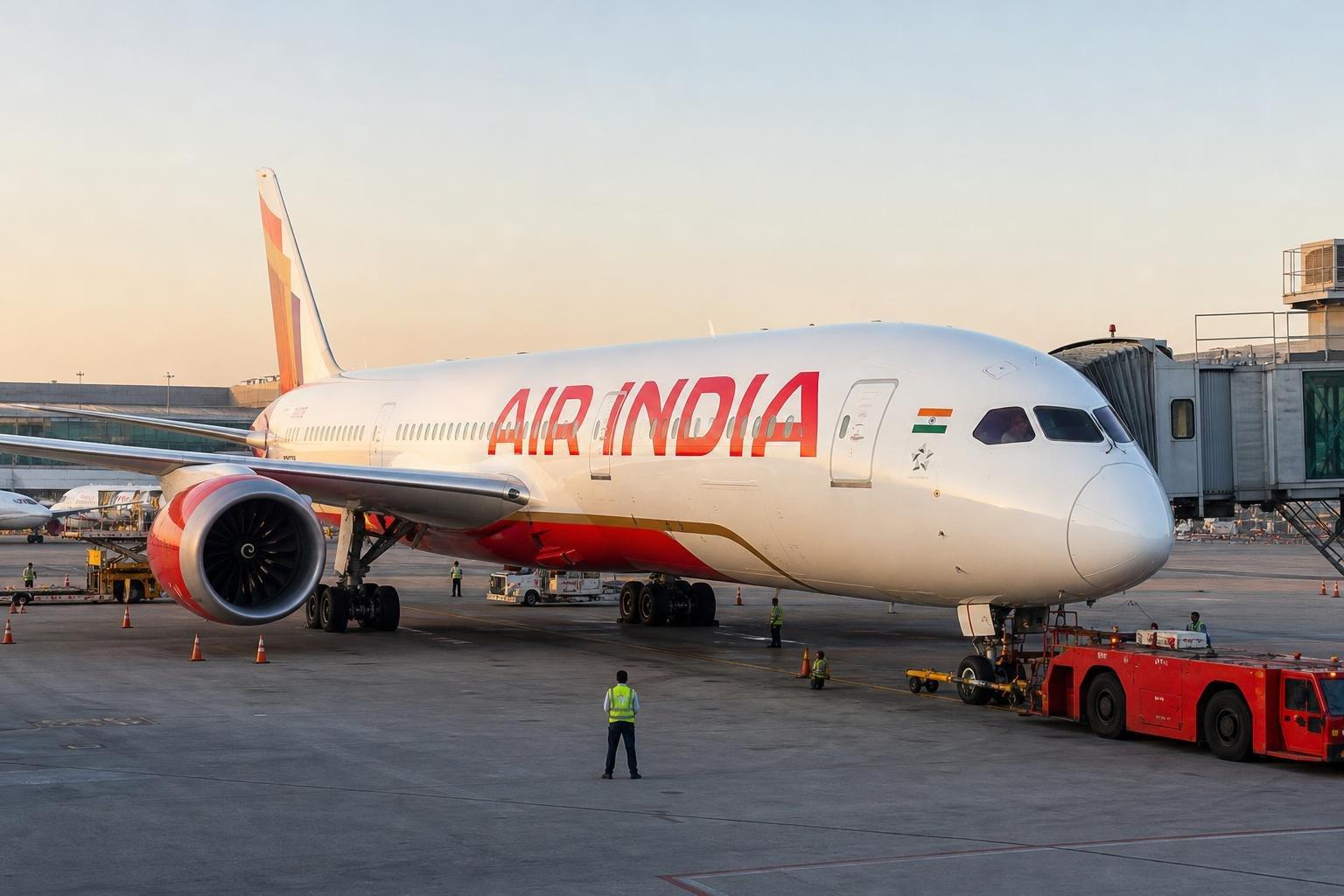
AI-generated illustration
Tata Sons Gives Air India CEO Tewolde Gebremariam Free Hand to Rebuild Senior Leadership
Air India's new chief is reportedly cleared to bring in outside airline executives, with Chief Commercial and Transformation Officer Nipun Aggarwal expected to leave executive management.
The gist
Air India CEO Tewolde Gebremariam has reportedly been cleared by Tata Sons to reshape top management, with Nipun Aggarwal set to step back.
Continuing coverage
All India →- Pilots' Federation Asks India to Curb SpiceJet Flights and Vet Its ₹5,500-Crore Fundraise
- Indian Carriers Schedule 7,154 Fewer Domestic Flights for November and December Peak
- Philippine Airlines Plans Nonstop Manila Flights to Delhi and Mumbai From December
- Gulf Carriers Threaten Diplomatic Escalation as Mumbai Airport Pushes 14 Routes to Navi Mumbai
- Indian Oil Cleared to Sell Sustainable Aviation Fuel From Panipat Refinery
Tata Sons has given Air India managing director and chief executive Tewolde Gebremariam wide latitude to remake the airline's senior management and speed up its turnaround, according to a report by The Economic Times. The mandate reportedly allows Gebremariam to bring in executives with extensive aviation experience, including senior hires from outside the Tata Group who have run large airlines. Tata Sons chairman N Chandrasekaran is said to have backed the move.
The first expected casualty of the reshuffle is Nipun Aggarwal, Air India's Chief Commercial and Transformation Officer, who is expected to move out of executive management. Aggarwal joined the airline in January 2022 and played a central role in Tata Sons' acquisition of Air India. His remit has covered aircraft procurement, financing, network planning, revenue management and the airline's large aircraft orders, and he was once considered a contender to succeed Campbell Wilson as chief executive. Chandrasekaran has discussed the transition with Aggarwal, who has been offered alternative roles within the Tata group, the Economic Times report said.
Gebremariam led Ethiopian Airlines as Group CEO from 2011 to March 2022. His appointment at Air India was made in August 2026, and he formally took charge as MD and CEO on October 1, succeeding Wilson. Since then he has made cost reduction and operational efficiency his priorities, and the airline has set up a multidisciplinary team to find savings across the business.
Air India's board met last Friday at the carrier's Gurugram headquarters, chaired by Chandrasekaran. Gebremariam briefed the directors on the airline's performance and plans. Those present included three independent directors, Sanjiv Mehta, Alice G Vaidyan and P R Ramesh, and two non-executive non-independent directors, P B Balaji and Goh Choon Phong. The board reportedly discussed higher fuel costs and efficiency gains across the Air India Group, and reviewed possible synergies with Air India Express, including integrating key operations.
The financial pressure behind the changes is plain. Speaking at the Aviation India and South Asia conference in November, Gebremariam acknowledged that Air India's cost per available seat kilometre is higher than its revenue per available seat kilometre, meaning the airline spends more to fly its capacity than it earns from it. The carrier has committed billions of dollars to new aircraft, cabin refurbishment, technology and network expansion, but that spending has not yet produced the expected financial results. In the previous financial year, Air India's consolidated net losses widened sharply, according to Aviation Jeta.
Gebremariam has said some of the airline's problems come from industry-wide factors, including elevated fuel prices and geopolitical tensions in the Middle East. At his first public event as CEO, he said profitability remains a key concern even as the airline sees long-term growth opportunities. Earlier this month he outlined plans to rebalance the route network, try to regain overseas market share, cut costs and order more wide-body aircraft.
The network is central to that plan. Gebremariam said much of Air India's flying to Europe and America has been hit by airspace closures, and that Delhi has been more affected than Mumbai. Air India has historically concentrated much of its international operations in Delhi, with Mumbai as a second gateway, and he wants to spread that activity more evenly, lift aircraft utilisation and create more connecting options through Indian airports. Alongside Delhi and Mumbai, the airline is considering Bengaluru as a third hub.
Reported by Livemint, with additional reporting from Aviation Jeta and Live From A Lounge
Read more
All Airlines →
Pilots' Federation Asks India to Curb SpiceJet Flights and Vet Its ₹5,500-Crore Fundraise
The Federation of Indian Pilots wants regulators to test whether SpiceJet has the money, aircraft and crew to fly its approved schedule safely, and to verify its planned ₹5,500-crore capital raise.
Thai Airways Swings to Q3 Net Loss as Jet Fuel Costs Jump 60% Ahead of CEO Appointment
Thai Airways International lost 418 million baht in the third quarter despite a 13% revenue gain, and says cutting costs, starting with fuel, will lead its 2027 plans.
Philippine Airlines Plans Nonstop Manila Flights to Delhi and Mumbai From December
PAL intends to fly A321neo jets to Delhi three times a week and Mumbai four times a week starting December 2026, pending approval from the Indian government.
easyJet Airline Unit Swings to £195 Million Loss as Fuel Bill Climbs £244 Million
Higher jet fuel prices and weaker bookings tied to the Middle East conflict cut easyJet Group's headline pre-tax profit by 89% in fiscal 2026, with easyJet holidays keeping the group in the black.
The Daily Touch & Go
The day's best aviation news in your inbox. Free, no spam.