

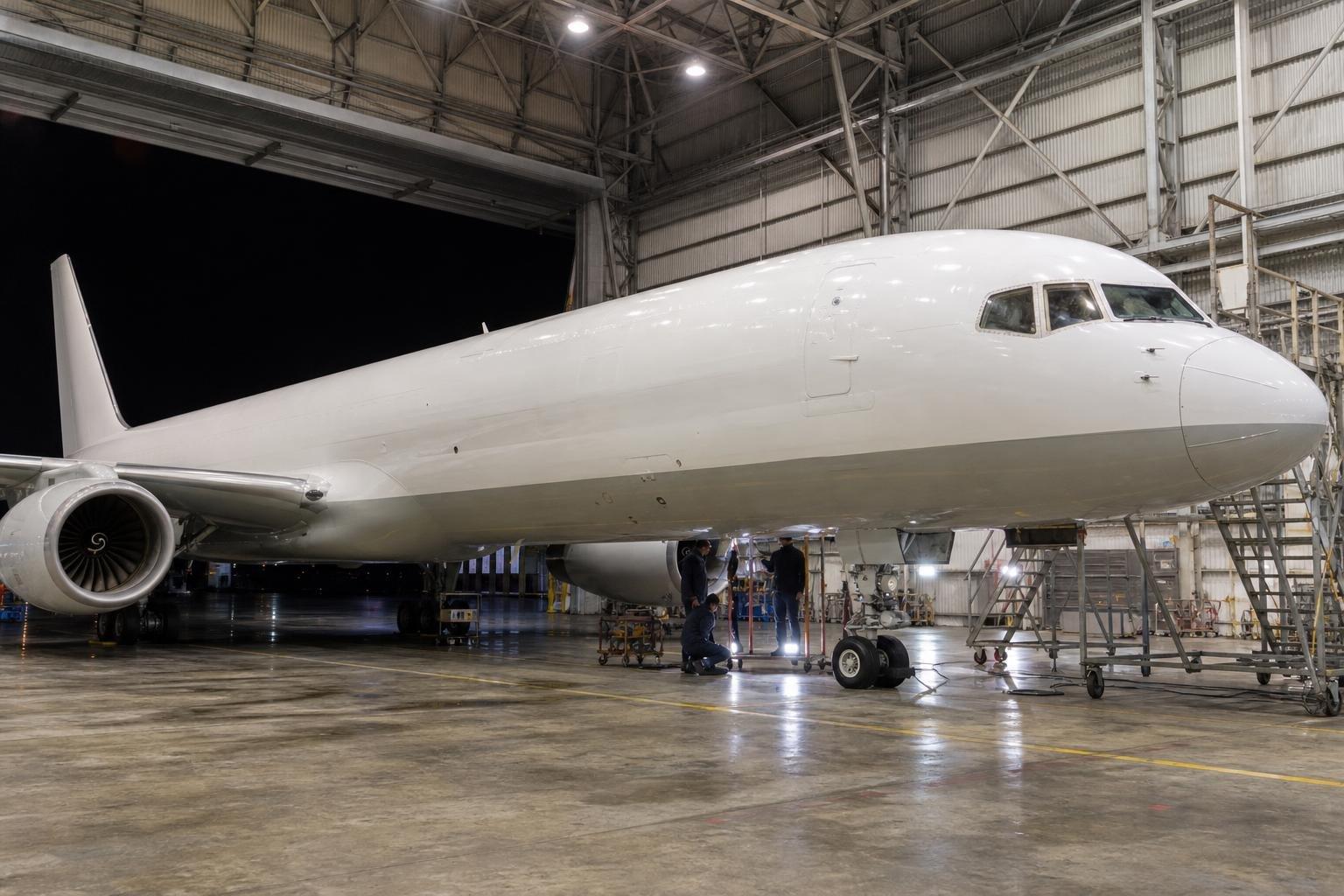
AI-generated illustration
FAA Orders Pre-Flight Inspections of Boeing 757 Fuselage Repairs After Crack Reports
A new airworthiness directive covering an estimated 427 US-registered 757s requires checks of reinforcing repairs in the lower fuselage before further flight, and the FAA rejected an industry bid for more time.
The gist
The FAA will require 757 operators to inspect lower-lobe fuselage repairs for cracks before further flight, starting 28 December.
Continuing coverage
All Faa →- Academy Report Says FAA Skipped Required Risk Assessment Before Closing DC Helicopter Route 4
- FAA Ground Stops Hit O'Hare and Atlanta on Three Straight Days of Thanksgiving Week
- Surface Radar Outage Forces Second Ground Stop in Two Days at Chicago O'Hare During Thanksgiving Rush
- Army Seeks to Restart Helicopter Training Flights Near Reagan National as FAA Approval Remains Pending
- FAA Follows Canada in Ordering Bell 429 Tail Rotor Checks Over Uncoated Bearings
The Federal Aviation Administration has ordered inspections of certain Boeing 757s before further flight after receiving reports of crack damage at existing reinforcing repairs in the fuselage frame lower lobe areas of certain sections. The airworthiness directive (AD) was published on 20 November and takes effect on 28 December. The FAA estimates that 427 aircraft on the US registry are covered by the order.
Under the directive, operators must inspect for any existing reinforcing repairs in the affected lower lobe areas and carry out the applicable on-condition actions. The FAA said it is issuing the AD to address an unsafe condition on these aircraft. The agency put the cost of the inspections at up to $22,355 per aeroplane and up to $9.5m across US operators, with each inspection expected to take up to 263 work-hours.
The order reaches deep into the freighter market. Industry data shows nearly 450 757s in service with airlines, more than 250 of them freighters. Data from Planespotters lists UPS, FedEx, SF Airlines and DHL Group among the major 757F operators. Other operators of the type include 21 Air, Asia Pacific Airlines, India-based Blue Dart Aviation, Cargojet, Russia-based E-Cargo and Aviastar-TU Airlines, Kalitta Charters, MIAT Mongolian Airlines, Romania-based Mister Air, Canada-headquartered Morningstar Air Express, Spain-based Swiftair, Uzbekistan-based My Freighter, SkyGuard and Stratos, and China-based YTO Cargo Airlines, North-Western Cargo and China Postal Airlines.
Airlines for America (A4A) pushed back when the directive was still a proposal. In a June response, the trade association said its affected members were Delta, FedEx, United and UPS. It warned that a high number of repairs in the inspection area could create a heavy workload for airlines, Boeing and the FAA alike, potentially leading to aircraft groundings and compliance delays.
A4A sorted the repairs it expected operators to find into three groups: undocumented repairs, documented repairs based on data that has not been FAA-approved, and documented repairs carried out using FAA-approved data. The association argued that the third category carries lower safety risk because those repairs had already been evaluated and approved by the FAA or a designated authority, and said it expected most of the repairs found to fall into that group. It asked the FAA to give operators up to 36 months from the effective date to contact Boeing and complete any follow-up work on those approved repairs, rather than requiring action before further flight.
The FAA confirmed it received requests from both A4A and FedEx to extend the compliance time for Category 3 repairs, and turned them down. The agency said all existing reinforcing repairs are affected by the AD, including repairs done under 757 SRM 53-00-07 Repair 5 or Repair 6, FAA Form 8100-9 or FAA Form 8110-3. On that basis, the FAA said it considers it necessary to require the applicable on-condition actions for every reinforcing repair before further flight.
The affected freighter fleet is old. Most 757 freighters in service are around 25 to 40 years old. Factory-built freighters were largely manufactured between 1987 and 1999, while most conversions were carried out between the mid-1980s and the early 2000s.
The type has drawn regulatory attention before. In December 2025, the FAA issued an AD for certain 757 aircraft, including the 757PF package freighter, addressing precooler wear-out conditions and thermal switch failures. In February of that year, the agency recommended a series of checks on certain 757-200 passenger-to-freighter conversions after a main cargo door opened in flight; rather than issuing an AD, it published a safety information bulletin citing a February 2021 event in which the door opened on a DHL Air aircraft flying out of Leipzig. The European Union Aviation Safety Agency had also warned airlines in June 2023 of a door malfunction risk on 757-200P2Fs.
Originally reported by Air Cargo News
Read more
All Regulatory →
FAA Requires Stand-Alone Tower Supervisors for Line Up and Wait as Thanksgiving Rush Begins
A new FAA staffing rule bars towers from using Line Up and Wait unless a dedicated supervisor is on duty, and controllers are already warning pilots of possible departure delays.

Everett-Built 737 MAX Jets Added to Boeing Production Certificate as North Line Nears Deliveries
Boeing's new 737 line in Everett, Washington, has reportedly cleared a regulatory step toward handing over jets, with the planemaker working through the final stages of an FAA audit.

Aviation Coalition Asks Congress for $30 Billion in ATC Funding, Short of White House $50 Billion Ask
More than 60 aviation groups urged lawmakers to approve at least $30 billion for air traffic control modernization, even as the Trump administration now seeks about $50 billion after this month's national ground stop.

DOT Inspector General Opens New Audit of FAA Manufacturing Oversight as Six Boeing Fixes Remain Open
The Transportation Department watchdog will examine how the FAA polices manufacturers and their US and foreign suppliers, while six of 16 recommendations from a 2024 Boeing audit are still unresolved.
The Daily Touch & Go
The day's best aviation news in your inbox. Free, no spam.