

Illustration: The Touch & Go
EAA AirVenture Oshkosh 2026 to Showcase Cutting-Edge Aviation Technology and Historic Warbirds
The world's largest fly-in event returns July 20-26 with displays from innovative aviation firms, military warbirds, and new flight training aircraft.
The gist
EAA AirVenture Oshkosh 2026 brings tech innovations, rare warbirds, and new aircraft to Wisconsin this July.
Continuing coverage
All Flight Training →- From Build Nights to Solo Flight: Cadet Carter Froehlich's Aviation Journey
- Pilots urged to secure renters insurance amid limited owner policy coverage
- How the Law of Primacy Shapes Pilot Training Habits and Safety
- China grounds private light fixed-wing aircraft after fatal crash into Beijing skyscraper
- McFarlane Aviation Launches New Replacement Parts for Aging Cessna and Beechcraft Aircraft
The Experimental Aircraft Association's AirVenture Oshkosh is set to return as the premier global aviation fly-in, running from July 20 to 26, 2026. This year’s event promises a vibrant blend of historic aircraft and cutting-edge technology, illustrating the industry’s rich past and innovative future. Aviation enthusiasts will gather at Wittman Regional Airport in Oshkosh, Wisconsin, to witness a diverse array of exhibitions, airshows, and immersive learning experiences designed to engage all ages and interests.
A central focus at this year's AirVenture is the Boeing Plaza, which will be transformed into a technology hub featuring leading-edge aviation companies. Notable participants include BETA Technologies and Bye Aerospace, pioneers in electric and sustainable flight, as well as Jetson and American Drone showcasing advanced urban air mobility and unmanned systems. Additionally, Zipline and Amazon Delivery will provide insights into the evolving role of drones in logistics. The event also features academic contributors like Embry-Riddle Aeronautical University, supporting the intersection of education and aviation innovation.
The airshow schedule is highlighted by flights from several of the featured innovators, including Bye Aerospace’s electric aircraft and American Drone’s latest unmanned demonstrations, complementing a thrilling lineup of traditional air displays. A Twilight Flight Fest will spotlight the drone delivery company Wing, displaying its newest operational developments during evening performances. This fusion of historic aviation and state-of-the-art technology exemplifies AirVenture’s role as a bridge connecting aviation’s longstanding heritage with emerging trends.
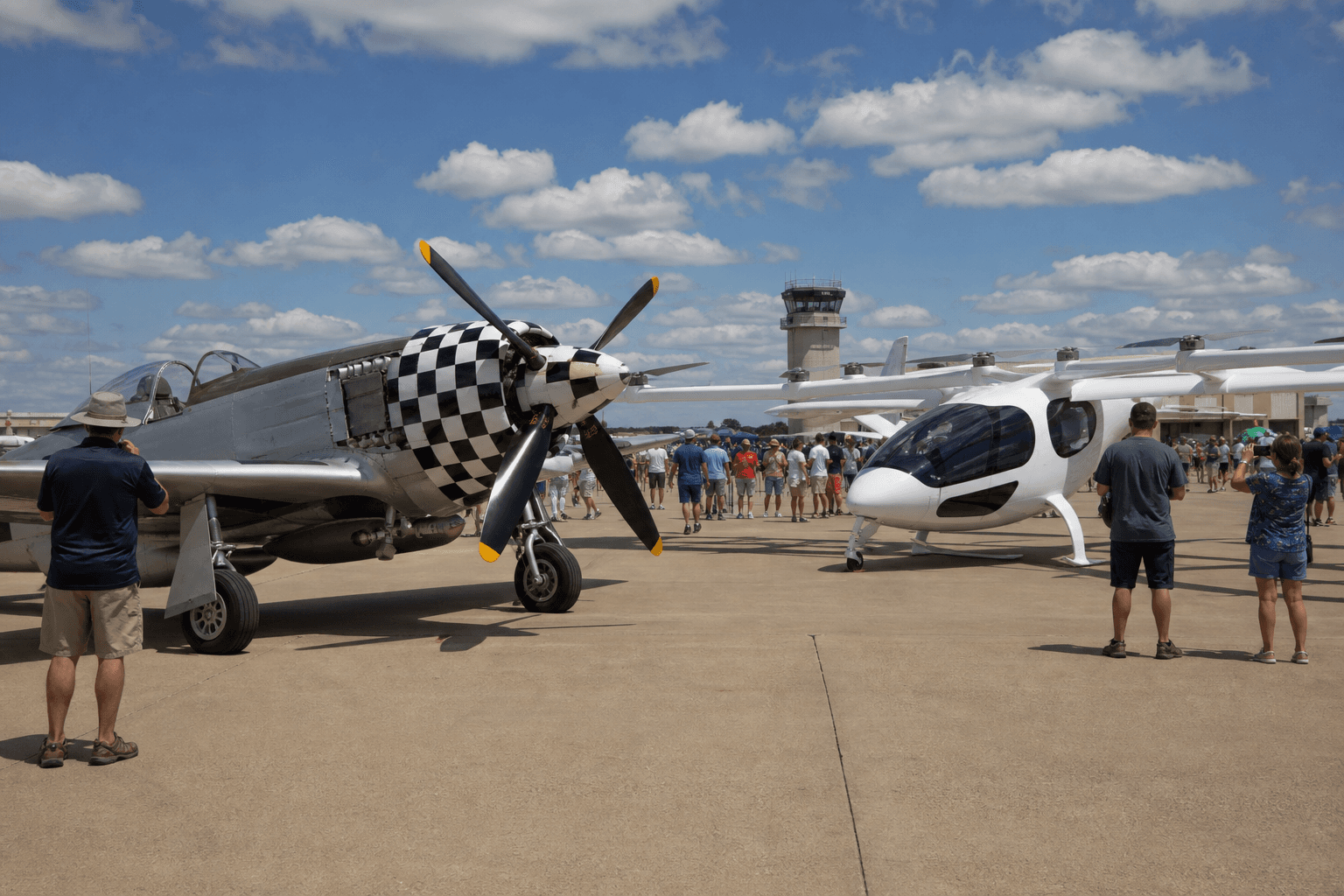
Warbird enthusiasts will have exceptional opportunities to see and hear some of the most iconic military aircraft in rare public displays. The Boeing Plaza static exhibits will feature the legendary B-29 Superfortress named Doc, a rare Consolidated PB4Y, and the Commemorative Air Force’s B-24 Liberator. Acrobatic warbird flights in the afternoon will include Vicky Benzing piloting the P-51 Mustang Plum Crazy, while Bernie Vasquez will demonstrate the might of the Republic P-47 Thunderbolt. These events celebrate the remarkable history and engineering of military aviation.
The Aviation Gateway Park will offer an interactive experience focused on vertical lift and emerging eVTOL aircraft. Visitors can explore static displays and interactive exhibits highlighting helicopters, advanced vertical lift platforms, and electric vertical takeoff and landing vehicles, reflecting the sector’s rapid technological advancements. This segment aims to educate attendees on the future possibilities of urban and regional air mobility.
Flight training also features prominently at Oshkosh 2026 with the introduction of the Cirrus TRAC10, a new light aircraft purpose-built for flight schools. Powered by a turbocharged Rotax 916 iSc FADEC engine, the three-seat TRAC10 includes a Garmin flight deck and the Cirrus Airframe Parachute System, underscoring a commitment to safety and modern avionics. Cirrus has already secured 100 orders from 13 flight schools, indicating strong market interest in flight training modernization.
Recent aviation industry developments provide crucial context as the event unfolds. Notably, the U.S. Air Force has incorporated an ex-Qatari 747-8, converted by L3Harris into a new Air Force One variant using a 24/7 fast-track process. This bridge aircraft entered service in July 2026, reflecting the pace of aerospace refurbishment projects. Additionally, regulatory changes by the FAA are paving the way for quiet supersonic flight over U.S. land, replacing the longstanding ban with noise-based standards—a shift that could accelerate commercial supersonic travel initiatives.
Aviation innovation is further exemplified by Boom Supersonic’s progress on its Symphony engine, which doubles as a power generator for AI applications on the ground. This dual-use strategy helps offset development costs, signaling a novel approach within aerospace propulsion markets. Coupled with AirVenture’s demonstration of emerging flight technologies and educational outreach, 2026’s event encapsulates where aviation stands today—grounded in history but soaring towards transformative horizons.
Read more
All Military/Defense →
VC-25A Air Force One Retires After 35 Years as New 747-8 'Bridge' Model Prepares for Service
The world has been so focused on the new/interim/'bridge' Boeing 747-8 Air Force One and its journey to entering service that many failed to think about how it would spell the end for the VC-25As in their long-running role in transporting the president.

Trump takes first presidential flight on Qatar-donated VC-25B Air Force One
The new Air Force One ferried the president from Washington, DC to North Dakota. US President Donald Trump has logged the first executive flight aboard the US Air Force’s newest Air Force One presidential jet. Trump boarded the aircraft at Joint Base Andrews outside of Washington, DC on 1 July and flew to Bismarck Municipal…

Wreckage of missing K2 Airways 737-400 freighter found off Pakistan coast
Aircraft lost contact over water while en route from United Arab Emirates to Pakistan. Pakistani search and rescue authorities have found wreckage from the K2 Airways Boeing 737-400 freighter which was declared missing during a flight between Sharjah and Karachi on 7 July. The Pakistani airports authority says the country's navy and the maritime security agency have "successfully located and identified" debris from the twinjet, adding that it was recovered about 53nm south of the coastal region of Ormara. Karachi-based K2 Airways states that the aircraft had five crew members on board when it disappeared over the Arabian Sea. Pakistan’s civil aviation authority says the crew “reported navigational system issue” at 21:18, and was in contact with Karachi area control centre. However, the aircraft was then seen on radar displays to be “rapidly descending” with a “rapid heading change” and contact was lost at 21:21, with the jet 155nm west of Karachi. K2 Airways says it was carrying two pilots, two engineers and a loadmaster. "Search and rescue operations are being conducted by the concerned organisations," it states. Public flight-tracking data, yet to be verified, suggests the aircraft was cruising at 35,000ft, some 1h 20min after departure, when it deviated from its heading and lost altitude over the Arabian Sea. The airline adds that it is "fully co-operating" with the Pakistan civil aviation authority and other agencies. It identifies the missing twinjet as AP-BOI, a 1999 airframe formerly in service with Aeroflot and Garuda Indonesia before being converted to a freighter. The company has not specified the nature of any cargo on board, and whether it included any hazardous goods. K2 Airways is a relatively young carrier, having been established in 2018. The company says its first aircraft arrived in Karachi two years ago, in July 2024.
US Defense Innovation Unit seeks low-cost attritable drone to replace MQ-9A Reaper
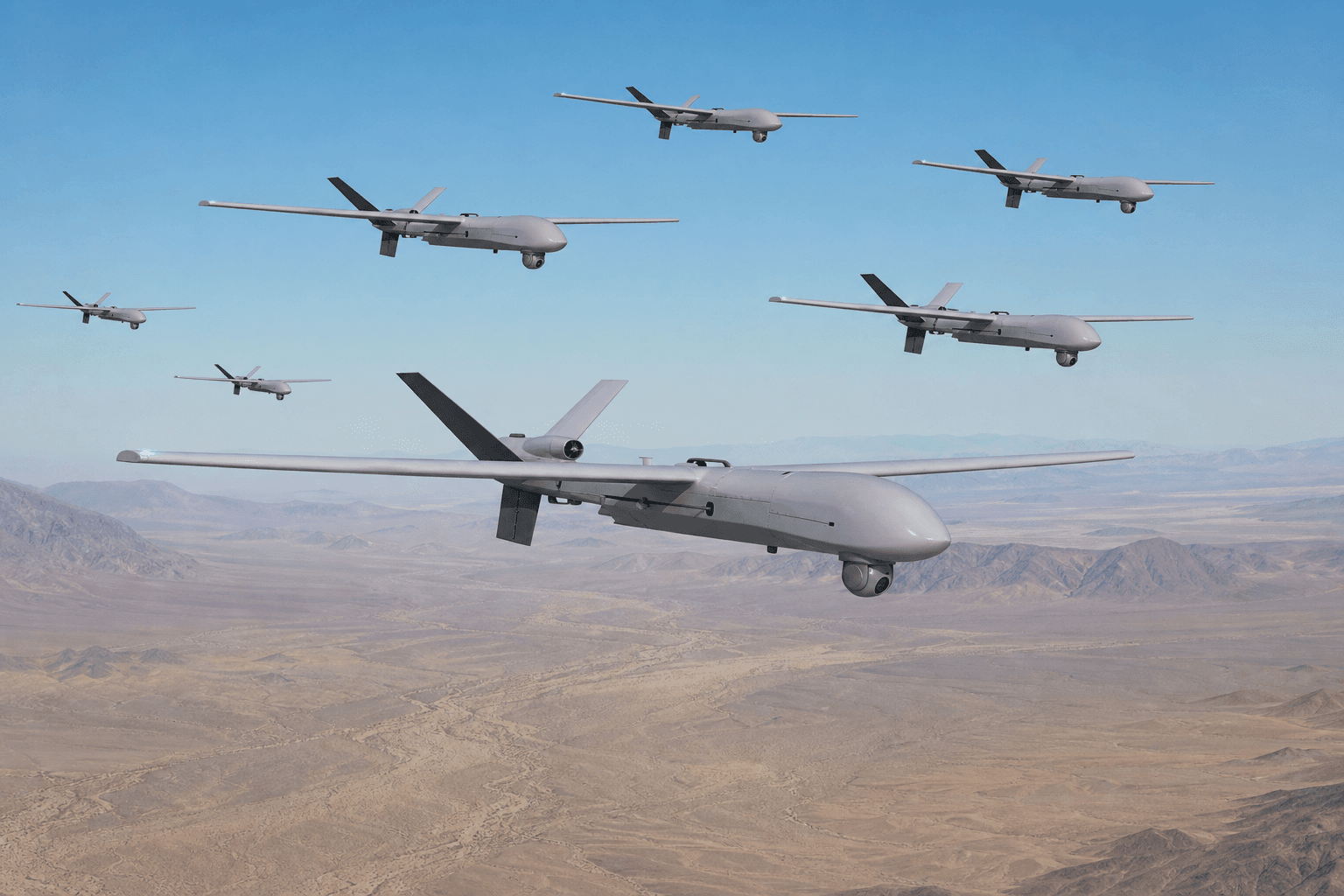
The “Massed Modular Aircraft” tender envisions an uncrewed system that can be produced in large enough quantities at a low enough cost to be considered attritable in combat. The US military’s Defense Innovation Unit (DIU) has released a solicitation for a new low-cost, high-volume uncrewed aircraft that can perform the missions of the General Atomics MQ-9A Reaper. Dubbed the “Massed Modular Aircraft”, the programme envisons a modular UAS that can provide what the DIU describes as a “risk-tolerant option” in the air domain. “The joint force’s reliance on low-density, high-value ‘exquisite’ (>$30 million) manned and unmanned aircraft is unsustainable against adversaries utilising layered defences enabled by increasingly low-cost antiaircraft capabilities,” the DIU says. “This drives the joint force into unacceptable compromises: either operate safely outside a threat zone – negatively impacting mission effectiveness – or manoeuvre inside a threat engagement zone with increased levels of attrition.” At least 24 US MQ-9As were lost in combat during the heaviest fighting of the US-Israeli air campaign over Iran throughout February, March and April. USAF chief of staff General Kenneth Wilsbach has described the uncrewed strike and reconnaissance platform as the “most valuable player” of the air war. “We get a lot of utility out of them and don't put our folks at risk," Wilsbach said during congressional testimony in May. However, the campaign revealed some limitations of the Reaper platform, namely that it is vulnerable to modern air defences (at least in the manner employed by the Pentagon) and neither easy nor cheap to replace when lost. In fact, General Atomics shuttered the MQ-9A production line in 2025 due to a lack of new US orders. The company is currently assembling MQ-9B SkyGuardians at a sticker price of around $30 million. The new MMA concept aims to address both issues by focusing on a design that can be produced at high rates for a much lower cost. Rather than improving survivability, the aircraft will instead be built with high rates of attrition in mind. “By deploying large groups of risk-tolerant MMA, the joint force can overwhelm enemy defences even while experiencing numerous MMA losses,” the DIU says. Although no specific target is provided regarding production volume, the tender notes the goal is to field “many aircraft at once” to ensure a “persistent, overwhelming [and] credible threat despite inevitable attrition.” Specific technical attributes listed in the MMA solicitation include a payload capacity of at least 1,270kg (2,800lb), an unrefuelled combat radius of at least 2,300nm (4,260km) while carrying payload, and the ability to self-deploy one-way at least an 8,000nm. MMA designs must also offer the ability to be outfitted with a variety of sensor payloads, including full-motion video, in order to fully replicate the mission set of the MQ-9A. General Atomics is offering the MQ-9B options to the US Air Force as an MQ-9A successor. The new B-variant is on contract with the UK, Canada, Poland, Belgium, Denmark, India, Taiwan, Germany, Japan and US Special Operations Command. Source: General Atomics Interestingly, autonomy is listed in the tender only as a secondary attribute with the ability to operate with a “one-to-many operator-to-UAS control ratio”. The MQ-9A is a remotely piloted aircraft with one pilot flying one vehicle. Other secondary attributes include a true airspeed of at least 200kt, the ability to operate from a runway of 6,000ft or shorter, 25kW of onboard power generation and 5kW of cooling. Design submissions are due by 23 July, with companies required to deliver a full-scale prototype for flight testing within 21 months of receiving an award. Although DIU prototyping contracts do not guarantee a subsequent deal for rate production, the agency seems inclined to move forward with operational fielding of the MMA. The tender notes the DIU is targeting 2031 for initial operating capability, defined as 20 mission-ready aircraft delivered to an operational unit and able to be deployed. General Atomics has pushed back on the notion that all of the MQ-9A’s capabilities can be replicated at a fraction of the cost. The company’s senior communications director, C. Mark Brinkley, previously described that idea as a “wonderful dream” and counters that the MQ-9 series remains “the best value for dollars out there today”. “General Atomics sells real airplanes, at scale, all around the world,” Brinkley said in May. “We are offering the US Air Force modular options for MQ-9B, at a price that reflects the [Department of War’s] requirements and can be delivered today, not someday.” Between the remaining spare parts in storage and a number of company-owned Reapers, General Atomics says it could produce between five and ten MQ-9As to offset the Pentagon’s recent combat losses . Although bearing a similar name, the MQ-9B is essentially a new aircraft, one designed to comply with civil aviation regulations. It boasts a larger 24m (79ft) wingspan, significantly improved 40h of flight endurance and automatic take-off and landing. The MQ-9B is also available in a maritime-configured SeaGuardian variant.
The Daily Touch & Go
The day's best aviation news in your inbox. Free, no spam.