

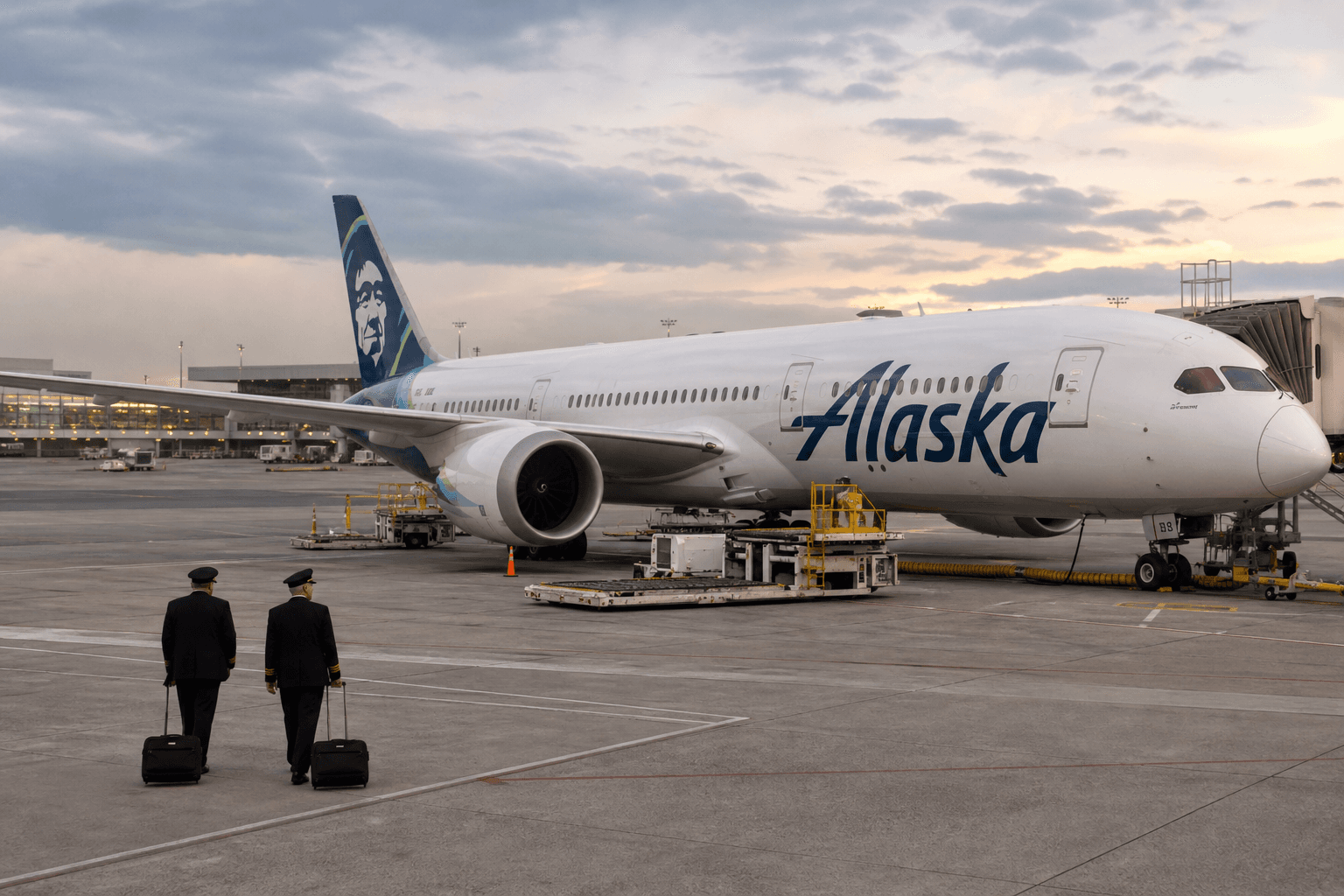
AI-generated illustration
Alaska-Hawaiian Pilot Deal Sets 12-Year Widebody Captain Pay at $493.41 an Hour
A tentative four-year contract between Alaska Air Group and ALPA would lift senior widebody captain pay to $539.16 an hour by 2030, with 4,600 pilots voting from December 1 to 22.
The gist
Alaska and Hawaiian pilots will vote on a deal paying 12-year widebody captains $493.41 an hour from 2027, rising to $539.16 by 2030.
Continuing coverage
All Boeing 787 →- Malaysia Aviation Group Nears Order for Up to 20 Boeing 787s to Replace A350 Fleet
- India Tells Supreme Court Draft Final Report on Air India AI-171 Crash Is Two to Three Weeks Away
- FAA Orders Inspections of 60 US Boeing 787s Over Fuel Tank Sealant Defects Linked to Lightning Risk
- American Airlines Adds Seven International Routes This Winter, From Oaxaca to Tokyo Narita
- Etihad Paints a Boeing 787-10 in McLaren Papaya to Mark Its New Formula One Partnership
Alaska Airlines and Hawaiian Airlines have reached a tentative joint collective bargaining agreement with the Air Line Pilots Association that would pay a 12-year widebody captain a base rate of $493.41 an hour starting in early 2027. The deal follows more than 600 days of negotiations, and ALPA agreed to the terms on November 10. Mainline pilots typically credit between 800 and 1,000 flight hours a year, so the new top widebody rate works out to roughly $395,000 to $493,000 in base flight pay alone. The 4,600 pilots covered by the agreement will vote on it from December 1 through December 22.
The $493.41 figure is a floor for 2027, not a ceiling. Rates are scheduled to climb each year and reach $539.16 an hour by 2030. Each annual adjustment will match the average pay of American, Delta, Southwest and United on comparable aircraft or rise by at least 3%, whichever is greater. Alaska Air Group will also put 18% directly into pilots' 401(k) accounts and run a performance-based program with 5% annual payouts.
If a majority of pilots approve the contract, the new pay scales and scheduling rules take effect on January 31, 2027, and run through January 30, 2031. The agreement would close the pay gap between the two legacy pilot groups. Pilots would see an immediate hourly raise in the range of $86.41 to $102.41, an increase of 21.2% to 26.2%.
The contract is the labor piece of a merger that closed when Alaska Air Group bought Hawaiian for $1.9 billion in September 2024. The Federal Aviation Administration granted the combined carrier a single operating certificate in October 2025, but the two pilot workforces stayed on separate contracts. Joint negotiations began in February 2025 with two goals: a uniform pay scale and an operational framework for reorganizing the pilots and aircraft of the combined fleet. ALPA negotiators used Alaska's existing contract as the base while keeping legacy Hawaiian protections in place.
Captain Drew Coyle, who chairs the Alaska Airlines master executive council, said the joint negotiating committee stayed focused on the priorities of both pilot groups through some of the hardest issues facing the combined membership, and that none of it was easy. He said it is now up to pilots to review the deal, ask hard questions and decide whether it meets their expectations. Captain Larry Payne, his counterpart at Hawaiian, said the decisions made in the talks will shape pilots' careers and quality of life for years, and that an approved agreement would form the basis for future contracts as a single pilot group.
Ratification does not finish the job. Alaska and Hawaiian pilots still cannot fly each other's aircraft until their seniority lists are merged, and federal law requires a neutral arbitrator to combine the two rosters into one master list. Seniority governs captain upgrades, schedules and holiday bidding, so pilots stay on their legacy fleets until that process is done. Until then, management cannot freely assign crews across both networks or move aircraft to different airfields as demand shifts.
The deal also removes a labor obstacle to the airline group's widebody plans. Alaska expects up to 17 new Boeing 787 Dreamliners that will launch 12 new overseas routes, and it is building an international gateway at Seattle-Tacoma International using 787s taken over from Hawaiian's order book and rebranded. From Seattle, the 787-9 serves Tokyo Narita, Seoul, London, Rome, Paris and Athens. Hawaiian first chose the 787-9 in 2018, canceling an order for six A330neos in favor of the Dreamliner's fuel efficiency, range and larger business cabin, and later raised its commitment to 12 aircraft before the merger.
In January, Alaska ordered 105 Boeing 737 MAX 10s and five more 787-10s, pushing its total Boeing order book past 240 aircraft. Folding Hawaiian's Dreamliners into an all-Boeing mainline fleet spares Alaska the cost of training crews and stocking parts for an Airbus widebody type it would otherwise add. The Honolulu operation, however, keeps its Airbus jets for now, which means the group runs separate supply chains, training programs and maintenance programs for its two widebody types.
Hawaiian's 24 Airbus A330-200s remain the backbone of its Honolulu long-haul flying, serving Tokyo Haneda, Osaka, Sydney, Papeete and Pago Pago along with major West Coast cities. Under a $600 million modernization plan, all 24 aircraft will be retrofitted with new Leihōkū lie-flat suites and premium economy cabins, with the work starting in 2028.
Originally reported by Simple Flying
Read more
All Airlines →
Malaysia Aviation Group Nears Order for Up to 20 Boeing 787s to Replace A350 Fleet
Malaysia Airlines' parent is said to favor the Dreamliner over the A350 because Boeing can deliver by 2030, ahead of a fleet renewal deadline of 2032.
Aer Lingus to Launch Its First Premium Economy Cabin on 10 Airbus A330s From October 2027
The Irish flag carrier will install 28 Recaro R4 premium economy seats on 10 A330s alongside new business and economy cabins, with fares starting at 700 euros one-way.
Alaska Airlines Adds Charlotte, Norfolk, Jacksonville and Des Moines Nonstops From Seattle
Alaska Airlines will launch daily year-round Seattle flights to four eastern and Midwestern cities in June 2027, plus seasonal Guadalajara service from March, lifting its Seattle network to 119 nonstop destinations.
Commercial Aircraft Orders Jump 88% in Third Quarter as Global Backlog Hits Record 17,058
ADS figures show 506 aircraft ordered between July and September 2026, while deliveries reached 361 and the backlog stretched to more than 12 years of production.
The Daily Touch & Go
The day's best aviation news in your inbox. Free, no spam.