

Illustration: The Touch & Go
USAF Plans Long-Term Procurement of 130 Heavy Weapons Pylons for B-52H Bombers
The Air Force aims to replace aging pylons on B-52H fleet with new assemblies capable of carrying heavier conventional and nuclear weapons.
The gist
USAF seeks 130 new heavy weapons pylons to upgrade B-52H bombers for modern, heavier weapon loads.
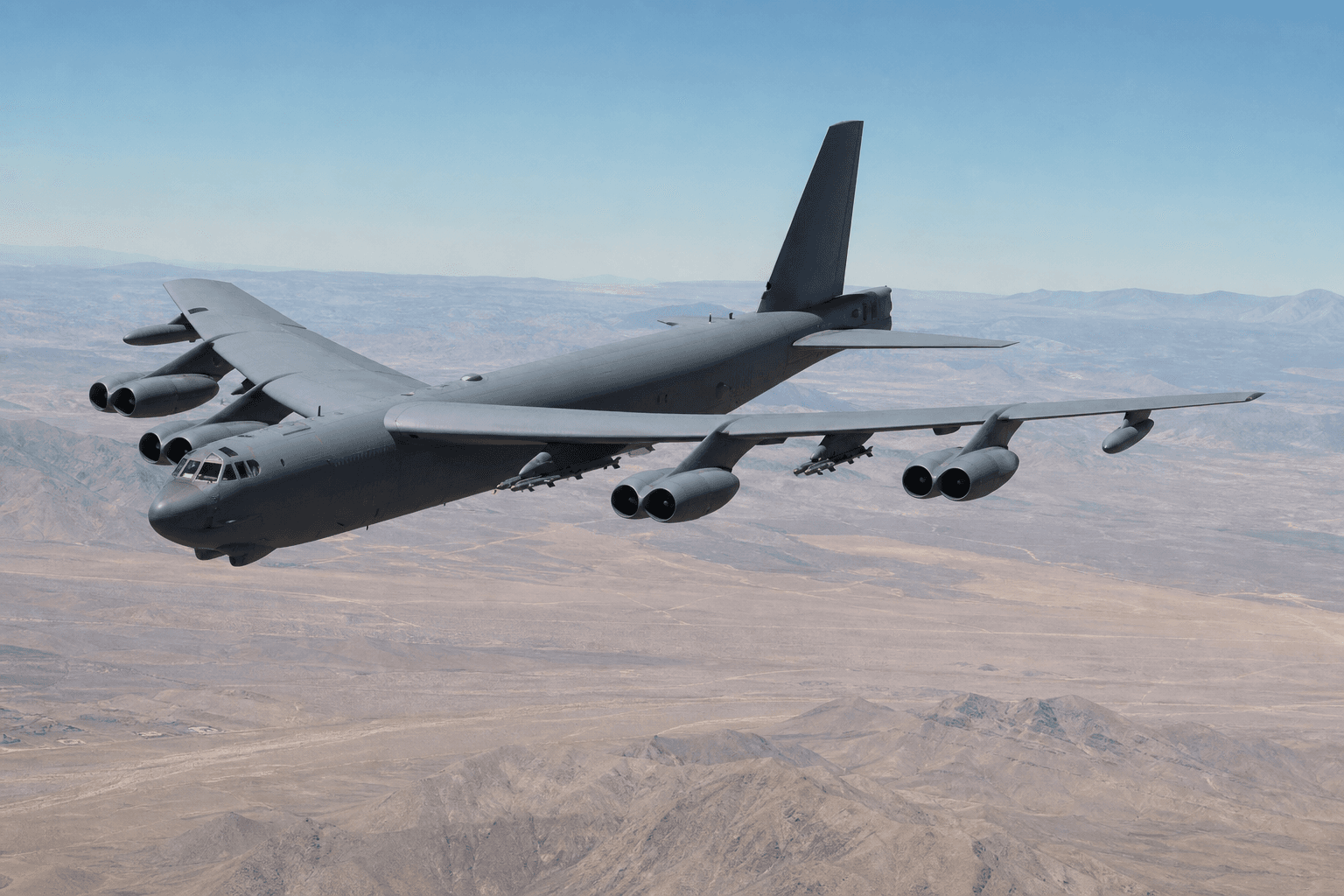
The United States Air Force is planning a significant upgrade to the B-52H Stratofortress bomber fleet by procuring as many as 130 new Advanced Weapons Wing Pylons (AWWP). These pylons will enable the venerable aircraft to carry conventional or nuclear weapons weighing up to 20,000 pounds, a substantial increase over the current capacity. This upgrade reflects evolving requirements to handle heavier modern weapons, a need not envisioned when the current Integrated Conventional Pylon (ICP) system was introduced.
The current ICP pylons, adapted in the late 1990s to incorporate MIL-STD-1760E technology, were originally designed for weapons weighing no more than 5,000 pounds. While the ICP has performed well over more than two decades, the Air Force acknowledges limitations regarding heavy weight capacity and concerns about the structural integrity of the pylons under modern load demands. The AWWP is intended to replace these with a stronger and more capable system suited for today’s arsenal.
The weight limit for each new pylon corresponds to the wing's hard point capability of 28,000 pounds, allowing for up to 8 Joint Air-to-Surface Standoff Missiles (JASSM), compared to the 6 carried with the current ICPs. This reflects increased flexibility and firepower, expanding the B-52’s role in carrying a larger payload of heavier munitions. Such enhancements align with the Air Force’s continuing modernization efforts to keep the B-52 fleet relevant despite the aircraft’s first flight occurring decades ago.
The B-52 program is undergoing several modernization initiatives, including the Commercial Engine Replacement Program that will swap the bomber’s eight aging Pratt & Whitney TF33-PW-103 engines for more efficient Rolls-Royce F130 engines. Additionally, the Radar Modernization Program will replace the antique Northrop Grumman APQ-166 radar with an active electronically scanned array (AESA) radar, based on Raytheon Technologies’ APG-79. These projects complement the weapons pylon upgrade by enhancing the aircraft’s performance and combat capabilities.
In fiscal year 2027, the Air Force has requested $1 million to initiate a new heavy bomber analysis of alternatives aimed at evaluating a potential B-52 successor. Along with this longer-term planning, $50 million has been requested to integrate the latest variants of Lockheed Martin's AGM-158 JASSM into the B-52, while $30 million is allocated for research and development of the new AWWP system. These investments highlight the priority given to extending the operational life and effectiveness of the B-52.
The B-52H fleet currently consists of 75 aircraft, following the recent crash of a test bomber at Edwards AFB in June 2026, which tragically resulted in the loss of eight crew members. Despite its age, the B-52 remains a key component of U.S. strategic and conventional air power, and the planned upgrades underscore its continued importance. The new pylon system ensures that the B-52 can carry emerging heavy weapons effectively and safely into the future.
Historically, the B-52 has shown remarkable longevity, with the last airframe built in 1962. While the Air Force plans to field over 100 B-21 Raider stealth bombers to ultimately replace B-1 and B-2 bombers, the B-52 is expected to remain in service for decades, making these enhancements essential. The AWWP represents a vital modernization step that will enable the bomber to meet current and forthcoming operational demands without limitations imposed by aging hardware.
This procurement initiative to replace the ICP with the AWWP is described by the Air Force as essential to unlock future heavy weapon capabilities. The integration of government-furnished weapons onto the new pylons will allow expanded carriage amounts and weights, reflecting changing battlefield requirements and the evolving nature of strategic bombing. Execution of this upgrade program is critical for maintaining the B-52 as a formidable platform in the U.S. bomber fleet.
Read more
All Military/Defense →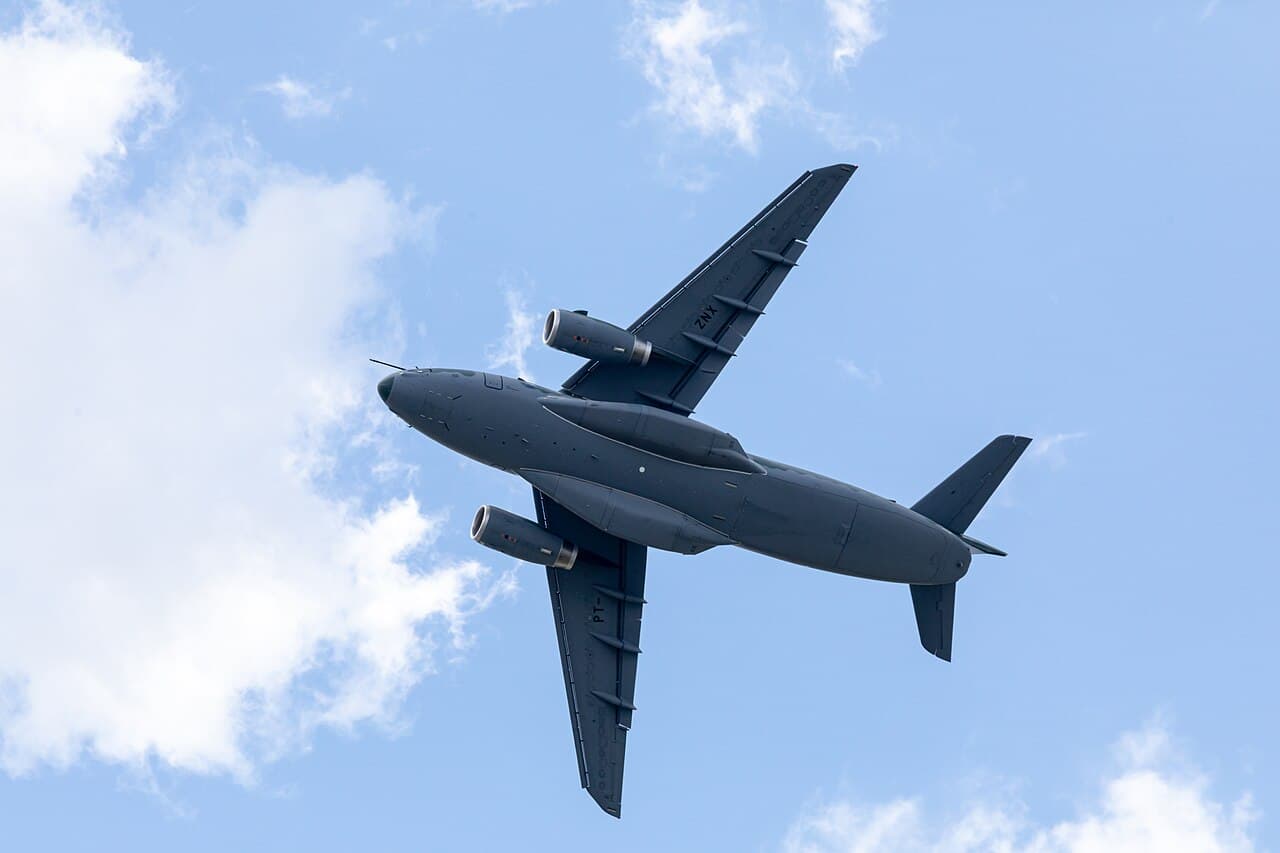
Embraer's KC-390 Secures 5 NATO Orders as a C-130 Alternative but USAF Remains Uninterested
Embraer's KC-390 Millennium has debuted to a resoundingly successful reception from many air forces around the world. A number of operators in Europe have jumped at the compact airlifter with its aerial refueling capability bundled in the twinjet, akin to a half-scale McDonnell Douglas C-17 Globemaster III. The US Air Force is currently struggling severely with its new Boeing KC-46A Pegasus, but it has not shown any interest in the Millennium.

Boeing's VC-25B Air Force One Replacements Delayed to 2028-29 Completion
The Boeing 747 may have ended its commercial production run, but two of the most consequential examples ever built remain deep inside a modification program that has stretched years beyond its original timetable. Boeing 's two purpose-built VC-25B presidential aircraft, which are the long-awaited replacements for the US Air Force's aging VC-25As, were originally expected to be delivered by the end of 2024. Instead, the first aircraft is now scheduled for roughly mid-2028, while the second is expected around mid-2029, according to the latest program reporting summarized by Yahoo Finance .
US Air Force Deploys Nearly One-Third of B-1B Bomber Fleet to RAF Fairford
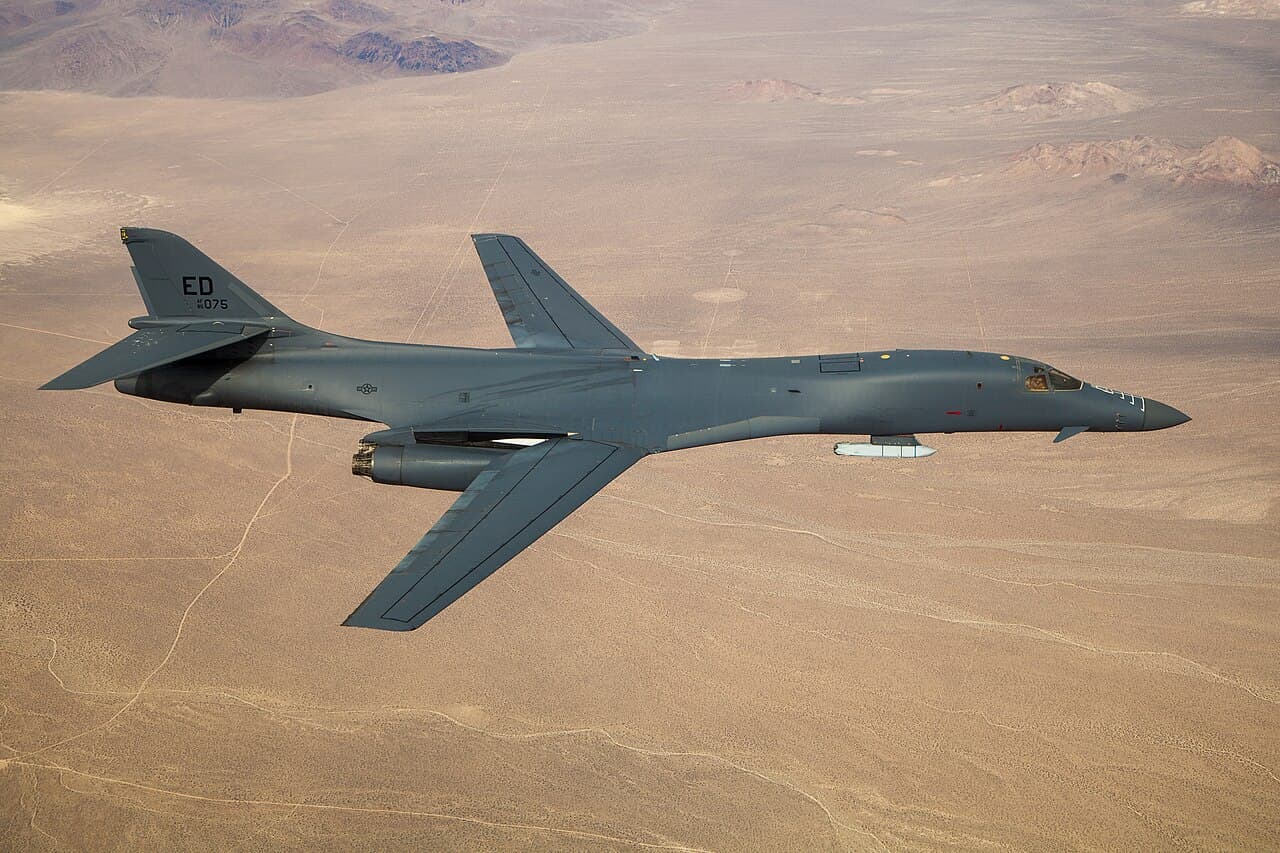
At the peak of Operation Epic Fury (around late March 2026) , the US Air Force deployed around 15 B-1B Lancers and around six B-52H Stratofortresses at the UK's RAF Fairford airbase. The initial wave of B-1Bs arrived on or after March 6, with B-52s arriving soon after. As of the time of writing (late July), a large share of the Air Force's operational Rockwell B-1 Lancer fleet remains deployed at RAF Fairford.

Whisper Aero's Ultra-Quiet Electric Engines Power First Piloted Flights in Tennessee
An electric aircraft engine designed to reduce operational noise to a whisper is now powering piloted aircraft. Whisper Aero on Wednesday revealed that its "ultra-quiet" eQ250 electric ducted fan propulsion system is being put to the test in Tennessee under an FAA special airworthiness certification. The company said it installed a pair of eQ250s on a modified Aériane Swift 3 glider, with which test pilot Zac Majors conducted three flights spanning 130 minutes, or about 43 minutes on average. Majors said the aircraft, which the company refers to as the Whisper Powered Swift, produced more thrust and was quieter than the standard propeller version of the glider, "but still great handling." "[I] could really do whatever I wanted with it," Majors said in a statement. "Look forward to flying it again." Fortunately for him, the campaign is only just beginning. Whisper plans to continue testing the Swift in Tennessee before advancing to flight tests and evaluations with "government customers" later this year. The company is under contract with the U.S. Air Force to develop a new family of quiet, efficient, autonomous aircraft for contested logistics, with initial testing planned for 2027. How It Works The eQ250 is the flagship product of Whisper's electric quiet (eQ) engine series. According to the company, it produces up to 85 pounds of static thrust for fixed-wing aircraft. It can also power Group 3 uncrewed aircraft systems (UAS)—which have maximum weight of 1,320 pounds and speed under 250 knots—or larger drone platforms. The specialized electric ducted fans are 10 inches in diameter and produce about 20 dB less noise than "comparable quiet propulsion systems," while also being 20 percent more efficient, according to Whisper's website . For short takeoff and landing (STOL) aircraft, the eQ250 is designed to enable coefficients of lift as high as 14. The propulsion system is intended to unlock short-to-medium-range regional air mobility services using small airports. The idea is similar to Electra's concept for "direct aviation," which involves the company's "ultra-short" takeoff and landing EL9. The goal is to replace trips that would take about 90 minutes driving with air service that takes closer to 20 minutes. Whisper said the Swift's 26:1 lift-to-drag ratio made it ideal for evaluating handling qualities and the propulsion system's performance, integration, and acoustics. Video: Whisper Aero The glider's eQ250s are powered by five Epic 1.0 Energy modules from Whisper partner Electric Power Systems (EPS). According to EPS, they provide 60 minutes of usable flight time with 30 minutes of reserve for trainer, eVTOL (electric vertical takeoff and landing), and "thin-haul" aircraft, which are used for very short trips with a handful of passengers. Whisper said the aircraft "completed its planned objectives," which included validating its propulsion integration, battery, control, and other systems. At full throttle at 100 feet agl, Whisper said the engines were quieter than the airframe itself. Ian Villa, co-founder and chief operating officer, told The Air Current that the glider can generate substantial noise without engines. Flown during the early morning, the aircraft produced about 52 dB(A) of noise compared to 34 dB(A) background noise, Whisper said. "The ability to fly within the soundscapes of even rural environments…will be critical for flights of FAA MOSAIC aircraft," the company added. The Modernization of Special Airworthiness Certification (MOSAIC) took effect in phases over the past few months and permits electric propulsion systems in the light-sport aircraft (LSA) category. More to Come Whisper said the test campaign "reduces risk" for the eQ250's larger civil and defense applications. The company is developing its JetFoil integration for STOL and VTOL aircraft, designed to enable runway independence. The JetFoil distributes ducted fan engines across the entire leading edge of the wing and would enable near-vertical takeoffs with 50 feet of ground roll. Whisper claims it will do so using half the thrust of tilt-rotor VTOL aircraft while offering more range and double the payload. Villa earlier this year told FLYING that Whisper is in talks with government customers to build and fly JetFoil-equipped prototypes, the idea being that they could be transitioned to commercial manufacturers who could bring them to market. For example, one could swap the de Havilland Twin Otter's high wing for a JetFoil and hybrid-electric powertrain. Whisper said the testing will further support its Collaborative Logistics Aircraft (CLA) program with the U.S. Air Force. The CLA concept is similar to the service's Collaborative Combat Aircraft (CCA) framework, which pairs crewed fighter jets with uncrewed "loyal wingmen." Instead, CLA aircraft would carry between 500 and 3,000 pounds of cargo and operate from austere or degraded runways. Whisper is studying two CLA concepts that incorporate 12 and 30 eQ250 engines on the leading edge of the wing, using the JetFoil integration. According to the company, at 250 knots, the CLA aircraft would generate reduced noise and heat signatures compared to models they could replace. Whisper in May 2025 said that initial CLA flight testing would begin in 2027 at White Sands Missile Range in New Mexico. The company has also shared concepts for a regional Whisper Jet and more robust 100-seat model, both based around its ducted fan and eQ technology.
The Daily Touch & Go
The day's best aviation news in your inbox. Free, no spam.