

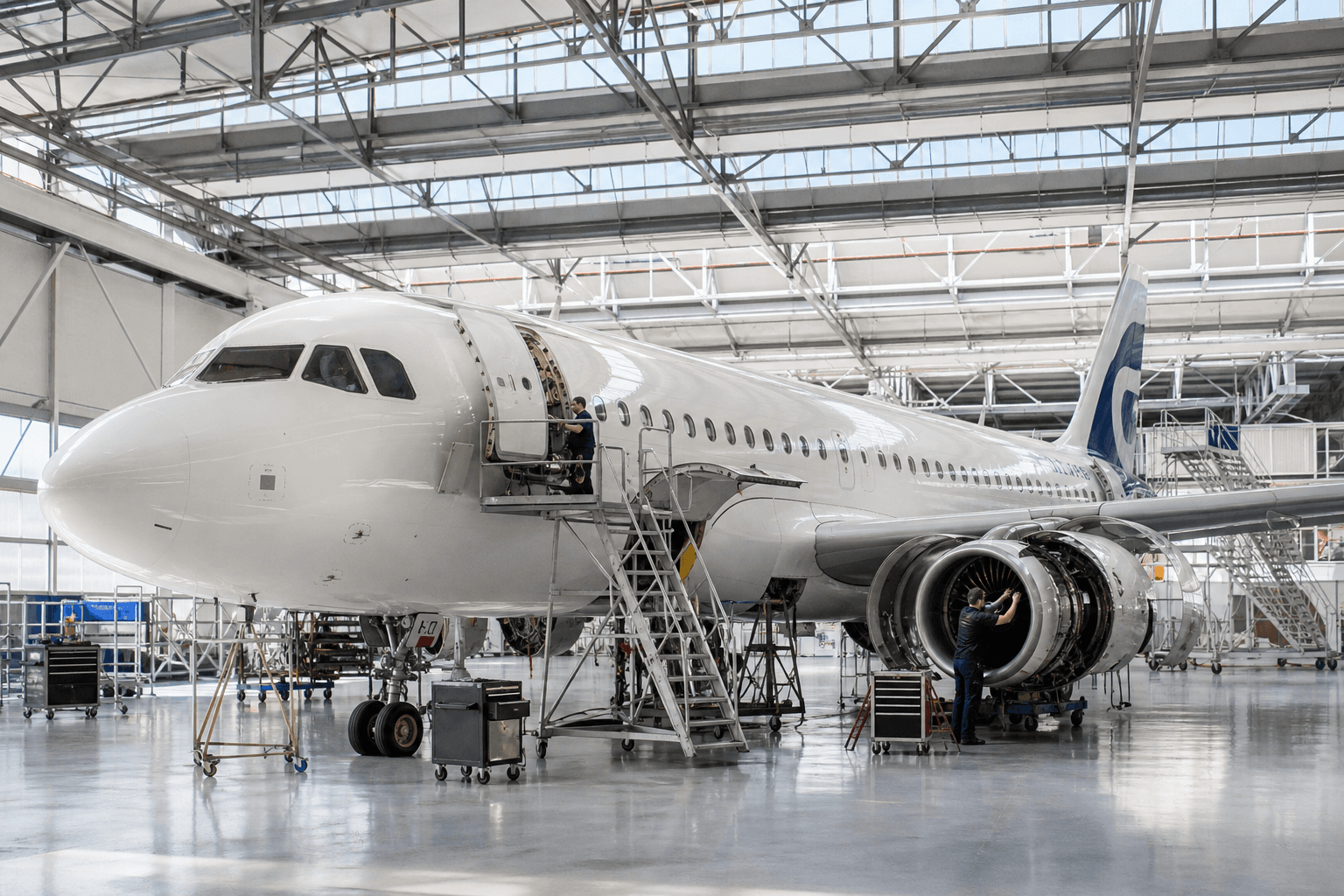
Illustration: The Touch & Go
Avia Solutions Group appoints FL Technics chief as new CEO amid reshuffling
Avia Solutions Group has named Zilvinas Lapinskas as chief executive, replacing Jonas Janukenas who shifts to chief financial officer, marking a leadership change during ongoing restructuring.
The gist
Avia Solutions Group installs FL Technics leader Zilvinas Lapinskas as CEO as former chief moves to CFO role amid corporate restructuring.
Continuing coverage
All Mro →Avia Solutions Group, a global wet-lease specialist with an operational fleet of 136 aircraft, has announced a key leadership transition within its executive ranks. Effective 7 July 2026, Zilvinas Lapinskas, previously head of FL Technics, the group’s maintenance, repair and overhaul (MRO) division, has been appointed as the new chief executive officer. This leadership change involves the outgoing CEO Jonas Janukenas stepping down from his top executive role to assume the position of chief financial officer. Janukenas will now focus on overseeing Avia Solutions' financial strategies and ensuring fiscal discipline as the company navigates a period of significant corporate evolution.
FL Technics, the maintenance arm of Avia Solutions Group, plays a critical role in supporting the operational readiness and airworthiness of multiple carriers under the group’s umbrella. Lapinskas, who led the division prior to his promotion, is credited with transformative leadership that expanded FL Technics' capabilities and scaled its operations within the tightly regulated aviation maintenance sector. The division’s growth and increased efficiency under his guidance have been highlighted by Avia Solutions as instrumental in strengthening the company’s service portfolio and operational footprint.
The leadership reshuffle arrives amid an extensive restructuring phase for Avia Solutions Group. Several carriers under its management have ceased operations recently, signaling a deliberate strategic recalibration. This process aims to streamline the group’s wet-lease services and optimize resources against changing market dynamics. Lapinskas underscored the importance of building on the sustainable growth foundation laid over the past several years, expressing commitment to accelerating momentum and reinforcing long-term partnerships within the aviation industry.
Avia Solutions operates a diversified wet-lease network that spans multiple regions, providing leased aircraft alongside crew and maintenance services to operators globally. The fleet of 136 aircraft reflects the group’s significant footprint in this niche market segment. However, the broader aviation environment, marked by fluctuating demand and regulatory challenges, necessitates adaptability and precise operational agility. The restructuring and leadership changes are geared toward positioning Avia Solutions for enhanced resilience and growth potential.
In discussing his strategic priorities, Lapinskas emphasized a focus on solidifying the operational footprint of the group. This involves consolidating strengths across the wet-lease and MRO businesses while navigating complex, regulated aviation markets worldwide. His background in scaling FL Technics equips him with insights into managing compliance, efficiency, and service quality, which are crucial for maintaining competitive advantage in aviation services.
Meanwhile, Janukenas’ move to the chief financial officer role signals a shift toward financial stewardship as the group aligns its strategy with evolving market conditions. He stated his intention to concentrate on maintaining financial discipline and strategic agility, essential aspects for navigating the uncertainties of the global aviation sector. His expertise will be critical in managing costs, investments, and capital allocation during this transformation phase.
The tandem of Lapinskas and Janukenas aims to leverage their respective strengths—operational leadership and financial management—to steer Avia Solutions through its restructuring and position the company for future growth. Their leadership transition reflects a deliberate approach to balancing operational execution with prudent financial oversight as the group recalibrates its business model.
This development is significant for the wet-lease and MRO industries as Avia Solutions Group is a notable player with substantial fleet size and geographic reach. The management changes indicate the company’s intent to sharpen its competitive edge and strengthen client relationships, which will be closely watched by market participants and industry analysts.
Looking ahead, stakeholders will be keen to observe how Lapinskas implements his vision for operational strengthening and partnership reinforcement. The group’s success in navigating the current restructuring while leveraging its maintenance capabilities will be pivotal in determining its trajectory in the evolving aviation market.
Read more
All MRO/Maintenance →
1976 Piper PA-32R-300 Lance offers six-seat capacity and performance upgrades
Each day, the team at Aircraft For Sale picks an airplane that catches our attention because it is unique, represents a good deal, or has other interesting qualities. You can read Aircraft For Sale: Today's Top Pick at FLYINGMag.com daily. Today's Top Pick is a 1976 Piper PA-32R-300 Lance. Aircraft manufacturers are known for developing existing models into new ones. Often this method makes more economic sense than embarking on a clean- sheet project. Piper is especially famous for squeezing, pulling, and stretching its original PA-28 Cherokee in ways that resulted in a whole fleet of airplanes, from trainers to twins. Enlarging the PA-28 to become the PA-32 Cherokee Six was one of Piper's greatest moves because it gave pilots the flying equivalent of the family station wagon—at a time when station wagons were very much in vogue and economical six-place airplanes were rare. If you ask me, though, it was the decision to retract the gear and further modify the Six to produce the Lance that truly moved Piper into the mainstream of high-performance personal transport. The Lance's cabin has plenty of room for six seats. [Credit: Bradford Fuller] The aircraft for sale today has plenty of space for growing families traveling on vacation or colleagues making business trips to cities without airline service. A wide cabin means occupants are not constantly rubbing shoulders and passengers have space to get comfortable on long flights. This heavy hauler has the bonus of LoPresti aerodynamic modifications to improve speed. It also received new paint and interior in 1998. This 1976 Piper Lance has 4,417 hours on the airframe and 512 hours since overhaul on its Lycoming IO-540K1G5D engine, which also underwent a top overhaul 240 hours ago. The aircraft's Hartzell Scimitar propeller has logged 250 hours since new. The Lance has a gross weight of 3,600 pounds, useful load of 1,508 pounds, and fuel capacity of 98 gallons. This Lance's panel includes Garmin GPS and other updated equipment. [Credit: Bradford Fuller] The panel includes a Garmin GNS 430W GPS/nav/com, King KX170B nav/com, AutoControl IIIB autopilot, Garmin 495, GTX 345 transponder, KMA 20 TSO audio panel, FS 1000II intercom, Narco DME, and JPI EDM 700 engine monitor. Pilots looking for the carrying capacity of a large SUV with cross-country performance that feels more like that of a super sports car should consider this 1976 Piper PA-34R-300, which is available on AiircraftForSale . If you're interested in financing, you can do so with FLYING Finance. Use our airplane loan calculator to calculate your estimated monthly payments. Or, to speak with an aviation finance specialist, visit flyingfinance.com . FLYING Magazine: Air Compare: Piper Lance vs. Saratoga FLYING Magazine: Piper Saratoga Avionics Install: Part 1 Plane + Pilot : Piper Cherokee Six/Lance/Saratoga Plane + Pilot : Piper Lance/Turbo Lance Plane + Pilot : Piper Saratoga The Aviation Consumer: Used Aircraft Guide: Piper Saratoga and Lance

AOPA Foundation to launch high school aviation maintenance curriculum by 2028
The AOPA Foundation will add a maintenance and manufacturing pathway to its High School Aviation STEM Curriculum as early as 2028.

Tech Boom Fuels Surge in Private Jet Demand Among Young SpaceX Employees
There is a youth movement taking place in the world of private aviation as young technology sector workers benefit from an explosion of growth. In June, SpaceX raised a record $85.7 billion in its initial public offering (IPO), and the company's valuation now hovers around $2 trillion. The New York Times estimated that around 4,000 SpaceX employees could become millionaires once they sell their stock. Already, some are contemplating ditching commercial travel for luxury jets, whether through full ownership or fractional or charter programs. "The past six to 10 months, I've had a handful of guys that are involved in SpaceX with money burning a hole in their pocket," an anonymous aircraft broker based in California told Reuters . The person said that technology clients comprise about 75 percent of the broker's customer base, compared to only about one-third a decade ago. They added that customers are willing to pay 10 to 15 percent more than what they were one year ago. Typically, chartering a private jet costs anywhere from $2,500 to $19,000 per hour , depending on the aircraft type, flight distance, time of year, and number of people traveling. Purchasing a brand-new jet will typically run you $1.1 million to $90 million , not accounting for the cost of a qualified crew—which can be upward of $215,000—insurance, storage, or fuel and maintenance. Used jets still cost millions. Those costs are prohibitive to the vast majority of Americans. But data indicates that the percentage of people who can afford them is on the rise. Youth Movement Private jet and jet-card membership company Jet Linx, which also spoke to Reuters, said that through May, its business is up 70 percent year over year—"far ahead of the expectations we had going into 2026," per CEO Jamie Walker. The company said jet-card membership sales did particularly well in San Antonio, Dallas, and Austin, Texas. SpaceX launches its gargantuan Starship rocket from a remote site near the Texas-Mexico border. Charter provider Mercury Jets told Reuters it has seen double-digit growth in demand among technology executives this year. The company said that following SpaceX's IPO, it heard from several prospective customers who had never flown private. WingX, a subsidiary of aviation intelligence provider Jetnet, backed up the trend with data. It told Reuters that during SpaceX's IPO window, business jet activity near the company's Texas launch site spiked 177 percent. The explosion in private aviation began in earnest months ago, per Jetnet's data. Globally, the firm recorded a 13.4 percent increase in flights operated by private owners through the first five months of 2026 compared to the same stretch last year. Fractional ownership grew 11.8 percent over the same period. The trend could be due to higher investor confidence amid the anticipation of other IPOs. Among the next major companies in line to go public are OpenAI and Anthropic, both based in San Francisco. WingX told Reuters that through June 14, business jet traffic in San Francisco was up about 11 percent year-over-year—the fastest growth among major U.S. cities. D.J. Hanlon, executive vice president of sales at Flexjet, told the outlet that the company's customer base is getting younger as more people benefit from "self-made first-generation wealth," such as through IPOs. Jetnet noted that business jet deliveries grew about 24 percent during the dotcom boom. The Outlook North America is already the largest global market for private aviation, accounting for 71 percent of global business jet departures through May, per Jetnet's most recent "market monitor." And it could continue to take market share. "Global business jet departures grew 5.1 percent over the last twelve months and U.S. corporate profits hit a record high, while the ultra-wealthy population that drives most of the industry's demand is also at an all-time high," read the outlook, published July 2. Jetnet found that there were more than 684,000 ultra-high-net-worth individuals (UHNWIs) in 2025, up from 658,000 the prior year. U.S. corporate profits in the first quarter of 2026, meanwhile, reached a record $3.95 trillion, it said. At the same time, consumer confidence tracked by the University of Michigan reached an all-time low. The report found that Latin America and Africa led growth in private aviation activity over the 12 months trailing May, while the Middle East contracted sharply. Corporate flight departments and branded charter services also saw less activity. Average aircraft utilization globally, though, was 9.4 percent above 2019 levels, with fractional fleets increasingly turning to midsize jets. According to the data, which excludes turboprops, there were 751 global business jet deliveries in the trailing 12 months preceding May 26, a decline from the 819 deliveries in full-year 2025. Transactions of pre-owned aircraft decelerated hard. The total value of these transactions also declined, but order books reached record highs. Bombardier's backlog was up 43 percent year-over-year, while Gulfstream led the industry with $22.3 billion in its order book. Despite slowing transactions, private aviation inventory remains tight and is creating a seller-friendly market, Jetnet concluded. For-sale inventory is also getting older, and 2025 saw a below-average number of aircraft scrapped. That leads Jetnet to believe a wave of fresh retirements is imminent.

Essential Maintenance Tips for Pilots Heading to AirVenture Oshkosh and Beyond
With EAA AirVenture Oshkosh in Wisconsin around the corner, thousands of pilots are preparing to take their aircraft on long cross country trips. Inevitably, some of those pilots will find themselves facing a challenging maintenance issue far from home. Preparation is the key here, and a little advance planning can go a long way toward reducing your risk and salvaging your trip. Here are some of the most important do's and don'ts for your next cross-country adventure:
The Daily Touch & Go
The day's best aviation news in your inbox. Free, no spam.