

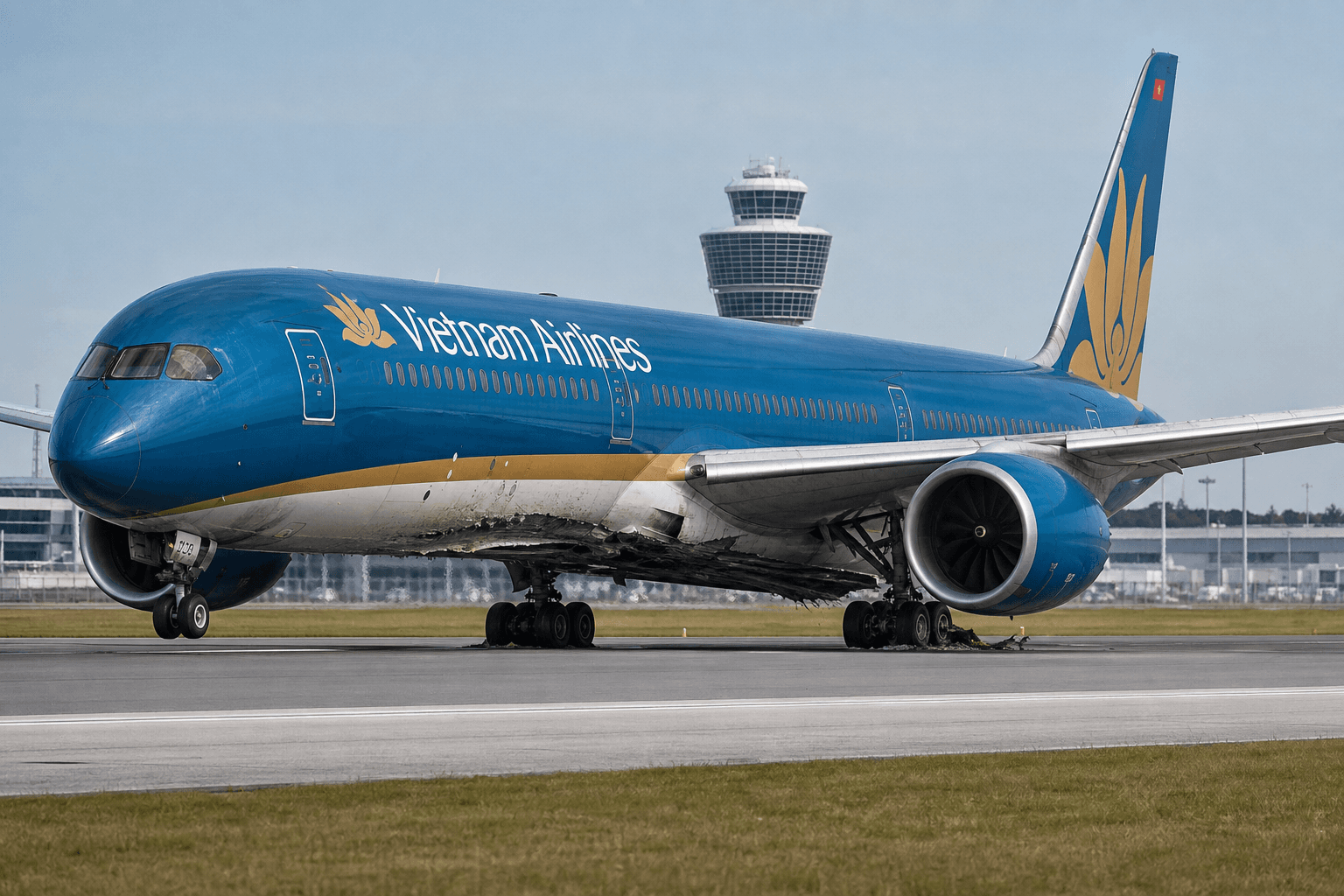
Illustration: The Touch & Go
Vietnam Airlines Boeing 787-9 Skids 120 Meters Past Munich Runway End During Takeoff
A Vietnam Airlines Boeing 787-9 with 274 passengers nearly overturned during takeoff at Munich Airport after overshooting the runway and suffering tailstrike damage.
The gist
Vietnam Airlines Boeing 787-9 overshoots Munich runway by 120 meters on takeoff with significant aircraft damage but no injuries.
On August 15, a Vietnam Airlines Boeing 787-9 Dreamliner operating flight VN34 from Munich to Hanoi experienced a severe takeoff incident at Munich International Airport (MUC). The aircraft, registered VN-A867 and equipped with General Electric GEnx-1B engines, failed to lift off within the designated runway length and skidded approximately 120 meters past the runway's end. During this overrun, the plane’s wheels struck runway lights before it finally became airborne, narrowly averting a catastrophic accident.
The flight departed Munich’s Northern Runway (26L), a 4,000-meter concrete surface known for accommodating large aircraft. Despite this ample length, video footage captured by aviation enthusiasts showed the aircraft accelerating along the runway without achieving liftoff at the expected rotation point. This extended ground roll suggested a critical issue preventing the plane from climbing promptly.
Following takeoff, the flight crew immediately communicated with air traffic control reporting anomalous conditions and requested a return to Munich. Because the aircraft was fully fueled for the long-haul journey to Vietnam, it had to enter a 90-minute holding pattern to burn fuel and reach a safe landing weight. This measure highlights standard long-haul protocols for overweight landings, crucial for safety in emergency scenarios.
Rather than landing after fuel dumping, the crew conducted two low approaches over runway 26R to allow airport personnel to visually inspect the aircraft’s underside for damage. On the third attempt, the 787-9 finally landed but showed visible smoke and debris emanating from the landing gear, a result of severely shredded tires caused by the abnormal takeoff roll and hard landing. The aircraft ultimately came to a complete stop on the runway and was disabled there.
Subsequent assessments revealed significant structural damage including a confirmed tailstrike, where the tail section impacted the runway during the late and prolonged rotation. Photographs leaked online depicted a puncture and heavy scrape marks on the fuselage underside consistent with a severe tailstrike. Additionally, potential electric brake actuator issues on the main landing gear were reported, although investigations are ongoing.
Munich Airport announced the Northern Runway remains closed, causing delays and operational disruptions. Fortunately, no injuries were reported among the approximately 274 passengers and crew onboard. However, the severity of the aircraft damage indicates substantial repairs will be necessary before the Boeing 787-9 can return to service, likely sidelining it for an extended period.
The cause of this event remains under investigation. Early hypotheses include potential errors in takeoff performance calculations made by the pilots or possible mechanical malfunctions affecting aircraft acceleration or rotation. The incident underscores the critical importance of precise data input and thorough mechanical condition verification ahead of demanding long-haul departures.
Vietnam Airlines and aviation authorities are collaborating on a detailed analysis to determine definitive causes. This incident adds to rare but serious runway excursion cases involving widebody aircraft during takeoff, reinforcing ongoing safety measures and pilot training protocols focusing on abnormal acceleration and rotation scenarios at major international airports.
Frequently asked questions
- How far did the Vietnam Airlines Boeing 787-9 overshoot the runway at Munich?
- The aircraft overshot the end of the runway by approximately 120 meters during the takeoff roll before becoming airborne.
- Were there any injuries reported from the Munich runway overshoot incident?
- No injuries occurred among the 274 passengers and crew during the incident at Munich Airport.
- What damage did the Boeing 787 sustain during the incident?
- The aircraft suffered a severe tailstrike causing a puncture and scrapes on the fuselage underside, and multiple landing gear tires were shredded upon landing.
Read more
All Aviation Safety →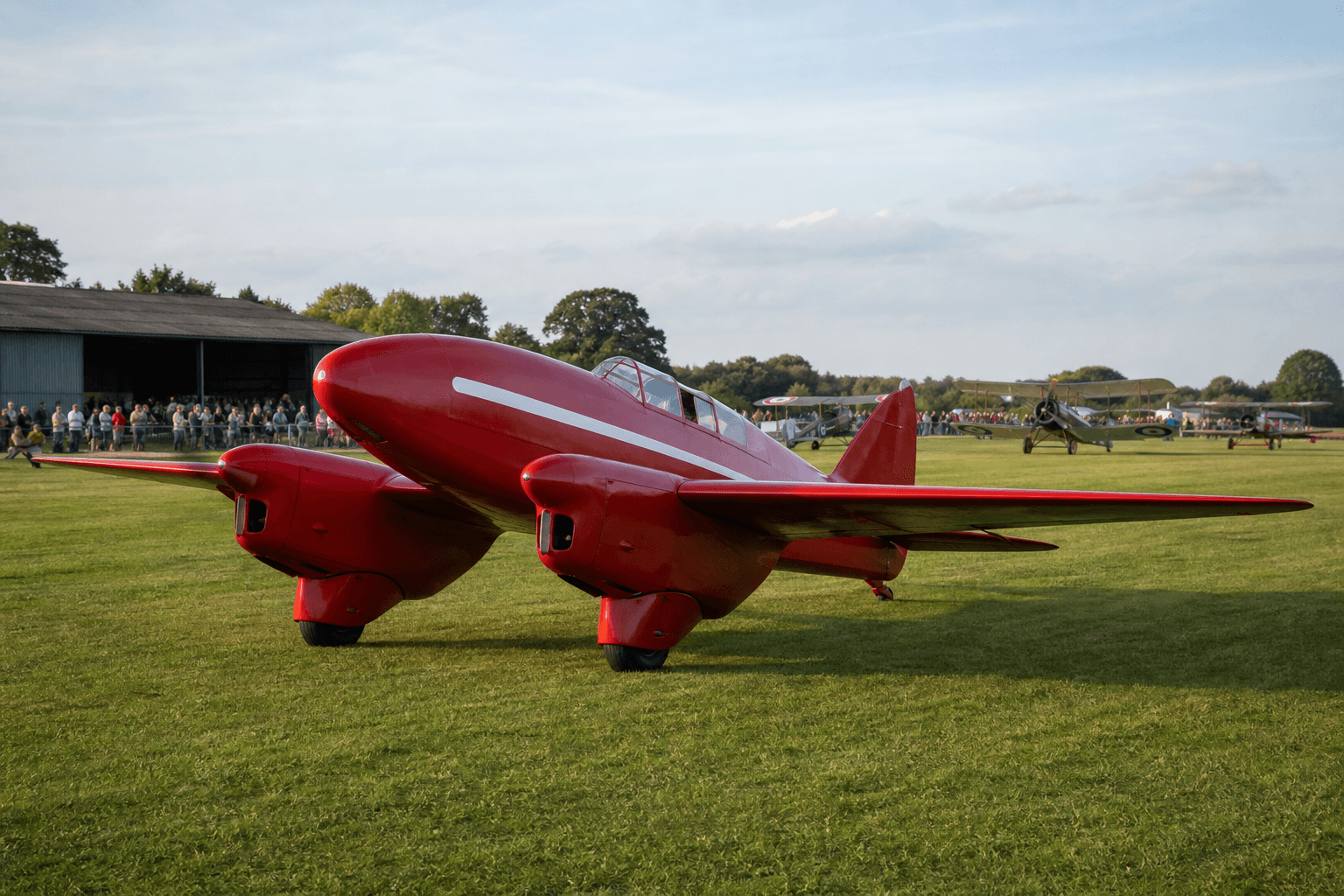
Historic 1934 DH.88 Comet 'Grosvenor House' Crashes at Shuttleworth Airshow
The de Havilland DH.88 Comet G-ACSS "Grosvenor House", the aircraft that won the 1934 MacRobertson England to Australia air race, overturned on landing at Old Warden aerodrome in Bedfordshire, United Kingdom, on August 15, 2026, sustaining extensive damage. The Shuttleworth Trust said the accident happened at approximately 19:20 local time during its Flying Proms air show, with one crew member on board. Emergency services extracted the pilot, who was responding at the scene and was taken to hospital for assessment. Shuttleworth later confirmed that the pilot was discharged from hospital. Nobody else was hurt. Bedfordshire Fire and Rescue Service sent crews from Sandy and Kempston to support the on-site fire service. The UK Air Accidents Investigation Branch, which has investigated several recent accidents involving historic aircraft in the UK , had not commented at the time of writing. An unfortunate incident occurred at the Shuttleworth evening airshow yesterday. The (notoriously tricky) DH -88 Grosvenor House crashed on landing.. Fortunately, the pilot suffered only minor injuries. pic.twitter.com/lgMV2c3nsp — Trev Clark's Obscure Aviation History (@clark_aviation) August 16, 2026 The only airworthy DH.88, and the MacRobertson winner De Havilland built five DH.88s, three of them for the 1934 race. Two survive. G-ACSP "Black Magic" has spent years under restoration, which leaves G-ACSS as the only airworthy example and the only one that actually won. Flown by Charles W. A. Scott and Tom Campbell Black, G-ACSS covered the Mildenhall to Melbourne course in 70 hours and 54 minutes. It was the first British aircraft to combine stressed-skin construction, a cantilever wing, retractable undercarriage, flaps, variable-pitch propellers and an enclosed cockpit in a single airframe, the design vocabulary de Havilland later carried into the Mosquito. The airframe has been rebuilt repeatedly since. Written off in Royal Air Force hands as K5084 and sold for scrap, it was rebuilt by Essex Aero, raced as "The Orphan" and set records as "The Burberry" before reaching the Shuttleworth Collection in 1965. A landing accident already grounded it for 12 years Restored with support from about 50 organizations, G-ACSS flew again on May 17, 1987, from Hatfield. That airfield closed in 1994 and the Comet went back to Old Warden by road, where the runway was initially too short to operate it. On October 28, 2002, after a test flight for its permit renewal, its undercarriage failed on landing. Investigators found that the legs as originally designed were liable to fail under certain conditions, and a modified structure had to be approved by the UK Civil Aviation Authority. The aircraft did not fly again until August 1, 2014. Shuttleworth has not said whether the damage is repairable. Operators of historic fleets typically suspend flying until a cause is established, as the Royal Air Force did with its Battle of Britain Memorial Flight Spitfires and Hurricanes . It is the second accident at Old Warden since May 30, 2026, when an Avro Triplane IV replica came down during the Wings and Wheels air show.
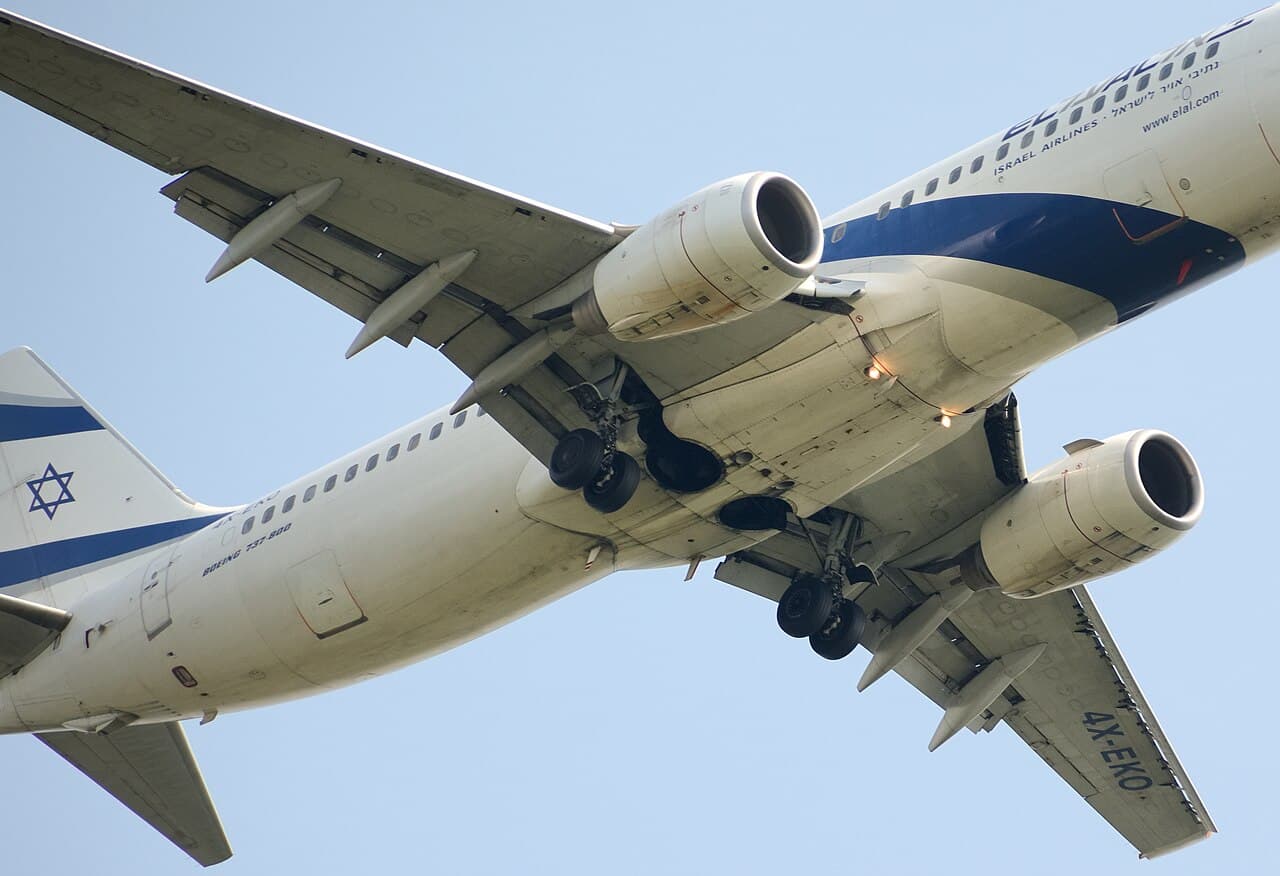
American Airlines Boeing 737-800s with identical callsigns nearly conflicted near Phoenix
Controller acted to separate converging outbound and inbound services on Chicago O’Hare route. Air-ground radio communications have revealed that a controller at Phoenix had to resolve an extraordinary conflict between outbound and inbound American Airlines Boeing 737-800s that were using identical callsigns. The aircraft were both operating the AA2482 service, whose flight number applies to the Phoenix-Chicago and Chicago-Phoenix sectors. Communications from Phoenix departure control, archived by LiveATC, indicate that the conflict occurred just after midnight on 14 August, about 5min after the Chicago-bound aircraft took off from runway 7L. It turned north and its crew informed the controller that they were climbing through 6,000ft to their assigned altitude of 9,000ft. The controller appeared to realise that the aircraft would cross the flightpath of the inbound service, arriving from Chicago, which was descending from the northeast at about 12,000ft. Distinguishing the inbound flight to its crew by referring to its being "on the arrival", the controller instructed it to maintain 10,000ft, which the crew confirmed. The controller then asked: "And there's an American 2482 on a 0730 code, is that correct, on the departure?" When the outbound crew confirmed they were climbing to 9,000ft, the controller acknowledged. "On the departure I need you to maintain 9,000, traffic one o'clock and 10 miles," he instructed, then added: "[It's] your company, same callsign, out of 11,800 descending to 10,000." "Incredible – we're looking, thank you," the outbound crew replied. Publicly-available ADS-B data suggests the outbound aircraft passed behind, and below, the inbound, although their precise horizontal and vertical separation has not been verified. The inbound Chicago-Phoenix flight appears to have been running some 90min behind schedule which would have contributed to the coincidental positioning. Identical callsigns for inbound and outbound services between the same city pairs are not unusual. American's flight AA1888 operates both ways on the Dallas-Raleigh route, as does Delta Air Lines' DL2006 between Milwaukee and Minneapolis.
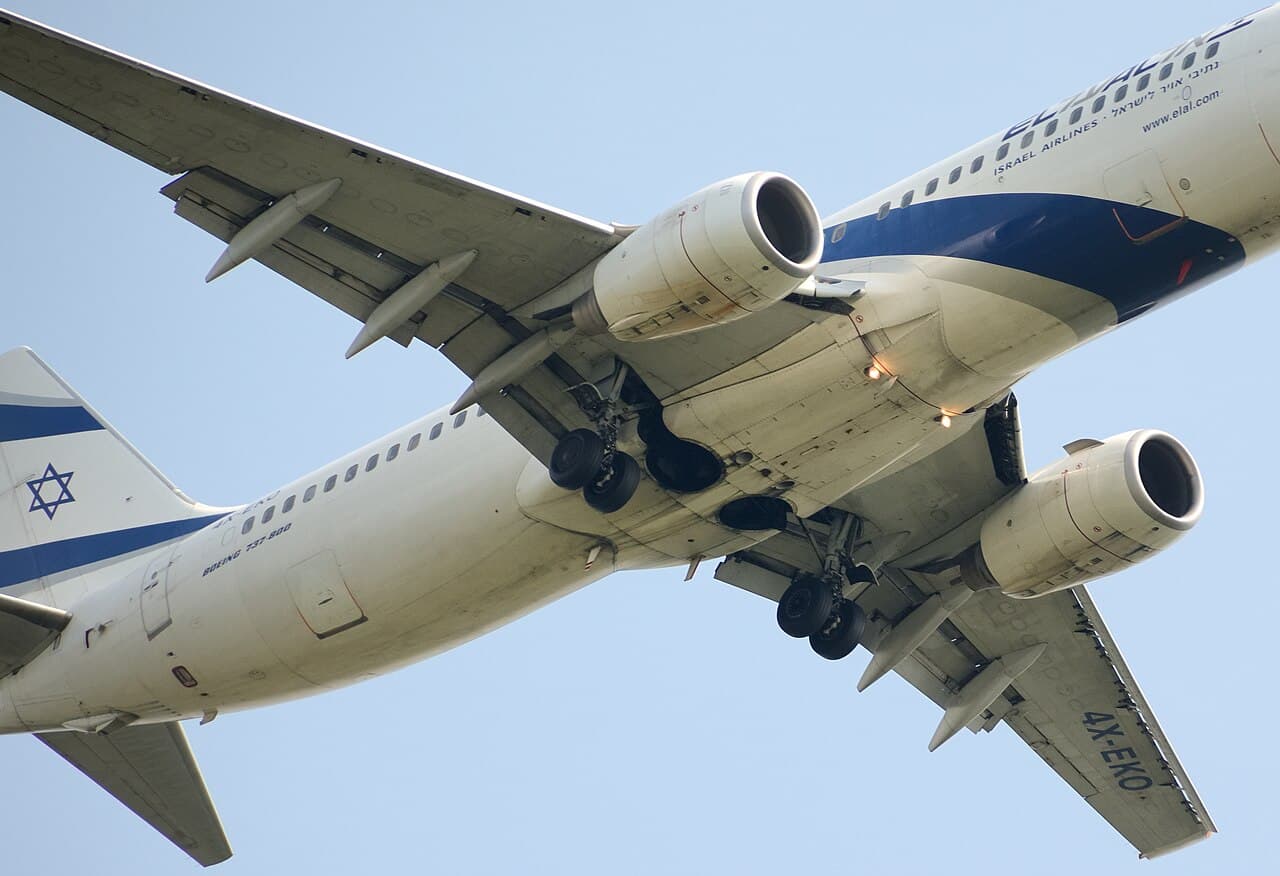
Engine debris caused cabin decompression on Ryanair 737-800, NTSB reveals
A passenger was partially sucked through an open window before being pulled back inside the cabin.
Researchers Reveal Rapid 60-Second Hardware Hack on Boeing 737 Avionics Systems
Researchers from UC San Diego and Oberlin College on Thursday presented a proof-of-concept hardware attack that could interfere with communications between critical avionics systems on Boeing 737 Next Generation and MAX aircraft. The device can be installed during roughly 60 seconds of physical access on the ground, according to the research presented at the USENIX Security Symposium. The team demonstrated the attack on a testbed built from authentic 737 components and software rather than an operating aircraft. Device Targets Maintenance Connection The researchers identified an unused maintenance connector inside the 737 Electronics and Equipment bay. The bay sits below the aircraft’s nose and can be accessed from the ground. Their paper estimates an attacker could open the access hatch in 15 seconds, install the device in about 30 seconds and close the hatch in another 15 seconds. The implant targets ARINC 429 data buses between the flight management computer and the multipurpose control display unit. Researchers demonstrated that the device could alter flight-plan information and values used for weight, balance and takeoff calculations while suppressing indications of some changes on the pilot’s display. "This is something the aviation industry will want to plan to defend against," UC San Diego professor Stefan Savage told WIRED. "I would not sleep on this one." The researchers said the attack would require advance planning, technical knowledge and physical access to the aircraft. Their paper says the findings apply to 737 NG and MAX models, which account for more than 95% of the active 737 fleet. Boeing Reviewed Findings The research team first disclosed the vulnerability to Boeing in 2020 and later demonstrated the attack in a Boeing laboratory. Boeing told WIRED that it reviewed the relevant component designs, installations and interfaces after receiving the researchers’ findings. The company said existing protections in the aircraft and its operating environment substantially reduce the feasibility and risk of a real-world attack. "Our technical experts are confident that the layers of protection in place on the airplane, including within the system design and the operating environment, provide sufficient mitigation to significantly limit the feasibility and risk of real-world attacks," Boeing told WIRED . Pilots could override changes to the autopilot by taking manual control, the researchers noted, and some correct information would remain available through other cockpit displays. The team proposed several possible defenses. Those include removing or permanently blocking the unused connector, adding software capable of detecting the attack, increasing electrical isolation between systems and eventually adding authentication to avionics data communications.
The Daily Touch & Go
The day's best aviation news in your inbox. Free, no spam.