

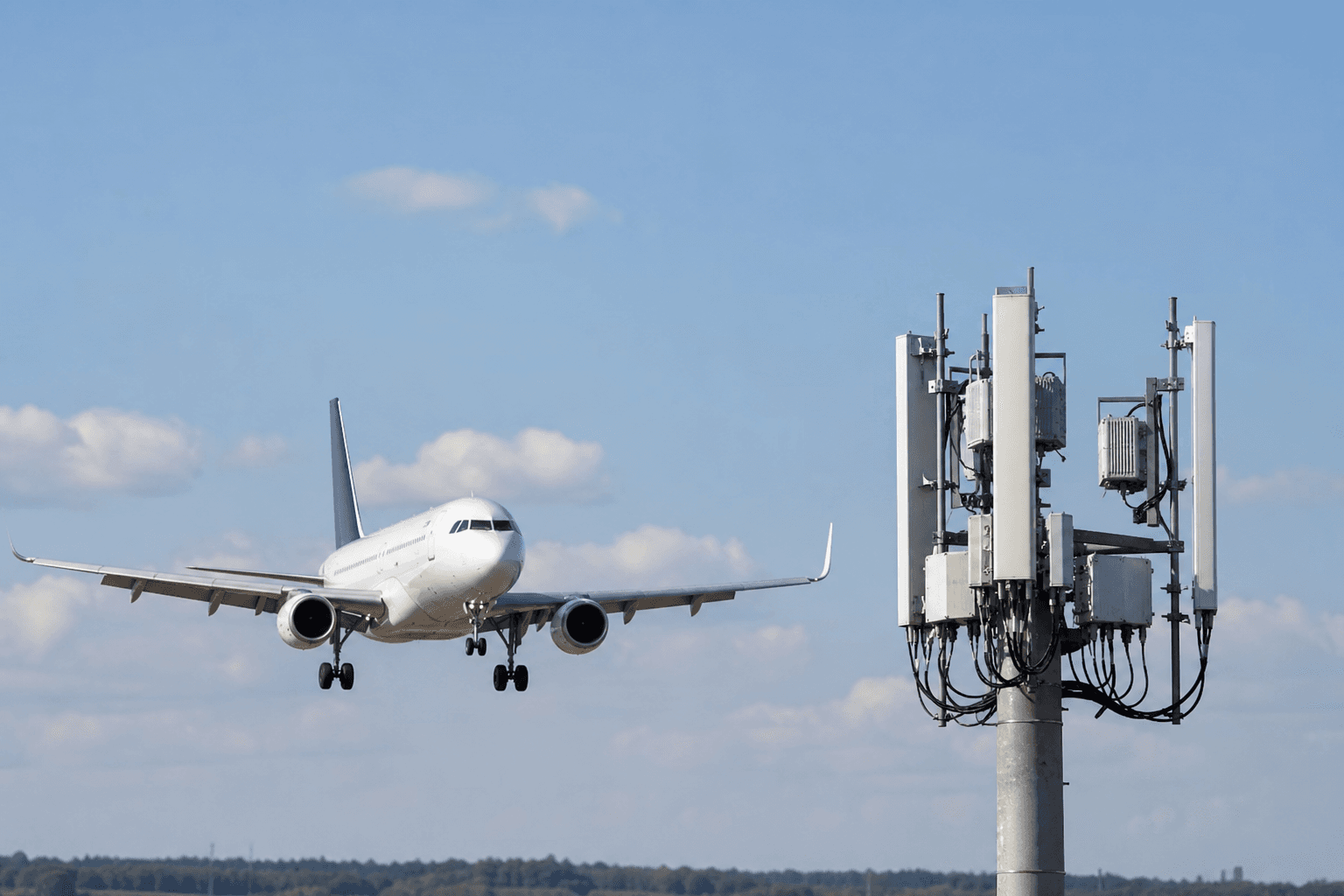
Illustration: The Touch & Go
Transport Canada Announces New 5G Mitigation Measures to Protect Aircraft Radio Altimeters
Transport Canada updates guidance for aviation sector on managing 5G interference risks, extending voluntary telecom mitigations beyond June 2026 to safeguard aircraft radio altimeters.
The gist
Transport Canada and telecom providers agree on extended 5G mitigations through 2027 to protect aircraft radio altimeters from interference in Canadian airspace.
Transport Canada has issued updated guidance addressing interference risks between emerging 5G cellular networks and aircraft radio altimeters, key instruments for measuring altitude during critical flight phases. This follows a voluntary agreement between Canada’s major telecom service providers to continue mitigating those risks beyond initial regulatory sunset dates. The new measures aim to maintain aviation safety amid expanding 5G deployments in the C-band frequency ranges relevant to avionics.
Earlier regulatory mitigations including nationwide reductions in fundamental emissions power based on antenna tilt, as well as exclusion zones around 35 major Canadian airports, were originally scheduled to expire in January 2026. To bridge that gap, telecom providers agreed to extend these protections through June 30, 2026. Now, after collaboration with Transport Canada as well as Innovation, Science and Economic Development Canada (ISED), the providers have consented to a fresh set of voluntary mitigations effective July 1 that will last through the end of 2027.
The newly implemented measures include specific technical constraints on base stations operating in the 3450-3900 MHz and 3650-3900 MHz bands, which overlap or lie close to frequencies used by radio altimeters. For the 3450-3900 MHz band, base stations must maintain cross-polarized antennas with equal power distribution and comply with a tightened spurious emissions limit of -42 dBm/MHz, stricter than the prior -30 dBm/MHz standard. This reduces the potential for unwanted emissions that could interfere with avionics.
Within the 3650-3900 MHz band, telecom providers are required to coordinate closely with both Transport Canada and ISED for any tall base stations exceeding 70 meters in height located near 245 airports nationwide. Additionally, a new National Effective Isotropic Radiated Power (EIRP) power mask has been established for base stations in this band to further control signal strength and minimize interference risks.
Transport Canada and ISED will monitor the effectiveness of these voluntary mitigations through two scheduled reviews in January and July 2027. Following these assessments, authorities will determine if the protections can be rescinded or require extension beyond January 1, 2028. This ongoing evaluation underscores regulatory commitment to maintaining aviation safety alongside 5G network growth.
In parallel, Transport Canada is urging operators to retrofit their aircraft to meet radio altimeter tolerance requirements outlined in Airworthiness Directives CF-2024 for fixed-wing aircraft and CF-2024-15 for rotorcraft. Operators owning non-tolerant aircraft may encounter more stringent operating restrictions when flying in Canadian airspace, reflecting the critical importance of safeguarding avionics against 5G interference.
Authorities emphasize the importance of immediate reporting of any radio altimeter disturbances or interference using the designated Radio Altimeter Disturbance/Interference Report form. Reports from operators are treated as non-punitive to encourage transparent sharing of incidents that can inform regulatory decisions and technical adjustments.
The voluntary nature of the telecom mitigations represents a collaborative approach among government, industry, and operators to balance the expanding demand for 5G spectrum with the uncompromising safety requirements of civil aviation. This multi-stakeholder effort demonstrates a precautionary strategy to address emerging coexistence challenges in shared spectrum bands.
Transport Canada’s updated guidance and the extended telecom mitigation commitments provide a clear signal that the integrity of aircraft avionics remains a top priority as 5G technology continues to proliferate across Canada’s airspace. These measures ensure continuous oversight and adjustment to protect the reliability of radio altimeters, essential for safe landings, approaches, and obstacle clearance.
Read more
All Airlines →
Air Canada Names Anko Van der Werff as New CEO Ending January 2027 Transition
Air Canada announced on July 8, 2026 that Anko Van der Werff will become its next President and Chief Executive Officer, and a member of the Board, by the end of January 2027. Mr. Van der Werff, currently President and Chief Executive Officer at Scandinavian Airlines, succeeds Michael Rousseau, who previously announced his retirement after […]
Delta launches Basic fare option across premium cabins to lower prices
Starting Wednesday, customers can select a lower-priced, no-frills rate for Delta First, Delta Premium Select, and Delta One.
Icelandair Reverses Dash 8-200 Retirement to Maintain Flights to Ísafjörður
The airline has changed its fleet and network plans after securing a new air service agreement.

Wright Brothers Dayton Sites Added to Irreplaceable America List for Aviation Heritage Preservation
The Wright brothers' Dayton, Ohio, landmarks have been named to the World Monuments Fund's "Irreplaceable America" list, recognizing the sites where aviation history was made. The designation highlights the locations where Wilbur and Orville Wright developed the technology that made powered flight possible while emphasizing the importance of preserving America's aviation heritage. It covers a collection of sites connected to Wilbur and Orville Wright's work, including Huffman Prairie Flying Field, where the brothers conducted flight testing and advanced their aircraft designs; the Wright Cycle Company building; the Wright & Wright Printing Company; and the Wright family home, Hawthorn Hill. The Dayton locations showcase how the brothers moved from experimentation in their bicycle shop to creating a practical flying machine that changed transportation worldwide. Their work culminated in the first successful powered flights at Kitty Hawk, North Carolina, in 1903, followed by years of testing and refinement in Dayton. The World Monuments Fund's "Irreplaceable America" initiative is designed to bring awareness to historically significant places and encourage preservation efforts through partnerships, funding and public engagement.
The Daily Touch & Go
The day's best aviation news in your inbox. Free, no spam.