

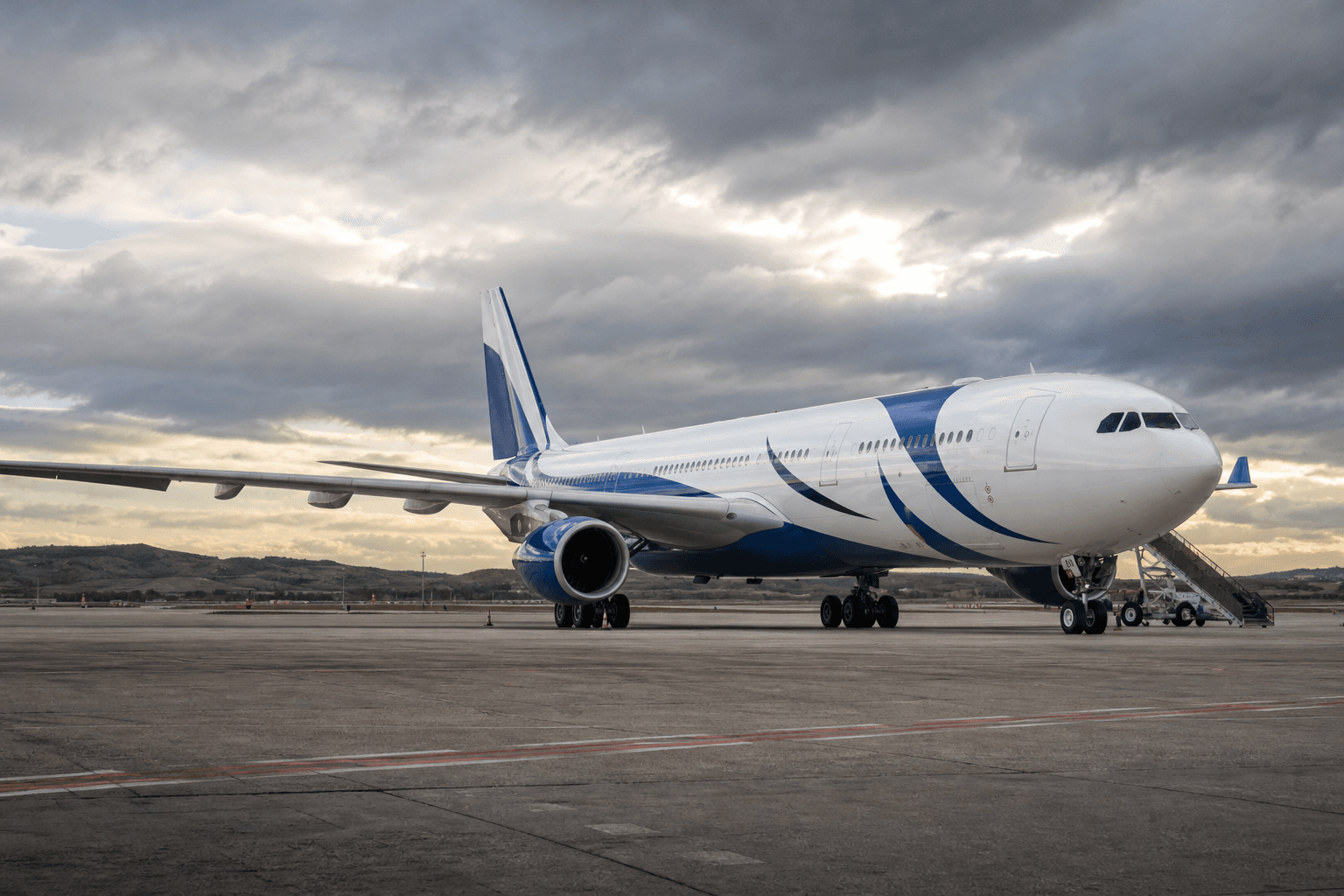
AI-generated illustration
Plus Ultra Drops Lima and Buenos Aires, Enters Pre-Insolvency Talks with Creditors
The Spanish long-haul carrier plans to cut scheduled flight hours by more than 61%, shrink its fleet and open a redundancy process covering 679 Madrid staff.
The gist
Plus Ultra has suspended Madrid–Lima and Madrid–Buenos Aires and opened creditor talks as fuel costs ran 51.6% over budget.
Continuing coverage
All Latin America →Spanish long-haul carrier Plus Ultra Líneas Aéreas suspended its scheduled Madrid–Lima and Madrid–Buenos Aires services on November 17, 2026, and has opened negotiations with creditors under Spain's pre-insolvency restructuring framework. The airline also plans to reduce scheduled commercial flight hours by more than 61%, downsize its fleet and begin a collective redundancy process for its Madrid workforce. After the cuts, its scheduled international flying rests mainly on Venezuela, with Caracas linked to Madrid and Tenerife.
The two latest suspensions do not run on the same timeline. Lima is off the schedule until further notice. Buenos Aires flights were initially suspended through December 15. Plus Ultra has not given a confirmed resumption date for either route. The cuts follow the suspension of service to Colombia in June 2026.
The airline once flew a wider Latin American network that included Peru, Argentina, Colombia, Uruguay and Venezuela. Its ACMI and charter division, which leases aircraft with crew, maintenance and insurance to other airlines, has reportedly continued to operate normally. That business gives some of the fleet work while scheduled flying contracts.
Plus Ultra blamed the cuts on higher operating costs, particularly jet fuel. The carrier now projects 2026 fuel spending of 104.83 million against an original budget of 69.13 million, an overrun of about 51.6%. It reported an operating loss of 31.08 million between February and August 2026. Limited liquidity and a failure to bring in new investors pushed the restructuring forward. The airline said the measures are meant to strengthen its finances and protect its long-term viability.
Spanish law firm Summa Iuris is advising on the creditor talks, which Europa Press reported on November 17 and 18. The negotiation window runs an initial three months, with a possible further three-month extension. A pre-insolvency filing is not a bankruptcy declaration, and the airline has not stopped flying; the process lets it try to reach terms with creditors and avoid formal insolvency proceedings.
The planned redundancy process, known in Spain as an ERE, covers the company's Madrid headquarters and its operating base at Adolfo Suárez Madrid-Barajas Airport. The workforce in scope totals 679 people, 668 of them active and 11 on leave of absence. The final number of job losses has not been set. With several long-haul routes gone, some aircraft are reportedly sitting on the ground at Barajas, though the number parked, their registrations and their future have not been independently established.
Consumer group FACUA – Consumers in Action used the Plus Ultra case on November 19 to criticise the European Union for failing to create a dedicated guarantee mechanism for passengers of insolvent airlines. FACUA wants carriers either to hold specific insurance or pay into a common fund that would refund unused tickets and could cover alternative travel if an airline collapsed. The group had pushed the idea during the reform of Regulation EC 261/2004, the EU rule on compensation and assistance for denied boarding, cancellations and long delays.
The proposal did not make it into the revised legislation adopted in 2026. The updated framework covers cancellation and delay compensation, assistance during disruption, hand baggage and rerouting, but it contains no fund to repay passengers when a failed airline lacks the money to meet its obligations. FACUA said travellers who buy tickets weeks or months before departure carry that risk if the carrier later cannot operate the flight.
Originally reported by FL360aero
Read more
All Airlines →
airBaltic Shuts Gran Canaria Base, Cutting Direct Nordic and Baltic Links to Maspalomas
The Latvian carrier is closing every base outside Riga after a €115 million loss in 2025, ending point-to-point service that fed northern European visitors to southern Gran Canaria.
Apollo's £5.7 Billion easyJet Deal Caps Its Funds at 49.9% to Keep EU Operating Rights
The US asset manager will hold no more than 49.9% of easyJet's new parent, with rollover shareholders and an EU trust holding the rest so the airline stays compliant with European and UK ownership rules.

Aer Lingus Reveals Refitted A330 Cabins with Its First Premium Economy, Debuting on Dublin-New York in 2027
The Irish carrier will refurbish 10 Airbus A330s with Business Class suites, a new 28-seat Premium Economy cabin and redesigned Economy, starting with JFK flights on 1 October 2027.
Arajet Sets April 2027 Launch for Santo Domingo Flights to Caracas and Valencia
The Dominican low-cost carrier will start seven weekly 737 MAX 8 flights to two Venezuelan cities, selling onward connections to Miami, Newark and Mexico City through its Santo Domingo hub.
The Daily Touch & Go
The day's best aviation news in your inbox. Free, no spam.