

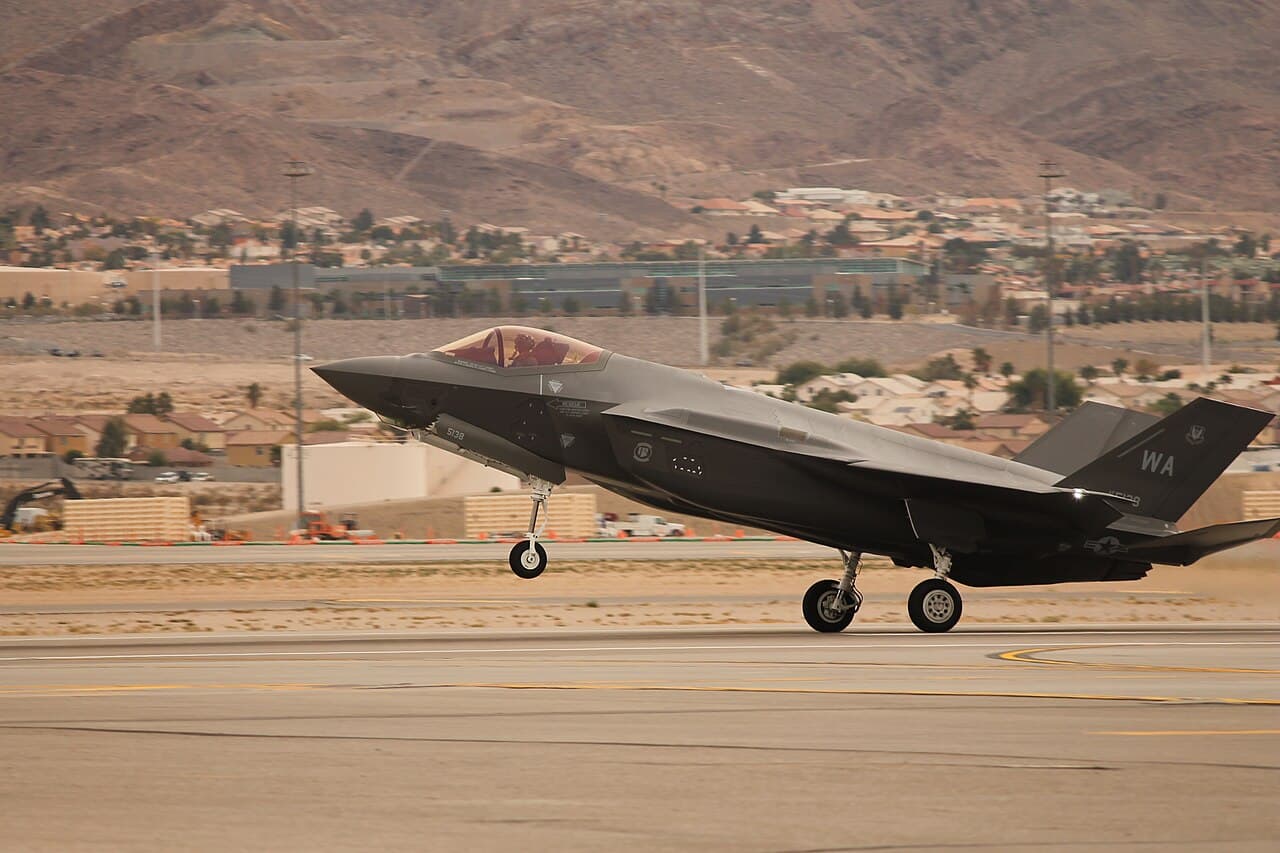
Image: Noah Wulf · CC BY-SA 4.0 · via Wikimedia Commons
UK RAF evaluates total F-35A fleet size to restore nuclear-capable airforce role
The Royal Air Force plans to purchase 12 F-35A jets to support training and assess aircraft needed for future nuclear missions alongside existing F-35Bs.
The gist
The RAF is acquiring 12 F-35As for training and studying the fleet size needed to reestablish nuclear-capable strike roles within NATO.
The United Kingdom’s Royal Air Force is actively determining the number of Lockheed Martin F-35A aircraft it will require as part of its broader strategy to resume an air-launched nuclear capability. Officials confirmed the intent to acquire 12 conventional take-off F-35A jets to underpin its operational conversion unit, a crucial step in preparing pilots to operate the platform effectively. This development was disclosed at the Global Air & Space Chiefs’ Conference held in London on 15 July by Air Vice-Marshal Jim Beck, director of capability and programmes for the RAF.
This prospective acquisition comes as an addition to the RAF and Royal Navy's existing fleet of 15 F-35B jets, which are the short take-off and vertical landing variant of the Lightning II family. The F-35B has been integral to British carrier aviation operations, but the F-35A variant is necessary for certain roles, including those involving conventional runway operations and potential nuclear missions.
The reintroduction of the F-35A aligns with the UK Ministry of Defence's plans to enable Britain to reenter NATO’s dual-capable aircraft (DCA) mission, a role that the RAF has not carried out since the late 1980s. These DCA missions involve aircraft capable of delivering both conventional and nuclear weapons, reinforcing NATO’s nuclear deterrence posture. The RAF had previously retired its nuclear-capable Panavia Tornado aircraft in 1998, which had carried free-fall WE177 bombs.
Air Vice-Marshal Beck clarified that the initial purchase of F-35As is primarily to support the RAF’s training and operational conversion units rather than immediately fielding a nuclear delivery capability. Concurrently, the RAF is conducting detailed assessments to define the future fleet size and operational posture necessary to fulfill its commitments within NATO's nuclear sharing framework. This involves analysis of the number of aircraft required to maintain an effective deterrence and strike capability.
Key to this nuclear mission will be the integration of US-supplied B61-12 tactical nuclear bombs that the F-35As would carry. Additionally, the RAF remains without in-house boom-equipped aerial refueling tankers capable of supporting the extended-range nuclear missions, necessitating reliance on NATO-operated support assets. The RAF aims to standardize operational tactics and training in partnership with other European and NATO dual-capable aircraft operators to ensure cohesion and readiness.
The revival of this nuclear role is portrayed as one of the most significant strategic movements by the RAF in recent decades. Beck emphasized the changing global threat environment, particularly pointing to Russia’s demonstrated willingness to consider tactical nuclear weapon use, underscoring the strategic imperative for NATO members and partners to maintain credible deterrence forces. This move is framed as critical in preserving the collective security arrangements in the face of evolving military doctrines.
At the same conference, counterparts from France outlined their continuous operational testing and exercises to maintain a robust airborne nuclear strike readiness, highlighting the active status of their strategic forces. This broader context points to a renewed emphasis among NATO allies on ensuring effective nuclear deterrence capabilities.
Meanwhile, experts highlighted the growing nuclear capabilities of China, noting substantial expansions in its missile arsenal and shifts in strategic posture that complicate the global security landscape. This backdrop reinforces the RAF's drive to review and potentially expand its F-35 fleet to meet modern deterrence challenges, maintaining interoperability and capability alongside key NATO partners.
Frequently asked questions
- Why is the UK Royal Air Force acquiring F-35A jets now?
- The RAF plans to acquire 12 F-35A aircraft primarily to support its operational conversion unit and to study requirements for re-establishing a nuclear-capable dual-capable aircraft role within NATO.
- What nuclear capabilities will the RAF operate with the F-35A?
- The RAF intends to arm additional F-35As with US-supplied B61-12 tactical nuclear bombs as part of its future nuclear strike mission within NATO’s nuclear sharing framework.
- What challenges does the RAF face in supporting its nuclear delivery mission?
- The RAF currently lacks boom-equipped aerial refueling tankers needed for extended nuclear missions and will rely on NATO-operated tankers, while also needing to standardize training and operations with NATO dual-capable aircraft partners.
Read more
All Military/Defense →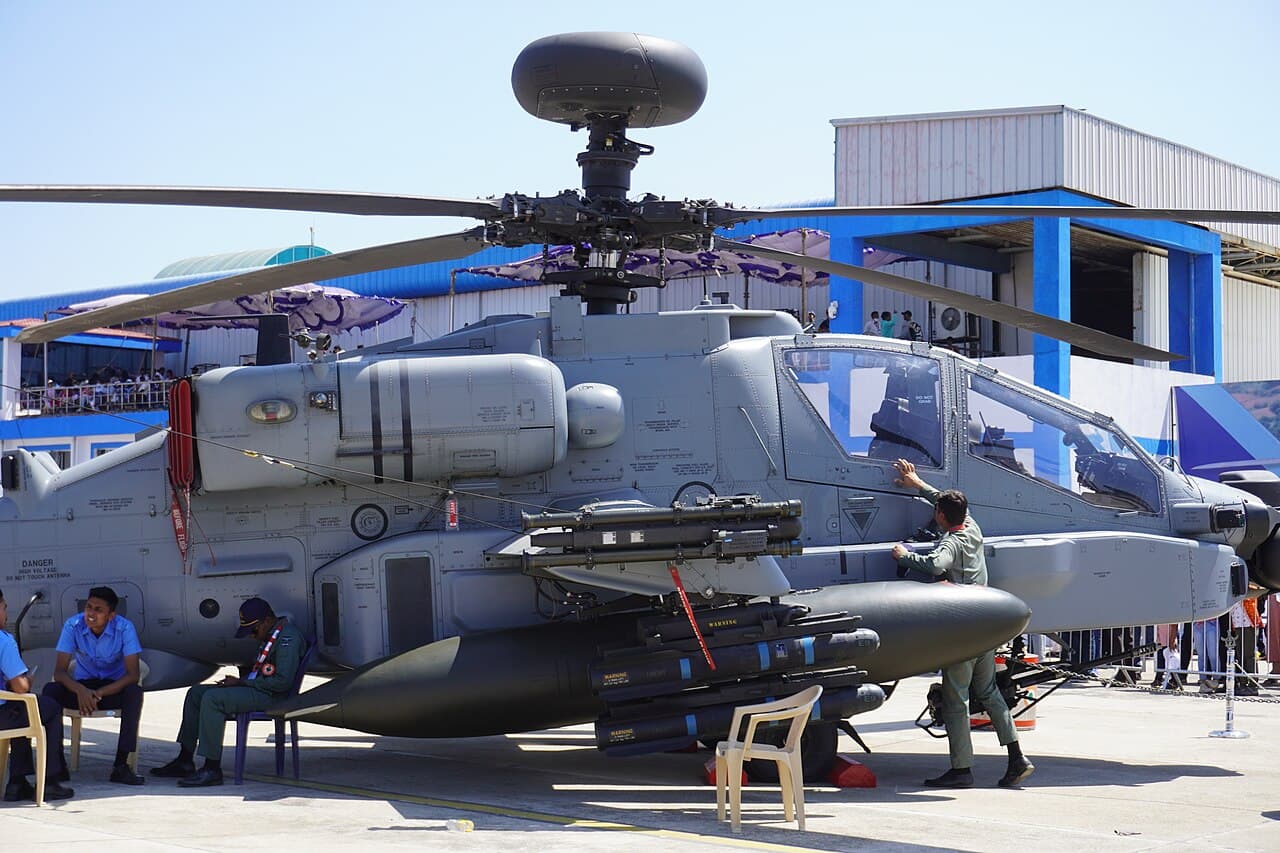
Boeing Eyes AESA Radar to Boost Apache Attack Helicopter Against Drone Threats
More capable sensor would boost detection of airborne threats. Boeing is advancing further enhancements for its AH-64E Apache to boost the platform's ability to engage non-traditional threats such as one-way attack drones. The US Army has used the attack helicopter to "great effect" in the counter-drone application recently in the Middle East, including in the Strait of Hormuz , says TJ Jamison, Boeing's director of business development for attack helicopter programmes. That has included using a new air-to-air mode with its Longbow fire-control radar to "help locate enemy drones coming in and engage and destroy them". "Adapting to change is nothing new for the Apache – it has been doing it since its inception," he notes. "The next chapter is we take lessons learned from Ukraine [and] the ongoing conflict with Iran… as we continue to modernise and adapt this aircraft to meet the changing face of warfare." He refers to a US Army trial conducted last year named Operation Flyswatter, during which the service "flew 14 small-, medium- and large-scale drones at two Apaches". The rotorcraft shot down 13 of the targets, with the remaining one having accidentally flown off the exercise area, ruling it out from being engaged. Among enhancements now being made to the type include the use of a new proximity fuze on the 30mm shells fired from its chin-mounted cannon, so that a direct hit is no longer required to bring down a drone. Meanwhile, the Apache's V6.5 software standard, which Jamison says is "in the process of finalising its certification and testing, and will be fielded soon… [with] increased range, lethality and survivability", uses an open system architecture, enabling rapid updates. "The goal is to get it as simple as a download on your iPhone," he says, while adding: "We're not quite there yet." Another option being explored by the US Army would involve the integration of a fuselage-mounted active electronically scanned array (AESA) radar. "Now you can see the next generation of drones – the very small, swarm type – all organic to the aircraft," Jamison says of the possible addition. "There are a number of OEMs that have an AESA capability currently that we are looking at for potential integration into Apache as we continue down that army modernisation path," he says. However, the service has made no decision yet about funding any such update. Noting that the Apache's original Longbow radar detection capability gave "an 8km [4.3nm] range", necessitating the sensor to be installed on top of the rotor mast, he says: "As you get out to the 50, 60, 70km range, hiding it behind a hill or a tree or a building is not quite as critical as it was when we had that shorter range." Boeing also sees an opportunity to potentially use directed energy, microwave or electronic warfare capabilities to counter the drone threat in the future.

US Approves $2 Billion Sale of Guided APKWS Rockets to Saudi Arabia
Acquisition of guided rockets will bolster Riyadh's ability to counter Iranian drones. The US government has cleared the possible sale of nearly $2 billion in BAE Systems Advanced Precision Kill Weapon System (APKWS) munitions to Saudi Arabia. According to the US Department of State, the potential Foreign Military Sale covers up to 20,000 APKWS rounds, divided equally between air-to-air and air-to-ground weapons. Valued at $1.96 billion, the package includes a range of other equipment, including LAU-131 launchers, which allow the APKWS system to be mounted on fixed-wing combat aircraft. The scope of the potential package reflects the rising threat of one-way attack drones. Systems such as the Hesa Shahed 136 have been among Tehran's main ways of striking US partners in the Persian Gulf, including Saudi Arabia. "The proposed sale will improve Saudi Arabia's capability to deter current and future threats by strengthening its homeland defense, and improving interoperability with U.S. forces, and other regional and NATO forces," says the Department of State. "The proposed sale will also augment Saudi Arabia's operational aircraft and enhance its air-to-air, and air-to-ground self-defence capability. The Kingdom of Saudi Arabia will have no difficulty absorbing this equipment and services into its armed forces." Separately, Kuwait has been cleared for a potential $484 million sustainment package for its Boeing C-17 strategic transports, comprising spares and other equipment and services. FlightGlobal's 2026 World Air Forces directory indicates the Kuwaiti air force operates a pair of C-17s.
Australia's Top End hosts 19 nations and 100 aircraft for Exercise Pitch Black 26
Australia's Northern Territory will serve as a hub of international air power from July 20 to August 7, 2026, as 19 partner nations take part in Exercise Pitch Black 26, a three-week air combat training exercise. The exercise officially launched on July 16, 2026, when Royal Australian Air Force (RAAF) Air Commodore Matthew McCormack, who is commanding this year's edition, joined detachment commanders from participating countries at RAAF Base Darwin. In total, the exercise has brought 100 aircraft and 2,500 personnel from around the world into RAAF Bases Darwin and Tindal, turning both installations into temporary centers of multinational air operations. As #PitchBlack26 heats up, we're shining a spotlight on the combat support teams who keep the mission moving. No. 23 Squadron at RAAF Base Amberley is supporting international tanker aircraft and ensuring safe, efficient airfield operations pic.twitter.com/06Q5MF0z0l — Royal Australian Air Force (@AusAirForce) July 17, 2026 Why the Northern Territory is an ideal training ground #image_title The location is far from incidental. Northern Australia is home to one of the largest military training areas in the world, offering vast, largely unrestricted airspace that few other regions can match. This degree of space matters for an exercise built around modern fighter aircraft, many of which need significant room to operate at full capability. McCormack pointed to that airspace directly, noting that some of the world's most advanced fighters require exactly the kind of operating room that the Top End provides. As #PitchBlack26 heats up, we're shining a spotlight on the combat support teams who keep the mission moving. No. 23 Squadron at RAAF Base Amberley is supporting international tanker aircraft and ensuring safe, efficient airfield operations pic.twitter.com/06Q5MF0z0l — Royal Australian Air Force (@AusAirForce) July 17, 2026 What Exercise Pitch Black training involves At its core, Pitch Black is built around large-force employment missions, exercises that bring together fighter aircraft, intelligence, surveillance, and reconnaissance platforms, air mobility assets, and command-and-control elements in scenarios meant to mirror real-world combat conditions. McCormack described the exercise as war fighter-focused, designed to expose both Australian aviators and their international counterparts to complex, high-end air combat scenarios. The goal, he said, is to sharpen decision-making and tactical skill while preparing participating forces to operate effectively in contested environments. Building relationships that extend beyond the flightline While the flying is the centerpiece, McCormack suggested the exercise carries value that extends well beyond the aircraft themselves. With so many nations training side by side, Pitch Black gives participants a chance to understand how other air forces operate, something that he feels would pay dividends if those same nations should ever need to work together in real conflict. That collaboration isn't limited to pilots. Aircrew, mission planners, engineers and support personnel from across the participating nations are all working together throughout the exercise, building the kind of professional familiarity that underpins effective coalition operations when it matters most. Staged every two years, Pitch Black has become one of the Royal Australian Air Force's signature international exercises, combining demanding air combat training with a rare opportunity for allied air forces to train, coordinate and build trust together at scale. RELATED Royal Australian Air Force announces Exercise Pitch Black for July-August 2026
Australia begins hunt for next-gen lead-in fighter trainer to replace Hawk 127s
The Australian government will explore several financing models to fill trainer requirement. Canberra has reached out to airframers as it explores possibilities to replace the Royal Australian Air Force's (RAAF’s) fleet of BAE Systems Hawk 127 advanced jet trainers. Designated Project Air 6002, the lead-in fighter training system (LIFTS) effort calls for a new aircraft that will train pilots for types such as the Boeing F/A-18F Super Hornet fighter, EA-18G Growler electronic attack jet, and the Lockheed Martin F-35A, according to an Australian government tender document. The requirement also is referred to as FLIF, for future lead-in fighter. The new aircraft will be required to enter service in the 2030s and help pilots develop skills ranging from general and instrument flying to air combat manoeuvres and integrating with other combat assets. "The system must have a sufficiently flexible architecture such that future capabilities can be introduced as future training requirements emerge," says the document. The aircraft could be acquired under several financial models including leasing, Foreign Military Sales, international cooperation, public private partnership, or working with foreign partners. The document does not list the number of aircraft to be obtained, or specifics about when the new type will attain initial and final operational capability. Cirium, an aviation analytics company, indicates that the RAAF operates 33 Hawk Mk-127s with an average age of 25.4 years. In April, the Australian Department of Defence's 2026 Integrated Investment Program document reiterated the need to replace the Hawks among other modernisation efforts. The replacement effort is likely to attract interest from companies such Boeing, Korea Aerospace Industries, and Leonardo.
The Daily Touch & Go
The day's best aviation news in your inbox. Free, no spam.