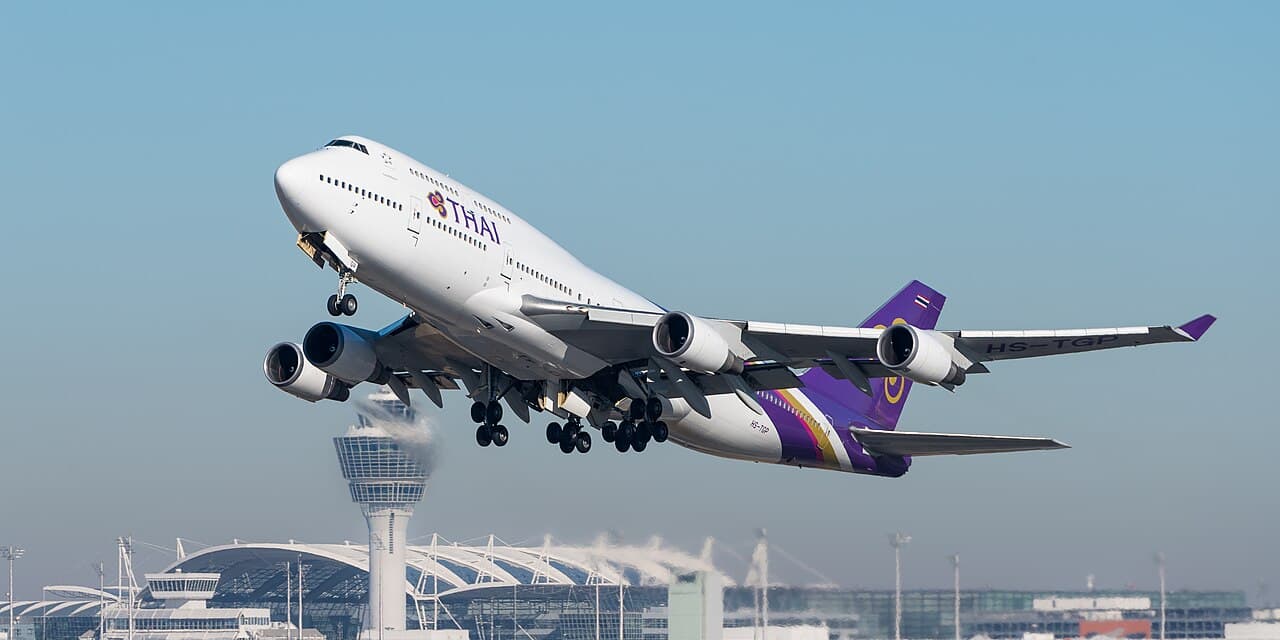
Image: Julian Herzog ( Website ) · CC BY 4.0 · via Wikimedia Commons
Boeing 747-8 Uses Raked Wingtips Instead of Winglets to Boost Efficiency
The 747-8 features larger, redesigned wings with raked wingtips that reduce drag and improve fuel efficiency more effectively than traditional winglets.
The gist
Boeing’s 747-8 employs raked wingtips rather than vertical winglets to achieve better aerodynamics and longer range.
The Boeing 747-8, the latest and largest variant in the 747 family, showcases a distinctive wing design that forgoes the typical vertical winglets seen on many modern airliners. Instead, it utilizes raked wingtips—long, tapered extensions that sweep backward—to enhance aerodynamic performance. This design choice yields up to a 16% fuel efficiency improvement over the previous 747-400 by reducing induced drag more efficiently.
Induced drag occurs from wingtip vortices generated by pressure differences between the upper and lower wing surfaces. Traditional winglets act vertically at the wingtip, mitigating these vortices by redirecting airflow upward, which helps improve the lift-to-drag ratio and reduces fuel burn on long missions. However, winglets also add weight and complexity, and their benefits vary depending on the aircraft’s operational profile and structural constraints.
The 747-8’s designers took a different approach, prioritizing a broader aerodynamic solution that integrates performance gains into the wing itself. The wingspan was extended from 211 feet 5 inches on the 747-400 to 224 feet 7 inches, which shifted the airplane into the larger Code F airport compatibility category. This allowed Boeing to focus on longer, more efficient wings rather than working within the tighter span limitations that had previously mandated winglets as an aerodynamic compromise.
Raked wingtips effectively increase the wingspan while maintaining a smooth, continuous wing shape. By gradually tapering and sweeping the wingtip backward, the airflow leaves the wing more smoothly, weakening the strength of wingtip vortices without the added weight or structural demands of vertical winglets. This design closely approximates the efficiency of a longer wing, a principle well understood from glider designs that favor high aspect ratio wings for minimal induced drag.
The choice of raked wingtips over winglets highlights a balance between aerodynamic performance and operational practicalities. While longer wings reduce drag better than winglets, they must fit within airport infrastructure constraints. The 747-8’s larger wingspan limits its access to smaller airports but grants significant efficiencies on long-haul routes between major hubs like Frankfurt, Hong Kong, and Dubai. This is an acceptable trade-off given the aircraft’s role as a flagship intercontinental passenger and cargo transporter.
In comparison, the earlier 747-400 had to balance efficiency improvements with the necessity to remain within a smaller wingspan class. It used traditional winglets as a retrofit or additive solution to induced drag, which fit within the airport size limits but did not deliver the optimized lift distribution and fuel economy that the 747-8’s integrated design achieves.
By designing a completely new wing with advanced airfoil profiles and materials, Boeing enhanced the 747-8’s structural strength and aerodynamic efficiency simultaneously. This holistic redesign reduces drag throughout the flight envelope and allows airlines to operate longer nonstop routes with lower fuel consumption per passenger or cargo mass.
Boeing's approach illustrates the trade-offs in aircraft design between aerodynamic idealism and real-world operational environments. The 747-8’s raked wingtips provide a cleaner, more integrated solution for reducing drag than winglets, particularly suited for large, long-range aircraft where marginal efficiency gains significantly impact operating costs and environmental footprint.
Frequently asked questions
- Why does the Boeing 747-8 use raked wingtips instead of traditional winglets?
- The 747-8 uses raked wingtips to increase wingspan and reduce induced drag more efficiently than winglets, improving fuel economy without adding the weight and structural stress winglets cause.
- How does the 747-8's larger wingspan affect its airport compatibility?
- Its larger wingspan classifies it as a Code F aircraft, limiting access to smaller airports but allowing optimized aerodynamics suitable for major international hubs and long-haul flights.
- What are the aerodynamic benefits of raked wingtips compared to winglets?
- Raked wingtips provide a smooth, tapered wing extension that weakens wingtip vortices by gradually releasing airflow, achieving better lift distribution and lower drag than vertical winglets on large aircraft.
Read more
All Airlines →
Norse Atlantic and IndiGo end 787 damp-lease amid India-Europe route challenges
Indian budget carrier was using six Norse twinjets but had already opted to return one of them. Long-haul airline Norse Atlantic's entire damp-lease operation with IndiGo is being terminated after the Indian carrier encountered difficulties with its services to Europe. The partnership will end on 1 November. IndiGo had damp-leased six Boeing 787-9s from Norse Atlantic, but had already agreed to return one of the twinjets after axing its route to Manchester in the UK. Geopolitical issues in the Middle East had caused IndiGo to rethink the Manchester service, and Norse says the situation is still affecting India-Europe connections. "There is no doubt that the elevated fuel prices, airspace disruptions and longer flight routes resulting from the Middle East conflict have affected the commercial viability of the arrangement for both parties," states Norse chief executive Eivind Roald. Norse says the two airlines have "mutually agreed" to discontinue the lease arrangement. "We have…jointly concluded that alternative deployment of the aircraft will be more commercially beneficial to both parties," says Roald. Norse is holding talks with several airlines regarding lease opportunities for up to five 787s. It adds that it plans to use part of the fleet returned by IndiGo on its own network, in order to increase capacity on "selected profitable routes" – such as New York and Orlando – during the winter 2026-27 season. The end of the IndiGo partnership is nevertheless a setback for Norse, which has been struggling to become profitable, and had adopted the capacity leasing strategy to counter seasonal fluctuations on its own network. While IndiGo had leased half of Norse's 787 fleet, Roald insists there are positive aspects to the termination. "Return of these six aircraft opens up strategic opportunities that were not available to us before," he says. "We are seeing strong demand for modern, fuel-efficient long-haul aircraft, and we also see attractive opportunities to deploy additional capacity within our own network. "Our priority is to use this increased flexibility to improve profitability and create long-term value for our shareholders." Norse has been undertaking a strategic review of its business and says it will embark on a formal process – which could involve a sale, merger or other partnership – "given the level of interest received to date". IndiGo senior vice-president for planning Abhijit Dasgupta expresses "appreciation" for Norse's "valued partnership". Termination of the lease arrangement comes just as IndiGo is undergoing a management transition, with chief executive-designate Willie Walsh about to take up the top post and a newly-appointed chief financial officer in place.
American Airlines' New DFW Schedule Yields Modest On-Time Departure Gains in Q2
The carrier's systemwide on-time rate climbed sharply in the second quarter, but its busiest hub improved only slightly and stayed near the bottom of the national rankings.
Air France-KLM Flying Blue Unveils August 2026 Promo Rewards with 25% Savings on Select Awards
The Air France-KLM Flying Blue program has its monthly Promo Rewards promotion, whereby members can save 25% on select award tickets over a limited travel period. The program has just published its new Promo Rewards list for August 2026, offering discounted short haul and long haul awards for travel over the coming months. There are quite a few destinations bookable with this promotion, including several in the Americas. While business class options are limited, this time around premium economy seems to be the sweet spot, so there's value to that. What are Flying Blue Promo Rewards? I'm a big fan of the Air France-KLM Flying Blue program , especially for long haul premium cabin redemptions. Not only does Flying Blue largely have attractive award pricing for business class travel, but the program also has access to more Air France and KLM award space than other programs. The Promo Rewards offer is published every month by the Flying Blue program, and offers 25% discounts off select awards for travel on Air France and KLM. The Flying Blue program has dynamic award pricing, and this promotion specifically applies for the lowest, saver level award costs. We sometimes see Promo Rewards for Air France business class New Flying Blue Promo Rewards now live Flying Blue has published its August 2026 Promo Rewards , valid for bookings between August 1 and August 31, 2026. Most of these Promo Rewards have long travel windows, and can be used for flights all the way through January 31, 2027. As a reminder, Flying Blue has standardized saver award pricing, so ordinarily you'll pay the following amounts for one-way transatlantic awards between Europe and most of North America: One-way economy awards cost 25,000 miles One-way premium economy awards cost 40,000 miles One-way business class awards cost 60,000 miles Here are the awards that are available with the Promo Rewards list this month for travel between Europe and North America, along with the pricing: Save 25% on Air France economy awards between Europe and Dallas (DFW), New York (JFK), Phoenix (PHX), and Seattle (SEA) — starting at 18,750 miles Save 25% on KLM economy awards between Europe and Houston (IAH) — starting at 18,750 miles Save 25% on KLM premium economy awards between Europe and Las Vegas (LAS), Mexico City (MEX), San Diego (SAN), and San Francisco (SFO) — starting at 30,000 miles On top of that, the Flying Blue Extra program was recently launched (the cost starts at €379 per year), which is essentially a paid membership program that offers extra perks. One of the perks of Flying Blue Extra is access to additional Promo Rewards, so eligible members receive access to the following extra Promo Rewards availability to North America this time around: Save 25% on Air France economy awards between Europe and Los Angeles (LAX) and Orlando (MCO) — starting at 18,750 miles Save 25% on KLM economy awards between Europe and Miami (MIA) — starting at 18,750 miles There are of course also Promo Rewards opportunities outside of North America, including some business class options to South America, so check out the full list. All of the lowest priced awards in the above markets through January 31, 2027, should be bookable with the Promo Rewards pricing (though not necessarily the extra award availability that Flying Blue Platinum members receive ). You can use all of these awards for travel to and from destinations across Europe, so you can travel beyond Amsterdam and Paris. If you're having trouble finding availability, remember to use Flying Blue's secret award calendar . Also keep in mind that children ages two to 12 receive 25% off Flying Blue award tickets , including Promo Rewards. We sometimes see Promo Rewards for KLM business class Earning Flying Blue miles is easy One of the things that's awesome about the Flying Blue program is how easy it is to rack up miles: Flying Blue is transfer partners with Amex Membership Rewards , Bilt Rewards , Capital One , Chase Ultimate Rewards , and Citi ThankYou , meaning you can transfer points earned from a variety of cards Flying Blue sells miles directly , often at an attractive cost, and also has a Subscribe to Miles scheme Flying Blue has a co-branded credit card in the United States Flying Blue miles are easy to come by Bottom line The Air France-KLM Flying Blue program offers a Promo Rewards promotion, whereby members can book discounted award tickets in select markets. This can be a great deal, especially when you consider how easy Flying Blue miles are to come by, and also how much award space is sometimes available through Flying Blue. With the latest Promo Rewards, you can save 25% to several destinations in the Americas. This time around there are especially good options in premium economy on KLM, along with several opportunities in economy. This has the potential to be quite a good deal, so if you have any travel you're interested in booking, this would be a great time to do so. Are there any Promo Rewards you're considering booking?
JetBlue's Mint Studio Emerges As Premier Transcon Business Class Amidst Competitive Pricing
JetBlue Airways has spent years refining its premium offering, and while most discussions about premium transcontinental travel focus on whether JetBlue can compete with legacy airlines, the real story is happening in the very front row of the Airbus A321neo . With just two Mint Studio suites available on each aircraft, the product combines exclusivity with a surprisingly approachable pricing strategy that has steadily built a loyal following among frequent travelers.
The Daily Touch & Go
The day's best aviation news in your inbox. Free, no spam.