

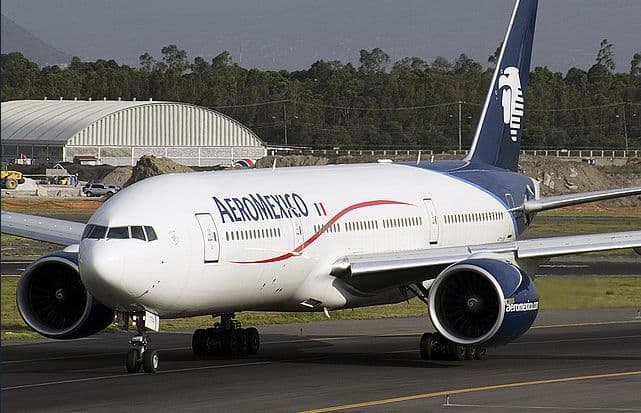
Image: Johnnysast at English Wikipedia · Public domain · via Wikimedia Commons
Aeromexico anticipates strong second half after Q2 profit decline due to fuel and World Cup effects
Aeromexico reported weaker Q2 profits impacted by higher fuel costs and World Cup-related demand shifts but forecasts double-digit operating margins for the full year.
The gist
Despite a challenging Q2 with losses from fuel surges and World Cup demand shifts, Aeromexico expects robust profitability and capacity growth in H2 2026.
Continuing coverage
All Mexico City Airport →Aeromexico faced a challenging second quarter in 2026, posting an operating profit of $68 million, a significant decline from $230 million during the same period a year earlier. The airline also reported a net loss of $58 million for Q2, reversing from a $68 million profit in 2025. This downturn came amid steep rises in fuel costs and fluctuating passenger demand linked to the football World Cup, which Mexico co-hosted. Despite these pressures, Aeromexico’s leadership described results as largely matching the outlook provided in April, signaling that the company had anticipated the tough market environment.
Fuel expenses surged markedly due to geopolitical tensions linked to the Iran conflict, adding $219 million to Aeromexico’s second-quarter fuel bill compared to the previous year. This spike in operational costs presented a major headwind, forcing the airline to balance fare adjustments with maintaining passenger volumes. On the demand side, the World Cup’s impact proved nuanced; travel was steady in April and May, but June saw a softening in domestic market demand, particularly because of altered travel patterns during Mexico’s national team matches.
To mitigate risk from weakened corporate travel during the World Cup matches, Aeromexico strategically adjusted its network by scaling back flights in June to avoid unprofitable operations. This careful capacity management helped limit losses and demonstrated the carrier’s adaptability in response to large-scale event-driven demand fluctuations. The approach aligns with Aeromexico’s longer-term strategy to optimize route profitability even when external factors disrupt normal travel behavior.
Revenue generation remained robust under challenging conditions, with Aeromexico increasing quarterly revenues by 13% to $1.48 billion. A notable highlight was the growth in premium cabin revenues, which rose to a record 43% of passenger revenues. The airline reported that fare hikes made necessary by rising fuel prices did not drive customers to downgrade their travel class, indicating sustained strength in demand for higher-value seats.
Chief Executive Andres Conesa emphasized the company’s ability to adjust swiftly without compromising its strategic priorities. He pointed to healthy underlying demand and solid execution of commercial strategies as factors supporting a positive operational outlook. Despite fuel price volatility, Conesa expressed confidence that Aeromexico could leverage improving conditions, including stabilizing fuel costs expected in the latter half of the year.
Aeromexico’s forecast for the third and fourth quarters projects higher earnings before interest, taxes, depreciation, and amortization (EBITDA) and earnings before interest and taxes (EBIT). The airline aims for a full-year EBIT margin in the low double digits, a strong result given the turbulent external environment it faced. This optimistic guidance reflects expectations for recovering capacity growth and more stable fuel markets.
Capacity growth is set to accelerate, with Aeromexico planning an up to 8% increase in available seat kilometers (ASKs) in the fourth quarter, up from a modest under 2% capacity expansion in Q2. This planned capacity boost will partly come from the addition of two Boeing 787 Dreamliners recently delivered to the fleet, supporting the carrier’s widebody services. Furthermore, Aeromexico will utilize additional slots at Mexico City International Airport, which raised its hourly movements from 44 to 46, granting the airline 10 extra daily slots.
The expanded slot availability aligns with anticipated demand recovery and offers opportunities for network growth during the busy winter season. Conesa signaled that although the airline still faces the challenge of selling a substantial number of seats, the demand environment remains resilient. The company continues to monitor global fuel price volatility closely, particularly given uncertainties around the Iran-US ceasefire, but remains focused on meeting its financial targets for 2026.
Aeromexico’s response to the second-quarter setbacks underscores a strategic focus on fleet modernization, disciplined capacity control, and targeting premium customer segments. The carrier has positioned itself to reap benefits from increasing travel demand and broader economic normalization in its key markets. Its ability to maintain pricing power despite cost pressures and event-related demand shifts will be critical to achieving the projected profitability for the remainder of the year.
Frequently asked questions
- How did Aeromexico's fuel costs change in the second quarter of 2026?
- Aeromexico's second-quarter fuel expenses increased by $219 million year-on-year due to rising global fuel prices linked to the Iran conflict.
- What impact did the 2026 football World Cup have on Aeromexico's passenger demand?
- The World Cup caused demand to moderate in June, particularly affecting domestic travel around Mexico's national team matches, leading Aeromexico to adjust its network to avoid unprofitable flights.
- What capacity changes does Aeromexico plan for the second half of 2026?
- Aeromexico expects to increase available seat kilometers by up to 8% in Q4 2026, supported by new Boeing 787 deliveries and additional slots at Mexico City International Airport.
Read more
All Airlines →
Airlines Confirm Structural Shift with Sustained Fare Increases Amid Rising Fuel Costs
Earnings season has officially begun with, as always, Delta kicking off festivities late last week and then United just yesterday releasing its numbers . The airlines unsurprisingly did very well, but the results and more importantly, forward-looking guidance, show that we may have finally seen a structural shift. Airfares are up, and I don’t imagine they’ll be going back down anytime soon. On the surface, it looks like Delta is outperforming with an operating margin of 9.4 percent versus United’s 6.2 percent, but remember, Delta owns a refinery and that helped boost the company’s fortunes this quarter. Since today’s topic is about the core business, let’s try and strip out fuel’s impact. Excluding the refinery, Delta’s operating revenues were up 13.9 percent, below United’s 16.0 percent Fuel expense at Delta rose 67.2 percent year-over-year while United was up 84.1 percent Fuel went from being worth 55.8 percent of Delta’s largest expense — total salaries and wages expense — to 86.3 percent, but at United fuel soared to become the airline’s number one cost at 109 percent of salaries and wages Delta’s unit costs were up 21.4 percent, but excluding fuel, they were up only 6.8 percent while United’s numbers were up 15.2 and 6.1 percent respectively You get it. Fuel is a big deal, and it was very messy in Q2 when the bulk of the Iran War was being waged. And yes, I’m well aware that it’s still being waged and probably won’t end anytime soon now that Iran has learned it can toy with the Strait of Hormuz whenever it feels like it. Just look at the downward slope reversing course recently. via IATA And when fuel goes up, fares have to go up. In the past, this often meant cutting significant capacity thanks to basic economics, but that’s not happening now. And even when fuel came down off its highs, fares didn’t budge downward at all. Demand has been very strong, and it took an event like this to get airlines to actually be able to take real pricing increases for the first time in a long time. To see what I mean, you can look at the Government Accountability Office’s new report on the impact of mergers . I sat with Courtney Miller as my guest host on The Air Show this week to talk about that report in detail. I won’t get into those details here, because it frankly isn’t helpful to this discussion since the study period stopped in 2024. This just provides the historical context that fares have been going down for quite some time. In other words, while this consolidated industry structure has been in the works for a couple decades, the airlines really didn’t significantly flex their pricing muscles until recently. The Air Show A podcast about the business of the sky Listen on Spotify | Listen on Apple Podcasts There’s no question that consolidation made this possible, and sometimes in ways you might not imagine. For example, airline pricing teams are better at their jobs simply because there are fewer of them out there. The ones that remain tend to be much better at the job at hand. The reason this is so important for gaining pricing power is that one airline has historically been able to tank a fare initiative pretty easily, even something as simple as a small, across-the-board fare increase. Today, we aren’t seeing that. Let’s get back to Delta’s results — I can’t do this with United yet since the 10-Q wasn’t out at the time of publication. Strip out things like loyalty revenues (which always seems to go up these days) and look at just Delta’s Q2 ticket revenue, and we see it increased 12.5 percent year-over-year. The reality is that fares went up much more than that, because a decent chunk of Q2 bookings happened before the recent run-up. But even 12.5 percent is a remarkable increase considering that capacity was flat. This doesn’t look like a temporary blip, even though we know everything in this industry is somewhat temporary. Just look at Delta which reaffirmed its earnings guidance for the full year and United which improved it . They won’t be the only ones. It’s easy to say this is all due to that growing pot of credit card money or refinery earnings or something else, and yes, those all help. But the reality is that none of this happens without the industry’s main players all realizing that there is room for higher fares. Even if that weren’t the case, it has become easier for airlines to insulate themselves from low-cost airline fare actions, something that has always been a problem. Pricing is far more complex than it was in the past, so there are more levers to pull. If Frontier decided it wanted a massive sale since its results are not great, the other airlines could match with Basic Economy fares only and not see their entire fare structure collapse. The ability to better segment means that fare actions can be compartmentalized. The airlines love segmentation so much that it continues to spread. Delta is now introducing Basic Business — or as I like to call it, Delta None — which will undoubtedly keep the same pricing business class has today, simply creating an upsell for those who want a seat assignment in advance along with other goodies. It’s a straight-up fare increase that others likely can’t torpedo. (United has already gone down this path anyway.) All this being said, fare increases don’t work in a vacuum. Capacity levels are very important, and the industry has seen capacity decline dramatically very recently. Spirit finally went away in Q2 after being unsustainable as a business for a couple of years. This takes away one more desperate management team and further consolidates the industry into something more rational. This doesn’t mean that fares will only go up from now on. There will be a recession. There will be downturns. Maybe there will even be a well-funded startup, though that doesn’t seem very likely today. We don’t know when, but when this happens, fares will fall. But instead of plunging, airlines will better manage their capacity and keep pricing at a higher level. This is exactly the kind of thing former American CEO Doug Parker meant when he said the industry wouldn’t lose money again. It was a tone-deaf statement that didn’t land with employees, but it also didn’t prove to be strictly true. Of course, he wasn’t thinking about a global pandemic when he said it; he was talking about normal economic cycles. And he was right. The thing is, the big airlines hadn’t really been willing to test it out until this year once it was pretty clear they had largely vanquished the low-cost carrier threat. Admittedly, we haven’t seen this tested in any significant way since the pandemic ended. Only time will tell if this is right or not, but the fact that airlines are pushing fares higher and not seeing much blowback means they will be emboldened to keep trying to push the envelope. Now the only real question is whether the government will eventually decide this is an antitrust issue that it needs to revisit.
United Airlines surpasses Q2 earnings forecasts despite $6 billion fuel cost surge
United Airlines' second quarter financial results beat Wall Street projections despite the US carrier projecting a $6 billion fuel hit this year. On July 15, 2026, United Airlines CEO Scott Kirby lauded the airline's ability to "thrive in every environment" even when oil prices spiked in March 2026. "We quickly and decisively acted to adjust our schedules, while simultaneously doubling down on our customer investments," Kirby added. United confirmed that full-year adjusted diluted earnings per share guidance is raised to $9 to $11. The airline posted adjusted earnings of $1.99 per share, above the $1.85 predictions. Based on oil prices as of July 14, 2026, United expects nearly $6 billion in added fuel expense for full-year 2026 compared to the expectation at the start of the year. United Airlines In the second quarter alone fuel expenses were up $2.3 billion, although the company said it was able to recover around half of this increase. Its successes included premium revenue being up 16% compared to the second quarter of 2025, while revenue from economy class was up 11%. United's revenue for the second quarter rose 16% to $17.67 billion. During the same period last year, the figure was $15.2 billion. The company's operating income was down 17% from $1.3 billion during the second quarter in 2025 to $1 billion over the same period in 2026. Net income also dropped 17% to $805 million from $973 million last year. Highlights included United announcing that 450 aircraft now have Starlink stalled with nearly 1,000 expected by year end. United said it remains on track to bring Starlink to the whole fleet by the end of 2027. You can view the full results on the United Airlines website . RELATED Rolls-Royce, Boeing and Lufthansa line up new 787-9 ecoDemonstrator venture
Europe Faces Critical Jet Fuel Shortage Amid Strait of Hormuz Conflict
Brussels, we have a problem. With the fragile ceasefire with Iran officially over, and fighting over access to the Strait of Hormuz ongoing, new analysis suggests that the risk of Europe running dry of jet fuel supply is a lot more precipitous than everyone has been led to believe. Before the Iran War started at the end of February, Europe and the United Kingdom sourced the majority of its jet fuel supplies from the Middle East, primarily from Kuwait and the United Arab Emirates, with supplies shipped on months-long journeys that started with passage through the Strait of Hormuz. Initially, jet supplies weren’t in danger as there were still plenty of tankers in transit to Europe, having already sailed through the SoH before the conflict began. Europe then looked towards the United States and Canada for additional fuel supplies. The real issue facing many airlines wasn’t the physical supply of jet fuel but rather the dramatic rise in the cost of buying fuel… especially for airlines that hadn’t ‘hedged’ their fuel needs (whereby airlines lock in a set price for their fuel regardless of whether the wholesale price goes up or down). No doubt, the entire aviation industry breathed a collective sigh of relief when President Trump reached a memorandum of understanding for a ceasefire with Tehran last month. The SoH would reopen, allowing hundreds of stranded ships loaded with fuel to set sail towards Europe and Asia, where the bulk of Persian Gulf oil is consumed. The threat of mass flight cancellations over the busy Summer holiday period, and airlines told customers that they could have confidence in booking flights. Unfortunately, the supply crunch facing Europe and the UK may be more severe than initially thought. According to Reuters , there is only one month of jet fuel supplies left in Europe, and Energy Aspects claims the continent could face a supply deficit of 600,000 barrels per day in the third quarter. Europe and the UK’s woes are particularly acute because their own jet fuel refineries have been shut down in recent years, with a heavy reliance on supplies from the Middle East. So far, supplies have been kept steady by tapping new imports from Canada, India, Nigeria, and the United States. At present, these warnings haven’t translated into flight cancellations. Airlines were, at first, alarmed by the closure of the SoH, although that panic quickly subsided when supplies were sourced from other countries. The end of the Summer season, though, does present an issue with airlines expected to ramp up their schedules to meet seasonal demand. That being said, we’ve heard these warnings before, and planes have continued flying without interruption. The biggest risk remains the high cost of jet fuel, with airfares expected to remain elevated for quite some time to come. In fact, some airlines, such as Delta Air Lines, have indicated that they won’t necessarily lower airfares in line with the falling price of jet fuel… whenever that might happen.

Spinner vs. Roller Luggage: Weighing the Pros and Cons for Travelers
People have strong opinions about just about everything in the travel space, and that includes luggage . In this post, I'd like to address one of the most controversial topics in the luggage world — should you get a spinner suitcase? I have strong opinions on this, but I know others vehemently disagree with me. What are spinner suitcases? For those not familiar with the terminology, a spinner suitcase is an upright bag with four wheels (as opposed to roller luggage, which has only two wheels). While it's absolutely not always the case, spinner suitcases are often hard-sided, while roller bags are more often soft-sided. It seems like in recent years, spinner suitcases have become all the rage, with many bag manufacturers largely switching from two wheels to four wheels for their bags. So, what are the pros and cons of spinner bags vs. roller bags? The pros of spinner suitcases There are several benefits to spinner suitcases compared to roller luggage: Spinner suitcases are much more flexible, in the sense that you can roll them next to or in front of you, which isn't so practical with roller luggage Spinner suitcases are more maneuverable, and can be rolled sideways into tighter spaces; this is great whether you're walking down an airplane aisle, or are rolling a bag through an automated immigration kiosk or through a train turnstile On flat and even surfaces, spinner suitcases are arguably easier to roll, as there's less friction, and less pressure on your arm and shoulder Spinner suitcases are often hard-sided, which some prefer, as it's potentially more durable, and protects the items in your bag Rimowa spinner carry-on The cons of spinner suitcases There are also several downsides to spinner suitcases compared to roller luggage: Spinner suitcases typically have external wheels, which doesn't help with maximizing space, as they stick out; when you put your carry-on bag in a sizer, the wheel space counts toward the limit Spinner suitcases are great on flat and even surfaces, but the second you deal with an incline, or you're inside something that's moving (a train, subway, etc.), or you have an uneven surface, they can become a burden Not all bags are equally durable, and sometimes wheels break; you're more likely to have issues if you have four wheels rather than two wheels, especially with spinner suitcases often having external wheels Spinner suitcases are more likely to be hard-sided, which doesn't maximize space, and doesn't allow you to expand your bag in the event that you're carrying more than usual Briggs & Riley two wheel carry-on I'm in the anti-spinner luggage camp Let me acknowledge that this is a topic that divides my household. Ford exclusively has spinner bags with four wheels, for both carry-ons and checked bags (he uses Rimowa bags). He says I'm too practical. I exclusively have roller bags with two wheels ( I use Briggs & Riley ), for both carry-ons and checked bags. I say Ford isn't practical enough. Does Ford's Rimowa look nicer than my Briggs & Riley bag? I'd say so (though I find Rimowa bags scratch up so easily… perhaps that's part of the charm?). Personally I don't think Briggs & Riley bags look particularly great, but they're incredibly durable ( I made the switch from Tumi several years back, and have been very happy about that). But style aside, I can't help but point out that when we travel together, I generally have fewer issues with my bag than Ford does. Basically any time we're not on a flat, smooth surface (which is quite a bit of the time), I find that my bag offers a more seamless experience. I know some people feel like it can be tougher on your wrists and heavier to have a two wheeled bag than a spinner bag. My solution is that I hang my backpack off the back of my carry-on with a clip. This acts as a balance to the bag's weight when I'm carrying it behind me, and makes it feel virtually weightless. There's also not nearly as practical of a way to hang a second bag off a spinner bag as with a roller bag. You can place something on top, but that can be limiting. My typical carry-on setup Anyway, I make absolutely no claim that my system is better than anyone else's. However, I've been using two wheeled roller bags for as long as I can remember, and I refuse to make the switch. I'm probably just stubborn, since the luggage industry is increasingly headed in the direction of spinner suitcases. I just can't get behind the concept. Bottom line People have strong opinions about the merits of four wheel spinner luggage vs. two wheel roller luggage. There are pros and cons to both types of bags. Call me traditional, but I'm stuck in my ways with roller luggage. I appreciate how these bags perform better with complicated surfaces, and I also like how I can clip something to the side of the bag, to maximize how much I can easily carry. For that matter, I also find they are more durable, so are less likely to have wheels break, etc. Where do you stand — do you prefer spinner luggage or roller luggage?
The Daily Touch & Go
The day's best aviation news in your inbox. Free, no spam.