

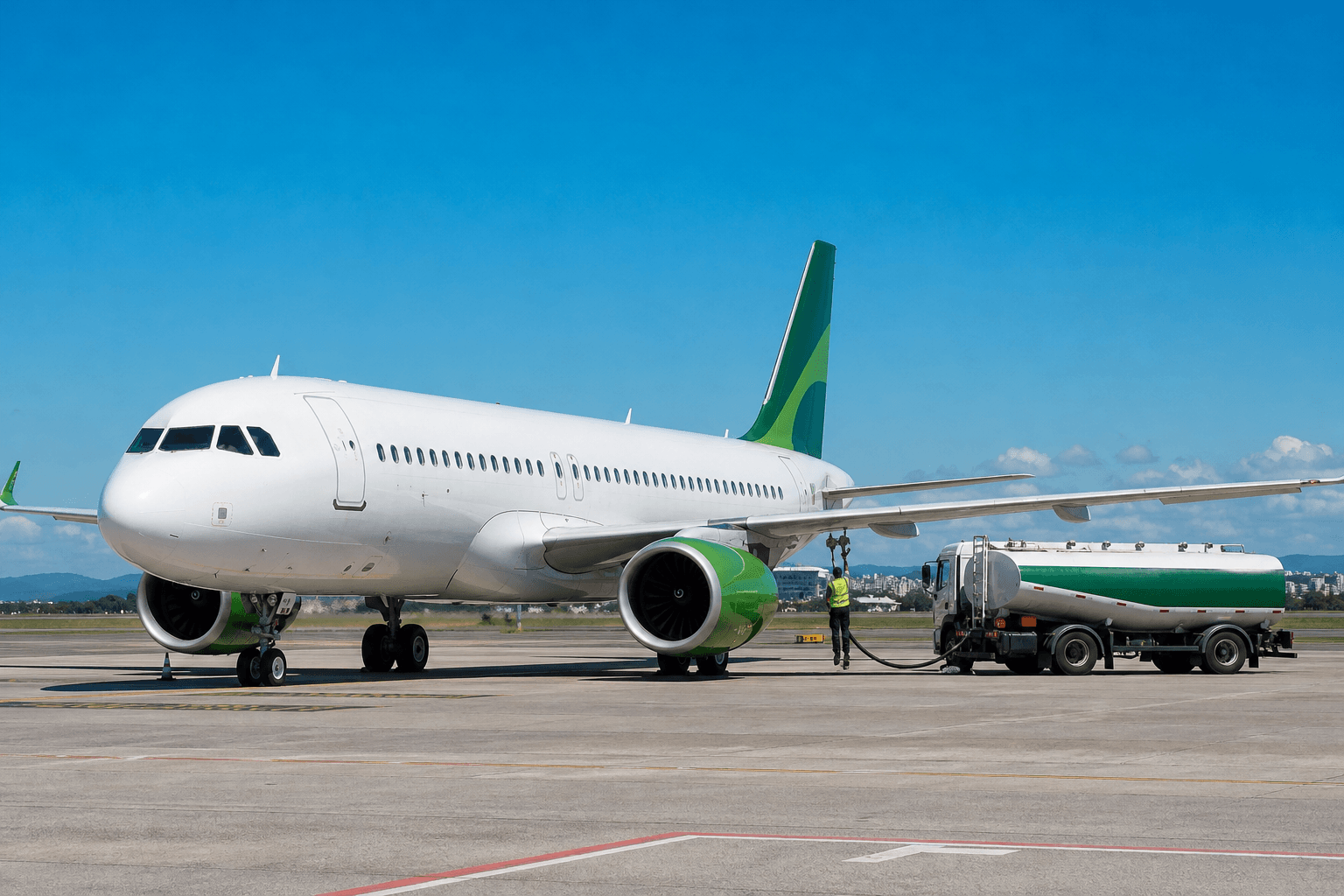
AI-generated illustration
Brazil's ANAC Sets R$750-Per-Ton Fine for Airlines That Miss SAF Emissions Targets From 2027
Resolution No. 820 sets out how Brazilian airlines must monitor, report and cut domestic flight emissions under ProBioQAV, starting with a 1% target in 2027 and rising to 10% from 2037.
The gist
Brazilian airlines must cut domestic emissions 1% from 2027, or pay R$750 per ton of CO2 missed and still make up the shortfall the next year.
Continuing coverage
All Saf →Brazil's National Civil Aviation Agency (ANAC) has approved rules that require airlines to cut greenhouse gas emissions on domestic flights from 2027. Carriers that miss their targets will be fined R$750 for every metric ton of CO₂ equivalent they fail to reduce. The framework, Resolution No. 820, falls under the National Sustainable Aviation Fuel Program, known as ProBioQAV. ANAC's board approved it in November 2026, and it was published in the Federal Register on November 17, with a correction issued the following day.
The first target is 1%. Covered operators must reduce emissions from their domestic operations by that amount in 2027 and again in 2028. The requirement rises to 2% in 2029 and climbs gradually to 10% from 2037. That schedule follows the trajectory set by Brazil's Future Fuels Law and the decree that created ProBioQAV.
Not every aircraft owner is covered. The rule applies to operators subject to ANAC's certification rules whose domestic flights produce more than 10,000 metric tons of CO₂ in a calendar year. Monitoring and target obligations begin in January of the year after a company crosses that threshold, subject to other conditions in the resolution. Each covered airline will have to track fuel burn, calculate its emissions and show how much it has cut.
The target does not mean every aircraft must carry a 1% blend of sustainable aviation fuel. Compliance is measured by emissions reductions calculated under ANAC's methodology, not by the share of SAF in an aircraft's tanks. SAF can be made through several industrial pathways from vegetable oils, agricultural waste, fats and other eligible carbon sources. It can be used in existing aircraft and fueling systems as long as technical specifications and authorized blending limits are respected.
Brazil's Ministry of Ports and Airports estimates that SAF can cut lifecycle greenhouse gas emissions by up to 80%, citing IATA data. The actual reduction depends on the fuel's composition, how much is used and the sustainability of its supply chain. Domestic production is already under way. In December 2025, Petrobras announced its first deliveries of SAF made entirely in Brazil and certified to international standards, produced at the Duque de Caxias Refinery in Rio de Janeiro.
The penalty is calculated per ton. An airline that falls 1,000 metric tons short of its target would face a R$750,000 fine at the stated rate, before applicable administrative procedures and criteria. Paying the fine does not cancel the obligation. The shortfall must be made up the following year on top of that year's new target.
ANAC will also police the data airlines submit. Companies must file an Emissions Monitoring Plan, an Emissions Report and a Target Compliance Report under procedures the agency sets. In the corrected version of the resolution, failing to submit an Emissions Report carries a base fine of R$84,000. Incomplete or inaccurate information in a report carries a base penalty of R$60,000. The rule is already in force, but fines for missing 2027 targets will depend on documented emissions and reductions, following reporting and oversight deadlines.
The main compliance tool will be SAF Sustainability Certificates, or CS-SAF, which document a fuel's environmental attributes and tie the resulting reduction to a specific operator. Airlines may cover a limited share of their target through other instruments, including decarbonization credits (CBIOs), international SAF certificates, low-carbon aviation fuels, and recognized emissions reduction or removal certificates. Those alternatives can account for up to 15% of the target in 2027 and 2028, with the cap falling in later years. To prevent double counting, companies must prove they own the certificates they submit and show that the certificates have been used.
The resolution also addresses fuel availability at airports. An operator that documents it could not obtain enough SAF may have its target adjusted, subject to conditions ANAC sets. Until the electronic certificate system is running, companies will have to document the fuel they use through other means set out in the rule.
Originally reported by CPG Click Oil and Gas
Read more
All Sustainability →
Airbus and Air India Team Up on India's First Voluntary Corporate SAF Programme
Airbus and Air India have partnered to launch what is described as India's first voluntary corporate sustainable aviation fuel programme.

Senator Moran Presses Duffy to Justify Jump to $50 Billion Air Traffic Control Request
The Kansas Republican who chairs the Senate aviation subcommittee says Transportation Secretary Sean Duffy must explain why his ATC modernisation ask rose from $30 billion to $50 billion after the 13 November ground stop.
JetBlue Adds Daily Fort Lauderdale Flights to Grand Cayman and Honduras for February 2027
JetBlue will launch daily service from Fort Lauderdale to Grand Cayman and to Palmerola, near Tegucigalpa, next February, taking its international network at the airport to 20 destinations.
Alaska-Hawaiian Pilot Deal Sets 12-Year Widebody Captain Pay at $493.41 an Hour
A tentative four-year contract between Alaska Air Group and ALPA would lift senior widebody captain pay to $539.16 an hour by 2030, with 4,600 pilots voting from December 1 to 22.
The Daily Touch & Go
The day's best aviation news in your inbox. Free, no spam.