

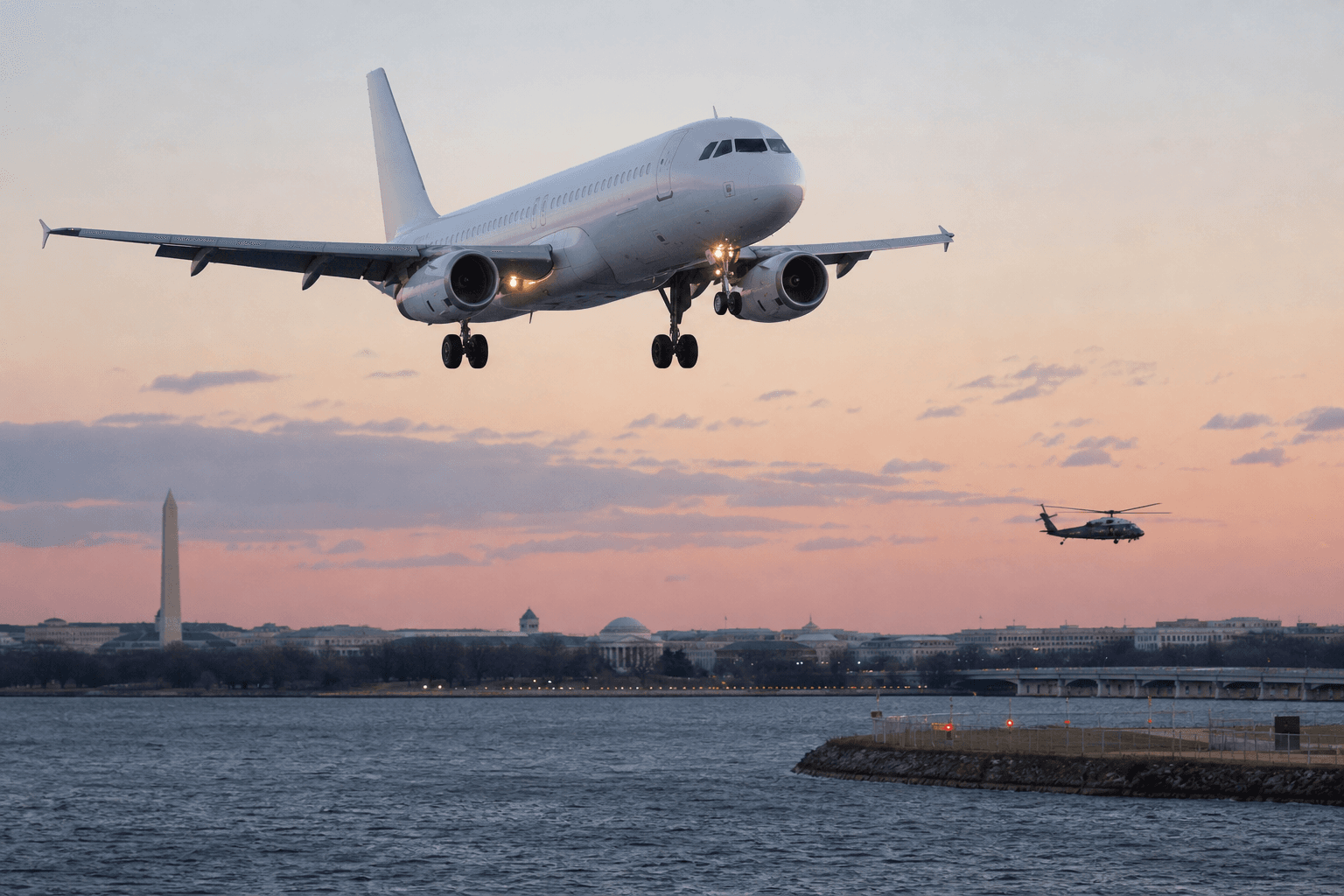
AI-generated illustration
Senate Aviation Chair Moran Says ADS-B In Mandate Could Slip Past Year-End
Days after Ted Cruz said Congress was very close to requiring ADS-B In, Senator Jerry Moran warned the ROTOR Act provisions may not pass this year, with military language still unresolved.
The gist
Sen. Jerry Moran says Congress may miss its year-end goal for an ADS-B In mandate as military provisions remain unsettled.
Continuing coverage
All Ntsb →- FAA Urges Pilots to Call Out Runway Number Before Crossing After 2023 JFK Near-Collision
- Nine Killed as Bahamas-Bound Learjet 60 Breaks Up Over Greenacres, Florida
- NTSB Finds Approved Fire Retardant Corroded Airtanker Wings, Cables and Engines in One Season
- Three Men Killed as Piper PA-24 Crashes on Grand Canyon North Rim After NFL Game Trip
- NTSB Finds Storm-Damaged Southwest 737 MAX Flew 44 Times Before Dutch Roll Accident
Senator Jerry Moran, the Kansas Republican who chairs the Senate panel overseeing aviation and also sits on the Appropriations Committee, said Thursday he would not be shocked if Congress ends the year without passing legislation that broadens ADS-B equipage requirements. Moran said he believes lawmakers are moving toward finishing the ROTOR Act's ADS-B provisions by the end of the year. He added, however, that a failure to do so would not come as a surprise.
His assessment arrived two days after Senator Ted Cruz of Texas, who chairs the Senate Committee on Commerce, Science, and Transportation, said Congress was very close to finalizing the mandate. The measure under discussion would require every aircraft that must broadcast ADS-B Out to also carry ADS-B In, which lets crews receive traffic information from other equipped aircraft. That requirement would apply to operations in Class A, Class B, Class C, Mode C Veil, and Class E airspace.
Cruz said Tuesday that the Senate and House had reached an agreement in principle, but that a few details still had to be worked out with the House Armed Services Committee. Senator Maria Cantwell of Washington, the ranking Democrat on the Commerce Committee, put the gap more plainly: the two chambers have a deal on the civil provisions but none on the military provisions. That split tracks the main difference between the two bills. The Senate-passed ROTOR Act would require ADS-B In on all military aircraft flying in airspace where ADS-B Out is mandatory, while the House-passed ALERT Act would not.
Moran said the continued failure of Congress and the administration to pass the ROTOR Act, or some version of it, is unacceptable, and he cautioned that an agreement in principle should not become an excuse for inaction. He said Cruz's reference to the Armed Services Committee told him the Department of Defense is involved in a way lawmakers need to resolve. Moran pointed to the department's position on limiting its use of airspace near Ronald Reagan Washington National Airport as a source of difficulty for the bill. He said there has to be a better way of handling military aircraft than what has been seen at Reagan for a long time, and that an NTSB recommendation involving the Army or the Pentagon should not become a stumbling block that prevents any action.
The legislation stems from the January 2025 midair collision near Reagan National between a U.S. Army helicopter and a commercial passenger jet. The helicopter was not broadcasting ADS-B Out at the time. The NTSB issued 50 safety recommendations after the crash and has said wider ADS-B use could have saved lives by warning flight crews of the converging traffic. The board has been urging the FAA to require ADS-B In, alongside ADS-B Out, since 2008. The NTSB and the Air Line Pilots Association, among other groups, have backed the ROTOR Act, arguing that the ALERT Act does not satisfy some of those recommendations.
The Army released its own investigative report in October. It found breakdowns across all layers of conflict management that contributed to the collision and assigned part of the blame to the FAA and air traffic control. A report from the National Academies of Sciences, Engineering, and Medicine published Wednesday concluded that some hazards the FAA and Army failed to adequately assess before the accident are still present nearly two years later.
NTSB Chairwoman Jennifer Homendy, speaking at the same summit, said 47 of the board's 50 recommendations from the collision remain open. Earlier this year the NTSB classified the FAA's responses to 11 of the 33 recommendations directed at the agency, including the one on ADS-B In, as unacceptable. Homendy cited past investigations that produced lasting changes. The 1974 crash of TWA Flight 514 led to ground proximity warning systems, the forerunner of today's terrain awareness and warning systems. American Airlines Flight 587 brought worldwide changes to pilot training and new certification standards covering rudder reversals, and Colgan Air Flight 3407 led to improved pilot training and reporting systems and an overhaul of flight duty and rest rules for Part 121 pilots.
Homendy said those accidents had different causes in different eras but taught the same thing: safety improves when people choose action over acceptance. She told Congress and the industry that the findings and recommendations are already in hand, and that everyone involved has a duty to act on them.
Originally reported by Aviation Safety Magazine
Read more
All Regulatory →
FAA Urges Pilots to Call Out Runway Number Before Crossing After 2023 JFK Near-Collision
New voluntary guidance under InFO 26016 asks airline, charter and fractional crews to read the runway number off airport signs aloud before crossing, a step the NTSB found missing at JFK.

Modern Skies Coalition Launches ACT NOW Ad Campaign Pressing Congress for ATC Modernization Money
A coalition of more than 50 aviation groups began a national ad push a week after a nearly five-hour nationwide ground stop, as DOT seeks another $50.1 billion for infrastructure.

Senator Moran Presses Duffy to Justify Jump to $50 Billion Air Traffic Control Request
The Kansas Republican who chairs the Senate aviation subcommittee says Transportation Secretary Sean Duffy must explain why his ATC modernisation ask rose from $30 billion to $50 billion after the 13 November ground stop.

FAA Opens Antidepressant Certification to Any AME and Cuts Post-Medication Wait to 60 Days
Pilots on FAA-accepted antidepressants no longer need a HIMS-trained examiner, and the wait to reapply after stopping medication drops from 90 days to 60, changes NBAA welcomed on Nov. 20.
The Daily Touch & Go
The day's best aviation news in your inbox. Free, no spam.