

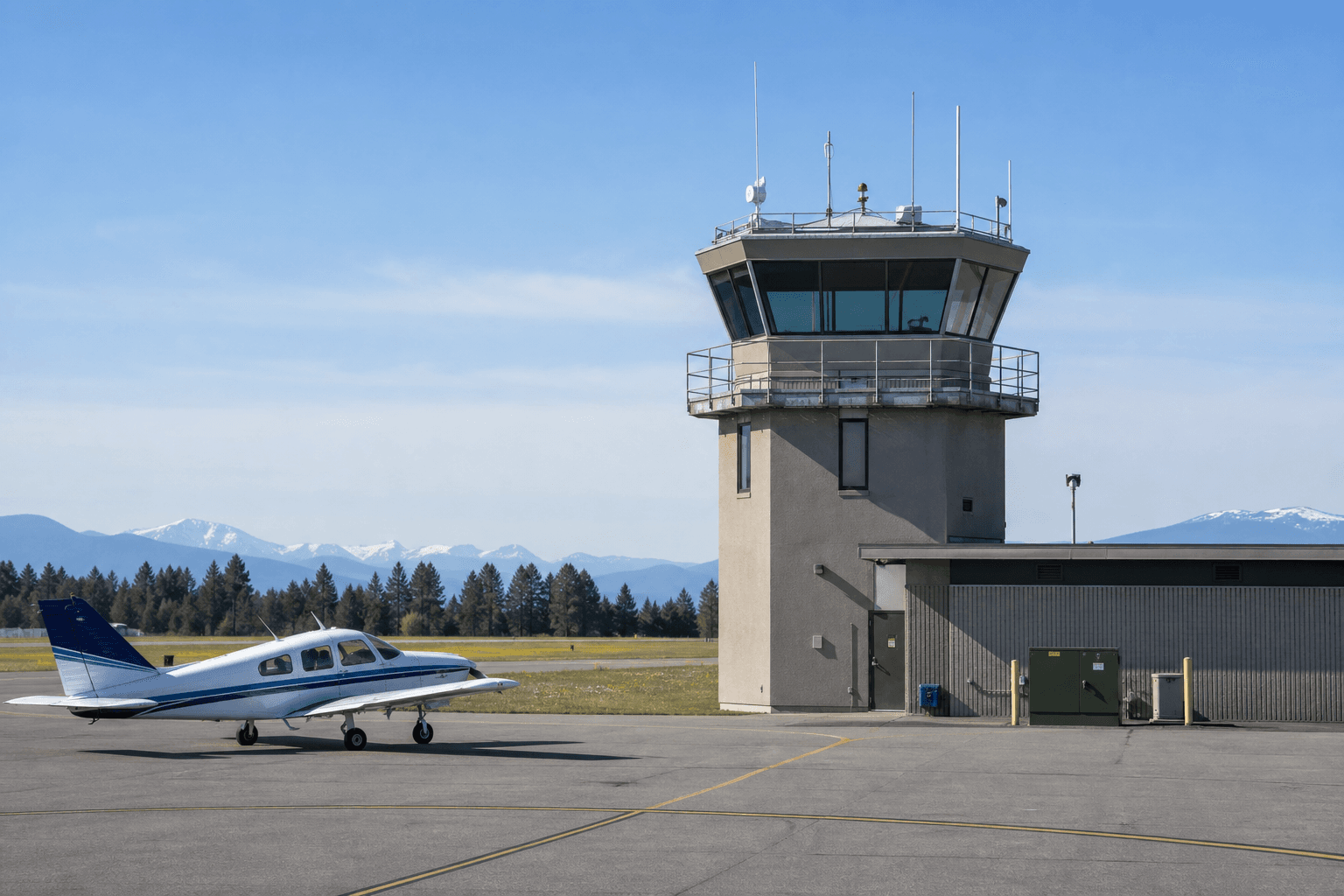
Illustration: The Touch & Go
FAA Makes Control Tower Operator Partnership Hiring Path for Contract Towers Permanent
The FAA officially includes graduates from FAA-approved Control Tower Operator Partnership schools as eligible hires for Federal Contract Tower companies starting July 2026.
The gist
FAA permanently adds Control Tower Operator Partnership graduates to contract tower hiring paths, expanding the candidate pool amid staffing challenges.
Continuing coverage
All Faa →- FAA Proposes Replacing 53-Year-Old Ban on Supersonic Flight Over U.S. Land With Noise-Based Rules
- Guide for Airports on Unleaded Avgas Transition Released Ahead of FAA Final Plan
- FAA Issues New Guidance to Preserve Cockpit Voice Recorder Data After Incidents
- FAA Proposes Noise-Based Rules to Enable Supersonic Flight Over US Land
- FAA Unveils Proposal to Revamp Mechanics' Inspection Authorization Renewals
The Federal Aviation Administration has formally established a permanent hiring pathway for Federal Contract Tower (FCT) controllers by incorporating graduates from FAA-approved Control Tower Operator Partnership (CTO-P) schools into eligibility criteria. Effective July 9, 2026, the update to FAA Order JO 7210.3EE Change 3 allows private companies staffing FAA-funded contract towers broader access to trained candidates. The order governs facility operation and administration policies and is a key regulatory document for the National Airspace System's air traffic control operations.
Contract towers, operated by private companies under FAA funding, provide vital air traffic control services mainly at smaller airports that see considerable general aviation activity. Prior to this policy change, contract tower operators mostly hired applicants who already held a control tower operator certificate or an FAA Air Traffic Safety Oversight Service credential with a tower rating. The inclusion of FAA-approved CTO-P graduates expands this pool, enabling earlier career-stage candidates who complete FAA-aligned classroom and simulation training to be considered for developmental controller roles.
The new eligibility criteria retain the previous option for hiring from applicants with endorsements from Enhanced Air Traffic Collegiate Training Initiative (E-AT-CTI) schools, ensuring continuity for that established recruitment route. Regardless of hiring path, developmental controllers must successfully complete facility-specific training before they are authorized to control air traffic independently. The FAA emphasized this update will assist FCT companies in addressing continued recruitment challenges by widening the accessible talent base.
This adjustment transitions the CTO-P pathway from a temporary FAA notice into an embedded regulation, signaling a long-term commitment to utilizing this training framework. The CTO-P program is designed to mirror FAA Academy standards and prepares candidates through rigorous academic courses complemented by simulation exercises. This alignment aims to produce candidates who can adapt efficiently to facility training, helping to mitigate persistent staffing shortages at contract towers.
Recent data from the Department of Transportation Office of Inspector General highlights the critical context for this change. As of 2024, the FCT program encompasses 266 contract towers across 46 states and territories, representing approximately half of all air traffic control towers nationwide. These towers managed over 18 million operations in the 2024 calendar year, underscoring their significant operational role within the national system.
Despite expanding recruitment pathways, the Office of Inspector General reports the FCT program remains significantly understaffed. As of April 2025, there was a shortfall of approximately 276 controllers, equating to 18 percent of the total workforce, which impairs operational capacity. Contract tower contractors cited attrition, competitive wage markets, geographic isolation, and the high cost of living in some areas as contributing factors to recruitment and retention difficulties.
Interestingly, all four contract tower contractors confirmed to inspectors that none had hired any Enhanced AT-CTI graduates by July 2025, indicating challenges remain in translating expanded eligibility into actual hires. The addition of the CTO-P route aims to alleviate some of these pressures by offering a more accessible entry point aligned with FAA standards.
By embedding the CTO-P pathway in FAA policy, the agency strengthens recruitment frameworks for contract towers, which are integral to the national airspace. The measure addresses operational concerns in smaller communities served by these towers, many of which depend heavily on general aviation. Continuous development of hiring frameworks in alignment with robust training standards is essential to maintain safe and efficient air traffic control nationwide.
Frequently asked questions
- What is the new permanent hiring path for Federal Contract Tower controllers?
- Graduates from FAA-approved Control Tower Operator Partnership schools are now permanently eligible for hire by Federal Contract Tower companies, as formalized in FAA Order JO 7210.3EE Change 3 effective July 9, 2026.
- Why did the FAA make the Control Tower Operator Partnership hiring path permanent?
- The FAA aims to expand the pool of qualified applicants for contract tower controller positions to address persistent staffing shortages and improve recruitment by including candidates trained in FAA-aligned CTO-P programs.
- What challenges do Federal Contract Tower companies face in staffing controllers?
- Contract towers often struggle with high attrition, wages, remote and high cost-of-living locations, leading to an 18 percent workforce shortfall as of April 2025, despite expanded hiring routes like Enhanced AT-CTI and CTO-P programs.
Read more
All Aviation Safety →
Guide for Airports on Unleaded Avgas Transition Released Ahead of FAA Final Plan
The June publication of a new Airport Cooperative Research Program guide arrives during a very much unresolved stage of the federal unleaded avgas process. The FAA's comment period on its draft Transition Plan to Unleaded Aviation Gasoline closed earlier this year, and as of this writing, the final plan has not been published, nor has the agency released the public comments it received. "Our priority is releasing the Transition Plan," the FAA said in response to an AVweb status inquiry. "We will do that first and then release the comment summary in late 2026." That leaves airports and aircraft owners preparing for a transition whose direction is established while many of its key governing details remain pending. The National Academies Press published Transitioning to Unleaded Aviation Gasoline, A Guide and Tools in June, along with a companion primer . The documents were developed under ACRP Project 03-73, sponsored by the FAA and administered by the Transportation Research Board. It is important to mention that they do not attempt to replace the FAA transition plan. They instead serve a different purpose of bringing the national effort down to the airport level to address some of the practical issues they will face as the transition moves forward. Federal Policy Meets Airport Operations Most who have any skin in the game when it comes to the upcoming unleaded avgas transition are probably well aware of the history, but a bit of background before we dive in. In 2023, the Environmental Protection Agency issued its finding that lead emissions from aircraft engines operating on leaded fuel endanger public health and welfare. The ACRP primer says leaded aviation gasoline is now the largest current source of airborne lead emissions in the United States, after the phaseout of leaded automotive gasoline and reductions from other sources. "Lead emissions from aircraft are an important and urgent public health issue," the EPA said. "Lead exposure can have harmful effects on cognitive function, including reduced IQ, decreased academic performance, as well as increased risk for additional health concerns. There is no evidence of a threshold below which there are no harmful effects on cognition from lead exposure." Congress has also defined part of the airport problem. The FAA Reauthorization Act of 2024 requires airports that offered leaded avgas in 2022 or earlier to keep it available until Dec. 31, 2030, unless an FAA-authorized unleaded avgas replacement for nearly all piston-engine aircraft and engines is available and meets a standard the agency considers acceptable for safe use, production and distribution. That requirement preserves 100LL access for aircraft that still need it, at least for the moment. It also creates the transitional period that airport operators now have to manage. Some fields have the tankage, staff and fuel volume to add an unleaded avgas option before leaded fuel disappears. Others have a single avgas tank, a small based fleet and little operational room for parallel fuels. The ACRP guide’s starting point is that difficulty. Its recommended process begins with fuel suppliers and FBOs, then moves through local fleet compatibility, demand estimates, infrastructure review, funding options, financial analysis, unleaded avgas selection, implementation, safety procedures, training and continued monitoring. The sequence treats fuel choice as the product of airport-specific information and decisions. The Fuel Snapshot Needs A Date Stamp The report is a June publication, but its fuel-status discussion reflects information available when the guide was being prepared in January 2025. At that point, it identified non-oxygenated mogas, Swift Fuels UL94, GAMI G100UL and Swift Fuels 100R as unleaded avgas options that were commercially available or moving toward commercial availability. UL100E from LyondellBasell and VP Racing Fuels remained in FAA testing. Of course, unleaded avgas availability is not the same as universal usability. Mogas, UL94, G100UL and 100R depend on STCs unless the aircraft's type certificate already allows the fuel. The guide acknowledges this, and also describes the FAA's fleet authorization process, which depends on testing and standards work. For an airport, the relevant unit is not the national fleet, but the aircraft it actually services. A traffic count does not answer how many based airplanes can use UL94, how many still need a particular fuel, how many owners will obtain an STC, or how transient pilots will know which pump is appropriate. Those answers, the guide says, will have to come from aircraft surveys, N-number checks, engine information, STC status and fuel-use estimates. The guide also puts attention on unleaded avgas standards and compatibility. Mogas and UL94 are covered by ASTM standards. G100UL had no ASTM standard at the time covered by the report. Swift 100R had an ASTM standard in development. Those details may affect how airports, fuel providers, insurers and aircraft owners evaluate misfueling risk, product acceptance and infrastructure decisions. The Checklist Is The Work The National Academies material includes five tools for airports as they make the unleaded avgas transition. These include a transition checklist, separate survey forms for individual-aircraft owners and multi-aircraft operators, a fleet inventory spreadsheet and a fuel cost evaluation tool. Together, they are intended to give airports a way to track the process, estimate which aircraft can use available unleaded fuels, evaluate demand and compare the costs of possible transition paths. The guide draws on case studies from seven airports that had begun , or were preparing for, unleaded avgas service while continuing to offer 100LL. It also includes material related to Alaska, where seasonal fuel delivery, storage limits, remote communities and reliance on piston aircraft create a different transition problem from the one faced by many airports in the lower 48. Aircraft owners will face their own set of questions around unleaded avgas that the guide addresses only in part. It discusses fuel approval paths, STC requirements, compatibility, standards, price differences and some cost considerations, mainly as they affect airport planning. It does not settle what pilots will encounter in daily use, including long-term fuel availability, final pricing, warranty and insurance treatment, resale effects, or the fate of aircraft that may be legal to convert but difficult to justify economically. The FAA's draft plan raised many of those issues without closing them, and since the final plan has not yet been released, we still do not have a final, authoritative answer on how these will be addressed. The ACRP guide is strongest where it stays on airport work. It gives operators a way to survey the local fleet, evaluate tankage, train line staff and reduce misfueling risk. Those steps are necessary, although the guide has limited answers for airports with one avgas tank, uncertain transient demand, competing unleaded avgas products, unresolved production capacity or local economics that do not support adding another fuel grade. Its tools can help an airport organize the problem, but they cannot remove the market and regulatory gaps that will determine whether a local plan is workable. The final FAA transition plan will still matter greatly, and so will the comments the agency received and plans to summarize later this year. Production capacity, price, distribution, fuel standards and aircraft eligibility will shape the pace of change. The ACRP publications do not answer every national question, but of course, they do not claim to. Rather, they describe the work that airports can begin while those questions remain open. And that is where the unleaded avgas transition now sits. The policy deadline remains 2030 and the final federal plan is still pending as quite a few very practical questions remain unanswered. Even so, the burden is al

FAA Issues New Guidance to Preserve Cockpit Voice Recorder Data After Incidents
The FAA is developing recommendations to protect information captured by the cockpit voice recorder (CVR) of an aircraft that has been involved in an accident or reportable incident. The agency has issued a Safety Alert for Operators (SAFO) advising airline crews and maintenance teams to shut off power to the CVR to protect critical audio data after a reportable event. CVRs are designed with a finite amount of memory that is overwritten, unless the circuit breaker for the device is pulled. The SAFO advises operators to provide clear shutoff instructions for the CVR through flight, maintenance, and dispatch manuals, and instructs airlines and air taxi companies to assess applicable procedures through their Safety Management Systems (SMS) to ensure the guidance is implemented and effective. READ MORE: NTSB Releases Final Report on Alaska Door Plug Failure READ MORE: 4 Flight Attendants Sue Boeing Over Alaska Door Plug Blowout According to the FAA, the SAFO addresses a National Transportation Safety Board (NTSB) recommendation in 2025 stemming from the January 2024 in-flight loss of a door plug from Alaska Airlines Flight 1282, a Boeing 737-900. The mid-exit door plug (MED) departed the aircraft shortly after takeoff from Portland International Airport (KPDX) in Oregon. The loss of the MED as the jet climbed through 14,830 feet resulted in explosive decompression. The door, along with unsecured objects including cellphones, paper, children's toys, clothing, and parts of the aircraft interior rained down on a Portland suburb. One flight attendant and seven passengers received minor injuries. The captain, first officer, three flight attendants, and 164 passengers were uninjured. Video taken from inside the aircraft during the return to KPDX appeared on social media, showing supplemental oxygen masks hanging from the ceiling, seat frames twisted as if they were made of Play-Doh, and a gaping hole in the fuselage with the city lights of Portland below. The aircraft was able to land safely at the airport, where the passengers and crew departed. Mid-exit door (MED) plug from Alaska Airlines Flight 1282. [Credit: NTSB] During the preliminary NTSB hearing it was learned that the force of the decompression blew open the cockpit door and the flight crew lost their headsets. The loss of cabin pressure necessitated the use of supplemental oxygen, which further made it difficult for the crew to communicate. In addition, the interphone was knocked out, making it impossible to reach the flight attendants in the cabin to determine the extent of the severity of the event. The CVR was not available for review by the NTSB, because, as noted by several people during testimony, by the time the technicians returned to the cockpit, the CVR had overwritten itself as it is designed to record two hours at a time, then recycle. The procedure in the event of an accident or incident is to pull the circuit breaker to preserve the information on the CVR, but it was noted that the flight crew was focused on the welfare of the passengers and getting the aircraft safely back on the ground. As the FAA report indicates, because the CVR had been overwritten, the NTSB was not able to fully evaluate some flight deck environment events associated with the rapid depressurization, such as the difficulties the pilots had establishing communications back to their headsets after removing oxygen masks. Because of the missing CVR, the NTSB could not determine whether factors other than the loud noises in the airplane contributed to the reported communication difficulties that occurred while the pilots were wearing their oxygen masks, such as the captain and a flight attendant reporting inability to communicate with each other over the interphone despite multiple attempts. "Such a determination would support the development of recommendations for safety enhancements, which, depending on the reason for the difficulties, could involve equipment, procedural, or training solutions," the FAA report stated. One of the recommendations to come out of the NTSB investigation was to require CVRs capable of recording 25 hours at a stretch before the overwrite. The FAA recommends that each operator with a CVR installed "confirm that company manuals contain instructions that the CVR circuit breaker be pulled after a reportable event. The instruction that the CVR circuit breaker is pulled could be included in flight operation manuals, maintenance manuals, and dispatch manuals, increasing the likelihood that the task is accomplished. Certificate holders operating under Title 14 Code of Federal Regulations (14 CFR) parts 121 or 135 should use their safety assurance processes within their Safety Management System (SMS) to ensure the recommended risk controls are analyzed and assessed to meet the organization's safety objective." In an email to the FAA, the NTSB noted that following the accident Alaska Airlines implemented several changes related to preserving flight data recorder (FDR) and CVR data after an incident or accident, such as adding circuit breaker information to the Quick Reference Handbook (QRH) used by pilots, and adding a reminder to the flight operations duty officer and dispatch brief checklists to confirm that CVR and FDR circuit breakers are pulled following an event. The airlines also revised the Emergency Coordination Center maintenance and engineering checklist, non-Emergency Coordination Center maintenance control checklist, and Emergency Coordination Center flight operations checklist to prioritize timely pulling of the FDR and CVR circuit breakers following an event. "The FAA recognizes the importance of protecting cockpit voice recorder (CVR) data following a reportable event," said FAA Administrator Bryan Bedford in an email to the NTSB. "There are several 14 CFR sections, §§ 121.135, 125.73, 135.23, and 91.1025, that stipulate manual content requirements. However, none of these sections require operators to ensure the cockpit voice recorders (CVR) circuit breaker has been pulled after a reportable event." Bedford's email continues, noting that after May 28, 2027, "every Part 121 and Part 135 certificate holder is required under 14 CFR Part 5 to have a Safety Assurance module within their Safety Management System which will require them to consider notifications from external sources and, therefore, use their safety assurance module to determine if they have procedures in place to ensure that CVR data retention is located throughout their manual system."
FAA Awards $1.776 Billion in Airport Grants to Boost Infrastructure and Safety
Fresh funding will support a range of projects, from runway rehabilitations to safety upgrades.

FAA mandates radio altimeter upgrades amid 5G Upper C-band rollout with cellular carrier rebates
The FAA intends to pass an altimeter update mandate this summer, but aircraft operators could get rebates for the expense. The Federal Aviation Administration will soon issue another rule requiring all radio altimeters on US aircraft be updated to prevent interference from 5G transmissions, though cellular companies are likely on the hook to help foot…
The Daily Touch & Go
The day's best aviation news in your inbox. Free, no spam.