

Illustration: The Touch & Go
FAA Issues New Guidance to Preserve Cockpit Voice Recorder Data After Incidents
The FAA has released a safety alert urging immediate shutdown of cockpit voice recorders post-incident to prevent data loss and aid investigations.
The gist
FAA advises pulling cockpit voice recorder circuit breakers post-incident to preserve vital audio data for safety investigations.
Continuing coverage
All Faa →- FAA Proposes Noise-Based Rules to Enable Supersonic Flight Over US Land
- FAA Contracts L3Harris to Modernize ADS-B Ground Network Through 2045
- FAA mandates radio altimeter upgrades amid 5G Upper C-band rollout with cellular carrier rebates
- FAA proposes lifting 53-year ban on civilian overland supersonic flight in US
- FAA imposes Canadian operation restrictions on 1,000 US aircraft over 5G altimeter risks
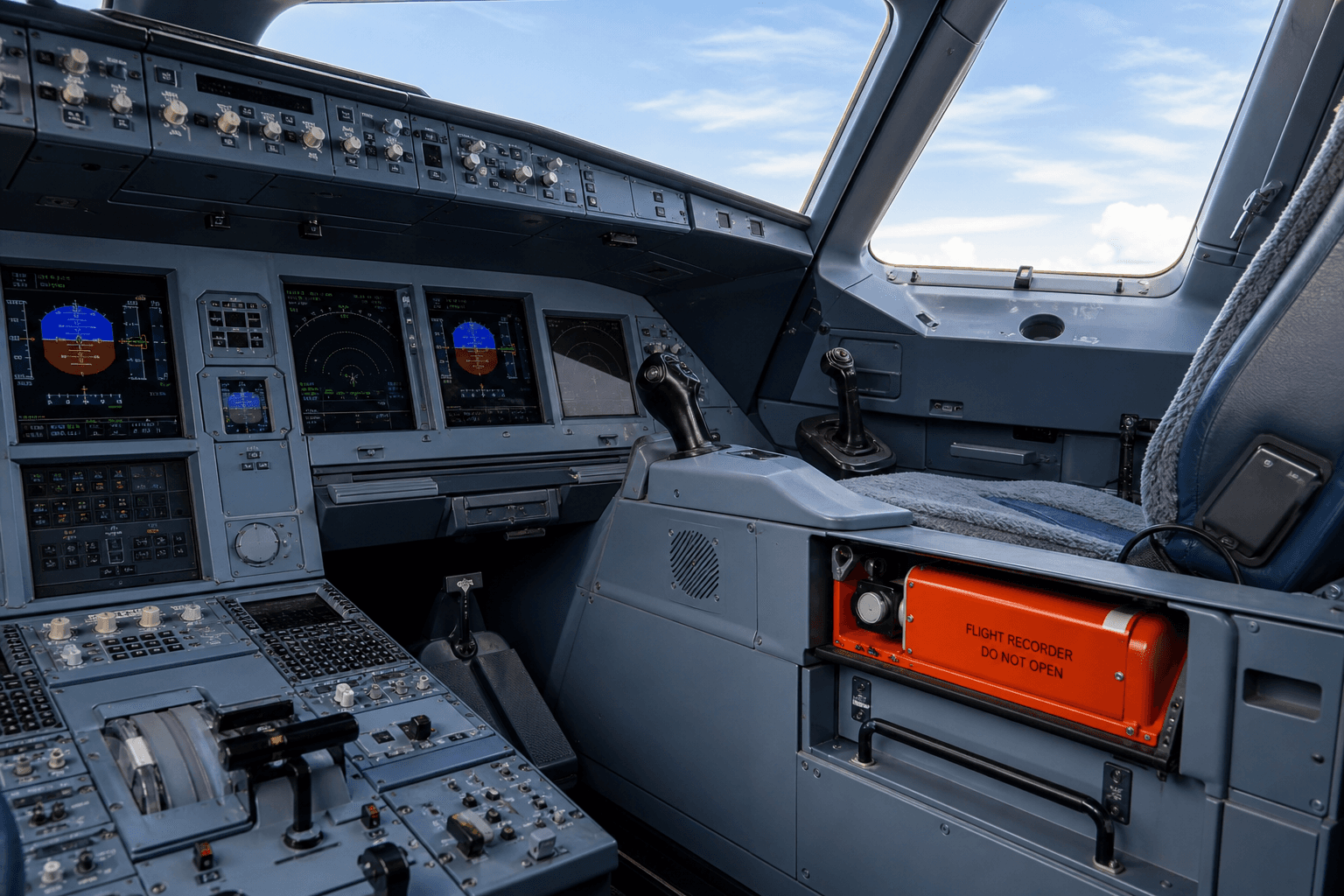
The Federal Aviation Administration (FAA) has introduced new safety guidance aimed at safeguarding critical audio data captured by cockpit voice recorders (CVRs) following aircraft accidents or reportable incidents. This move comes after investigations revealed that CVR data loss can significantly hamper safety assessments. The FAA's Safety Alert for Operators (SAFO) explicitly recommends shutting off power to the CVR promptly after such events to prevent crucial recordings from being overwritten. CVRs continuously record and store only the latest two hours of cockpit audio, whereby older data gets overwritten unless preserved by deactivating the recorder circuit breaker.
The FAA encourages operators to integrate explicit instructions in their flight, maintenance, and dispatch manuals detailing the procedure for pulling the CVR circuit breaker in the event of an accident or significant incident. Incorporating these directives across relevant manuals and operational procedures increases the likelihood that crews will preserve crucial audio evidence when it matters most. Additionally, the FAA advises airlines and air taxi businesses to leverage their Safety Management Systems (SMS) to assess and validate these procedures' effectiveness and compliance within their operations.
This advisory follows a 2025 recommendation by the National Transportation Safety Board (NTSB) after investigating an incident involving Alaska Airlines Flight 1282 in January 2024. The Boeing 737-900 aircraft suffered explosive decompression after losing a mid-exit door (MED) plug shortly after departing Portland International Airport. The rapid decompression forced an emergency return landing and caused minor injuries to several passengers and a flight attendant while leaving significant damage to the aircraft’s fuselage and interior.
Video footage from the incident shows the dramatic cockpit environment and cabin damage, including deployed oxygen masks and twisted seat frames. Importantly, the NTSB found that during the decompression event, the cockpit door was blown open, pilots lost their headsets, and supplemental oxygen use further complicated communications with the cabin crew. Communication breakdown was exacerbated by the failure of the interphone system, hindering coordination during the emergency.
Critically, the CVR data from Flight 1282 was unavailable to investigators because the recorder continued to loop and overwrite audio during the crew’s return flight. The flight crew understandably prioritized passenger safety and aircraft control, with no opportunity to pull the CVR circuit breaker to preserve recordings. The absence of these audio records limited the NTSB’s ability to fully analyze cockpit interactions and the communication challenges experienced during the incident.
The FAA report highlights that missing CVR data impeded understanding of how the noise and oxygen masks may have affected pilot communications, key factors in determining the effectiveness of cockpit procedures and equipment certifications. Consequently, the NTSB recommended mandating CVRs with significantly extended recording durations, proposing 25 hours of continuous audio capture to reduce the risk of critical data loss.
Following the incident, Alaska Airlines implemented several operational changes to enhance CVR and flight data recorder data preservation. These included updating the Quick Reference Handbook with circuit breaker information, adding reminders in dispatch and operations checklists to ensure timely circuit breaker pull, and revising maintenance and emergency coordination center procedures to prioritize data preservation after reportable events.
FAA Administrator Bryan Bedford underscored the regulatory gap regarding CVR data retention, noting that existing regulations require manual content standards but do not mandate operators to ensure CVR circuit breakers are pulled post-incident. New regulatory requirements effective May 28, 2027, will compel all Part 121 and Part 135 certificate holders to maintain Safety Assurance modules within their SMS. These modules will incorporate external notifications and evaluations to confirm that procedures preserving CVR data are established and functioning across organizational manuals and processes.
The FAA’s action addresses a critical factor in advancing aviation safety: ensuring that audio evidence from the flight deck remains intact following accidents or serious events. This data plays a pivotal role in reconstructing events, understanding human factors, and guiding future equipment and training enhancements. Clear procedures and system-wide adherence to these guidelines will better equip investigators and enhance safety outcomes across the commercial aviation sector.
Read more
All Aviation Safety →
Skydiving P-750XL Crashed After Steep Left Bank on Takeoff at Missouri Airport
Pilot and 11 parachutists did not survive accident which occurred moments after take-off from Missouri airport. Surveillance video shows that a Pacific Aerospace P-750XL skydiving aircraft, which crashed on take-off from Butler Memorial airport, had gradually started banking left until its wings were perpendicular to the ground. The aircraft, with a pilot and 11 skydivers…

FAA mandates radio altimeter upgrades amid 5G Upper C-band rollout with cellular carrier rebates
The FAA intends to pass an altimeter update mandate this summer, but aircraft operators could get rebates for the expense. The Federal Aviation Administration will soon issue another rule requiring all radio altimeters on US aircraft be updated to prevent interference from 5G transmissions, though cellular companies are likely on the hook to help foot…

FAA imposes Canadian operation restrictions on 1,000 US aircraft over 5G altimeter risks
The FAA estimates its newly issued airworthiness directives will affect 1,000 US-registered aircraft. Some US transport aircraft will face operating restrictions in Canada starting on 1 July. That is according to the US Federal Aviation Administration, which on 30 June published several airworthiness directives (ADs) in response to concern that 5G cellular signals near Canadian…

Airport Safety Hindered by Limited Sharing of Near-Miss Data in SMS Programs
Tuesday's Senate hearing raised concerns that open-records laws may be limiting the safety data airports need to make SMS programs fully effective.
The Daily Touch & Go
The day's best aviation news in your inbox. Free, no spam.