

Illustration: The Touch & Go
Pratt & Whitney launches PW1900G production in Middletown to expand GTF engine output
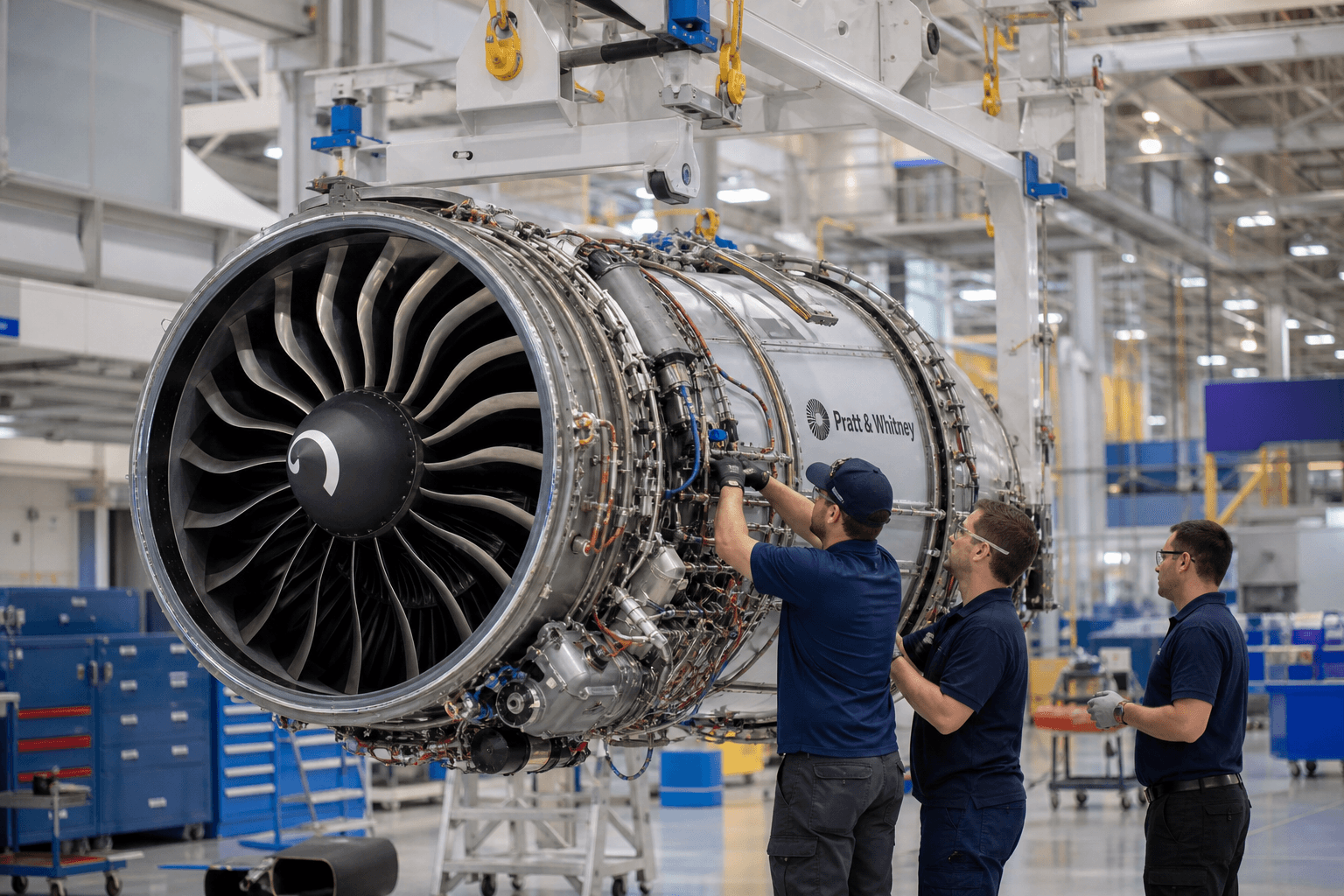
Pratt & Whitney has started assembling the PW1900G geared turbofan in Middletown, Connecticut, complementing its Mirabel facility and boosting output for Embraer's E2 jets.
The gist
Pratt & Whitney began building the PW1900G engine in Connecticut, increasing production capacity for Embraer's E2 aircraft and continuing Mirabel operations.
Pratt & Whitney (P&W) is preparing to deliver the first PW1900G geared turbofan engine built at its Middletown, Connecticut facility later this month, marking a significant expansion of production capacity for this engine variant. Previously, all PW1900G engines, which power the Embraer 190-E2 and 195-E2 regional jets, were assembled exclusively in Mirabel, near Montreal, Canada, where P&W also produces the PW1500G engine for the Airbus A220.
The decision to extend PW1900G assembly to Middletown aligns with increased demand and output at the Mirabel plant. Over the past year, Mirabel’s PW1500G production surged by 20%, reflecting growing orders and deliveries for the A220 program. This output growth pressured the facility’s capacity, prompting P&W to open a dedicated PW1900G production line in Middletown to alleviate the workload and maintain delivery targets.
Rick Deurloo, president of P&W commercial engines, explained that as Mirabel ramped its production lines, space became constrained. Establishing the PW1900G line in Middletown was part of the company’s strategic plan to expand manufacturing capabilities. The Middletown site already supports production of the PW1100G, an engine option for the Airbus A320neo family, supplementing P&W’s manufacturing footprint in the United States.
The PW1900G engine serves Embraer’s second-generation E-Jet family, specifically the E190-E2 and E195-E2 models, which are regional jets designed for efficiency and lower emissions. Continued strong sales of these aircraft underpin the need for increased engine assembly capacity. Embraer relies on robust PW1900G production to meet delivery schedules and support its market presence in the regional jet segment.
Despite the new assembly line in Middletown, P&W will maintain some PW1900G assembly operations in Mirabel, alongside their ongoing production of all PW1500G engines. Airbus, the customer for the PW1500G on its A220, has ambitious plans to increase A220 production rates to 13 jets per month by 2028. Airbus delivered 93 A220s in 2025, up from 75 jets in 2024, underscoring the rising demand fueling P&W’s expanded production.
Alongside expanding production lines, P&W announced a recent acquisition of advanced borescope-inspection software from Aiir Innovations, a firm based in Amsterdam. This software applies artificial intelligence to borescope video, enabling faster and more consistent engine inspections. P&W has already deployed this technology with commercial customers and maintenance, repair, and overhaul (MRO) providers, significantly reducing inspection duration.
The AI-powered inspection software is currently used on International Aero Engines V2500 turbofans, which power first-generation A320s. P&W is also evaluating the technology’s application to both its geared turbofan line and military engines like the F135, which powers the F-35 fighter jet. Incorporating AI into inspection processes represents an operational enhancement that supports P&W’s maintenance services and engine reliability.
P&W’s expanded assembly capacity in Middletown, coupled with technological upgrades like AI-assisted inspections, positions the company to meet growing commercial and military engine demands. For the PW1900G, increasing assembly capability beyond Mirabel helps accommodate Embraer's E2 program growth forecasts and ensures production resilience amid rising aircraft deliveries.
This strategic manufacturing diversification ensures Pratt & Whitney can meet evolving market needs for regional jets and narrowbody aircraft engines. By bolstering the production of its smaller geared turbofan variants in multiple locations, P&W strengthens its supply chain and service capabilities, supporting both airframers and operators with timely deliveries and enhanced maintenance technologies.
Frequently asked questions
- Where was the first PW1900G engine built outside of Mirabel assembled?
- The first PW1900G engine built outside of Mirabel was assembled at Pratt & Whitney's Middletown, Connecticut facility.
- Why did Pratt & Whitney expand PW1900G production to Middletown?
- Increased output demands and capacity constraints at the Mirabel facility led Pratt & Whitney to add a new PW1900G production line in Middletown to support growing Embraer E2 deliveries.
- What new technology has Pratt & Whitney acquired to improve engine inspections?
- Pratt & Whitney acquired AI-assisted borescope-inspection software from Aiir Innovations to speed up and standardize engine inspections for various engine types including the V2500, GTF, and F135 engines.
Read more
All Military/Defense →Australia's Top End hosts 19 nations and 100 aircraft for Exercise Pitch Black 26
Australia's Northern Territory will serve as a hub of international air power from July 20 to August 7, 2026, as 19 partner nations take part in Exercise Pitch Black 26, a three-week air combat training exercise. The exercise officially launched on July 16, 2026, when Royal Australian Air Force (RAAF) Air Commodore Matthew McCormack, who is commanding this year's edition, joined detachment commanders from participating countries at RAAF Base Darwin. In total, the exercise has brought 100 aircraft and 2,500 personnel from around the world into RAAF Bases Darwin and Tindal, turning both installations into temporary centers of multinational air operations. As #PitchBlack26 heats up, we're shining a spotlight on the combat support teams who keep the mission moving. No. 23 Squadron at RAAF Base Amberley is supporting international tanker aircraft and ensuring safe, efficient airfield operations pic.twitter.com/06Q5MF0z0l — Royal Australian Air Force (@AusAirForce) July 17, 2026 Why the Northern Territory is an ideal training ground #image_title The location is far from incidental. Northern Australia is home to one of the largest military training areas in the world, offering vast, largely unrestricted airspace that few other regions can match. This degree of space matters for an exercise built around modern fighter aircraft, many of which need significant room to operate at full capability. McCormack pointed to that airspace directly, noting that some of the world's most advanced fighters require exactly the kind of operating room that the Top End provides. As #PitchBlack26 heats up, we're shining a spotlight on the combat support teams who keep the mission moving. No. 23 Squadron at RAAF Base Amberley is supporting international tanker aircraft and ensuring safe, efficient airfield operations pic.twitter.com/06Q5MF0z0l — Royal Australian Air Force (@AusAirForce) July 17, 2026 What Exercise Pitch Black training involves At its core, Pitch Black is built around large-force employment missions, exercises that bring together fighter aircraft, intelligence, surveillance, and reconnaissance platforms, air mobility assets, and command-and-control elements in scenarios meant to mirror real-world combat conditions. McCormack described the exercise as war fighter-focused, designed to expose both Australian aviators and their international counterparts to complex, high-end air combat scenarios. The goal, he said, is to sharpen decision-making and tactical skill while preparing participating forces to operate effectively in contested environments. Building relationships that extend beyond the flightline While the flying is the centerpiece, McCormack suggested the exercise carries value that extends well beyond the aircraft themselves. With so many nations training side by side, Pitch Black gives participants a chance to understand how other air forces operate, something that he feels would pay dividends if those same nations should ever need to work together in real conflict. That collaboration isn't limited to pilots. Aircrew, mission planners, engineers and support personnel from across the participating nations are all working together throughout the exercise, building the kind of professional familiarity that underpins effective coalition operations when it matters most. Staged every two years, Pitch Black has become one of the Royal Australian Air Force's signature international exercises, combining demanding air combat training with a rare opportunity for allied air forces to train, coordinate and build trust together at scale. RELATED Royal Australian Air Force announces Exercise Pitch Black for July-August 2026

Australia begins hunt for next-gen lead-in fighter trainer to replace Hawk 127s
The Australian government will explore several financing models to fill trainer requirement. Canberra has reached out to airframers as it explores possibilities to replace the Royal Australian Air Force's (RAAF’s) fleet of BAE Systems Hawk 127 advanced jet trainers. Designated Project Air 6002, the lead-in fighter training system (LIFTS) effort calls for a new aircraft that will train pilots for types such as the Boeing F/A-18F Super Hornet fighter, EA-18G Growler electronic attack jet, and the Lockheed Martin F-35A, according to an Australian government tender document. The requirement also is referred to as FLIF, for future lead-in fighter. The new aircraft will be required to enter service in the 2030s and help pilots develop skills ranging from general and instrument flying to air combat manoeuvres and integrating with other combat assets. "The system must have a sufficiently flexible architecture such that future capabilities can be introduced as future training requirements emerge," says the document. The aircraft could be acquired under several financial models including leasing, Foreign Military Sales, international cooperation, public private partnership, or working with foreign partners. The document does not list the number of aircraft to be obtained, or specifics about when the new type will attain initial and final operational capability. Cirium, an aviation analytics company, indicates that the RAAF operates 33 Hawk Mk-127s with an average age of 25.4 years. In April, the Australian Department of Defence's 2026 Integrated Investment Program document reiterated the need to replace the Hawks among other modernisation efforts. The replacement effort is likely to attract interest from companies such Boeing, Korea Aerospace Industries, and Leonardo.
Strait of Hormuz Tensions Push Airline Stocks Down as Fuel Costs Rise
Global Aviation Round-Up from Aircraft Value Intelligence (AVN) File photo Editor's Note: To watch a video report that concisely examines the themes of this article, click here . Geopolitical flashpoints have a way of upending the market’s priorities. Investors may spend weeks focused on inflation, interest rates, or corporate earnings, only to have an overseas conflict suddenly dominate trading. On Wall Street, the phenomenon is known as "headline risk." The latest example is unfolding in the Middle East. Renewed friction between the United States and Iran is putting the Strait of Hormuz back in the spotlight, injecting fresh uncertainty into global financial markets. One sector particularly hard hit is aviation. Last week at the NATO summit in Ankara, Turkey, President Trump declared that the Iran cease fire was "over." Subsequently, on July 13, Trump announced that the U.S. would be "taking over" the Strait of Hormuz and reinstating its naval blockade on Iran. The result has been a jittery stock market. Major indexes have swung sharply as traders react to each new development out of the Middle East, and some of the market’s biggest losers have been airline stocks. The connection isn’t hard to understand. The Strait of Hormuz is one of the world’s most important oil transit routes, carrying roughly one-fifth of global petroleum supplies. Whenever shipping through the narrow waterway appears threatened, oil traders immediately begin pricing in the possibility of supply disruptions. Even if those disruptions never materialize, crude prices can spike simply because the risk has increased. That’s bad news for an industry that runs on fuel. For most airlines, jet fuel ranks just behind labor as the largest operating expense. Fuel costs can account for 20% to 30% of an airline’s budget, so even a modest jump in oil prices can quickly eat into profit margins. Unlike energy companies, airlines don’t enjoy a windfall when oil climbs. In fact, they’re often caught flat-footed. Seats may have been sold months in advance at fixed prices, leaving carriers little choice but to absorb higher fuel bills until they can gradually adjust fares. That’s why airline stocks often sell off almost automatically whenever oil starts climbing on geopolitical fears. There’s another problem that doesn’t get as much attention: flight operations themselves. Carriers serving Europe, Asia, and the Middle East sometimes have to reroute aircraft to avoid conflict zones or closed airspace. Those detours burn more fuel, lengthen flight times, complicate crew scheduling, and raise operating costs. On a busy international network, those expenses can add up quickly. Taken together, higher fuel bills and longer routes create an unwelcome squeeze on profitability. Investors know the pattern well. When geopolitical risk rises, money tends to flow out of economically sensitive industries and into sectors viewed as safer. Airlines, cruise operators, hotels, and other travel-related businesses often come under pressure, while energy producers and defensive sectors such as utilities or healthcare attract fresh buying. That shift isn’t always a reflection of company fundamentals. It’s often a response to uncertainty itself, and Wall Street hates uncertainty. Past Is Prologue History offers plenty of examples. During the Gulf War, after the September 11 terrorist attacks, and during previous confrontations involving Iran, airline shares generally lagged the broader market. Once oil prices retreated and tensions eased, many carriers recovered. But investors who held through the volatility had to endure some rough stretches along the way. This latest episode has followed a familiar script. Reports of military escalation have pushed crude prices higher and weighed on airline shares. Headlines hinting at diplomatic progress have sparked equally swift rebounds. Those reversals have become almost routine, producing the kind of volatile trading sessions that can leave investors wondering whether they’re watching markets or ping-pong. Indeed, the almost predictable reaction of financial markets to news out of the Middle East has sparked concerns about insider trading. None of that necessarily changes the industry’s long-term outlook. U.S. airlines are generally in stronger financial shape than they were before the pandemic, and demand for both leisure and business travel has remained surprisingly resilient. Travelers have continued booking vacations and business trips despite higher ticket prices, giving carriers some pricing power that didn’t exist a decade ago. Still, there’s a limit to how much cost inflation airlines can pass along. If crude oil remains elevated for an extended period, analysts will almost certainly begin trimming earnings forecasts. Carriers with extensive international operations or limited fuel-hedging programs could face the greatest pressure. Aircraft manufacturers are affected as well. Notably, Airbus recently lowered its forecast for global aircraft demand over the next 20 years, citing the economic effects of the Iran conflict, trade tensions, and a softer-than-expected post-pandemic recovery. The broader market faces a similar dilemma. Higher energy prices can reignite inflation just as central banks have been looking for room to ease monetary policy. If oil stays expensive, policymakers may find themselves reluctant to cut interest rates, even if economic growth begins to cool. Liquidity is the lifeblood of equity markets; investors turn bearish when the monetary spigot tightens. For now, every development involving Iran, U.S. military policy, or commercial shipping through the Strait of Hormuz is likely to keep traders on edge. For airlines and the OEMs that serve them with aircraft, the flight path will probably remain bumpy for a while. John Persinos is the editor-in-chief of Aircraft Value Intelligence . Previously, John covered global financial markets as the editorial director of Investing Daily .

EAA AirVenture Oshkosh 2026 Set to Host Over 10,000 Aircraft in Historic Aviation Gathering
Every July, the aviation world descends on a small city in Wisconsin for what has become the largest and most famous fly-in and air show on the planet. EAA AirVenture Oshkosh is a week-long celebration of everything that flies. From homebuilt aircraft and vintage warbirds to the latest military jets, airliners, helicopters and experimental designs. Nowhere else offers such an incredible variety of aviation in one place. Running from 20-26 July 2026 at Wittman Regional Airport, Oshkosh attracts more than 600,000 visitors and around 10,000 aircraft , transforming the airport into what is routinely the busiest in the world for aircraft movements during the event. Why Every Aviation Enthusiast Should Visit Oshkosh JJN1991, CC BY-SA 4.0 <https://creativecommons.org/licenses/by-sa/4.0>, via Wikimedia Commons Ask anyone who has attended AirVenture and they’ll probably tell you the same thing: there is simply nothing else like it. Whether you’re interested in classic airliners, military aviation, general aviation, homebuilt aircraft or the very latest aerospace technology, Oshkosh has something to offer. Throughout the week visitors can enjoy: Spectacular daily flying displays Hundreds of military and civilian aircraft on static display Rare vintage and warbird aircraft The latest aircraft from Boeing, Airbus, Textron, Cirrus, Daher and many more manufacturers Product launches and world debuts Forums, workshops and presentations by aviation experts One of the world’s biggest aviation trade exhibitions Evening air shows and entertainment For aircraft spotters, the arrival weekend before the show officially opens is almost an event in itself. Thousands of aircraft converge on Oshkosh using the famous FAA arrival procedures, creating one of aviation’s most extraordinary spectacles as everything from Piper Cubs to corporate jets carefully follows the published NOTAM into Wittman Field. Smoke From Canadian Wildfires Causes Concern This year’s event is beginning under rather unusual circumstances. Large wildfires burning across Canada have sent thick smoke south across the Upper Midwest, leading to reduced visibility and poor air quality across Wisconsin just as thousands of pilots prepare to fly into Oshkosh. The National Weather Service has warned that smoke could significantly reduce visibility, while air quality advisories have been issued across much of the state. At times this week, visibility at Oshkosh dropped to around one mile before conditions improved. For pilots flying into one of the world’s busiest temporary airspaces, visibility is every bit as important as cloud cover. Air traffic controllers have urged crews to remain conservative in their decision making and not attempt the famous VFR arrival if conditions are unsuitable. Thankfully, forecasts suggest conditions should continue to evolve over the coming days, and organisers remain confident AirVenture will proceed as planned, although pilots and visitors are being encouraged to monitor the latest weather information closely. AirportSpotting Is Heading To Oshkosh EAA AirVenture Oshkosh We’re delighted to be attending AirVenture this year. Throughout the week we’ll be bringing you regular updates, photographs and videos from the show across our social media channels, so if you can’t make it to Wisconsin you’ll still be able to follow the action as it happens. Follow us on Facebook Follow us on YouTube We’ll also be publishing a full review of AirVenture here on AirportSpotting.com after the event, covering the biggest announcements, highlights, aircraft and surprises from the week. For Airport Spotting Premium members, we’re preparing something even more special. Our forthcoming USA 250th Anniversary Special magazine will feature an extensive review of AirVenture 2026 alongside exclusive features celebrating American aviation, making it an essential read for anyone who loves aircraft and aviation history. Sign up to Premium Here Whether you’re making the pilgrimage to Oshkosh yourself or following from home, the next week promises to be one of the highlights of the aviation calendar.
The Daily Touch & Go
The day's best aviation news in your inbox. Free, no spam.