

Illustration: The Touch & Go
SAS Evolves With New SkyTeam Alliance And Modern Airbus Fleet
Scandinavian Airlines, Scandinavian flag carrier formed in 1946, now operates a youthful Airbus fleet and long-haul routes after restructuring and joining SkyTeam.
The gist
SAS reshapes its future joining SkyTeam and upgrades fleet with Airbus jets, linking Scandinavia globally.
Continuing coverage
All Airbus →- Airbus A220 Outpaces A319neo as Preferred 100-150 Seat Narrowbody
- Europe's FCAS fighter program collapses amid industrial disputes and divergent military goals
- Airbus Builds A321XLR Wings in UK and Final Assembly in Germany Across Four Nations
- Airbus Forecasts Doubling of Air Passengers by 2045 Led by Urban Growth and Aircraft Efficiency
- Syria Plans to Buy Eight Airbus Aircraft as Macron Visits to Support Reconstruction
Scandinavian Airlines, widely known as SAS, has marked a significant transformation since being established in 1946 by uniting the national carriers of Denmark, Norway, and Sweden. The airline has grown to become a key player in Northern Europe’s aviation market, especially after its 2024 restructuring and alliance shift to SkyTeam. Today, SAS operates an almost exclusively Airbus fleet and serves over 100 destinations across Europe, North America, and Asia.
The consolidation of the three Scandinavian national airlines in 1946 enabled SAS to compete more effectively on international long-haul routes, particularly in the post-World War II environment. During the mid-20th century, SAS gained recognition for pioneering transpolar flights over Greenland, significantly shortening the journey between Europe and North America. The carrier was an early adopter of jet aircraft including models like the Douglas DC-8.
Through its history, SAS has flown a diverse range of aircraft, from the Douglas DC-6 and DC-9 to Boeing 747s and McDonnell Douglas MD-80s. In recent decades, however, the airline has standardised its fleet on Airbus jets, reflecting a modernisation strategy aimed at efficiency and environmental performance.
The airline faced substantial financial pressure during the COVID-19 pandemic, leading to Chapter 11 bankruptcy protection in the United States in 2022. By 2024, a major restructuring finalized with investments from Air France-KLM, Castlelake, Lind Invest, and the Danish government had revived the airline. One key outcome was SAS’s exit from the Star Alliance and an entry into the SkyTeam alliance, a move that represents a major strategic realignment in European aviation.
SAS’s three Scandinavian hubs are Copenhagen, Stockholm Arlanda, and Oslo Gardermoen, with Copenhagen serving as the principal international gateway and receiving continued investment. Long-haul flights from Copenhagen to cities like New York JFK, Chicago O’Hare, San Francisco, Seattle, and Boston underline SAS’s significant transatlantic presence. Additional intercontinental flights serve Tokyo and Shanghai, emphasizing the airline’s Asian connections.
The core SAS fleet comprises Airbus types including A319-100s, A320neos, A321LRs, A330-300s, and A350-900s, supported by regional turboprops like the ATR 72-600. The airline operates 66 Airbus A320neos making it one of Europe’s youngest and most modern narrowbody fleets. Furthermore, SAS has firm orders for 18 Airbus A330-900neos, signaling ongoing long-haul fleet renewal.
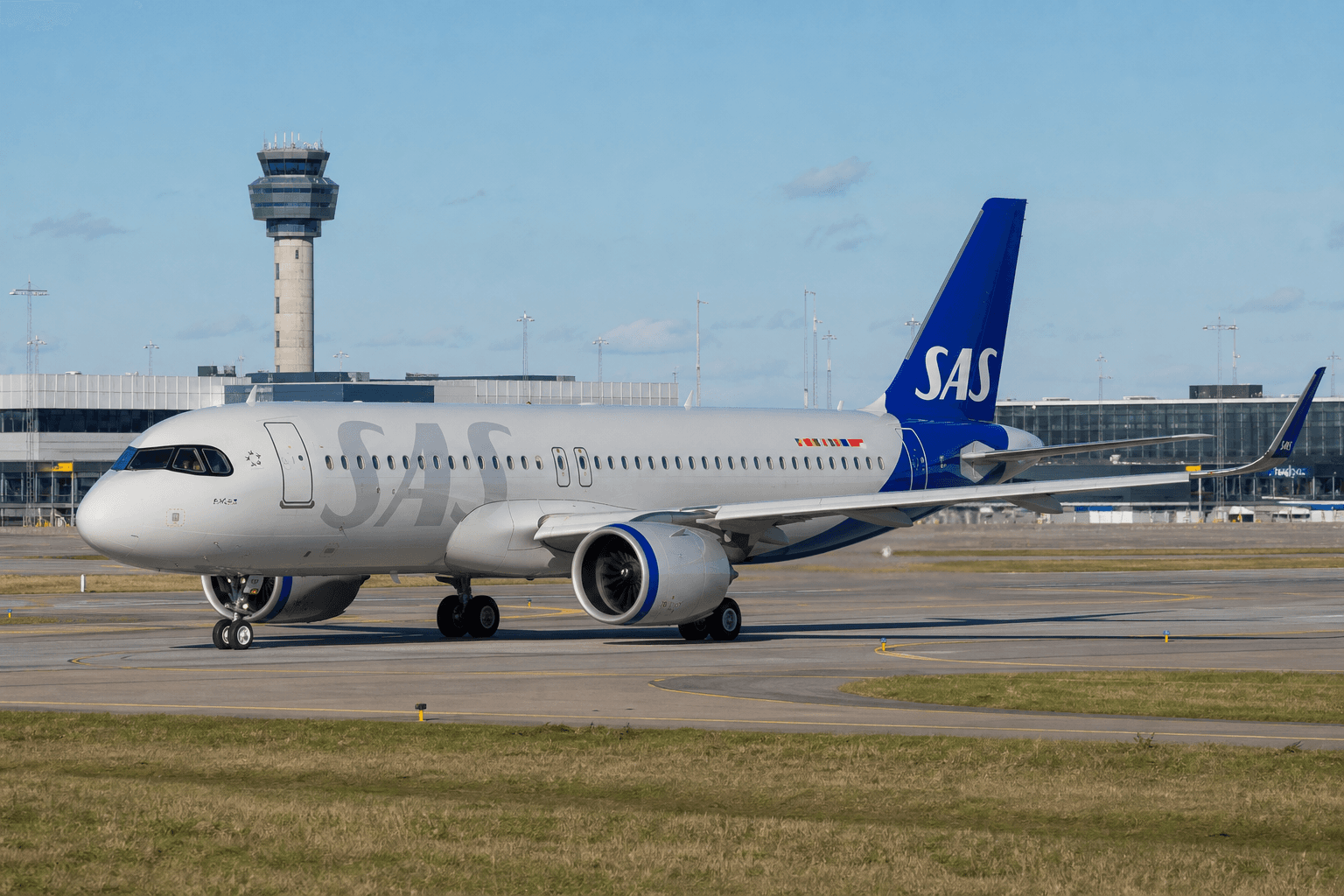
SAS introduced a new corporate livery in 2019, replacing a longstanding dark blue cheatline with a sleek silver-grey fuselage highlighted by bold blue SAS titles. The deep blue tail features a simplified white SAS logo and matching blue engines, projecting a clean, modern Scandinavian image. Although most aircraft have adopted this design, a number of A320neo family jets still carry the previous livery, resulting in a blend of old and new branding in service.
While generally maintaining a consistent livery across its fleet, SAS occasionally features promotional schemes, such as one marking its 80th anniversary on an Airbus A330. Additionally, select aircraft carry alliance or marketing decals tied to SkyTeam or seasonal campaigns, balancing brand consistency with occasional fleet variety.
SAS’s evolution from a postwar national collaboration to a modern global carrier highlights its adaptation to industry challenges through strategic alliances, fleet modernization, and hub development. Its transition into SkyTeam, combined with a youthful Airbus fleet, positions the airline to continue connecting Scandinavia with major international destinations efficiently and competitively.
Frequently asked questions
- When was Scandinavian Airlines founded and why?
- Scandinavian Airlines was founded on 1 August 1946 by combining the international operations of the national airlines of Denmark, Norway, and Sweden to better compete on long-haul routes after World War II.
- What major alliance change did SAS make recently?
- In 2024, following restructuring, SAS left Star Alliance and officially joined the SkyTeam alliance to strengthen its global network.
- What does the current SAS fleet mainly consist of?
- SAS operates an almost entirely Airbus fleet, including A319-100, A320neo, A321LR, A330-300, and A350-900 aircraft, supported by regional turboprops like the ATR 72-600.
Read more
All Airports →
Qatar Airways Delays Launch of New 21-Hour Triangular Route to South America
Qatar Airways has pushed back the start date of its triangular route from Doha Hamad International Airport (DOH) to Bogotá (BOG) and Caracas (CCS) to September. The Qatari flag carrier had originally planned to begin service on this route later in July, and, while the reason for the delay is unclear, there is no denying that regional tensions have impacted Middle Eastern schedules considerably in 2026.
Qantas Nears Full Airbus A380 Fleet Return After London Engine Repair
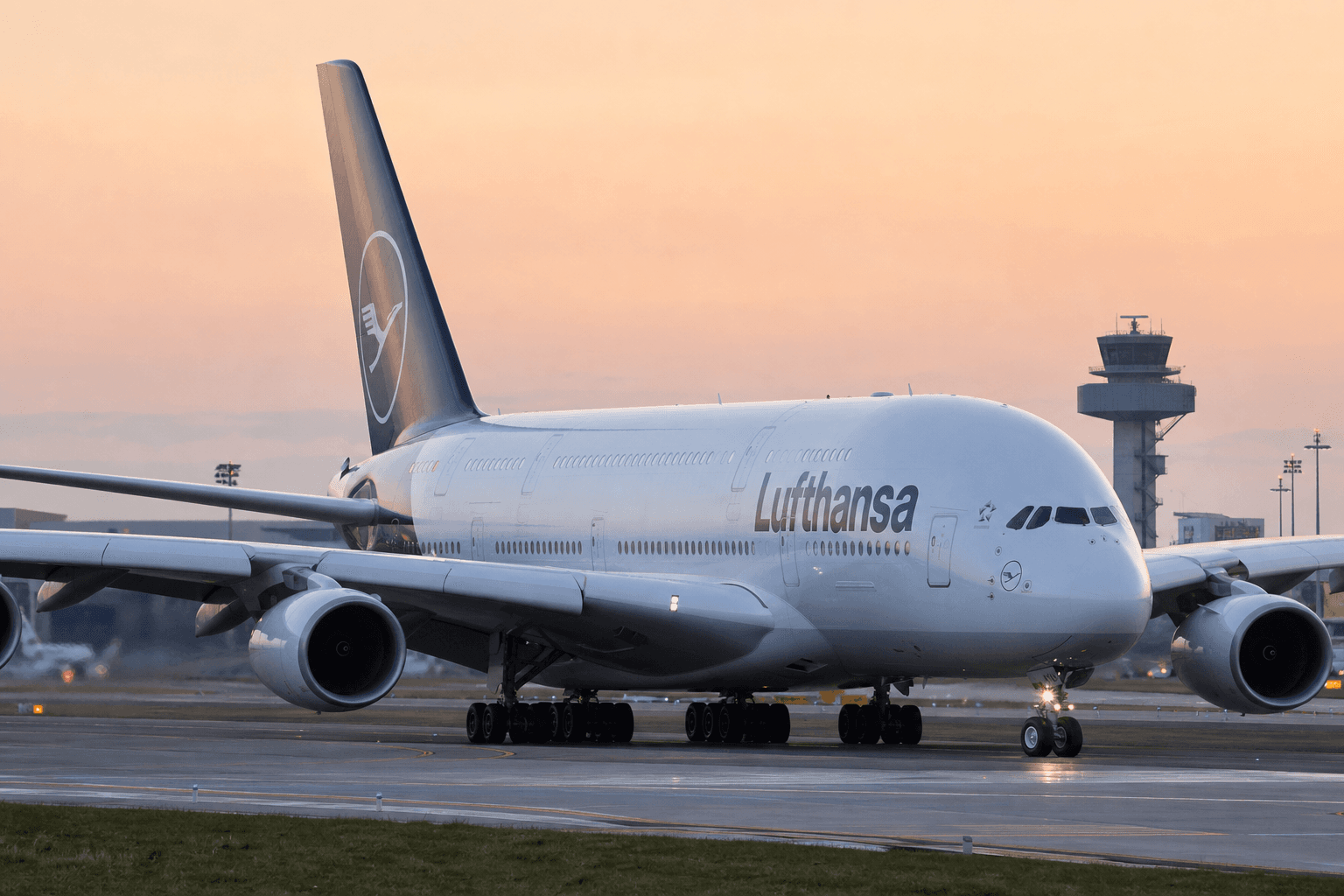
Qantas is on the verge of having its entire Airbus A380 fleet back in commercial service after a rare ferry flight sent one of the grounded superjumbos directly from London Heathrow Airport (LHR) to Los Angeles International Airport (LAX) over the weekend. VH-OQG, which had been stuck at Heathrow since early July awaiting an engine change, flew as flight QF6007 from London to Los Angeles on July 11, an unusual routing for an aircraft that typically shuttles between Sydney, London, and Singapore rather than crossing the Atlantic and Pacific in one movement.

How Much Time Should You Leave Between Separate Flights on Different Tickets?
OMAAT reader Peter asked me a question that I think is worth addressing more broadly — if you book an itinerary that involves two or more separate tickets, how much of a buffer should you leave between flights on those two tickets? There's not going to be a "one size fits all" answer, but I'd like to share my thought process, and hear how others approach this. First let's talk about why you might want to book tickets this way, the things I'd factor into deciding on a buffer, and the approach I take (admittedly I don't always get this right!). Why you might book an itinerary on separate tickets Typically, most people will book an itinerary between their origin and destination on a single ticket, even if multiple airlines are involved (which is possible thanks to partnerships and interline agreements ). However, there are definitely situations — especially in the miles & points world — where you might want to book separate tickets: Maybe you only found reasonably priced award tickets out of a long haul gateway city, and then you need to position there on a separate ticket Maybe you're being savvy and are trying to avoid the UK Air Passenger Duty , so you book your first flight out of the UK separately as a short haul ticket, and then pick up your long haul ticket elsewhere Maybe an itinerary just ends up being cheaper if booked as two separate tickets, whether you paid with cash or points Maybe you booked a ticket far in advance, but then your plans change, though the most economical option is to just book a separate positioning flight, but still take your originally booked ticket Anyway, I do end up booking itineraries as separate tickets with some frequency, and the most common reason is because I'm redeeming points out of another gateway city, and that ends up being the most economical option. I sometimes book itineraries on two separate tickets The considerations with deciding on what buffer to leave To state the obvious, there are many factors that would impact my decision of how much of a buffer to leave between flights on separate tickets. For example, if you're flying a once daily flight to board a cruise or to attend a very important business meeting, I'd take a different approach than if you're connecting to a ticket in a market that has 50 daily flights. So to expand on that a bit, here are the things that I'd take into consideration: How important is it to actually make the flights on your second itinerary, and to arrive at your destination on-time? How flexible are your tickets? If you miss your second itinerary, is it a "use it or lose it" situation, or could you easily rebook? Are you checking bags? Obviously you'll want to add to your buffer if you are, especially since bags often can't be checked through on separate tickets What time of day is your first flight? The earlier you fly, the better the odds of things going smoothly What are the weather conditions to consider? On summer afternoons you have to be worried about thunderstorms, and in winter, consider how likely a snowstorm could be How many other flights are there that could get you to your destination within a reasonable timeframe, assuming you miss the originally booked one? How skilled are you at managing your own travels? If you're very resourceful and not stressed out by a potential misconnect, you can handle this differently than someone who gets really stressed in these situations Consider how much flexibility your ticket has How I decide on how much of a buffer to leave It goes without saying that if you want to maximize your odds of not having any major disruptions, you should leave a massive buffer between separate flights on itineraries. It's definitely a best practice to maybe even leave a day between separate itineraries, or at least to leave an unpleasantly large number of hours. That being said, I want to be realistic here: Often people have limited vacation, so adding an extra day enroute might not be practical, might significantly add to the expense of the trip, etc. Of course leaving a really long layover sounds smart, but most people don't want to spend 10 hours at an airport waiting for their connecting flight Let me share my approach, acknowledging of course that I don't always get this right (including recently!) . As I view it, I take a calculated risk, trying to find the middle ground between minimizing risk and being efficient. Obviously it depends on the circumstances, but assuming that I don't 100% have to be at the destination exactly at my planned arrival time, my most common approach is to typically leave a buffer of four hours, and/or to have at least another flight between my original flight and subsequent one that I can be rebooked on, in the event that it cancels. Admittedly this isn't a perfect system, and a lot can still go wrong. After all, "when it rains, it pours" also applies to aviation. Sometimes there's just a very bad weather system, and you have flights for an entire afternoon delayed by hours. In those situations, there's nothing you can do. To get a bit more specific, personally I generally hope for a bit bigger of a buffer if I'm checking bags, and if my second ticket is non-refundable or non-changeable. Meanwhile if I'm traveling alone, I'm on separate tickets, or it's in a high frequency market, I've certainly booked connections way shorter than that. Just to give an example, maybe I have an award ticket booked from Frankfurt to Chicago on Lufthansa, and then I book a connecting flight to Miami on American. There I'd gladly book a short connection, and worst case scenario, I can just rebook on another flight. That's an example of a low risk situation, as I see it. I generally view things as lower risk if they're at the end of my trip, and if I'm headed home, especially flying a US carrier, since they tend to be more flexible if you miss a flight (compared to Asia, Europe, etc.). I'll often leave a shorter buffer when returning home Bottom line Especially in the miles & points world, it's common to see people book flights across multiple tickets. This is often necessary if redeeming miles for a long haul flight out of a gateway, and then needing to position. It can be hard to decide on the right buffer. Obviously the bigger the buffer, the better the odds of everything going smoothly. At the same time, adding an overnight layover can add a lot of time and expense to a trip. My general rule of thumb is that I try to leave a buffer of at least four hours between separate tickets, with at least one flight between the two that would still get me to that destination in time to make the flight. Admittedly there are many other considerations as well, so that's not some hard and fast rule. What approach do you take when it comes to leaving a buffer between separate itineraries?
Exploring South Tyrol: A Stunning Dolomites Destination with Rich Culture and Cuisine
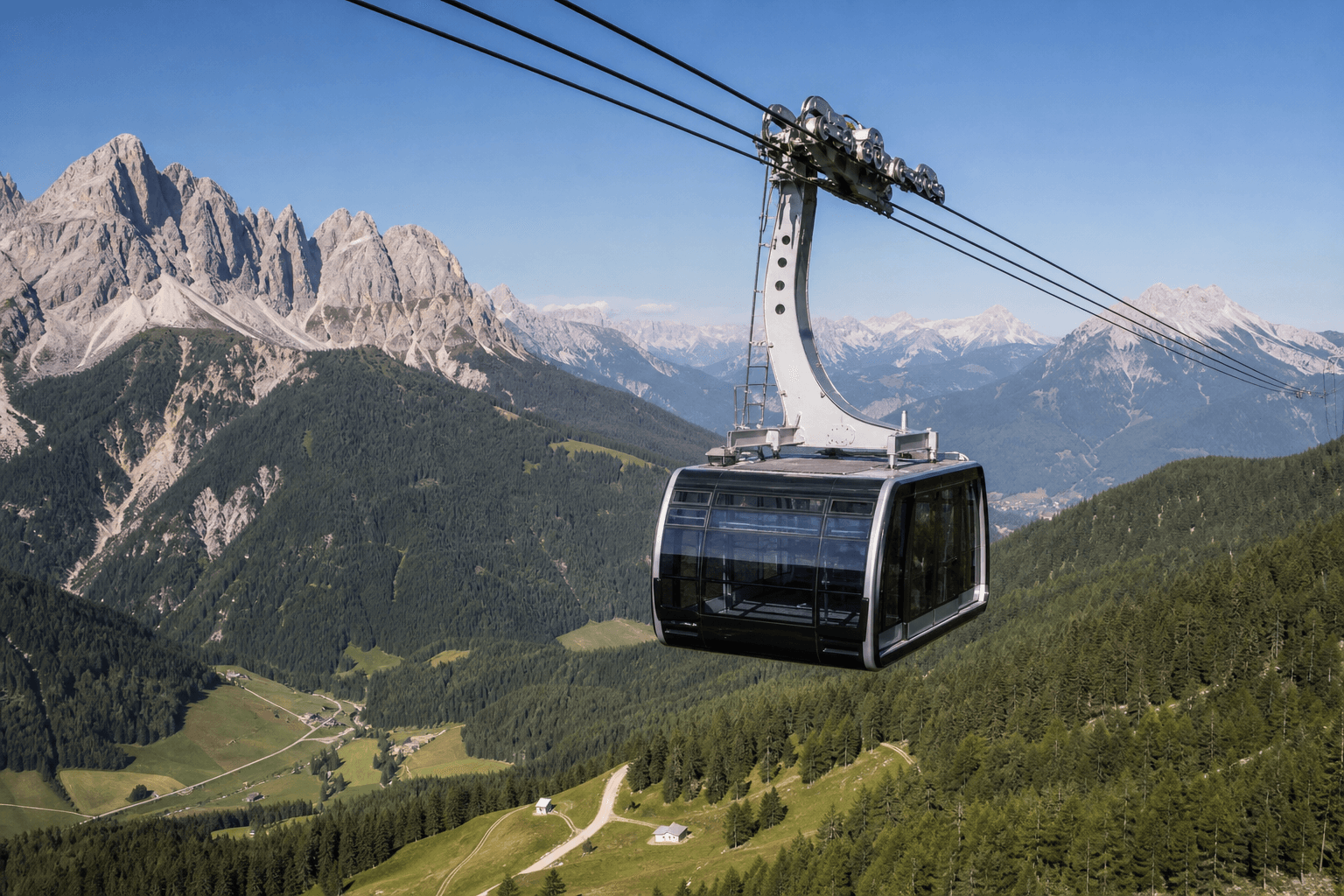
We recently took a family trip to South Tyrol (Südtirol), in the Dolomites. While I won't be writing a full trip report series about the trip (reviewing flights thoroughly while wrangling two little kids is impossible), I did want to review some of the individual portions of it, and in this short series, would like to focus on our time in South Tyrol, in the Dolomites. This was my first time visiting the region since I was a little kid, and I was so excited to return. In this post I'd like to talk about our time there in general, and then three hotel reviews will follow, of the places we stayed. Long story short, if you love mountain activities (especially in summer), amazing food, and an interesting culture, this is a place you should absolutely put on your list. I already can't wait to return. There are even some cool points hotel options, both belonging to Small Luxury Hotels of the World (via the Hilton Honors partnership), and Design Hotels (affiliated with Marriott Bonvoy). Why we decided to visit South Tyrol for a summer trip As longtime OMAAT readers know, I have a connection to Germany — both of my parents are from Germany ( I have dual citizenship ), and most of my relatives still live there. For that matter, Ford loves languages, and he picked up German at the start of the pandemic, and is fluent at this point. We'd also like our kids to have a connection to the culture, so we try to travel there when we can. Anyway, this summer we had a month-long trip to Europe, starting in Skiathos, Greece, and ending in Sylt, Germany. Between those two places, we had a period of around 11 days. So several weeks back, I posed the question on the blog of whether there are any charming hotels in Germany or Austria that I wasn't thinking of. There's plenty of natural beauty in the southern part of Germany and Austria, and I've enjoyed my time in places like Berchtesgaden, Salzburg, etc. However, I was hoping for something else unique. Several people brought up South Tyrol, and that reminded me that I had visited the region when I was a little kid, but not since. With my memory having been jogged, that immediately became the obvious choice for this trip. For those not familiar, South Tyrol is an autonomous region in northern Italy ( with a fascinating history ), located in the Dolomites. It's also interesting culturally, as it's a mix between feeling like you're in Germany (well, or Austria) and Italy, in terms of the language, food, etc. The easiest way to get there is to fly into Innsbruck (INN), and then it's a roughly two-hour drive. But you can also fly into Munich (MUC), and then it's around a four-hour drive. In our case, we fly into Innsbruck, which I was excited about as an avgeek, as it's a unique airport — I remember always flying into this in Microsoft Flight Simulator, back when I was a kid… good times! We flew Austrian into Innsbruck (INN) South Tyrol is has so much to offer as a destination I'm not going to write a detailed guide about South Tyrol, but instead, I'd like to share my big picture thoughts on this as a summer destination. South Tyrol is made up of all kinds of charming little towns, so there are endless choices as to where to stay, and there's no single best option. We ended up staying at three different hotels (20-60 minutes apart by car), and then made little day trips around the region. On the most basic level, the scenery in South Tyrol is just breathtakingly gorgeous, no matter where you look. It almost doesn't look real. Scenery around South Tyrol Scenery around South Tyrol Scenery around South Tyrol Even beyond the scenery in the region, the towns as such are charming and historic. For example, one of the places we stayed was the town of Castelrotto, and we happened to be there on "Church Day" (Kirchtag), which was fun to watch. Scenery around South Tyrol Scenery around South Tyrol The activities in the area are endless, from hiking, to cable cars, to wineries. It's a great family destination, given the access to the outdoors (all the little towns also have playgrounds), but it's also a great couples destination, given how spa oriented it is. Scenery around South Tyrol Speaking of spas, just about all the hotels in the area place huge emphasis on facilities dedicated to wellbeing, since that's kind of one of the selling points of the region. So while you can use hotels as a base for exploring the region, plenty of people just enjoy the hotel facilities as well. Scenery around South Tyrol The food and wine in South Tyrol were also truly incredible. As you'd expect for a region like this, there's a huge culture around food and wine, and goodness, it didn't disappoint. I love how the food is kind of a hybrid between Italian and Austrian classics, so whether you want a wiener schnitzel, raclette, or a plate of pasta, you won't be disappointed. Honestly, I don't remember ever having so many consecutively excellent meals. Dining in South Tyrol Dining in South Tyrol Oh, also, since this is technically in northern Italy, the coffee quality is next level, which I was delighted by. Coffee in South Tyrol I also thought it was interesting how few American visitors there were. A vast majority of the travelers we encountered were Germans, with Italians probably making up the second largest group. After that, I was surprised that the next biggest groups were from Asia (China, Japan, and Korea), which I wouldn't have necessarily expected. I think on the entire trip we heard maybe five people speaking American English, so that was certainly unusual for Europe in summer! South Tyrol has a good selection of charming hotels South Tyrol has almost no cookie cutter chain hotels, with the exception of the Four Points by Sheraton Bolzano (you don't actually want to stay in Bolzano — it's the industrial capital of the region). However, there are several options affiliated with Small Luxury Hotels of the World (allowing you to earn or redeem Hilton Honors points), and with Design Hotels (allowing you to earn or redeem Marriott Bonvoy points). Personally, we stayed at the following three properties: Miramonti Boutique Hotel, Small Luxury Hotels of the World ; this is an incredible property I can't recommend enough, and best of all, we booked it with Hilton Honors points Hotel Schwarzschmied, Marriott Design Hotels ; we enjoyed this hotel and it was the lowest price of the hotels we stayed at, with an amazing view, but it was my least favorite of the three (but it was still great!) Hotel Schgaguler, Marriott Design Hotels ; we loved this hotel as well, despite some of its quirks, and in particular, the half board was really great Miramonti Boutique Hotel, Small Luxury Hotels of the World Hotel Schwarzschmied, Marriott Design Hotels Hotel Schgaguler, Marriott Design Hotels Even beyond the hotels we stayed at, there are many others to choose from. For one, I've heard Forestis Dolomites is absolutely amazing, and more than one person has told me this is their favorite hotel in the world. However, it's very pricey and adults only, so wasn't right for this trip. Beyond the ones we stayed at, the selection of Marriott Design Hotels properties in the region is nothing short of astounding, and each looks charming. Beyond the two we stayed at, there are also the following six options: Villa Arnica is the smaller and more charming sister property of Hotel Schwarzschmied, but it was sold out on the days we were staying, and is also adults only 1477 Reichhalter is another sister property to Hotel Schwarzschmied and Villa Arnica, and it's located in the actual center of the town of Lana, with just eight rooms Parkhotel Mondschein is another property we considered, but which wasn't available for our dates Hotel Greif is a charming-looking hotel located in the city of Bolzano; I don't have any interest in staying here, but it looks better than the Four Points! Arua Private Spa Villas consists of several two-bedroom villas, so it's a great option for families Vigl
The Daily Touch & Go
The day's best aviation news in your inbox. Free, no spam.