

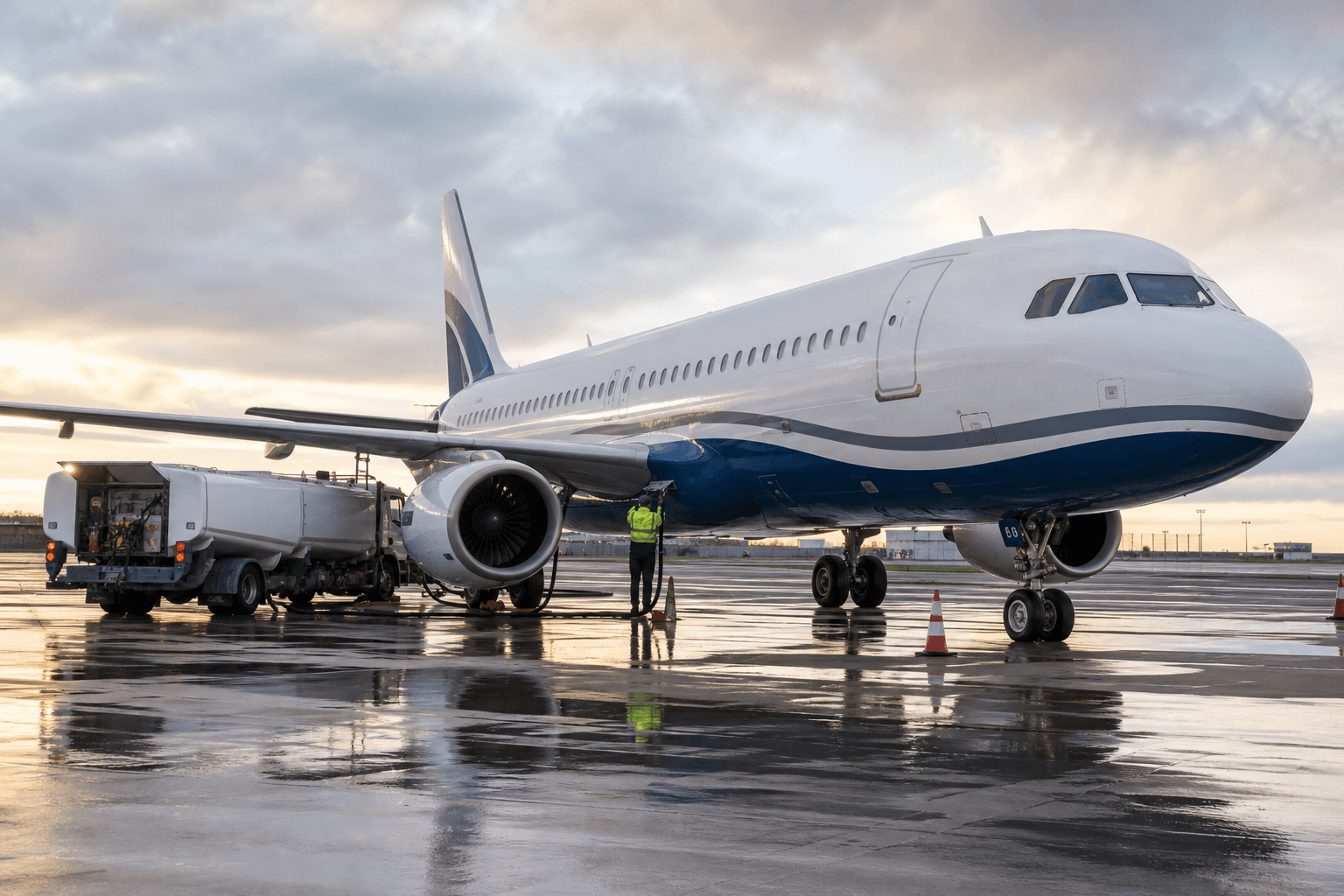
AI-generated illustration
UK Clears 2% SAF Mandate in First Year as Chinese Used Cooking Oil Supplies Most Feedstock
Sustainable aviation fuel reached 2.2% of UK jet fuel supply in 2025, but all of it came from the HEFA pathway and just 3% of feedstock was sourced domestically.
The gist
UK SAF hit 2.2% of jet fuel in 2025, beating the 2% mandate, but 68% of feedstock came from China and only 3% from the UK.
Continuing coverage
All Saf →Sustainable aviation fuel made up 2.2% of the jet fuel supplied in the UK in 2025, beating the 2% target set for the first full year of the government's SAF mandate. The figure comes from a Department for Transport report published on 19 November. The same report shows how far the country remains from producing its own supply. Every litre of SAF counted under the mandate was made through the hydroprocessed esters and fatty acids, or HEFA, pathway, which relies mainly on used cooking oil. More than two-thirds of the feedstock came from China.
The DfT said 68% of feedstocks originated in China. Malaysia was the second-largest source at 18%, followed by South Korea at 4%. Feedstocks from the UK accounted for only 3% of the SAF volume last year. That means almost all of the fuel used to meet the first-year obligation depended on imported waste oils.
In total, 320 million litres of SAF were certified under the mandate in 2025, the volume behind the 2.2% share. A further pool of fuel was reported as SAF but never certified as meeting the mandate's eligibility and sustainability criteria. Counting that fuel lifts the total to 398 million litres. The DfT said suppliers must report all fuel volumes accurately but are not required to apply for certificates on every litre they report. The department said this does not necessarily mean the uncertified fuel would have failed the criteria, and that some volumes may relate to commercial or voluntary arrangements it cannot fully identify. It said it will continue to monitor the gap as the market develops.
Certificates under the scheme are tied to greenhouse gas performance rather than raw volume. A fuel delivering a 70% saving against fossil jet fuel earns one certificate per litre, and fuels with deeper savings can earn more than one. The DfT issued 357 million certificates in 2025, an average of 1.1 per litre. Certified SAF delivered average greenhouse gas savings of 78%, cutting emissions by 756 kilotonnes of carbon dioxide equivalent compared with conventional jet fuel.
Fifteen suppliers delivered SAF to the UK market last year. Fourteen of them remain solvent and met their supply obligations, the DfT said. The government acknowledged that HEFA fuels currently dominate the global market. It said the mandate is designed to draw in a wider range of production pathways over time.
The policy is built to force that shift. It requires SAF to reach 10% of UK jet fuel in 2030 and 22% in 2040. Within those totals sit sub-mandates for synthetic power-to-liquid fuels, known as eSAF, which must make up 1.2% of jet fuel from 2030 and rise to 35% from 2050. From 2027, the mandate also caps the amount of HEFA-based SAF that can count, pushing suppliers toward second-generation routes such as alcohol-to-jet and fuels made from municipal solid waste.
Airlines have pushed back on the eSAF targets. Earlier this year, trade group Airlines UK called for the sub-mandates to be adjusted to match realistic supply. British Airways and Iberia parent IAG has since made the same request to the UK government and to the European Commission, which sets its own sub-mandates under the ReFuelEU Aviation Regulation. IAG argued that an expected shortage of next-generation SAF could expose airlines to fines running into billions for non-compliance.
The government has opened a consultation on the sub-targets, with a decision expected within six weeks. It is also developing a SAF revenue certainty mechanism, which it says will give producers and investors the confidence to build and scale production plants in the UK. Producers, for their part, have asked for a stable regulatory regime, warning that investors lose confidence when rules change.
The UK is not alone in beating its opening target. In September, the EU Aviation Safety Agency reported that SAF accounted for nearly 2.8% of fuel supplied at the bloc's airports, above the 2% minimum share required under ReFuelEU.
Originally reported by FlightGlobal
Read more
All Sustainability →
Indian Oil Cleared to Sell Sustainable Aviation Fuel Commercially From Panipat Refinery
India's state-run refiner has government approval to supply SAF at commercial scale from Panipat and wants airline offtake deals in hand before it funds further plants.
Airbus and Air India Team Up on India's First Voluntary Corporate SAF Programme
Airbus and Air India have partnered to launch what is described as India's first voluntary corporate sustainable aviation fuel programme.
Indian Oil Cleared to Sell Sustainable Aviation Fuel From Panipat Refinery
Indian Oil Corporation has won government approval to commercially supply SAF made largely from used cooking oil, with output planned at about 35,000 tonnes a year.

Russian Helicopter Suspected of Breaching Finnish Airspace Off Loviisa After Drone Strike on Cargo Ship
Finland says a Russian helicopter flew up to 4.1 kilometers into its airspace near Loviisa, possibly tied to rescue efforts for the burning cargo ship Sparta II.
The Daily Touch & Go
The day's best aviation news in your inbox. Free, no spam.